

创作上传
VIP
收藏下载
登录 | 注册有礼
查看完整案例

收藏

下载

分享
项目概况
Project Overview
中山八路交通换乘枢纽综合开发项目位于广州市荔湾区中山八路和内环路交界,建设用地为中山八路、新虹街及规划主干道所围合的三角形地块,地铁5号线及将建设的地铁11号线紧邻用地西侧横穿并设置换乘站点,交通条件十分便利,是地区未来重要的公共交通枢纽。
Guangzhou Zhongshan Eighth Road Integrated Transport Interchange Hub Development Project is situated at the junction of Zhongshan Eighth Road and the Inner Ring Road in Liwan District, Guangzhou. The development site occupies a triangular plot bounded by Zhongshan Eighth Road, Xinhong Street, and a planned urban arterial road. Adjacent to the western boundary, Metro Lines 5 and 11 traverse the site, providing interchange stations and offering exceptional transport connectivity. This location is poised to become a vital public transport hub for the region.
▼西北角人视图,Northwest corner view © 邹林

基地原为中山八路公交总站站场,用途较为单一,难以将其交通优势转化为所处历史城区的更新动力。为充分发挥该用地作为老城区黄金地块的综合开发效益,广州市公交集团决策对该公交车场地块进行综合开发,希望在保证原有公交总站功能的同时,将其打造成一个多功能复合型城市综合体,为融合公交设施驱动的城市更新模式提供具有示范意义的实践路径。
The site previously housed the Zhongshan Eighth Road Bus Terminal, serving a relatively singular purpose that hindered the conversion of its transport advantages into a catalyst for the regeneration of the surrounding historic urban district. To maximize the comprehensive development potential of this prime old-city site, the Guangzhou Public Transport Group decided to undertake an integrated redevelopment of the bus depot site. The aim is to preserve the original bus terminal function while transforming it into a multifunctional, mixed-use urban complex, providing a demonstrative model for urban renewal driven by public transport infrastructure.
▼中山八路街角人视图,Pedestrian view at the corner of Zhongshan Eighth Road © 邹林

该建筑总建筑面积约为70494.3平方米,地上6层,地下3层,总建筑高度为30米,实现了打造公共交通网络中高效便捷换乘枢纽、建构历史城区门户地标形象、营造与城市生活多向链接的公共场所、建设整合多种节能环保新技术的示范性绿色建筑等多重目标。
The building, with a total floor area of approximately 70,494.3 square metres, comprises six above-ground storeys and three basement levels, reaching a total height of 30 meters. The project achieves multiple objectives: establishing an efficient and convenient interchange hub within the public transport network; creating a gateway landmark for the historic district; fostering a public space with dynamic connections to urban life; and constructing a demonstrative green building integrating various energy-saving and environmentally friendly technologies.
▼中山八路入口方向人视点图,Pedestrian view from the Zhongshan Eighth Road Entrance © 邹林

区域整体分析
Regional Analysis
作为西向进入广州历史城区的重要门户,该地块具有突出的区位、交通和景观优势:
As a key gateway to Guangzhou’s historic city centre from the west, the site boasts exceptional locational, transport and scenic advantages:
▼清晨鸟瞰图,Morning aerial view © 邹林

首先,基地西望珠江,东靠历史城区,南接以荔湾湖公园为核心的逢源大街—荔湾湖历史文化街区,北与流花湖公园遥相呼应,具有丰富的历史文化基质;
Firstly, the site overlooks the Pearl River to the west, adjoins the historic city centre to the east, connects to the Fengyuan Street–Liwan Lake Historic and Cultural Quarter centred on Liwan Lake Park to the south, and corresponds with Liuhua Lake Park to the north, possessing a rich in historical and cultural fabric;
▼荔湾湖方向鸟瞰图,Aerial view fromLiwan LakePark© 邹林

其次,基地作为地铁5号线与地铁11号线相衔接的枢纽站点的所在,南临区域性东西向主干道中山八路,西北侧规划有南北向城市干道,交通联系的枢纽性优势明显;
Secondly, situated at the interchange hub connecting Metro Lines 5 and 11, the site borders the regional east-west arterial road Zhongshan Eighth Road to the south, with a planned north-south urban thoroughfare to the northwest, demonstrating clear transport connectivity advantages;
▼西侧半鸟瞰图,West-facing semi-aerial view © 邹林

第三,基地是北向、东向、南向辐射联系该地段主要开放空间(荔湾湖公园、流花湖公园及陈家祠广场)的重要衔接性空间节点,也是历史城区西向沟通珠江及东部城区的景观廊道的重要景观承接点,具有显著的城市空间结构作用。
Thirdly, the site serves as a vital connecting node radiating north, east, and south towards the area’s principal open spaces (Liwan Lake Park, Liuhua Lake Park, and the Chen Clan Academy Plaza). It also functions as a key landscape interface point for the scenic corridor linking the historic district westwards to the Pearl River and eastern urban areas, playing a significant role in the city’s spatial structure.
▼中山八路街道对面视点图,View point opposite © 邹林

为此,规划将该地块整体定位为:以公交换乘功能为核心,采用“公交站场+换乘枢纽+社会停车场”的开发模式,打造集无缝衔接各种公共交通设施与综合办公、便利型商业、区域文化意象、公共场所效应及生态节能技术于一体的低碳型综合交通换乘枢纽。
Accordingly, the planning strategy positions the site holistically as a low-carbon integrated transport interchange. Centered on public transport transfer functionality, it adopts a development model combining ‘bus depot + transfer hub + public car park’. This approach creates a seamless integration of diverse public transport facilities with comprehensive office space, convenience-oriented retail, regional cultural identity, public amenity effects, and eco-efficient technologies.
© 邹林
历史城区的综合交通枢纽
Integrated Transport Interchange Hub in the Historic City Centre
鉴于用地所处历史城区西部门户的特殊区位,设计力求塑造传承岭南建筑文化内涵的标志性门户建筑形象。首先,建筑结合炎热多雨的气候特点,营造开敞明朗、通风遮阳的沿街公共空间及通透轻巧、穿插变化的形体,形成清新明快的建筑形象;其次,建筑结合立体庭园,营造传统园林精神与现代建筑格调相融合的建筑景园,突显岭南韵味;第三,提炼区域的标志性建筑意象元素,结合建筑构件运用于建筑形体的造型语言之中,反映建筑的文脉意识。
Given the site’s unique position as the western gateway to Guangzhou’s historic district, the design strives to create an iconic portal structure that embodies the cultural essence of Lingnan architecture. Firstly, responding to the hot and rainy climate, the building features open, bright, and well-ventilated street-facing public spaces with sun-shaded areas. Its form is characterised by a light, airy quality with varied interplay, resulting in a fresh and vibrant architectural image;Secondly, the building integrates multi-level courtyards to create an architectural landscape garden that blends traditional horticultural spirit with contemporary architectural style, accentuating Lingnan charm;Thirdly, it distils iconic architectural motifs from the region, incorporating them through structural components into the building’s formal language through to reflect its cultural context.
▼交通换乘枢纽实景与街角设计意向,Actual scene of the transportation hub and design intentions for street corners © 邹林

由此,通过建筑整体对体现地域岭南特色的追求,共同构建出该枢纽作为广州历史城区西部门户的标志性形象。
Thus, through these strategies, the project holistically aspires to manifest regional Lingnan characteristics and it collectively establishes the hub as the gateway landmark on the western edge of Guangzhou’s historic city center.
▼中山八路街道正对面,Directly opposite Zhongshan Eighth Road © 邹林

与地铁合建
Joint Construction with the Metro
中山八路交通换乘枢纽综合开发项目最大的特点是与广州市地铁11号线合建。由于建设用地西北侧与广州地铁5号线、11号线毗邻,整个项目的设计与建设都变得更加复杂。
The most distinctive feature of the Guangzhou Zhongshan Eighth Road Integrated Transport Interchange Hub Development Project is its co-construction with Guangzhou Metro Line 11. Given that the north-western side of the construction site adjoins Guangzhou Metro Lines 5 and 11, the design and construction of the entire project have become significantly more complex.
▼新虹街方向视角,Perspective from Xinhong Street © 邹林

在广州市交委的统一规划下,中山八路交通换乘枢纽综合开发项目将与广州市地铁11号线中山八路站同步进行,双方设计团队、施工团队协同合作建设。
Under the unified planning of the Guangzhou Municipal Transport Commission, the project proceeds concurrently with the construction of Zhongshan Eighth Road Station of Metro Line 11. Design and construction teams from both projects collaborate closely throughout the process.
▼BIM模型示意图:项目跨越地铁11号线隧道,BIM model schematic: the project acrossing Metro Line 11 tunnel © 孙一民工作室

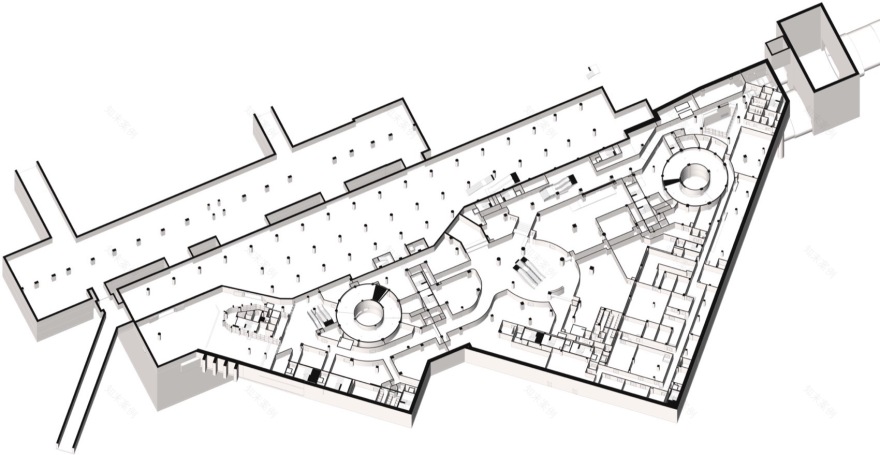
在建设方面,中山八路交通换乘枢纽综合开发项目的地下室建设与11号线站厅协同公用支护结构,在施工方案、施工工期方面都需要协同合作、同步推进。设计方面,中山八路交通换乘枢纽综合开发项目在地下二层,通过西侧、中部2个出入口衔接地铁出入口,实现地铁人流向公交始末站的无缝接驳。沿着接驳人流布置的地下商业街区,能够将接驳的人流转换为商业价值,提升综合体的运营效率。
In terms of construction, the basement works for the project shares a retaining structure with the Line 11 station concourse, requiring coordination and synchronization in both construction planning and scheduling.Regarding design, at the second basement level, the project connects to the metro station exits via two access points on the west and central section, facilitating seamless transfer of metro passengers to the bus terminus. The underground commercial precincts, positioned along these transfer routes, convert passenger flow into commercial value, thereby enhancing the operational efficiency of the complex.
▼交通换乘枢纽负二层与地铁11号线、5号线的衔接关系,The connection between the second basement level of the transport interchange hub and Metro Lines 11 and 5 © 孙一民工作室
集约复合的城市交通综合体
Integrated Urban Transport Complex
中山八路交通换乘枢纽因为地处历史城区,建设用地呈不规则的三角形、高度也受到一定的限制。我们在设计中采用了集约复合的策略,将公交始末站、商业街区、社区服务、派出所、综合办公、立体停车等多种功能,通过合理组合叠加,整合在综合体中,为周边社区提供了更多的功能价值。作为公交枢纽建筑,设计中注重交通人流动线与功能空间的整合,提升交通换乘的综合效能。通过立体化的空间组织,有效衔接各类交通设施的各种交通人流动线,与商业、文化展示等功能空间进行整合,形成连续复合的换乘空间网络,创造出便于各种人流多向流动的公共生活网络,从而通过提升交通换乘的综合效能,催化基于交通枢纽的复合的低碳化公共生活。
Situated within the historic urban district, the Guangzhou Zhongshan Eighth Road Transport Interchange Hub occupies an irregular triangular plot with building height restrictions. Our design employs an intensive, composite strategy, integrating multiple functions—including bus terminal, commercial precincts, community services, a police station, administrative offices, and multi - storey car parks—through rational layering and stacking within a single complex. This approach delivers enhanced functional value to the surrounding neighbourhood.
As a transport hub building, the design prioritises the integration of passenger flow routes with functional spaces to enhance overall interchange efficiency. Through three - dimensional spatial organisation, diverse passenger flow routes connecting various transport facilities are effectively integrated with functional spaces such as retail and cultural exhibition areas. This creates a continuous, composite transfer space network that facilitates multidirectional public circulation. By improving the overall efficiency of transport interchange, the design catalyses a composite, low - carbon public lifestyle anchored around the transport hub.
▼模型剖透视示意功能复合,Model sectional perspective illustration with functional integration © 孙一民工作室

换乘枢纽在1-3层的中部,是原公交始末站。首层公交通过西北侧的两个车行出入口进出首层公交站;去往2、3层的公交车通过两个交通筒的环形公交车道进出2、3层的公交站。出于安全考虑,公交车道坡度按城市交通标准,设置为6%的坡度。公交乘客通过中山八路沿街路口进入到公交站乘厅;枢纽的东北、西南两角,设置通往4-6层办公区的交通核心筒,是综合办公、社区服务、派出所的主要出入口;枢纽的负一、负二层是主要的商业空间,其中负二层通过通道与地铁11号线连接,地铁出站的乘客能够通过南、中、北3条商业路径换乘到公交站乘厅;枢纽在4-6层还设置了无人值守的立体停车库。社会车辆可以通过西边的交通筒内侧坡道,进入到负一层,用户在负一层开入运车电梯后交付停车。而用户取车在首层完成,取车后直接由新虹街驶出;开车的用户还能够通过西侧的交通筒内侧坡道进入枢纽的负三层地下停车库,并由东侧交通筒坡道驶出至新虹街;虽然枢纽的功能集约复合,但各功能区的出入口相对独立,避免了相互干扰。
The transport hub occupies the central section of Floors 1 to 3, which was the original bus terminus. Ground-level buses access the terminal via two vehicular entrances on the northwest side. Buses serving the second and third floors utilise circular bus lanes within two transport cores to access their respective terminals. For safety, bus lane gradients adhere to urban transport standards at 6%. Passengers enter the bus concourse from Zhongshan Eighth Road through street-level intersection.
Traffic core shafts at the northeast and southwest corners provide access to the office zones on Floors 4 to 6, serving as primary entrances for administrative offices, community services, and the police station.
Level B1 and B2 comprise the main commercial spaces. Level B2 connects to Metro Line 11 via passageways, enabling passengers exiting the metro to transfer to the bus concourse via three commercial routes: south, central, and north.
An automated multi-storey car park operates on Floors 4 to 6. Private vehicles access Level B1 via internal ramps within the western transport core. Users park vehicles on B1 using car lifts elevators, with collection occurring at the ground floor before exiting directly onto Xinhong Street.
Motorists may also access the hub’s underground car park on Level B3 via the inner ramp within the western traffic core, exiting via the eastern traffic core ramp onto Xinhong Street.
Despite the hub’s integrated and multifunctional design, entrances and exits for each functional zone remain relatively independent, ensuring clear circulation and minimizing interference among different users.
▼中山八路交通换乘枢纽6层采光筒露台,Sunshine terrace at the sixth floor © 邹林

可持续设计
Sustainable Design
换乘枢纽项目也充分考虑了可持续设计。项目一个显著的特征是中部两侧的圆形玻璃采光顶。采光顶的设计并非只是出于造型的考虑,其下部连接的是办公空间的环廊、公交环形坡道以及小车坡道。
The interchange hub project fully incorporates principles of sustainable design. A distinctive feature is the circular glass skylights flanking the central section. These skylights are not merely aesthetic elements; beneath them lie the office space’s ring corridor, the bus circular ramp, and the car ramp.
▼立体车库及太阳能光伏,Multi-storey car park and solar photovoltaic system © 孙一民工作室

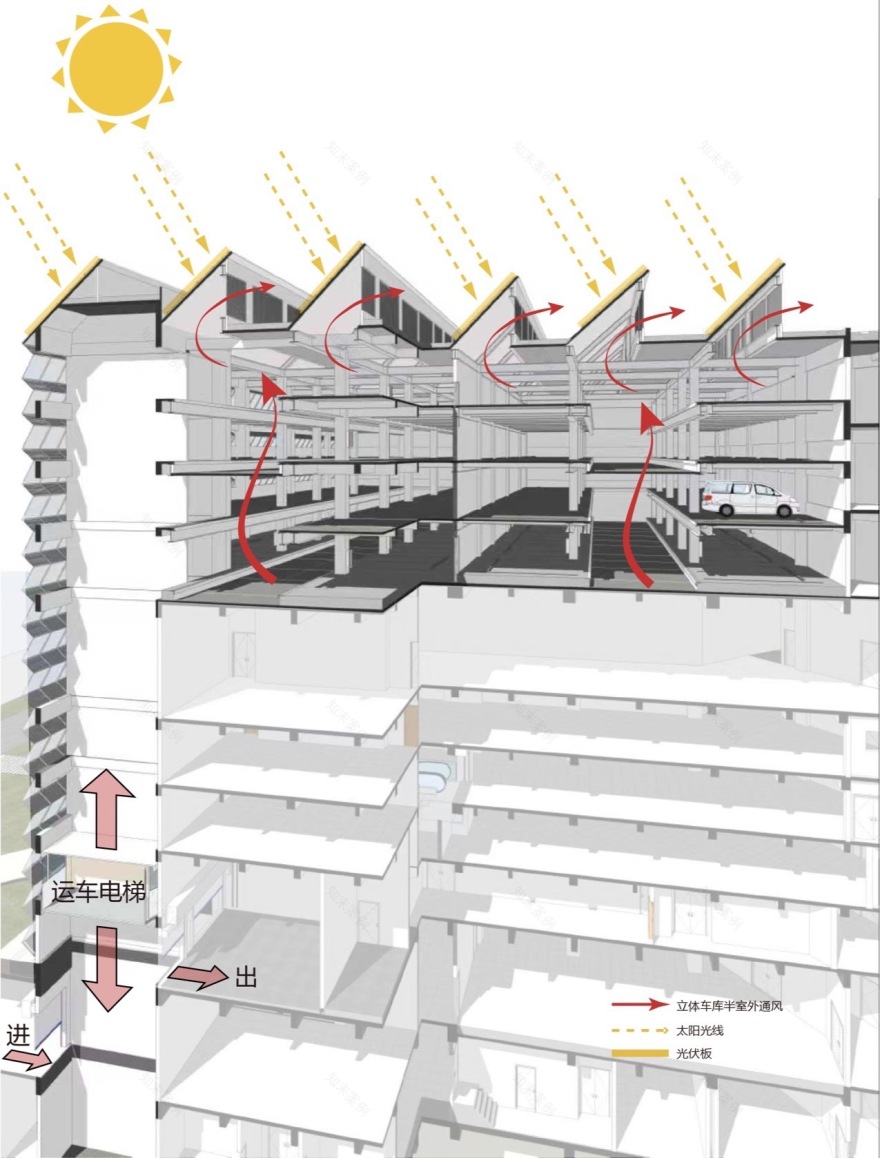
采光顶分为内外两层,内层直接连通至地下坡道,成为地下空间的换气筒;外层连通办公的环廊,将室外空气、光线引入到环廊,但同时实现遮雨的功能,为办公空间提供了两个空中花园;换乘枢纽的外立面也采用固定角度的金属遮阳设施,为办公空间遮蔽了炙热的阳光,同时也尽量减少对室内视线的遮挡,提高了室内空间的舒适度。同时建筑结合退台形式营造多层级立体绿化平台,以发挥散滞雨水、隔热控温、美化环境等作用,实践海绵城市理念,整体提升建筑的生态功能;建筑还采用新型的平面移动类立体停车库,满足公交枢纽对较大规模社会停车数量的需求,并结合光伏技术平衡能源供给,成为节能停车新技术的对外展示窗口。
The skylights comprise dual layers: the inner layer connects directly to the underground ramp, functioning as a ventilation shafts for the subterranean space; while the outer layer connects to the office ring corridor, introducing natural light and air while providing rain protection, creating two elevated gardens for the workspace;The exterior facade of the interchange hub incorporates fixed-angle metal sun-shades, shielding the office space from intense sunlight while minimising obstruction of interior views, thereby enhancing comfort. Furthermore, the building incorporates stepped terraces to create multi-level green platforms. These serve to retain and delay rainwater runoff, provide thermal insulation, regulate temperatures, and enhance the aesthetic environment. This approach reflects sponge city principles and elevating the building’s overall ecological performance;In addition, the project applies an innovative flat-moving multi-storey automated parking system to meet the transit hub’s demand for substantial public parking capacity. Integrated with photovoltaic technology to balance energy supply, it serves as a showcase for new energy-efficient parking technologies.
▼站乘厅候车区,Waiting area of the boarding hall© 邹林

▼站乘厅,Boarding hall ©邹林

全建设周期的数字化管理
Digital Management Throughout the Entire Construction Cycle
鉴于换乘枢纽项目的功能复合,空间关系复杂。设计团队基于openBIM理念,采用以Archicad为核心的三维设计平台进行整个设计周期的项目管理。
Given the multfunctional nature and complex spatial relationships of the interchange hub project, the design team, based on the OpenBIM concept, adopts the 3D design platform with Archicad as the core for project management throughout the entire design cycle.
▼采光筒采光、通风、雨水收集示意图,Diagram of the circular skylights for daylighting, ventilation, and rainwater Collection © 孙一民工作室

换乘枢纽的图纸由BIM模型直接输出,能够实现图纸、模型一致的设计表达,也让建设方、施工方能够更直观的理解我们的设计意图,共同高质量的推进项目建设。在施工工程中,我们也使用BIM模型与施工单位进行交底与沟通,让现场更加顺利高效,这是整个项目推进的重要保障。在与地铁合建沟通的过程中,我们也会使用BIM全模进行会议沟通,提前发现并解决了多处重大问题,为双方协作提供了保障。
Drawings for the interchange hub were generated directly from the BIM model, ensuring consistent design representation between drawings and the model. This enabled the client and contractors to intuitively grasp our design intent, facilitating high-quality collaboration and efficient project advancement.
During construction, we utilised the BIM model for technical briefings and coordination with contractors, ensuring smoother and more efficient site operations. This proved crucial for the project’s progress.
In the joint construction process with Metro Line 11, we employed the full BIM model for meeting discussions. This approach enabled the early identification and resolution of multiple significant issues, thereby safeguarding collaboration between both parties.
▼首层平面,Ground Floor Plan © 孙一民工作室

▼二层平面,Second Floor Plan © 孙一民工作室

▼四层平面,Fourth Floor Plan © 孙一民工作室

▼六层平面,Sixth Floor Plan © 孙一民工作室

▼负一层平面,Basement Level 1 Floor Plan © 孙一民工作室

▼负二层平面,Basement Level 2 Floor Plan © 孙一民工作室

▼剖面1,Section View 1 © 孙一民工作室
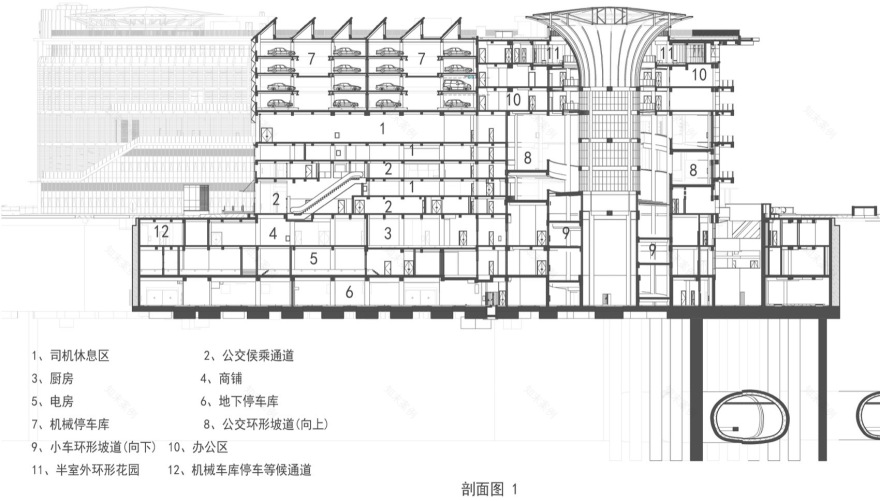
▼剖面2,Section View 2 © 孙一民工作室

▼东立面与南立面,East Elevation South Elevation © 孙一民工作室

项目名称:广州中山八路交通换乘枢纽综合开发项目
项目类型:交通建筑
设计方:华南理工大学建筑设计研究院有限公司孙一民工作室
项目设计:2015.12
完成年份:2024.12
项目总负责:孙一民、汪奋强
设计团队:孙一民、汪奋强、彭帆、黄烨勍、陈辉镇、郑闻天、陈惠容、柳庆、林耀阳、龚模松、吴倩芸、肖静芳、赵初华、张积洋、余晓龙、杜京京、陈飞洋、袁宸章、高飞、冯文生、耿望阳、范细妹、石刚、杨石泉、周华忠
项目地址:广东省广州市中山八路
建筑面积:70494.30 ㎡
摄影版权:阿尔法摄影 邹林
客户:广州市交通站场建设管理中心有限公司
材料:浅灰色金属铝单板、钢筋混凝土屋面
Project Name: Guangzhou Zhongshan Eighth Road Traffic Interchange Hub Comprehensive Development Project
Project type: Transportation Building Complex
Design: Atelier Sun of Architectural Design & Research Institute of SCUT Co., Ltd.
Design year: 2015.December
Completion Year: 2024.December
Leader designer:Sun Yimin, Wang Fenqiang
Project Team: Sun Yimin, Wang Fenqiang, Peng Fan, Huang Yeqing, Chen Huizhen, Zheng Wentian, Chen Huirong, Liu Qing, Lin Yaoyang, Gong Mosong, Wu Qianyun, Xiao Jingfang, Zhao Chuhua, Zhang Jiyang, Yu Xiaolong, Du Jingjing, Chen Feiyang, Yuan Chenzhang, Gao Fei, Geng Wangyang, Fan Ximei, Shi Gang, Yang Shiquan, Zhou Huazhong
Project location: Zhongshan Eighth Road, Guangzhou City, Guangdong Province
Gross built area: 70494.30 ㎡
Photo credit: Alpha Photo(Studio) Zou Lin
Clients: GuangZhou Transportation Station Construction Management Center Co., Ltd.
Materials: Light gray aluminum metal panel, Reinforced concrete roof



南京喵熊网络科技有限公司 苏ICP备18050492号-4知末 © 2018—2020 . All photos and trademark graphics are copyrighted by their owners.增值电信业务经营许可证(ICP)苏B2-20201444 苏公网安备 32011302321234号
苏公网安备 32011302321234号客服
消息
收藏
下载
最近