

创作上传
VIP
收藏下载
登录 | 注册有礼
查看完整案例

收藏

下载

分享
一座校园,向上生长。课间在空中奔跑,放学在楼间看天。在这里,把有限的土地,变成无限的空间想象。
A campus that grows upwards. Running in the air during breaks, gazing at the sky after school. Here, Limited land is transformed into boundless spatial imagination.
▼会呼吸的“天空知城”,A Breathable “Learning Community in the Air”© 张超

01.场地
Site
容积率超4.0,高密度下新校园设计
High-density New Campus Design with a Plot Ratio Exceeding 4.0
在深圳,校园建筑的空间模式正经历从“平面铺展”向“立体生长”的转变。深圳市宝安中学(集团)第二实验学校位于松岗车辆段,场地内存在10米高差。一半用地位于地铁车辆段站房屋顶,仅能布置场地而不能用于建设,另一半用地需满足各个方向后退12米的要求,导致最终可建设用地仅1.28万平米,需在此范围内建设6.8万平米的学校功能。如此极限的设计条件,已经没有合适的专业数据能体现其真实密度,堪称中国公立学校建筑的密度之最,同时也有可能催生出全新学校空间组合范式。
In Shenzhen, the spatial model of campus architecture is shifting from “horizontal spread” to “vertical growth.” Located at the Songgang Depot, Shenzhen Bao’an Middle School (Group) Second Experimental School has a 10-meter elevation difference on its site. Half of the land is situated on the roof of the metro depot station building, suitable only for site layout rather than construction, while the other half must adhere to a 12-meter setback requirement from all directions. This results in a final constructible area of merely 12,800 square meters, within which a 68,000-square-meter school must be built. Such extreme conditions, beyond the scope of appropriate professional data to reflect their true density, represent the highest density among public school buildings in China, potentially giving rise to a novel paradigm for campus spatial organization.
▼场地环境分析,Site Environment Analysis © 华阳国际设计集团

主创建筑师在这样的前提下,并没有被动接受局促的现实,反而以“立体社区”为基本设计原理,从关心学生的日常使用和心理健康的朴素视角出发,展开多维度的空间想象。设计方案中最具决定性的是借鉴坡地建筑设计原理,将原本约40米高的建筑体量拆解并定性为两座多层建筑垂直叠加,并多次论证,最终获得消防部门的认可。
Under these circumstances, the lead architect did not passively accept the constrained reality but instead adopted the “vertical community” as the fundamental design principle. Starting from a simple perspective of caring for students’ daily use and mental health, the architect embarked on multi-dimensional spatial imagination. The most decisive aspect of the design was drawing inspiration from the principles of slope architecture, decomposing and characterizing the originally approximately 40-meter-high building volume into two vertically stacked multi-story buildings. After multiple verifications, the design ultimately received approval from the fire department.
▼西侧鸟瞰,West Side Aerial View ©张超

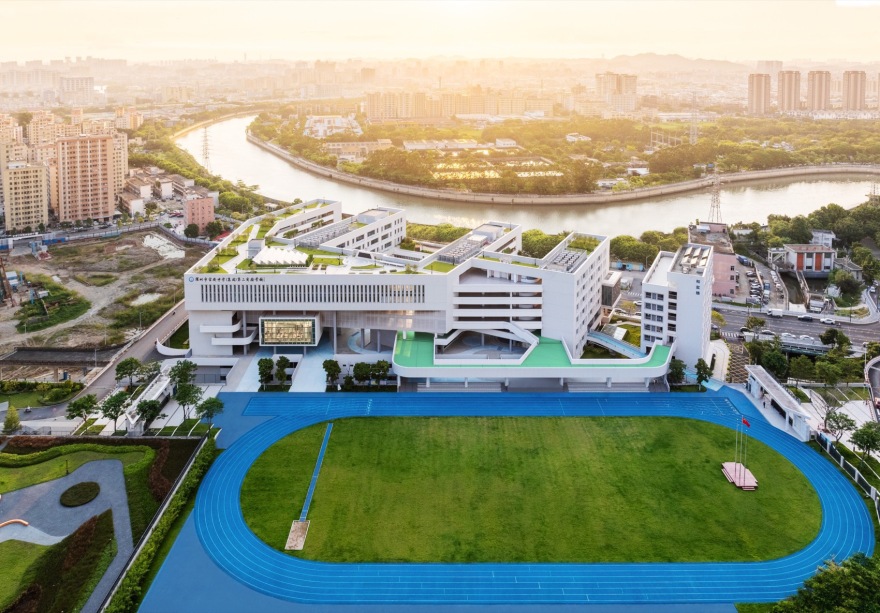
高差上的运动场、叠加的教学与交流空间、串联的立体动线……学生的学习与活动被自然延伸到不同层面,校园成为一座真正的“向上生长”的学习共同体。学校建成并投入使用一年以来,立体化的空间布局不仅回应了紧张用地条件,更以多层次的学习与活动场所,重塑了师生的日常体验。
The playground on the elevation difference, the stacked teaching and communication spaces, and the interconnected vertical circulation… Students’ learning and activities are naturally extended to different levels, transforming the campus into a truly “upward-growing” learning community. Since its completion and operation one year ago, the three-dimensional spatial layout has not only responded to the tight land conditions but also reshaped the daily experiences of teachers and students with multi-level learning and activity venues.
▼西北侧鸟瞰,Northwest Side Aerial View ©张超
02.剖面 Section
天空知城,高空之上的立体学堂
A Learning Community in the Air, a Vertical School in the Sky
设计概念围绕“天空知城”展开,在垂直方向呈现上中下三个空间维度的立体学堂,催生开放、复合、充满活力的校园环境。
The design concept revolves around the “Learning Community in the Air,” presenting a vertical school with upper, middle, and lower spatial dimensions, fostering an open, composite, and vibrant campus environment.
▼设计概念,Design Concept ©华阳国际设计集团
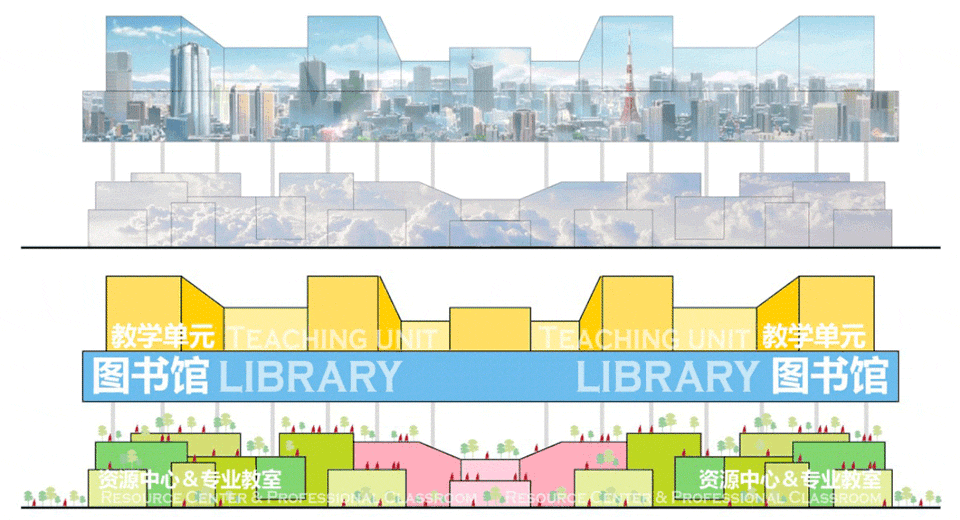
基座容纳各类公共教学空间合并成资源中心,其中可触发丰富活动场景。其形态处理如同一组很轻的云朵,此为第一级。
The base accommodates various public teaching spaces merged into a resource center, triggering a rich array of activity scenes. Its morphological treatment resembles a group of light clouds, constituting the first level.
▼西侧鸟瞰,West Side Aerial View ©张超

▼东面鸟瞰,East Side Aerial View©张超
针对场地10米高差,设计采用“双首层”设计策略,利用基座化解场地高差形成两级地面,上方是整层的架空活动空间,将失去的地面还给学生,此为第二级。最上方则是普通教学单元组成的空中学堂,于高空之中创造云中学堂景象,此为第三级。▼架空层轴测图,Elevated Floor Axonometric Drawing ©华阳国际设计集团

In response to the 10-meter elevation difference on the site, the design adopts a “double ground floor” strategy, utilizing the base to resolve the elevation difference and forming two ground levels. Above is an entire floor of elevated activity space, returning the lost ground to the students, representing the second level. The topmost level consists of ordinary teaching units forming an aerial school, creating a vision of a school in the clouds, representing the third level.
▼建筑基座与架空层,Building Base and Elevated Floor ©张超

▼入口大台阶&在此等候的学生们,Entrance Grand Stairs & Students Waiting There ©张超

设计团队力求建筑在提供各类功能、场景的同时,也必须消解高密度环境带来的压迫感,给孩子们一个自由呼吸的校园环境,同时建筑要回应深圳当地气候条件,呈现出新时代的岭南建筑气质。▼建筑剖面,Building Section©华阳国际设计集团
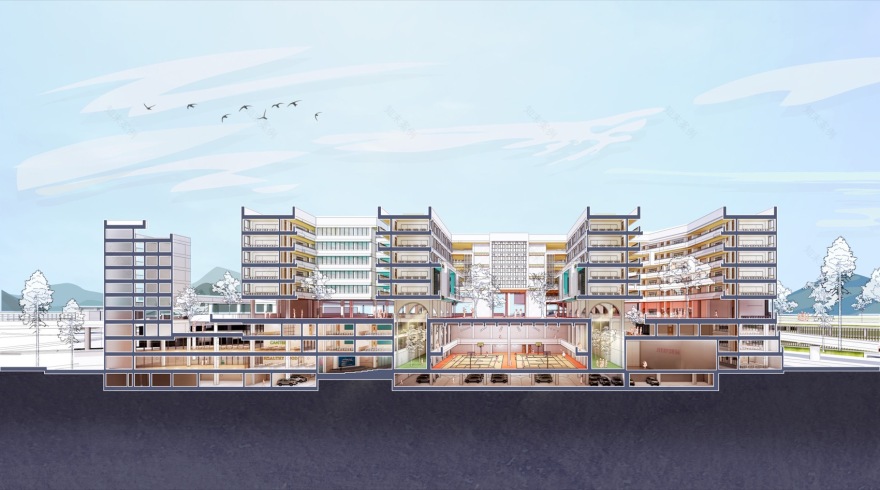

The design team strives to ensure that the building provides various functions and scenes while also eliminating the sense of oppression brought by the high-density environment, offering children a campus environment where they can breathe freely. Simultaneously, the building responds to the local climatic conditions in Shenzhen, presenting a contemporary Lingnan architectural style.
▼剖面空间,Sectional Space ©华阳国际设计集团

03.空间 Space
7级空间层级,公共空间的精神塑造
Seven-Level Spatial Hierarchy, Spiritual Shaping of Public Spaces
学校建筑的发展核心契合素质教育需求,建筑愈发强调公共与共享。在高密度条件下建筑往垂直方向延伸,依然保留了空间的完整性,结合水平向的功能融合,高密度反而可以创造出更具共享性、互动性和可参与性的景观场地。
The development core of campus architecture aligns with the demands of quality education, with architecture increasingly emphasizing public and shared spaces. Despite vertical extension under high-density conditions, the integrity of space is preserved. Combined with horizontal functional integration, high density can instead create more shared, interactive, and participatory landscape venues.
▼功能分析,Functional Analysis ©华阳国际设计集团

建筑在三级划分的基础上,采用“多层次空间策略”,创造性地组合出“城市地面-资源中心-架空层-图书馆-空中平台-教学楼-屋顶花园”7个层次的活动空间,通过功能重叠获得最高效便捷的功能流线与更加生动的校园场景,同时在各种空间层次中实现全方位立体绿色校园。
Based on the three-level division, the buildings adopt a “multi-level spatial strategy,” creatively combining seven levels of activity spaces: “urban ground-resource center-elevated floor-library-aerial platform-teaching building-rooftop garden.” This achieves the most efficient and convenient functional circulation and more lively campus scenes through functional overlap, while realizing a green campus across various spatial levels.
▼7个层次:城市地面-资源中心-架空层-图书馆-空中平台-教学楼-屋顶花园,Seven Levels: Urban Ground-Resource Center-Elevated Floor-Library-Aerial Platform-Teaching Building-Rooftop Garden ©华阳国际设计集团

资源中心位于地面层,通过较为轻松随意的体块交叠组合打破基座的厚重感。BOX穿孔板立面上印有轻盈的云朵图案,在光影的映衬下仿佛建筑浮动于空中,试图营造灵动而富有层次的视觉节奏,使上部建筑呈现出漂浮感。
Located on the ground level, the resource center breaks the heaviness of the base through relatively relaxed and casual block overlaps. The BOX perforated panel facade is adorned with delicate cloud patterns. Against the interplay of light and shadow, it creates an illusion as if the building is floating in the air, attempting to craft a lively and multi-layered visual rhythm, endowing the upper part of the building with a sense of levitation.
▼资源中心,Resource Center ©张超
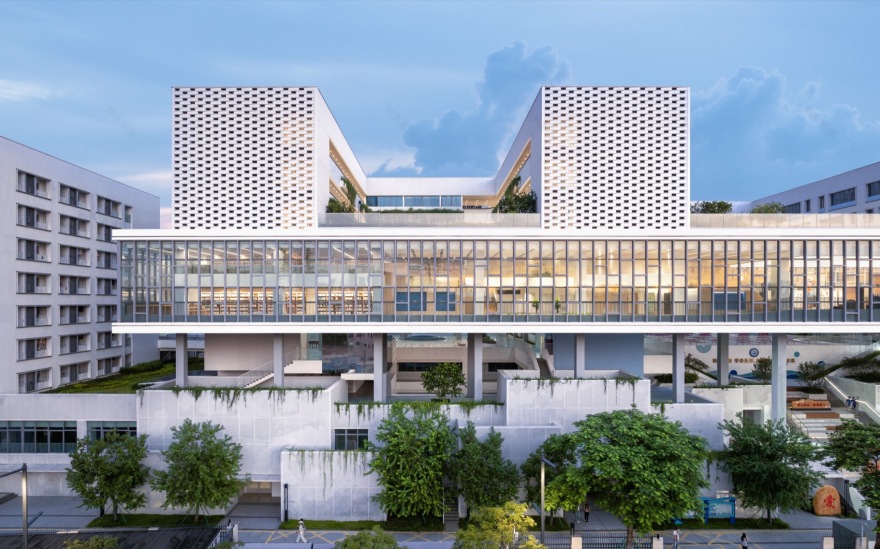

同时资源中心进深较大,将传统校园中大尺度的礼堂、体育馆等置于其中,与教辅等活动空间相互错动,形成丰富的空间变化。通过植入通达地面的下沉庭院,打破基座进深的限制,营造建筑的“呼吸感”。
▼基座轴测图,Base Axonometric Drawing ©华阳国际设计集团

Meanwhile, the resource center has a significant depth, placing traditionally large-scale campus venues such as auditorium and gymnasium within it, interspersed with teaching support and other activity spaces to create rich spatial variations. By incorporating a sunken courtyard that connects to the ground, the depth limitation of the base is broken, creating a sense of “breathability” in the building.
▼体育馆,Gymnasium ©张超

▼下沉广场空间,Sunken Space ©张超

架空层通过空间错落的变化,创造类似“童话小镇”的街区空间,其中蕴含多样探索路径。同时,架空层与操场连接,并利用高差形成看台,让校园生活自然融入建筑之中。架空层上方天花采用镜面不锈钢吊顶,镜面吊顶的存在使得在城市道路可以看到学校里孩子们热火朝天的玩耍,同时在校内视角,孩子们抬头便可见城市街道的车水马龙。城市与校园形成了有趣的对话,形成一种另类的开放式校园景观。
The elevated floor creates a “fairy-tale town” block space through spatial variations, containing diverse exploration paths. Meanwhile, the elevated floor connects to the playground and utilizes the elevation difference to form stands, naturally integrating campus life into the architecture.The ceiling above the elevated floor adopts a mirrored stainless steel ceiling, allowing people on the urban road to see the children playing enthusiastically in the school. From the campus perspective, children can see the bustling urban scenes when they look up. This creates an interesting dialogue between the city and the campus, forming a special open campus landscape.
▼架空层(童话小镇),Elevated Floor (Fairy-Tale Town) ©张超
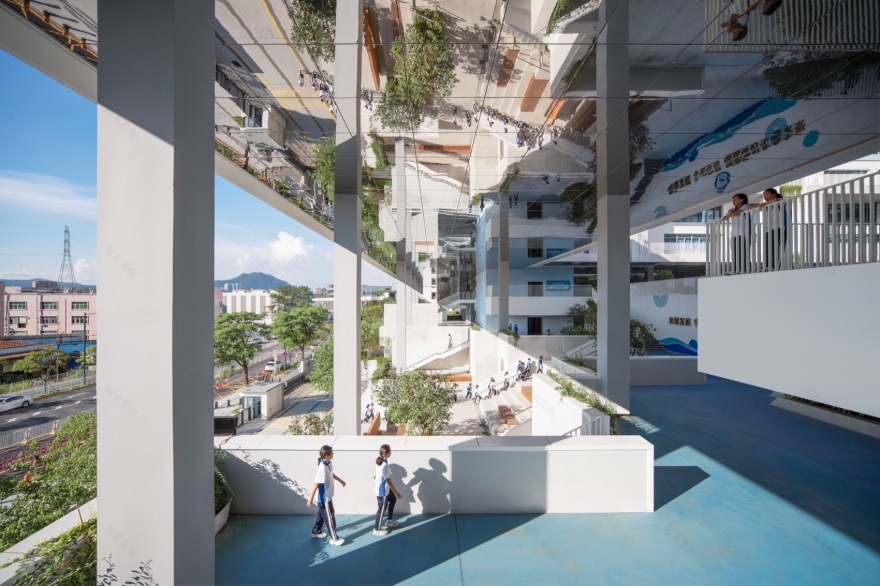

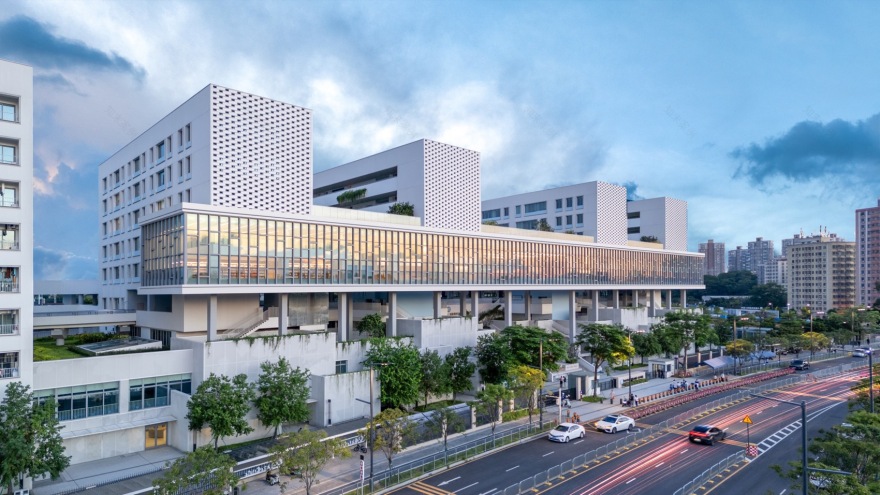
空中图书馆长度达150米,架空于校园上空,于高空之上正对东宝河滨水公园。巨构式的空中图书馆有如横跨天堑的大桥一般,成为深莞边界的醒目地标。
The aerial library stretches 150 meters, suspended above the campus, directly facing the park by the Dongbao River. This colossal aerial library resembles a bridge spanning a chasm, becoming a prominent landmark on the Shenzhen-Dongguan border.
▼空中图书馆,Aerial Library ©张超

▼图书馆沿街立面,Library Facade along the Street ©张超

图书馆不再是单一的阅读功能,通过打破多楼层重复叠加的空间属性,将活动空间拉升并植入至多个原本孤立的高楼层,自身也转化成中部的活动中心和南北两端的中小学图书馆。图书馆屋面平台为高楼层的学生提供了活动场所,进一步增加校园公共空间的多样性。
The library is no longer limited to a single reading function. By breaking the repetitive spatial attributes of multiple floors, activity spaces are elevated and integrated into various originally isolated high floors, transforming itself into a central activity hub and libraries for both primary and secondary schools at both ends. The library’s rooftop platform provides activity venues for students on high floors, further increasing the diversity of campus public spaces.
▼图书馆通透内部,Library’s Transparent Interior ©张超

▼图书馆屋顶,Library’s Rooftop ©张超

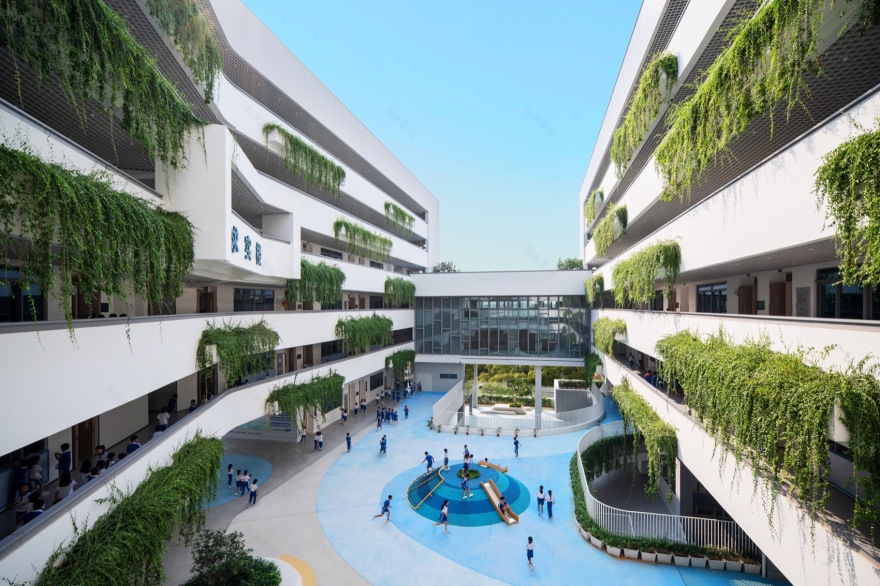
教学单元通过长廊串联,创造观景平台,同时层叠的平台、架空、屋顶花园,增加了水平楼层的空间趣味,在“天空”之中营造出一种绿化与光影交织的游走体验。
Teaching units are connected through long corridors, creating viewing platforms. Simultaneously, layered platform, elevated space, and rooftop garden increase the spatial interest of horizontal floors, creating a walking experience intertwined with greenery and light and shadow in the “sky.”
▼教学区架空层,Elevated Floor at the Teaching Area ©张超


▼教学区中庭,Atrium of the Teaching Area ©张超
▼多层次户外活动平台,Multi-level Outdoor Activity Platform ©张超

▼教学区多功能阶梯空间,Multi-functional Step Space at the Teaching Area ©张超

整层的架空形成了校园第二地面空间,校园东侧设计更强调教学楼与运动场的呼应,在立面上设置大量可以走出来的空间,使得课余时段的校园生活得以立体化呈现,产生人与空间的自然对话。其余下沉、平台等灰空间的设置同样将室内外自然连接,提供了完善的避雨、防晒、通风等功能,阳光、风和四季等自然元素能够在这里被更生动地感知,成为承载校园公共生活的重要场所。
The entire floor of elevated space forms the second ground level of the campus. The eastern side of the campus emphasizes the response between the teaching building and the playground, with a large number of walkable spaces incorporated into the facade. This allows campus life during breaks to be presented three-dimensionally, fostering a natural dialogue between people and space. The settings of other sunken spaces, platforms, and other gray spaces similarly connect indoor and outdoor spaces naturally, providing comprehensive functions such as rain shelter, sun protection, and ventilation. Natural elements such as sunlight, wind, and seasons can be more vividly perceived here, becoming important venues for campus public life.
▼东立面,East Facade ©张超
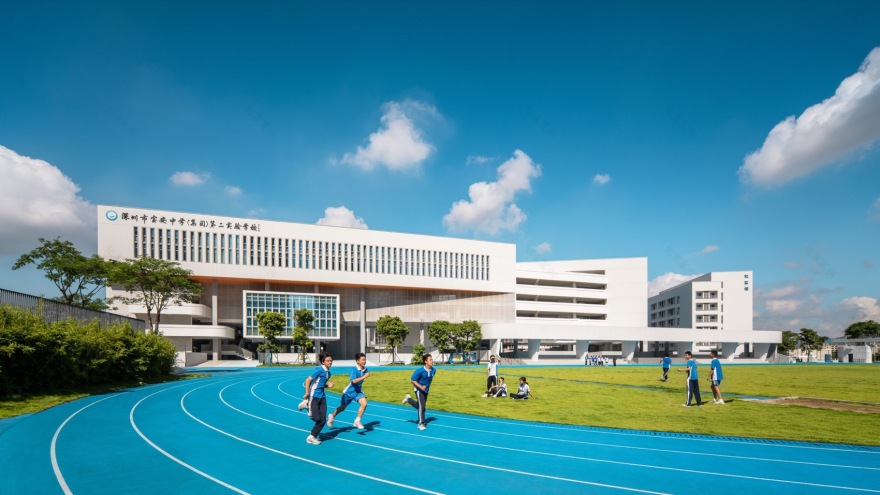

如何在前所未有超高密度的城市环境里建一所好学校,深圳市宝安中学(集团)第二实验学校,秉持着将孩子们的身心感知放在首位的初心,用充足而且多元的空间系统来实现舒适亲切、宽敞明亮的校园环境。建筑向上生长的同时回归了“社区”式的多元属性,于高密度校园里绽放独特生命力,形成了对新校园模式的生动诠释。
How to build a good campus in an unprecedentedly high-density urban environment? Shenzhen Bao’an Middle School (Group) Second Experimental School adheres to the original intention of prioritizing children’s physical and mental perceptions, using a sufficient and diverse spatial system to achieve a comfortable, intimate, spacious, and bright campus environment. As the architecture grows upwards, it returns to the “community”-style diversity, blooming with unique vitality in a high-density campus and forming a vivid interpretation of a new campus model.
▼东面鸟瞰夜览,East Side Aerial Night View©张超

▼东立面夜览,East Facade night view©张超


项目档案
项目名称:深圳市宝安中学(集团)第二实验学校
项目类型:教育建筑
项目地点:深圳,宝安
学校规模:72班
用地面积:34,859㎡(可建设用地面积:12,778㎡)
总建筑面积:68,040.06㎡
设计时间:2021年-2023年
竣工时间:2024年
业主单位:深圳市宝安区教育局
建设单位:深圳市地铁集团有限公司
设计单位:华阳国际设计集团深圳公司(建筑方案设计/建筑专业初步设计)
华阳设计团队:张燕龙、唐志华、钱欣、吴智鑫 、王婕、寇浩、李世强、王维滔、郑鑫东、安泰、赖耿彬
施工图合作设计:深圳市市政设计研究院有限公司
景观设计:深圳市市政设计研究院有限公司
室内设计:杰恩设计
建筑摄影:张超
Project Profile
Project Name: Shenzhen Bao’an Middle School (Group) Second Experimental School
Project Type: Educational Architecture
Project Location: Bao’an, Shenzhen
School Scale: 72 Classes
Land Area: 34,859㎡ (Constructible Land Area: 12,778㎡)
Total Building Area: 68,040.06㎡
Design Period: 2021-2023
Completion Year: 2024
Client: Shenzhen Bao’an District Education Bureau
Constructed by: Shenzhen Metro Group Co., Ltd.
Designed by: Huayang International Design Group Shenzhen Branch (Architectural Scheme Design/Architectural Professional Preliminary Design)
Huayang Design Team: Zhang Yanlong, Tang Zhihua, Qian Xin, Wu Zhixin, Wang Jie, Kou Hao, Li Shiqiang, Wang Weitao, Zheng Xindong, An Tai, Lai Gengbin
Construction Drawings Co-designed by: Shenzhen Municipal Design & Research Institute Co., Ltd.
Landscape Design: Shenzhen Municipal Design & Research Institute Co., Ltd.
Interior Design: J&A Design
Architectural Photography: Zhang Chao
南京喵熊网络科技有限公司 苏ICP备18050492号-4知末 © 2018—2020 . All photos and trademark graphics are copyrighted by their owners.增值电信业务经营许可证(ICP)苏B2-20201444 苏公网安备 32011302321234号
苏公网安备 32011302321234号客服
消息
收藏
下载
最近