

创作上传
VIP
收藏下载
登录 | 注册有礼
查看完整案例

收藏

下载

分享
这座建于1981年的原建筑由建筑师Oyevaar、Stolle和van Gool设计,最初被有意打造为一栋内向型建筑。它为荷兰财政情报与调查局(FIOD)而建——这一机构的工作特性需要保持低调。该建筑采用粗野主义风格,以醒目的黄色窗框而闻名。由于被认为“无法改造”,它一度面临被拆除的命运。然而,鉴于其地理位置以及区域临时办公需求,荷兰国家房地产管理局决定推进对该建筑的改造计划。2020年,Beyond Space与MVSA Architects赢得了该项目的设计招标。
The original building from 1981, designed by architects Oyevaar, Stolle, and van Gool, was intentionally an inward-oriented building. It was designed for the FIOD, the Fiscal Intelligence and Investigation Service, an organization that benefited from discretion. The brutalist building with distinctive yellow frames was nearly slated for demolition because it was considered non-transformable. Due to its location and the need for a temporary regional office, the State Real Estate Agency decided to proceed with a transformation. The tender for this project was won in 2020 by Beyond Space and MVSA Architects.
▼建筑外观,exterior of the building©Surina merpad

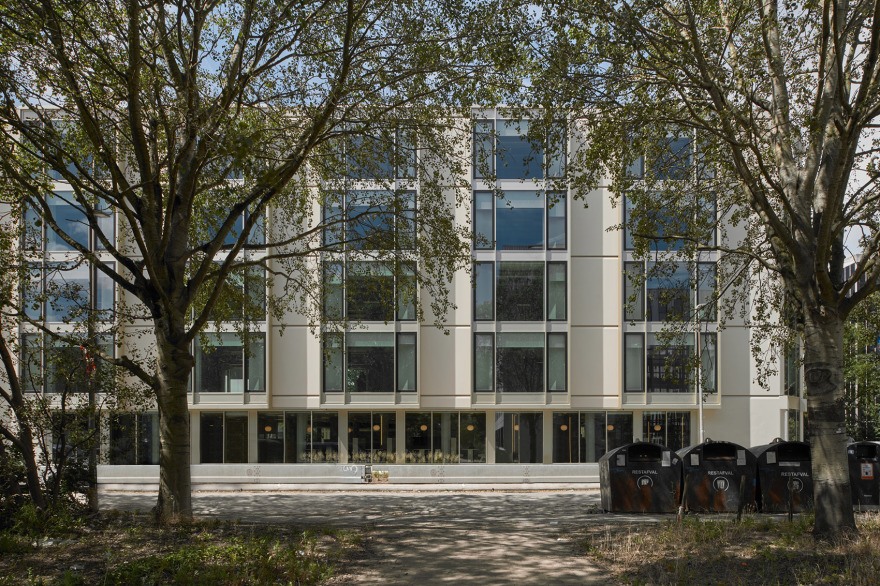
所谓“可持续建筑”,并不是在传统建筑上添加一些环保措施,而是一种彻底不同的思维方式——一种突破固有模式与流程的能力。它应贯穿设计与建造的每一个阶段,而非事后附加。建筑过程越早介入可持续理念,其决策的影响力与潜力就越大。荷兰国家房地产管理局在这方面已经迈出了关键的第一步:选择“再生利用”而非“新建”。同样的原则也体现在设计执行中——最大的节约来自“你不去建造的部分”,这正是本项目设计的核心理念。
A sustainable building is more than a traditional building with some additions. Achieving it requires a radically different way of thinking and the ability to break free from entrenched patterns and processes. It is also an integral part of every phase of the process and not something that can be added afterward. The earlier in the construction process, the more impact decisions have and the greater the potential. The State Real Estate Agency has already taken the first crucial step in this regard: revitalization instead of choosing new construction. The same principle applies to the design’s execution, with the greatest savings coming from what you don’t build, which is the basis of our design.
▼对原建筑的再利用,revitalization of the original building©Surina merpad

凸窗设计
Bay windows
最关键的设计决策是在原立面内凹的位置增加凸窗。通过这一高效的干预手段,建筑获得了实质性的转变。原本内凹、封闭的立面如今向外延展,使建筑从一个内向的封闭体变为一个开放、友好的空间,积极地与周边环境建立联系。
▼改造前后立面,the facade before and after renovation© Beyond Space + MVSA Architects

The most significant decision is to add bay windows at the points where the façade currently folds inward. With this effective intervention, the building undergoes a substantial transformation. Where the building used to turn inwards with its existing recessed niches, the bays now direct the building outward. This transforms the building from a closed structure into an open, inviting building that engages with its surroundings.
▼改造后立面,facade after renovation©Surina merpad


“少建”理念
Building Less
通过在局部增加凸窗形式的面积,设计同时实现了多重目标:根本性提升建筑外壳的可持续性能;显著改善既有建筑的可用性;在保持极小新增占地的前提下,减少额外建设需求。这种体量的增加被安置在建筑的“角部”位置,形成紧凑的结构,同时为城市森林(Urban Forest)的规划保留更多空间,契合城市区域的总体愿景。此外,基地上的所有原有树木均被完整保留。
By adding additional surface area in the form of bays, we achieve multiple goals at once: it provides the opportunity to fundamentally improve the building envelope’s sustainability and significantly enhances the usability of the existing building, reducing the need for additional construction with a minimal footprint. By positioning this extension in the ‘corner’ of the building, a compact structure is created with more space for urban forest in line with the urban area vision. Additionally, all existing trees on the plot are preserved.
▼改造后中庭空间,atrium space after renovation©Surina merpad

▼改造后室内空间,interior space after renovation©Surina merpad


减少拆除
Reducing Demolition
“少建”理念与“少拆”密切相关:最大化保留原结构、最小化拆除工作。现有的楼梯间、电梯核心及卫生间布局均被保留,仅在必要之处进行策略性拆除,以获得显著的空间价值。例如:在一层的多功能休息区与“锚点”空间之间新增一个中庭;一层部分混凝土立面板被拆解,以增强建筑的通透性与周边景观的联系;其他拆除仅限于现有内装部分的移除或拆解。
Limiting new construction goes hand in hand with maximizing the preservation of the existing structure. Demolition work is kept to a minimum, and the positions of the existing (structural) stairwells, elevator core, and restrooms are retained. Demolition is only employed strategically where it offers significant spatial value. For instance, we create an atrium between the multifunctional seating area and the anchor point on the first floor. Also, on the ground floor, concrete façade elements are disassembled to increase the transparency of the façade and strengthen the connection with the surrounding landscape. Other demolition work is limited to the removal or disassembly of the current interior package.
▼增强建筑的通透性与周边景观的联系,increase the transparency of the façade and strengthen the connection with the surrounding landscape©Surina merpad

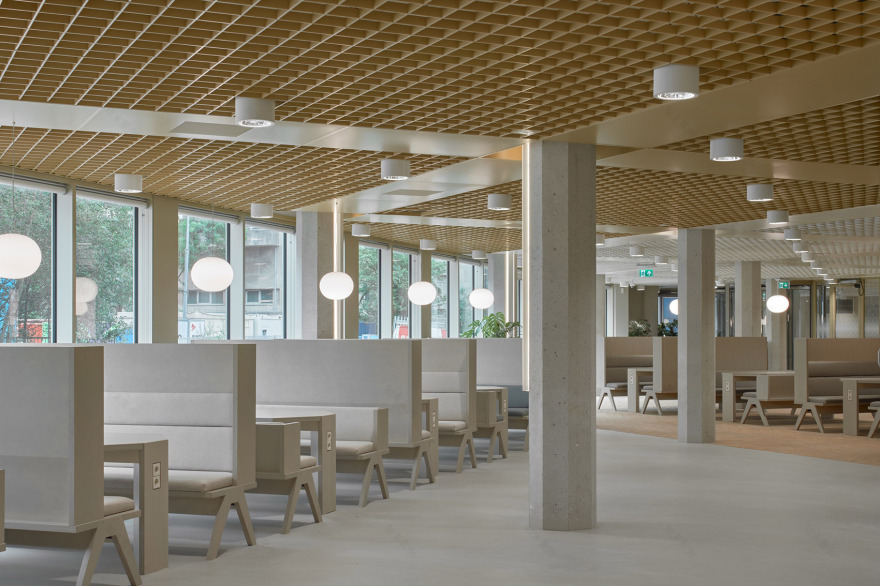
▼用色彩点亮空间,Light up the space with colors©Surina merpad


循环式扩建
Circular Extension
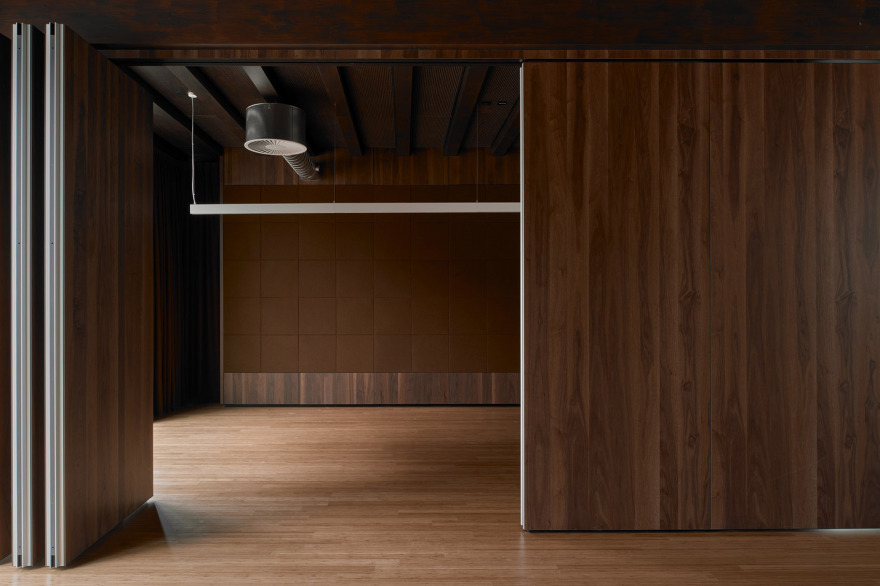
新增的凸窗与扩展部分均直接布置在原有承重轴线上,遵循既有建筑的结构原则,因此无需新建地基——而地基通常是建筑中环境污染最严重的部分之一。扩建部分采用循环式设计,可拆卸、可再装。为强化新旧部分的区分并赋予建筑新的特征,扩建部分的地板、墙体与结构全部采用木材制成。
▼设计策略,design strategy© Beyond Space+ MVSA Architects

Both the bays and the extension are positioned directly above the load-bearing lines and within the structural principles of the existing building. This approach eliminates the need for a new foundation, typically one of the most environmentally polluting aspects of a building. The extension is designed to be circular, demountable, and remountable. To add character and create a clear distinction between the existing building and the extension, the floors, walls, and structure of the extension are all made of wood.
▼木材构成空间的主基调,Wood forms the main tone of the space©Surina merpad


高度与空间气质
Height and Character
在室内,设计采取多种策略优化自然采光:采用浅色调与微反光表面(如铝制室内框架)引导光线深入室内;同时去除原有女儿墙与吊顶,从而提升自然光照强度并增加层高,使办公空间的品质显著提升。为凸显混凝土墙体与柱子的质感,设计将其打磨后保留原貌。色彩被用于视觉尽端及关键节点(如前台与主楼梯),帮助人们自然地在空间中导航。
Inside, various measures are taken to optimize the use of natural daylight. The use of light colors and subtly reflective surfaces, such as aluminum interior frames, further directs light inside. We also remove the parapets and the existing lowered ceiling to bring in even more natural light. This increases the ceiling height and, subsequently, the quality of the office space. To enhance the character of the concrete walls and columns, they are sanded and left exposed. Color is used at the end of sightlines and to highlight important elements such as the entrance desk and the main staircase, allowing users to navigate naturally through the building.
▼采用微反光表面(如铝制室内框架)引导光线深入室内,the use of light colors and subtly reflective surfaces, such as aluminum interior frames, further directs light inside©Surina merpad

▼色彩被用于视觉尽端及关键节点,Color is used at the end of sightlines and to highlight important elements©Surina merpad

“可持续性不是最后加上的一层酱料,而是整个设计的主原料。”——Beyond Space 创始合伙人 Stijn de Weerd
‘Sustainability is not a sauce that you can apply in the end. It’s your main ingredient.’ – Stijn de Weerd, founding partner Beyond Space
▼一层平面图,ground floor plan©Beyond Space+MVSA Architects

▼二层平面图,first floor plan©Beyond Space+MVSA Architects

▼剖面图,section©Beyond Space+MVSA Architects

Project team Beyond Space: Stijn de Weerd, Remi Versteeg, Arnoud Stavenuiter, Puck Vogelpoel, Rolf van der Leeuw, Tsz Ho Chau, Michiel Hilbrink
Project team MVSA: Kees Stoffels, Freke Schalken, Deniz Kutlu
Architects: MVSA Architects, Beyond Space
Interior Design: MVSA Architects, Beyond Space
Contractor: BAM Bouw en Techniek, Bunnik
Landscape Architect: Copijn, Utrecht
Acoustic & fire Advisor: DGMR, the Hague
MEP Advisor: BAM Advies & Engineering


南京喵熊网络科技有限公司 苏ICP备18050492号-4知末 © 2018—2020 . All photos and trademark graphics are copyrighted by their owners.增值电信业务经营许可证(ICP)苏B2-20201444 苏公网安备 32011302321234号
苏公网安备 32011302321234号客服
消息
收藏
下载
最近