

创作上传
VIP
收藏下载
登录 | 注册有礼
查看完整案例

收藏

下载

分享
在2020年在纽约古根海姆博物馆展示的《乡村》第一版中,我们选择了全球范围内的一些地点,这些地方的乡村正在经历剧烈的变化和剧变。通过这些焦点展示,我们提供了一个关于危机和潜力的全球概览,这些变化在我们的城市之外发生,因此往往未被注意到。
▼展览海报,the exhibition poster © AMO OMA
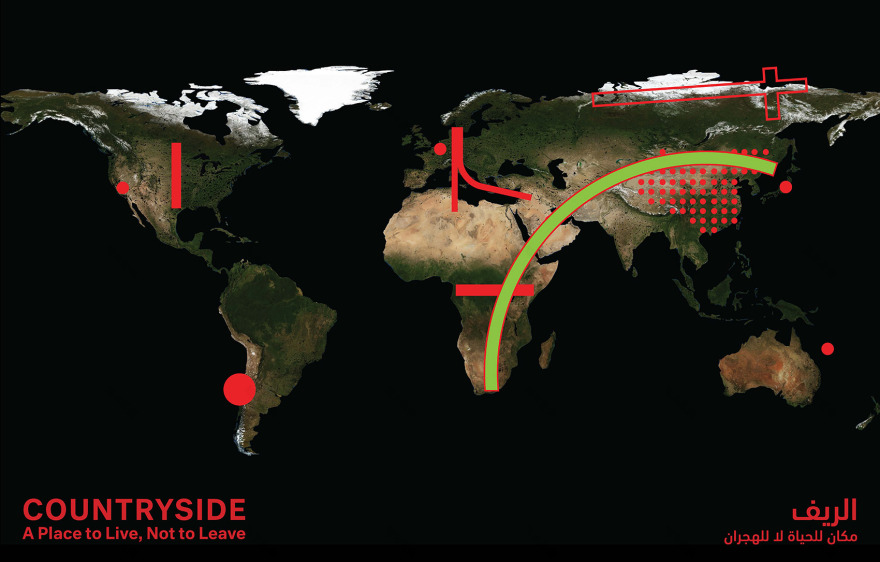
In the first version of Countryside, presented at the Guggenheim New York in 2020, we picked a number of sites all over the world, where the countryside was going through drastic changes and acute upheavals. Together, these zooms presented a global overview of crisis and potential that was unfolding outside our cities and therefore went largely unnoticed.
▼展览场地鸟瞰,aerial view of the exhibition © Marco Cappelletti Studio, courtesy AMO OMA

▼参观者步入“乡村”展览空间,visitors entering the “Countryside” exhibition space
© Marco Cappelletti Studio, courtesy AMO

▼室外展览区,outside exhibition space © Marco Cappelletti Studio, courtesy AMO OMA

在《乡村》的第二版中,我们呈现了“弧线”——一条从南非经东非、卡塔尔、中亚,一直延伸到中国东部的连贯“乡村”带。这是一片内陆的乡村地区,仍然以传统的方式居住,既有非洲,也有中亚,只有中东地区正在经历快速的现代化。
In this second iteration of Countryside, we present “the Arc” a contiguous band of “Countryside” that runs from South Africa through East Africa, via Qatar, Central Asia, all the way to Eastern China. It is an arc of landlocked rural areas, still inhabited largely in traditional ways, both in Africa and Central Asia, and where only the Middle East is undergoing rapid modernization.
▼乡村“弧线”的路径, band of “the Arc” © Marco Cappelletti Studio, courtesy AMO OMA

▼文字展览区, text exhibition area © Marco Cappelletti Studio, courtesy AMO OMA


今天,非洲、中东和中亚是世界85%人口的家园。到2100年,这些地区仍将占全球人口的80%以上。届时,非洲将成为人口最多的大陆,超过亚洲。卡塔尔及其周边地区位于这一人口变迁的地理和经济交汇点。
Today, Africa, the Middle East, and Central Asia are home to 85 percent of the world’s population. By 2100, these regions will still account for more than 80 percent of humanity. By then, Africa will have become the most populous continent, surpassing Asia. Qatar and its neighboring region sit at the geographic and economic crossroads of this demographic transformation.
▼模型展览区, model exhibition area © Marco Cappelletti Studio, courtesy AMO OMA


▼影像展览区, media exhibition area © Marco Cappelletti Studio, courtesy AMO OMA


▼参观者在电脑前参与调查, visitors engage in a survey © Marco Cappelletti Studio, courtesy AMO OMA

我们追溯这条弧线,因为它既涵盖了传统的生活方式,也展示了现代生活方式。它不是一连串的危机,而是一个潜力的弧线,在这里我们可以思考哪些方面可能发生变化,以及哪些传统应该保持。弧线的大部分地区是山区;地形本身抵制大规模的现代化,尽管它令人叹为观止的美丽面临着越来越大的压力。
We traced this arc because it encompasses both traditional and modern forms of living. Rather than a chain of crises, it represents an arc of potential, in which we can consider how much might change and what traditions should be maintained. Most of the Arc is mountainous; the landscape itself resists a wholesale modernization, though its breathtaking beauty faces mounting pressure.
▼展览走廊, corridor © Marco Cappelletti Studio, courtesy AMO OMA

智能手机对弧线地区产生了巨大的影响,连接了最为孤立的文化,质疑离开乡村去城市的必要性。手持互联网带来了无限的信息流、时尚、新闻和政治,创造了全新的经济形态。
The smartphone has had a colossal impact on the Arc, connecting the most isolated cultures, questioning the need to leave the countryside for the city. The handheld internet introduces limitless flows of information, fashion, news, and politics, enabling entirely new economies.
▼城市农田实验区, urban farmland test plot © Marco Cappelletti Studio, courtesy AMO OMA

弧线地区的大部分非洲地区在1960年代之前曾被殖民,而中亚则直到1990年代初才结束殖民统治。殖民主义留下了破坏性的遗产,包括种族隔离,以及在亚洲的大规模农业相关技术和核实验,这些实验目前正在重新思考和修复。在许多情况下,这些实验部分仍在继续。那么,在后殖民条件下,遗产到底是什么?
Large parts of the arc in Africa were colonized until the 1960s, and in Central Asia until the early 1990s. Colonization has left disruptive legacies of apartheid, and in Asia, large scale agriculture-related technological and nuclear experiments that are currently being rethought and remediated. In many cases these experiments partly continue. What is heritage then in post-colonial conditions?
▼夜览, nightview © Marco Cappelletti Studio, courtesy AMO OMA

Client: Qatar Museums
Location: Qatar Preparatory School and Qatar National Museum, Doha
Year: 2025
Status: Completed
Program: Exhibition, Research
Director: Samir Bantal, Rem Koolhaas
Project Architect: Yotam Ben Hur
Team: Stephanie Achkar, Zivar Aliyeva, Sebastian Bernardy, Jorge Cerdo Schumann, Thomas Hellier, Sean Li, Vicente Mateus, Konstantinos Papasimakis, Rita Varjabedian, Owen Wang, Louisa Weeren, Aleksandr Zinovev, Marina Zuquim, Daria Zvereva
南京喵熊网络科技有限公司 苏ICP备18050492号-4知末 © 2018—2020 . All photos and trademark graphics are copyrighted by their owners.增值电信业务经营许可证(ICP)苏B2-20201444 苏公网安备 32011302321234号
苏公网安备 32011302321234号客服
消息
收藏
下载
最近