

创作上传
VIP
收藏下载
登录 | 注册有礼
查看完整案例

收藏

下载

分享

For reconstruction and rehabilitation of Al Nouri Complex in Mosul, we mainly focus on diversity, publicity and feasibility of this design. Prototype of old town space and characteristics of local architecture have been carefully protected and modernly evolved in our design, to revive the spirit of Mosul and contribute to the diversity of local culture. According to the situation of urban facilities in Mosul after war, we are going to make public space of this new complex open to local residents as much as possible, to rebuild the relationship of community and cohesion of the whole society. Local materials, vernacular construction skills and appropriate new technology are fully taken into consideration to increase the feasibility of this design and provide more job opportunities to young citizens.


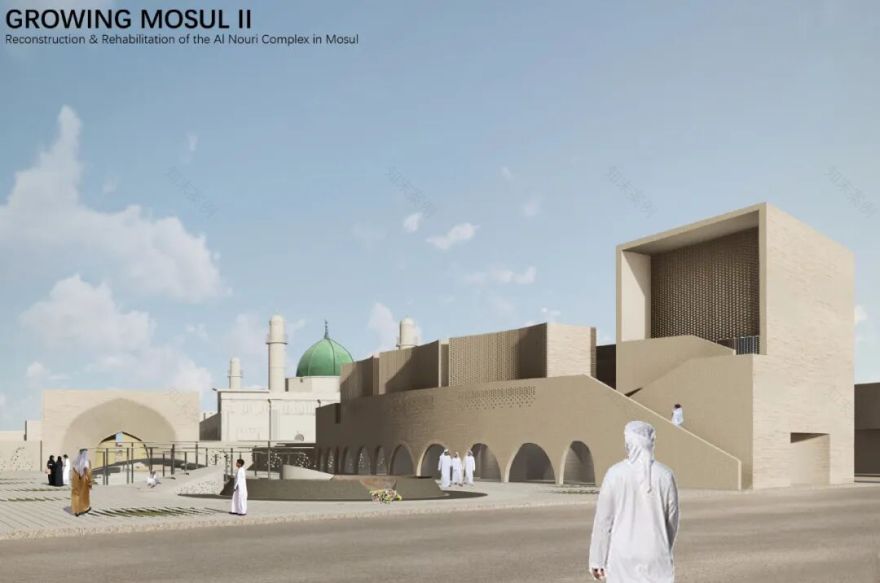
An urban axis from east to west linking extension and historical areas, is composed by main square, mosque gate and sahn. The main square is divided into three circle space respectively with symbol of War, Community and Religion. At the entrance of main square, a big hemisphere landscape sinking into ground with a permanent flame in center, remind visitors pain of war and hope of peace at the same time. Stepping down through slope with victims’ names carving into the memorial wall, visitors get to the second circle space which is an open bazaar encouraging communication between communities and providing more income opportunities of livelihood. Passing through a crescent pedestrian bridge, a huge mirror pool reflecting the mosque gate which is the third circle, describes the peacefulness of religion and purity of human nature.


Al Nouri Secondary school stands in the north-west corner of extension area, distributed around No.9 historical building which become a historical library after renovation. Due to local customs, 6 classrooms for boys and 6 classrooms for girls are organized respectively in first and second floor, and also one teachers’ room in each floor. Indoor sports hall on east side consists of 8 meters high space opening to main square, and it can be a public recreation place after school. As each functional space has its separated volume, the secondary school breaks down 1715sqm into a series of limited dimensional components like other neighborhoods, keeping a harmonious relationship to old town space.

Considering the influx of persons resulting from both functions., Festivities Hall is located closed to the mosque for purpose of facility sharing. Replacing the inside wall around courtyard with an open gallery, No.8 historical building serves as a cultural reception space of Festivities Hall.


As typical urban space in middle east , hundreds of narrow paths and tiny squares exist in Mosul old town . However, large amount of them have been turned into ruins because of war. Higher institute of Art and Islamic Architecture is not only a research organization focus on Al Nouri Complex and Mosul city, but also can be a Mosul traditional space itself, providing a touchable experience and good understanding of this historical city. We believe that is the best way to revive the spirit of Mosul and set up a typological template for the reconstruction . As a result, three paths and two small circle squares are organized around No.10 historical building to create the experience of wandering in the original city. Functional spaces of the institute are also divided into separated volumes like Al Nouri Secondary School . Facing to main square, an Architecture Art Museum which exhibits the original fragments of Al Nouri Mosque is open to public and provide people with an arcade recreation place in the front. 6 classrooms are organized at the top of the museum and the other two locates at the corner of Farouq Street and Great Mosque Street. Lectures, open courses and public salons can be hold in these two classrooms, making up for the lack of public education resources after war. Above this corner, meeting room with 35 seats at the top floor acts as the highest visual point and urban landmark of this complex. An independent staircase to the meeting room makes this space accessible directly from main square for public use. No.10 historical building becomes cafeteria and library open to public and can be used as community culture facility of old town. Teachers’ studios and administration offices on first floor in the east side share a flexible activities space downstairs, with possibilities of pantry, dining, speech and so on. The rooftop of south gate also provide a shortcut directly from Imam’s office to Al Nouri Mosque.
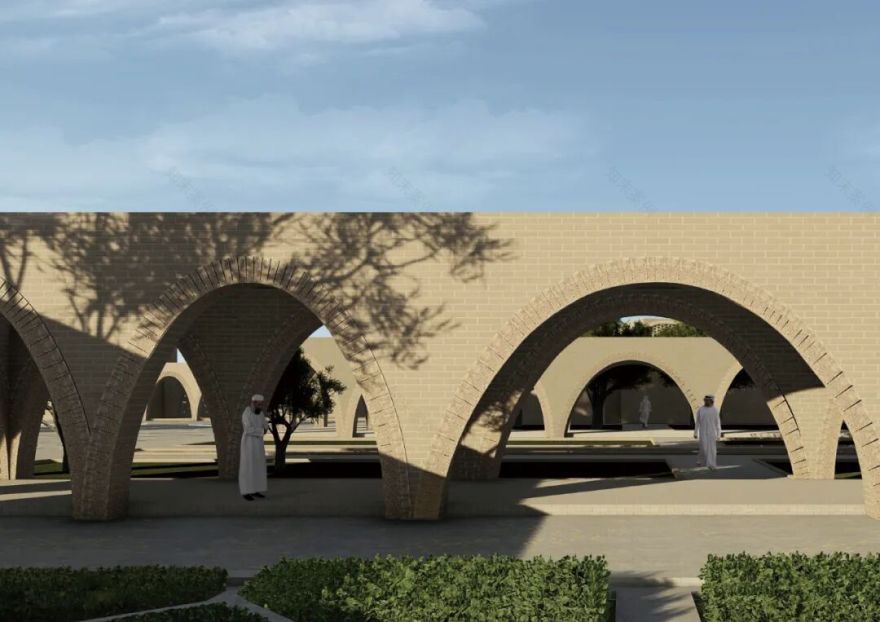
Connecting urban axis, a new gate of Al Nouri Mosque with appropriate dimensional relationship to main square act as the main entrance to historical area which is surrounded by adobe arcade fence. Inside the fence, green courtyard with a sub entrance changes its direction to make Sahn area more completed facing to Al Nouri Mosque. A long patio with arcade on both sides and mirror pool in the middle connects sahn and Al Nouri tomb reconstructed at original site. Sahn area is constituted by equilateral triangle pavement and one metal column in each triangle point acts as the support of shading fabrication in summer.

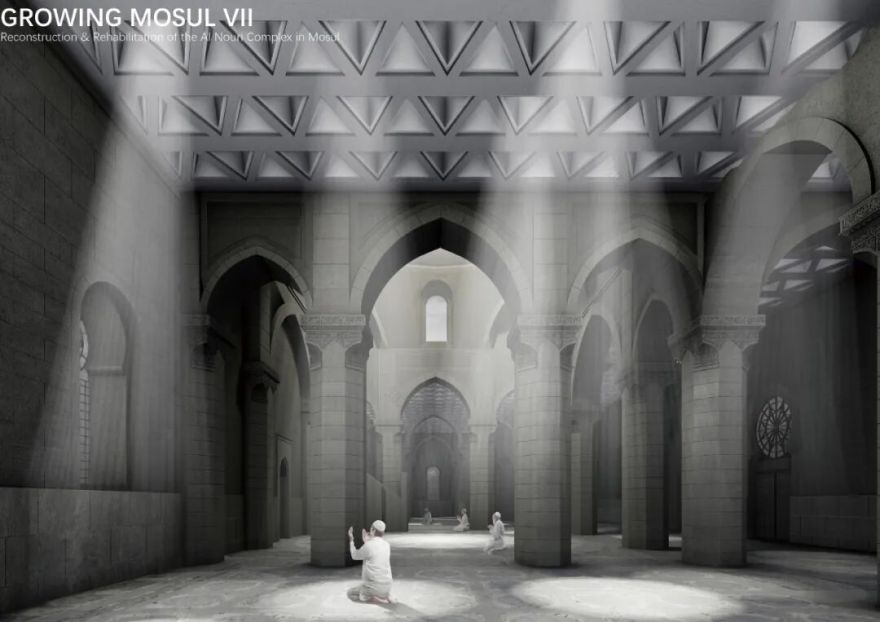
We define three kinds of components in reconstruction of Al Nouri Mosque: remaining structure, new structure and preserved objects. Stabilization measures will be undertaken for remaining structures, including metal grid system, supplement by original materials, protect layers and so on. New structure with concrete wall on four outsides and triangle unit concrete slab on the top which can easily create large span space, provide a new structure support system for Al Nouri Mosque. Free from structure purpose, those original objects collected from ruins, including columns, capitals, arches, pulpits, can be assembled again and fixed to the new structure to recreate graceful interior beauty of the past. Lighting filter with one glass brick on top installed inside triangle unit slab, will provide every person one quiet and independent space in this mosque, which is a modern approach to explain the understanding of religion.
Focusing on diversity, publicity and feasibility, what we do for Al Nouri Complex is to provide more flexible and public space for this post-war city with careful reconstruction to protect the vernacular culture and urban history. By feasible measures undertaken in the reconstruction process and public facilities at the end, more job opportunities, community activities, revive of Mosul spirit will be back right above this historical linking point place.

设计时间
: 2020.11
建筑面积
: 3650
㎡
项目地址
: 伊拉克,摩苏尔
设计团队:汪妍泽、吴冠中、崔凯宁、林剑博、李雨秾、李悦
南京喵熊网络科技有限公司 苏ICP备18050492号-4知末 © 2018—2020 . All photos and trademark graphics are copyrighted by their owners.增值电信业务经营许可证(ICP)苏B2-20201444 苏公网安备 32011302321234号
苏公网安备 32011302321234号客服
消息
收藏
下载
最近