

创作上传
VIP
收藏下载
登录 | 注册有礼
查看完整案例

收藏

下载

分享

编者按:
“青城之约”城市更新设计大赛以“青年建、青年享、青年爱”为核心理念,聚焦青春视角下大江南“老城厢”的城市更新与文化传承之间良性互动的关系。此次城市更新设计大赛,是一场关于青春、文化、创新和传承的盛会,它以青年之力,为城市注入新的生命力。邀请青年设计师、艺术家和跨学科从业者,共同为城市焕新注入青春活力。
本次竞赛甄选出一等奖1组,二等奖3组,三等奖4组,优秀奖27组。组委会将甄选部分获奖作品发布系列解读。本篇带来的是优秀奖作品《 Assembled Cultural Matter文化元素聚合体》。在无锡二泉广场的设计中,采用高度契合场地文脉的设计准则,通过设计聚合体体现了传统城市文化、乡村文化、当代中国文化、青年愿景以及城市景观的融合,形成一个多层次交织的动态系统:场所随昼夜与季节更迭而变换,实现了自然与文化的平衡,创造出适应梁溪区气候和环境的景观空间。
1
参赛团队
PARTICIPATING TEAMS

Team: Remedios Casas, Lucía Guanzetti, Melina Martínez, Agustina Valdenegro Lippo, Pablo E.M. Szelagowski
团队:雷梅迪奥斯·卡萨斯、露西娅·关泽蒂、梅利娜·马丁内斯、奥古斯蒂娜·瓦尔德内格罗·利波、巴勃罗·E·M·塞拉戈夫斯基
Architects of Taller 7 de Arquitectura. Facultad de Arquitectura y Urbanismo, Universidad Nacional de La Plata, República Argentina
阿根廷拉普拉塔国立大学建筑与城市规划学院,第七垂直工作室建筑师。
2
研究与分析
THE RESEARCH AND ANALYSIS PROCESS
For the competition we formed a design group of young and emerging architects coordinated by Taller Vertical de Arquitectura n° 7 de la Universidad Nacional de La Plata professors.
经由拉普拉塔国立大学第七垂直工作室的教授协调,我们成立了一个由青年先锋建筑师构成的设计团队来参与本次竞赛。
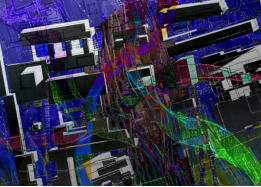
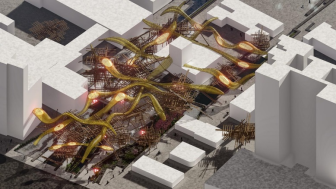
The design involves the renovation of Erquan Square and Chong'an Temple Block as a symbolic and traditional place in the Liangxi District.
该设计针对梁溪区具有象征意义与传统价值的二泉广场和崇安寺街区进行改造。
This proposal is designed using a particularly contextual criterion. The assembled matter represents traditional urban culture, rural culture, contemporary Chinese culture, the desires of the youth, and the landscape over the city through spaces and significant elements. It is a game of intertwined layers that define places that change by day and night, during the seasons, balancing nature and culture, and that create scenic spaces adaptable to the climate and environment of the district.
提案采用高度契合场地文脉的设计准则。通过空间与标志性元素的组合,该设计聚合体体现了传统城市文化、乡村文化、当代中国文化、青年愿景以及城市景观的融合,形成一个多层次交织的动态系统:场所随昼夜与季节更迭而变换,实现了自然与文化的平衡,创造出适应梁溪区气候和环境的景观空间。
The concept of the project is based on an architecturization of the Four Confidences: the idea of the path that organizes the space, the social and project theories that guide the architectural process, the system as an open, mobile and changing but precise organizational form, and the culture as a representation of the values of tradition and contemporaneity manifested in different expressions of the architectural space.
项目概念基于“四个自信”的理念实现建筑化转译:路径作为空间组织脉络,社会理论与设计方法论指导建筑生成,系统作为开放、流动且精准的组织形式,文化作为传统价值与当代性的空间表达,在建筑空间的不同表现形式中均有体现。
The project’s guiding concepts (objectives) are represented by multiple layers that interact with the urban space and between each other: Ground_Structures_Dragons_Lamps
项目的指导理念通过可与城市空间进行相互作用的四大互动层实现,包括地景、结构、游龙和灯月。
3
设计过程
DESIGN PROCESS
竞赛场地解读
In order to understand the theme of the competition and its transformation into a project concept, we begin with a dedicated study of the documents referring to the object of the competition and the physical, social and cultural framework in which the competition is called for.
为了理解竞赛主题并将其转化为项目设计概念,我们首先深入研究了竞赛文件中关于设计目标及所需物理、社会、文化框架及背景等内容。
One of our proirities was the theme set by the organizing committee regarding the need to attract young people to the historical sites of the city. We also reflected on the meanings of the Four Confidences and the role of young people in contemporary Chinese society, using these criteria as design tools.
我们重点关注组委会提出的"吸引青年回归城市中的历史遗迹"命题与倡议,并思考“四个自信”的具体涵义与当代青年在中国社会中的角色,将上述标准转化为设计工具。
At the same time, we studied the city of Wuxi: its spaces, its structure, its growth, its dynamics, its heritage, by using old maps, photographs, satellite images, etc. to create an idea of the city dynamics in its development.
同时,我们通过使用旧地图、照片、卫星图像等媒介,研究无锡市的城市空间、结构、发展、动态和历史遗产特征,以了解其发展中的城市动态。
We investigated the different proposed sites and the information available on each of them from afar, understanding that Erquan Square was the location from which we obtained the most material to work with.
我们调查了不同的拟建场地及通过远程调研获取每个场地的具体信息,基于基础信息的深度与完整性,最终确定将二泉广场作为核心设计场地。

The construction of the theme was based on the study of traditional cultural aspects and the current physical and cultural context.
To this purpose, we studied:
主题的构建主要基于对传统文化与当前物质文化背景的研究,包括:
- the mode and criteria of occupation of the urban territory
- 城市空间占用模式与标准
- the qualities of rural space, agriculture, topography and vernacular constructions
-乡村空间、农业、地貌与乡土建筑的特质
- traditional and contemporary architecture that respects traditions: its criteria and components.
-尊重传统的传统承续与当代转译:标准与组成内容
- the function of traditional architectural elements in space.
-传统建筑元素的空间表达功能
- youth Chinese art
-中国青年艺术表达

From the beginning, we intended to interpret all these issues and represent them through architectural elements combined in a varied, dynamic and attractive composition that generates a revulsive focus in the city as an attractor for the citizens.
从设计初始,我们就计划逐个诠释上述研究议题,并通过多样化且有吸引力的建筑元素形成动态组合,创造具有城市吸引力的活力空间和焦点。
竞赛设计过程
It is important to emphasize that our team is characterized by experimental design profiles which generate exhaustive projectual information that is essential for the pursuit of optimal architectural results.
需要格外强调的一点是,我们的团队采用实验性设计方法,可以生成详尽的项目信息,这对追求和实现最佳的建筑效果至关重要。
From this position, the design process began with the studying of the cultural components to be processed in the design by discussing the traditional elements representative of the culture that could be recreated, renewed to establish a contemporary composition with roots in tradition.
从设计初衷出发,整个设计过程始于研究设计中需处理的文化要素,讨论传统文化元素中可重构并更新的部分,以建立根植于传统又兼具当代性的组合体系。
Three levels of intervention were initially proposed, referring to three horizontal planes that corresponded to the ground, the movement space and a new horizon plane. These levels were completed with project layers to be conjugated, with different components and functions in a diagrammatic base that could be updated given its dynamic essence.
设计初期,我们构建了三级空间干预体系,包括与地平面、活动空间和新天际线相对应的三个平面。三级空间通过项目层级结合完成,在图库中有不同的组件和功能,可以根据其动态本质进行更新。
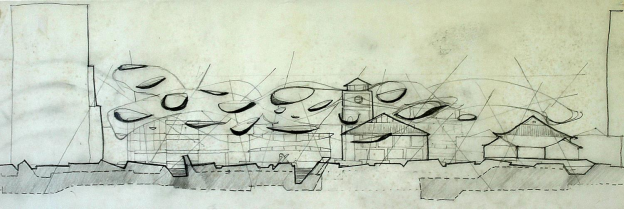
Each team member focused on the choice and study of some of the elements in particular, enhancing their current development. Each chosen element was given a specific power and function, each one becoming a layer of information.
每位团队成员均专注于选择和研究其中部分元素,以促进其当前的发展。每个选定的元素都被赋予了特定的影响力与功能,最终成为一层信息。
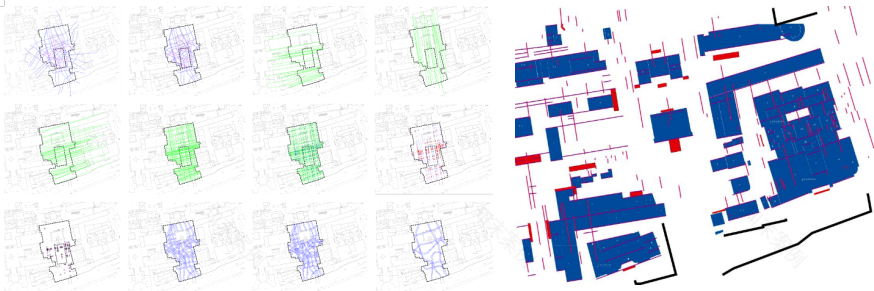
The project was fed by many drawings, sketches, and analogical and digital drawings that were building a design criterion that was growing in its project implications.
该项目设计由许多图纸、草图、类比图和数字图纸组成,这些图纸共同构建了设计标准,对项目的影响也在不断增长。
We worked with four layers: the floors (referring to those of the Chinese rural space), the dragons or ribbons, the wood structures and the lamps or moons. We gave particular attention to designing an organizational structure that governed the layers, marked by the physical context and in reference to “The Moon Over a Fountain” music.
我们通过四重结构深化设计:地景层(指中国乡村空间中的地面)、游龙或飘带、木制结构以及灯或月亮。我们特别设计出一个组织结构来管理这些层级,以物理环境为标志,并参考“二泉映月”的音乐结构。
The combination of the four layers of elements built an organism that was updated from relationships with the physical context and its possibilities of expansion, forming a dynamic and adaptable system of multiple spatial, visual and tactile qualities, changing and adaptable to different context conditions.
四重结构将不同元素构建为一个有机体,能够根据与物理环境的关系及其扩展的可能性实现更新,形成一个极具适应性的动态系统,具有多种空间、视觉与触觉品质,能够适应不同的环境条件。

The ground has the characteristics of farmland and urban gardens, recreated in a new topography that combines greenery, platforms, water, and other elements under a geometric matrix derived from the Chinese landscape. A ground that redefines a topography and connects with the undergrounds of the area (shopping malls, subways, etc.).
地景层:融合了农田与城市花园的特征,以中国园林景观的几何矩阵重组并结合了绿地、平台、水源等多样元素,重新定义地形并连接地下商业与交通空间(购物中心、地铁等)。


The structures, linear elements of traditional architecture, organize the spatial sequences and the proposed urban directionalities. They are arranged according to different densities, sections, and rhythms while maintaining their traditional material base: wood.
木构层:传统建筑的结构与线性元素构成空间序列,使城市方向初具雏形,通过不同的密度、剖面与节奏变化确保木材成为最传统的材料基础。


The dragons or snakes are moving ribbons/strips that define the qualities of the space, provoking scenes through performances that define the sense of place, reducing the effect of the existing large architectures.
游龙层:龙或蛇仿佛是移动的飘带或条纹,界定空间特质,通过表演场景重新定义场所精神,弱化大型建筑的压迫感。


The lamps are new moons reflecting on the water that accent the space, pointing out particular spaces, and evoking the music of Hua Yanjun.
灯月层:水中映月般的灯光设置突出了空间感,强化空间节点,致敬华彦钧的《二泉映月》。


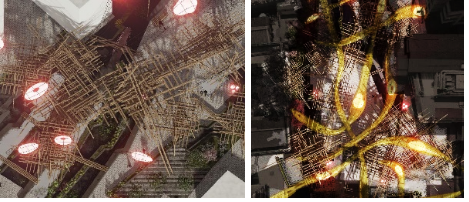
All these layers are composed of elements that resemble the traditional architecture and art of Chinese culture: working with roofs, borders, edges or walls, beams and columns, arches, spaces connected in sequence, with bridges and platforms at different levels. They work along with the interaction of stone, water and vegetation, with the colours of the culture, with techniques of repetition, superposition and different proposals of material density.
这些建筑层次皆由呼应中国传统建筑和艺术的元素构成:通过屋顶形制、边界界定、墙垣围合、梁柱结构、拱门形态、序列空间以及多标高桥梁和平台等手法,实现空间组织与石、水、植被等自然要素的相互交融,在材质密度变化中运用重复、叠加等传统技艺,同时融汇了中国传统色彩体系的文化基因。

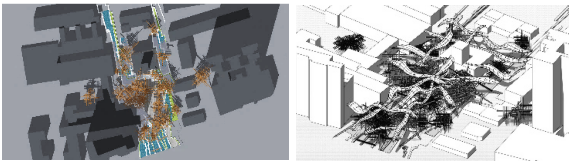
The spatial organization of the design is inspired by the structure of the musical theme “The Moon Over a Fountain” by Chinese folk musician Hua Yanjun. Sequences, intensities, sections, and relationships between instruments are recognized and translated into architectural language through the use of layers, elements, densities, sequences, matter, etc.
设计的空间组织灵感来自中国民间音乐家华彦钧作品《二泉映月》的曲式结构,通过层次、元素、密度、序列、物质等运用,识别序列、强度、剖面和工具之间的关系,并将其转译为建筑语言。


We propose a design that changes with the seasons of the year, with snow and rain, day and night, using water in its different states, and with the use of traditional colours and materials.
我们的设计考虑到四季更迭、雨雪昼夜等自然变化,运用水态转换以及传统的色彩和材料。
4
设计成果展示
DESIGN RESULTS DISPLAY
First sketches
第一版草图
Searching geometrical logics to develop the rural landscape criteria into the ground layout plan
探索几何逻辑:将乡村景观标准嵌入地面布局图

By applying the ground pattern on the Erquan Square area
二泉广场区域地纹应用

Placing ribbons/dragons to limit the space of the square
游龙/飘带在广场空间的限定应用

Overlapping dragons and ground pattern on the site
场地叠加应用龙纹及地面图案

Overlapping all layers and elements in the square
广场多层次多元素叠加应用


Exploration of the characteristics of timber frame nets
木结构网架特性研究


Aerial view of Erquan Square
二泉广场鸟瞰图

Architecture of the ground layer in different levels
多层次底层建筑示意图

Sections showing the four superimposed layers
四层叠加剖面图

Perspective of the Square with the four assembled layers
四层组合体广场透视图

Water, platforms, structures and ribbons organise the space.
水景、平台、结构与飘带的空间组织

Presence of the old library within the Project
项目中的旧图书馆展示

The natural landscape intertwines with platforms and structures
自然景观与平台和结构的交织

Walking through one of the spaces in the new Erquan Square.
二泉广场步行空间体验

A bird's-eye view of the whole
整体鸟瞰图
4
参赛感受
PERSONAL EXPERIENCE
The competition process has been a very pleasant experience for our team. For several team members this was their first architectural competition. It was also very engaged to see the collaborative work of architects who had never worked together before, now working in perfect harmony. We have learned a lot about the culture and present of Chinese society, its spaces and the diversity of its cities and landscapes. It has been captivating for us to understand a culture, seeking to find common ground in a universal language such as art and architecture.
本次竞赛的参与对我们团队而言是一次非常愉快的经历,部分团队成员是首次参与国际性建筑竞赛。不同背景且从未合作过的建筑师们协同协作,和谐融洽,令人振奋。通过了解和研究中国社会的文化和现状、空间、城市和景观的多样性,我们逐步理解了中国文化,在艺术和建筑的通用语言中寻找共鸣,令人充满向往。
It has also been very interesting to compare our proposal with those submitted by other competitors. We are very happy and delighted to have been selected for an Honourable Mention from the Organizing Committee.
将我们的提案与其他参赛团队的提案进行对比极具启发性,获得组委会的荣誉提名也令我们倍感荣幸!
- 组织机构 -
- 主办单位 -
共青团无锡市委
无锡市住房和城乡建设局
无锡市梁溪区人民政府
- 联合主办单位 -
都市更新(北京)控股集团
(CBC建筑中心)
- 协办单位 -
华昕设计集团有限公司
中建科工集团有限公司
-THANKS FOR READING
南京喵熊网络科技有限公司 苏ICP备18050492号-4知末 © 2018—2020 . All photos and trademark graphics are copyrighted by their owners.增值电信业务经营许可证(ICP)苏B2-20201444 苏公网安备 32011302321234号
苏公网安备 32011302321234号客服
消息
收藏
下载
最近