

创作上传
VIP
收藏下载
登录 | 注册有礼
查看完整案例

收藏

下载

分享
工业建筑的功能属性,决定了其外部独特的虚实关系。天府兴隆湖实验室坐落于成都天府新区,工艺尺度突破民用建筑的人体尺度逻辑,条件的独特性最终促成了极具张力的设计结果。
The functional attributes of industrial architecture determine its unique external relationship between solid and void. The Tianfu Xinglong Lake Laboratory, located in the Tianfu New Area of Chengdu, breaks away from the human-scale logic commonly applied in civil architecture through its process scale. The uniqueness of these conditions ultimately leads to a design result full of dynamic tension.
▼项目鸟瞰,aerial view of the project © 存在建筑


▼建筑远眺兴隆湖,the building overlooking Xinglong Lake © 存在建筑

横向的剖切
Horizontal Sectioning
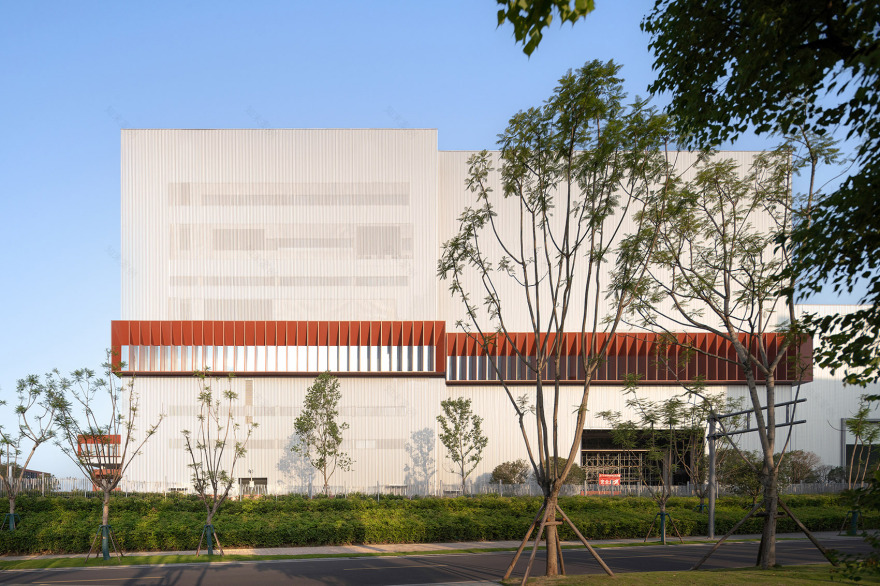
工艺决定主车间为单层密闭空间,其庞大体量难以通过单纯表皮设计实现结果的稳定感。因此以暴露的检修马道作为横向剖切元素,一方面化解了建筑巨大的体量感,另一方面也强化了人体尺度与机器尺度的对比张力。
The manufacturing process dictates that the main workshop be a single-story enclosed space. Its massive scale makes it difficult to achieve a sense of stability through mere facade design. Therefore, exposed maintenance catwalks are employed as horizontal sectioning elements. On one hand, they counteract the building’s overwhelming sense of bulk; on the other hand, they intensify the contrasting tension between human scale and machine scale.
▼建筑沿街视角,street view © 存在建筑


▼主入口,entrance © 存在建筑

转角的盒子
The Corner Box
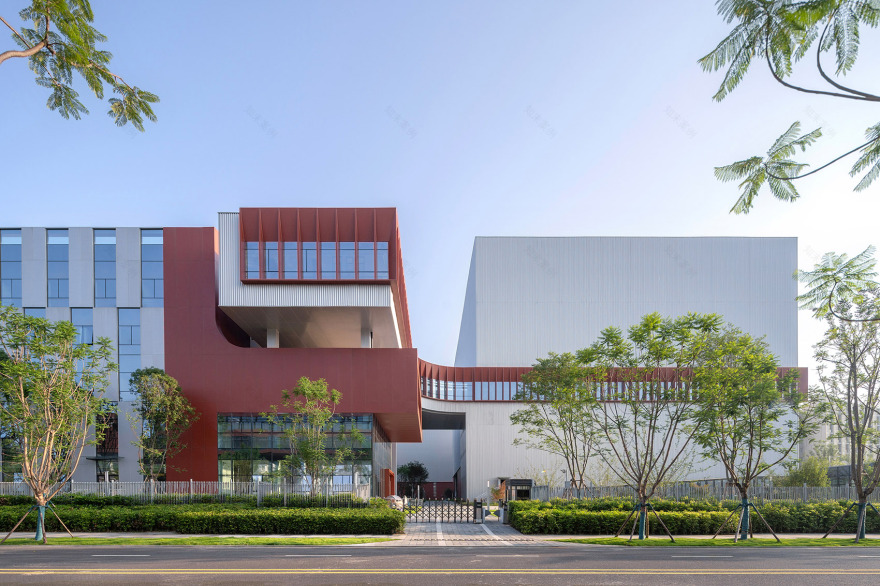
建筑东北侧的大型出入口是功能刚需,需以直接方式回应。角部挑出的同尺度盒子,巧妙中和了这种功能性表达的粗暴感;下部交错咬合的小盒子,进一步强化了体块的穿插关系与有机性。遵循这一设计逻辑,建筑其他角部也采用了相同处理手法。
The large entrance on the northeast side of the building is a functional necessity and must be addressed in a straightforward manner. A box of the same scale, cantilevered at the corner, skillfully mitigates the abruptness of this functional expression. Smaller boxes interlocking at the lower section further enhance the interplay and organic nature of the building’s masses. Following this design logic, the same treatment is applied to the other corners of the building.
▼入口处体块的穿插关系,the interplay of volumes at the entrance © 存在建筑

▼挑出的度盒子,A box cantilevered at the corner © 存在建筑

北侧的通风口 The Ventilation Openings on the North Facade
北立面四层因工艺需求,需设置若干位置固定、开口面积不小于规定值的不规则通风口。设计以 “最控制窄长比例” 为基础,寻求最优洞口尺寸;二三层则通过随机布置同规格玻璃窗形成视觉平衡,再融入竖向短线条元素,进一步消解了工艺条件带来的被动感,将功能限制转化为主动的设计表达。
The fourth floor of the north elevation requires several irregular ventilation openings with fixed positions and an opening area not less than the specified value, due to process requirements. The design is based on achieving the “optimal narrow aspect ratio” to determine the best opening dimensions. On the second and third floors, windows of the same specification are randomly arranged to create visual balance. Additionally, the incorporation of short vertical line elements further dissipates the passive response to technical constraints, transforming functional limitations into a proactive design expression.
▼融入竖向短线条元素的立面,the incorporation of short vertical line elements © 存在建筑

▼立面细节,facade details © 存在建筑


西侧的吊装口 The Hoisting Opening on the West Facade
工艺要求西侧厂房五层设置吊装口,且顶层层高需加高。为化解这一需求带来的形式违和感,设计采用错位窗手法,将功能限制转化为形式的有机组成部分。同时,通过调整各窗洞口局部的材料纹理方向,进一步强化了错位构图的设计逻辑。
The process requirements dictate the inclusion of a hoisting opening on the fifth floor of the west factory building, along with an increased floor-to-ceiling height for the top level. To resolve the formal disharmony introduced by these requirements, the design employs a staggered window arrangement, transforming functional constraints into an organic component of the form. Simultaneously, by adjusting the direction of the material texture around each window opening, the design logic of the staggered composition is further emphasized.
▼西侧立面,west elevation view © 存在建筑

▼立面错位窗,facade employs a staggered window arrangement © 存在建筑

外挂的楼梯间
The External Stairwell
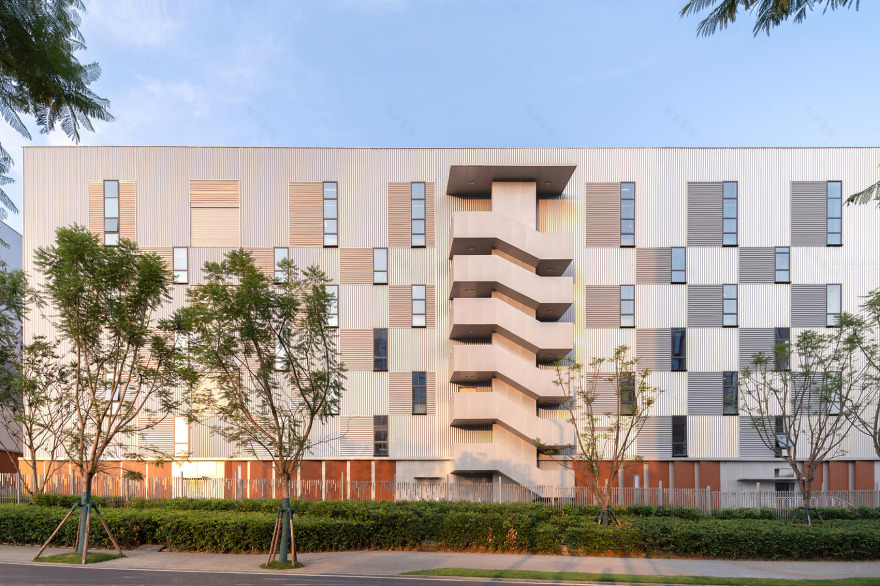
设计将楼梯间拖出建筑轮廓并外挂于立面,一方面确保内部空间不受干扰、保持完整,另一方面让楼梯间成为塑造立面形态的关键元素。
The External Stairwell
The design pulls the stairwell outside the building’s volume and attaches it to the facade. On one hand, this ensures the internal space remains uninterrupted and intact; on the other hand, it allows the stairwell to become a key element in shaping the form of the elevation.
▼楼梯间成为塑造立面形态的关键元素,the stairwell to become a key element in shaping the form of the elevation © 存在建筑
尺度的衔接
Scale Integration
厂区常见问题为办公楼因尺度差异,易与整体环境形成明显割裂。设计通过放大办公楼西侧山墙尺度,以顶层墙面与厂房衔接,再结合下部突出的体块,构建出整体感;同时将前文提及的检修马道延伸至办公楼南侧,成为园区核心亮点。南侧主要办公室采用错位开窗设计,让整个建筑群呈现出统一协调的视觉表情。
A common issue in industrial plants is that office buildings, due to differences in scale, often appear starkly disconnected from the overall environment. To address this, the design scales up the west gable of the office building, allowing the top-floor wall to seamlessly connect with the plant structure. Combined with the protruding volumes below, this creates a cohesive overall form. Additionally, the maintenance catwalks mentioned earlier are extended to the south side of the office building, forming a central highlight of the campus. On the south facade, the main office spaces feature staggered window arrangements, lending a unified and harmonious visual expression to the entire architectural complex.
▼立面的整体感,a cohesive overall form © 存在建筑

▼室外空间,landscape © 存在建筑

▼夜览,nightview © 存在建筑

项目名称:天府兴隆湖实验室二期
项目类型:工业建筑
设计方:方案设计:江苏中锐华东建筑设计研究院有限公司-荣朝晖工作室/杭州心象建筑设计公司
项目设计:2022
完成年份:2023
设计团队:荣朝晖 宋鹏 张帅
施工图设计:中国电子工程设计院股份有限公司
项目地址:四川成都
建筑面积:37907.87㎡
摄影版权:存在建筑
施工单位:中国建筑第五工程局有限公司
客户:成都天府新区投资集团有限公司
材料:波纹板:四川合兴铝业,铝板:雅丽泰 ,铝合金:成都阳光铝业,玻璃:中国南玻集团
南京喵熊网络科技有限公司 苏ICP备18050492号-4知末 © 2018—2020 . All photos and trademark graphics are copyrighted by their owners.增值电信业务经营许可证(ICP)苏B2-20201444 苏公网安备 32011302321234号
苏公网安备 32011302321234号客服
消息
收藏
下载
最近