

创作上传
VIP
收藏下载
登录 | 注册有礼
查看完整案例

收藏

下载

分享
Appreciation towardsStudio MORfor providing the following description:
项目的业主,虽然生活在一个镇子上,但是和其他人生活还是非常不同。他经营着一家工厂,从产品到展览室,其实都有室内设计师、平面设计师的参与。所以这也不是他第一次雇设计师,和设计师接触久了,他对现代主义是很钟爱的,对表现出来的简洁和明快是觉得亲切的。业主喜欢发烧碟,他的朋友们都有自己的影音室来听碟,我们一方面惊讶于在这个小地方还有一个这样小众的圈子,另一方面也惊讶于他们愿意花几年时间,去不停打磨,去打造一个自己的空间。
The client, though living in the same town, led a distinctly different lifestyle. He operated a factory where everything from product development to showroom presentation involved collaboration with interior and graphic designers. This was not his first experience working with design professionals. Through prolonged exposure, he had developed a genuine appreciation for modernism, finding its clarity and vibrancy particularly resonant. As an audiophile, he introduced us to his circle of friends, each possessing a dedicated home theater. We were struck not only by the existence of such a niche community in this small town but also by their dedication to spending years refining their personal spaces.
▼项目鸟瞰,Aerialview of the project © 单行线建筑空间
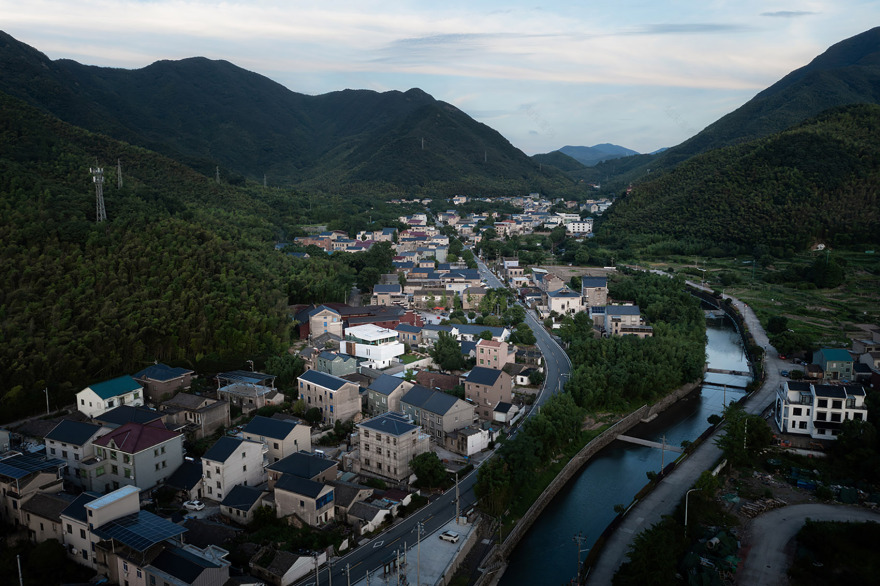

▼建筑与邻里关系,Building and neighborhood © 单行线建筑空间

▼建筑立面,Building exterior © 单行线建筑空间


夏叶村在我们镇子的上游,就在山脚下,和镇中心不一样,这边更有安静的氛围,气候也更加的舒服。村里的最出名的就是夏叶庙,庙不大,但逢到节日镇上人都会过来。场地就在庙的侧后方,大约为30米见方的正方形,有三栋房子,包括了一大家子的住宅和一个家庭工厂的作坊棚子。原来房子和邻里的关系很拥挤,但根据指标重建后,房子会小不少,院子会大很多,会变得比较空旷和舒适。
▼总平面图,Site plan
© STUDIO MAR

Xiaye Village, where the site is located, lies upstream from our town. Unlike the bustling town center, this area offers a quieter atmosphere, nestled at the foot of the mountains with a more pleasant microclimate. The village’s most notable landmark is Xiaye Temple. Though modest in size, it fronts a spacious square that attracts townspeople during festivals. The plot is situated beside and behind the temple—a roughly 30 - meter square that originally contained three houses for an extended family, plus a small workshop. The original structures stood in cramped conditions against neighboring buildings. Following redevelopment guidelines, the new structure was designed with a smaller footprint, creating a more generous courtyard that transforms the site into an open, comfortable space.
▼西立面,West elevation © 单行线建筑空间

▼建筑立面细节,Facade details © 单行线建筑空间

▼弧形楼板,Curved slab © 单行线建筑空间

由于庭院很大,处理它变成了我们的首要任务。传统的院子往往被围墙围起来,有很强的安全感,可以晒太阳乘阴凉,是居民最重要的生活场所。同时院子又提供了很舒服的开放性,坐在院内,观的景其实是墙外的村落、山林和天空。所以我们按照村里常见的院落的大小,将整个庭院一分为四,提出了“四季之庭”的概念,用花园、草坪、田地、枯山水四种不同的庭院来表达四季。同时四个不同的院子都与房子相接,玄关接入口的花园,客厅接休息的草坪,后勤空间接种地的田园,餐厅接观景的枯山水,让人能从不同的生活片段里步出到不同的自然中。同时我们也将墙外的景观切成了四段,分别和四个院子搭配,花园望出去的夏叶庙,草坪望出去的邻里,田园望出去的竹林,枯山水望出去的山林,使得原本杂乱的周遭得到有效的控制,并容纳进来。
▼轴测图,Exploded axonometric
© STUDIO MAR

With its expansive courtyard, the landscape became our primary design focus. Traditional walled courtyards provide a strong sense of security—serving as essential living spaces for basking in sunlight or resting in shade. Simultaneously, they offer a comfortable openness: sitting within, one enjoys framed views of the village, mountains, and sky beyond the walls. Drawing from typical village courtyard dimensions, we divided the garden into four sections, proposing the “Four Seasons Courtyards” concept. Each section takes a distinct form—a flower garden, lawn, vegetable patch, and kare-sansui (dry landscape)—to evoke the essence of the seasons. These four gardens are directly connected to different parts of the house: the entrance garden at the genkan, the lawn extending from the living room, the vegetable patch adjacent to service areas, and the contemplative dry landscape viewed from the dining room. This allows inhabitants to step from various daily activities into distinct natural settings. We also framed the external landscape into four composed views, each paired with a courtyard: Xiaye Temple from the flower garden, the neighborhood from the lawn, bamboo groves from the vegetable patch, and mountain forests from the dry landscape. This approach organizes the untamed surroundings while seamlessly incorporating them into the home’s experience.
▼从庭院看建筑,View of the building from the courtyard © 单行线建筑空间

▼春之庭院,Spring courtyard © 单行线建筑空间

▼夏之庭院,Summer courtyard © 单行线建筑空间

▼冬之庭院,Winter courtyard © 单行线建筑空间

▼冬之庭院,Winter courtyard © 单行线建筑空间
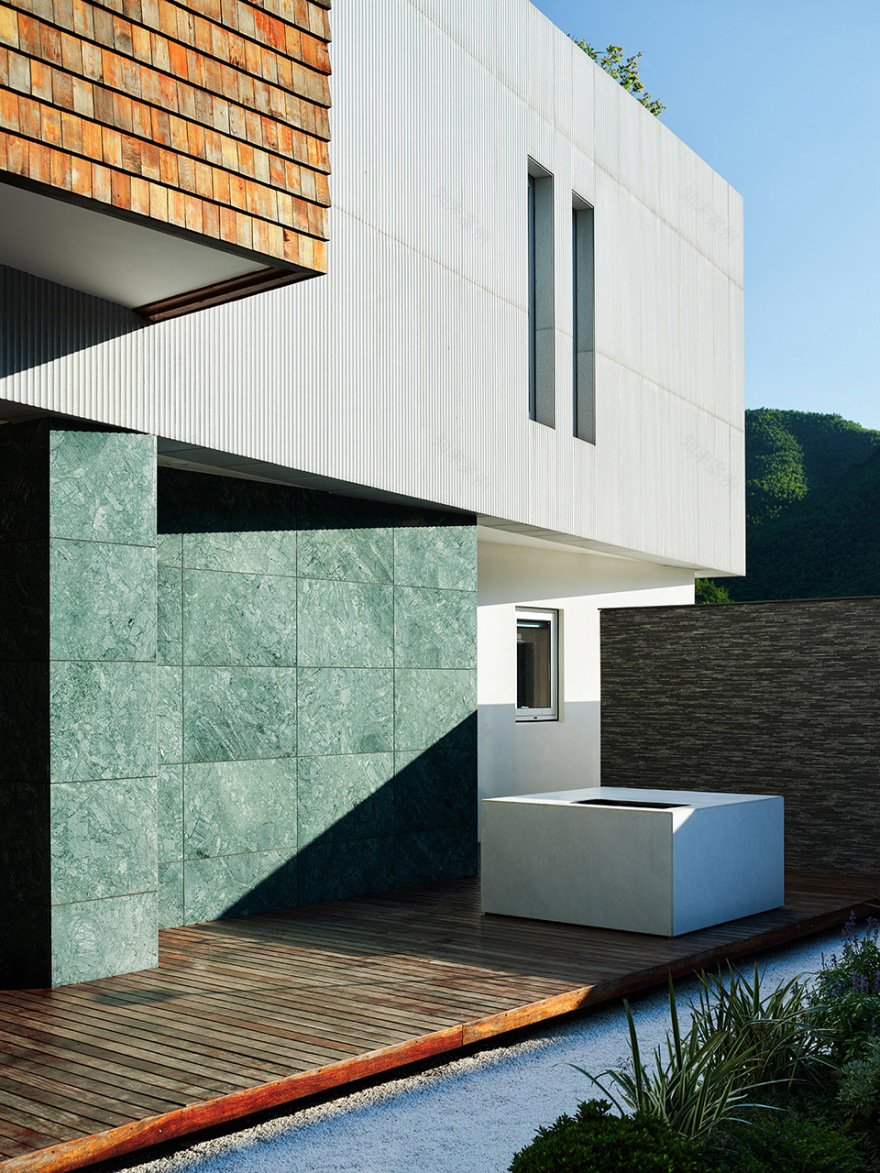
由于一层的院墙已有很多横向展开的墙体,为了将主体建筑和整个场地仍保持融合,我们将二三层也横向切开,让整体的尺度保持相近。二楼的立面有四道封闭墙体构成,由于平面上都不处于正交体系内,我们将其变成高度上也是变化的斜墙,从村中走过,房子会处在一种不停变化的动态之中。
The ground floor’s perimeter was defined by extensively spanning horizontal walls. To maintain cohesion between the main building and the site, we extended this horizontal articulation to the second and third floors, ensuring the massing remained harmoniously scaled.
▼客厅,Living area © 单行线建筑空间
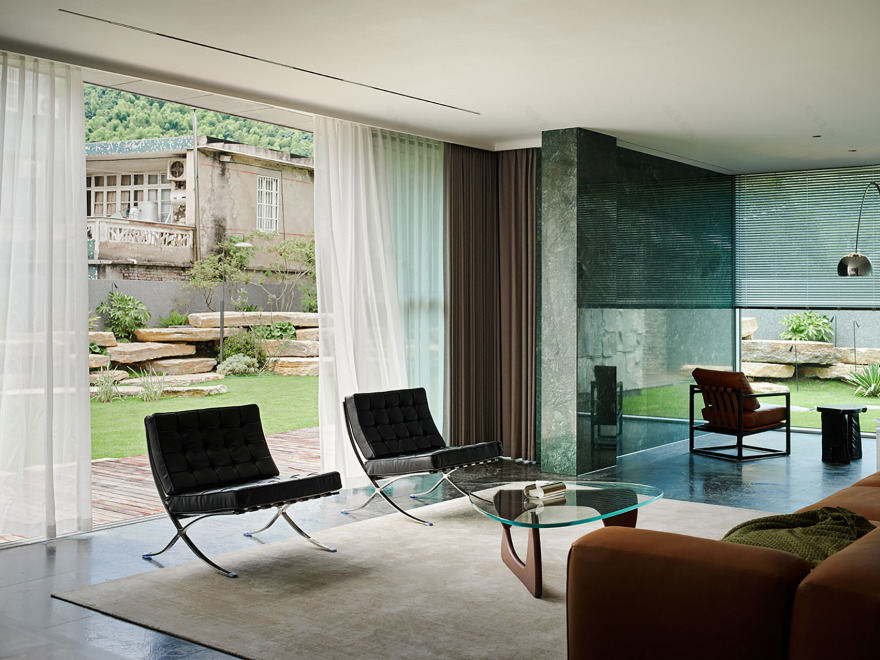

▼客厅看庭院,Living area view to courtyard © 单行线建筑空间

▼客厅看玄关,Living area view toward entrance © 单行线建筑空间
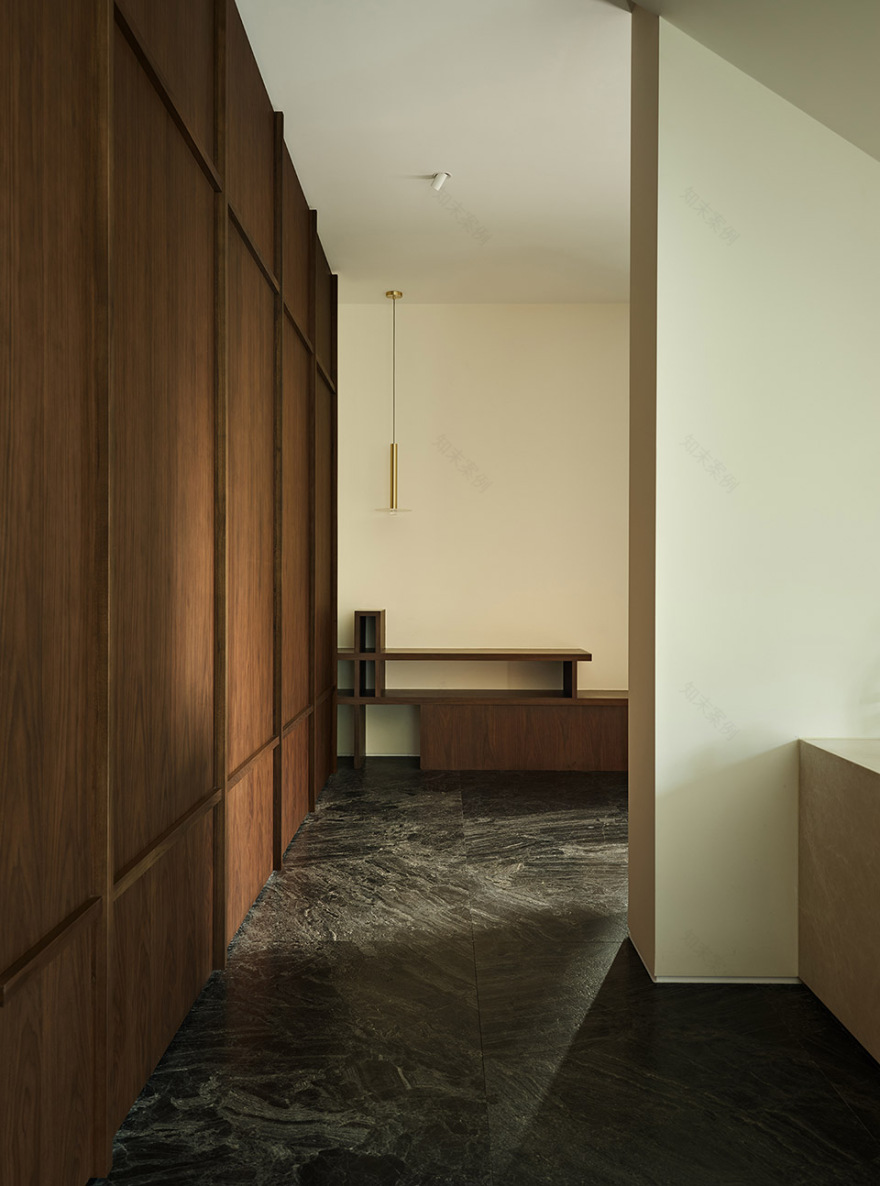
▼客厅看餐厅厨房,Living area view toward dining & kitchen © 单行线建筑空间

二楼斜墙较矮的那一角,三楼的楼板正好露出来,我们将楼板做了一个曲线的形状,让其和二楼完全脱开,有种漂浮感。而较高的那一角,变成了三层露台的栏杆。整个三楼加上了比较缓的单坡屋顶,呼应立面上的斜墙元素。特别在北立面上保持横向的完整性,而在南立面则断成两个小房子,尺度缩小,更有一种“家”的原型感。西侧做了一个很深的挑檐,一方面应对西晒,另一方面提供了舒适的檐下空间,在大露台上可以眺望远山。
The second-floor facade consists of four solid walls. Since none align with an orthogonal grid in plan, we transformed them into sloping walls of varying heights. This creates a dynamic, ever-changing appearance when viewed from village paths. At the lower corner of the sloped walls, the third-floor slab is intentionally exposed. We shaped this slab with a subtle curve, completely detaching it from the second floor to evoke a sense of floating. The higher corner transitions into the third-floor terrace railing. The entire third floor is capped with a gently sloping mono-pitched roof, echoing the sloped wall elements. The north elevation maintains strong horizontal continuity, while the south elevation breaks into two smaller volumes, reducing the scale to evoke an archetypal sense of “home.” A deep overhang on the west mitigates afternoon sun while providing a sheltered eaves space. From the spacious terrace, one enjoys distant mountain views.
▼餐厅,Dining area © 单行线建筑空间

▼厨房,Kitchen © 单行线建筑空间

一层的室内,为了和庭院结合,四道分割院落的墙体会延伸进室内。我们将其摆成风车型让其互相错动,使得室内的空间在分割的基础上也有适当的联通和互望,甚至一直了联通进庭院,让整个的一层空间处在一种可以漫步的状态。从餐厅走到客厅,还是从客厅推开门进入庭院,接着绕着院墙,穿过几个庭院,再回到室内,都不会有特别的分界感。我们希望均匀的把生活感铺满了整个场地。
On the ground floor interior, to maintain continuity with the courtyards, the four walls dividing the outdoor spaces extend inward. We arranged them in a pinwheel configuration, allowing them to shift and overlap—creating divisions while preserving visual connections and discovery. This interplay extends into the courtyards, making the entire ground floor a space for wandering. Whether moving from dining room to living room, stepping into a courtyard, strolling along garden walls, passing through multiple outdoor spaces, or returning inside, there is no strong sense of boundary. We aimed to distribute a sense of lived experience evenly throughout the site.
▼二楼小客厅,Second floor sitting area © 单行线建筑空间

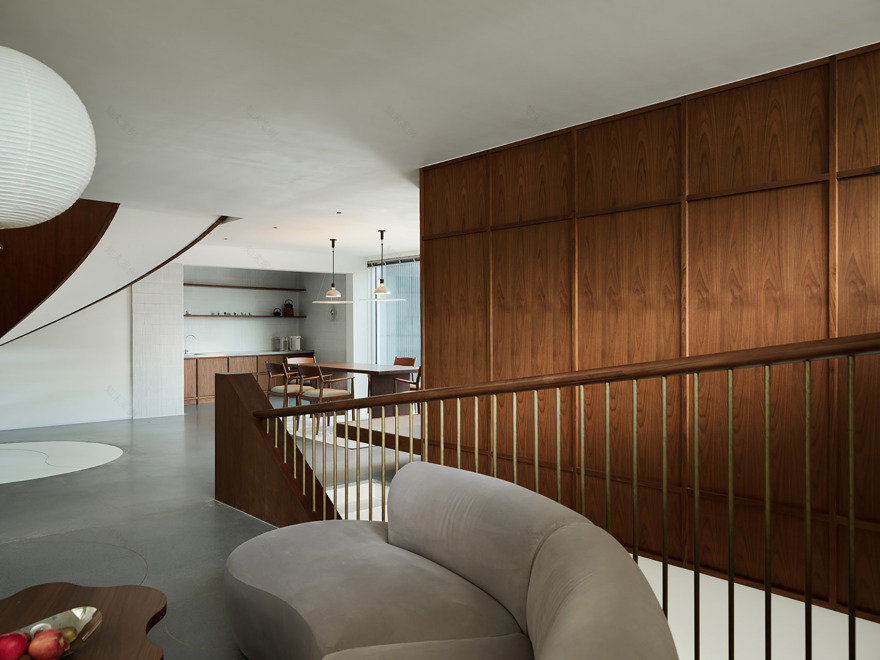
▼二楼午睡室看茶室,Nap room view to tea room © 单行线建筑空间

▼二楼卫生间,Restroom © 单行线建筑空间

业主心心念念的影音室就放在二楼。不正交的墙体、封闭的氛围、褶皱的界面,是影音室的特点。我们将其放大,推广到了整个二层,用一圈封闭的墙体将其包围,几乎没有窗户。不论内部还是外部的墙体都无视了柱网的正交体系,几乎没有两道墙是平行的。这造就了二层自由的布局,同样的,在功能上,除了影音室,我们的功能也是相对松散的,有喝茶的地方、午睡的地方、看电视的地方、烤火的地方、唱歌的地方、休息的地方,有所定义但又比较模糊。二层就像是是“第五个庭院”,虽然在室内,但整个空间是联通而连续的。一个人的时候,可以到处漫步,坐在这里坐在那里。几个人的时候有些这边在喝茶聊天,有些那边在热闹玩桌游,空间随着人而改变。
The client’s cherished home theater was placed on the second floor. We expanded its essential qualities—non-orthogonal walls, an enveloping atmosphere, and folded planes—to define the entire level. A continuous perimeter of solid walls encloses the floor with almost no conventional windows. Liberated from the orthogonal column grid, these walls rarely run parallel, fostering dynamic freedom. This approach enables a fluid, open layout. Beyond the dedicated theater, the floor accommodates loosely defined zones for tea drinking, napping, television viewing, gathering around the fireplace, karaoke, and quiet repose—each suggested yet intentionally ambiguous. The second floor becomes the “fifth courtyard.” Though entirely internal, the space feels connected and continuous. Alone, one may wander freely; with company, the space accommodates diverse activities—quiet tea conversations here, lively board games there—its character transforming with its occupants.
▼二楼楼梯空间,Staircase overlooking © 单行线建筑空间


▼二楼茶室,Tea room © 单行线建筑空间

▼二楼茶室景色,Tea room view © 单行线建筑空间

为了实现这个效果,我们将这些空间进行变形去模拟一种“庭院”的氛围,就像Paul Klee的画,通过秩序的几何拼贴,去表现一种有机和动态的感受。中心水磨石的地面就像是水池,我们用圆弧和直线的铜条,模拟水纹。其他空间,放置在这水池的周围,像亭台楼阁:午睡室有着平台和障子门,像临水的轩;卫生间单独抬高,需要踩着错落的石阶隐秘进入;上三楼的旋转楼梯,像半座石拱桥,配合圆形的镜面和吊灯组,有片段化的倒映;地毯上的茶室反而像一艘画舫,向外望出去有一层窗和一层墙,我们特意做了距离的变化,可以看到窗洞里的不变的屋檐画面和墙面上变化的光影;榻榻米区域,我们做了一个不规则的形状,像驳岸一样把水池的形状框定出来,踏着玻璃踏步上去,在火炉旁坐定,这个榻榻米又像在石林上的亭子,左侧是模拟的园林,右侧推开玻璃门,又是真实的植物景观,有风吹进来。我们又做了一个玻璃天井,一直从屋顶贯通而下,晴天有阳光落进来,雨天有雨水下进来,落在植物上,最自然的反而变成了一种最人工的精致景观。
▼Rocks cold-warm 1929
© Paul Klee

To realize this, we reshaped these areas to evoke a courtyard ambiance. Inspired by Paul Klee’s paintings, where geometric collages express organic dynamism, we adopted a similar approach. The central terrazzo floor serves as a water pond, with inlaid brass strips—curved and straight—mimicking ripples. Other areas are arranged around this “pond” like garden pavilions: the nap room with its platform and shōji screens resembles a waterside studio; the raised restroom is discreetly accessed via staggered stepping-stone-like stairs; the spiral staircase to the third floor suggests a half-arched stone bridge, complemented by a circular mirror and clustered pendant lights creating fragmented reflections; the carpeted tea area evokes a painted pleasure boat, with layered windows and walls at varying distances framing constant eave views through openings while capturing changing light patterns; the irregularly shaped tatami area defines the “pond’s” edge like a stone embankment. Reached via glass treads and settled beside the fireplace, it suggests a pavilion perched atop a stone forest—with an abstract garden to the left and real plantings to the right through sliding glass doors, allowing breezes to enter. A glass skylight well extends from the roof downward. Sunlight filters through on clear days; rain falls onto plants below on rainy days—transforming natural phenomena into a meticulously crafted landscape.
▼二楼条窗及天井,Strip window and skylight © 单行线建筑空间

▼二楼走廊,Corridor © 单行线建筑空间

▼二楼玻璃天井,Glass skylight © 单行线建筑空间

这时,围绕二楼的这组墙,变成了“庭院”的围墙,为了配合移步换景,我们将其变成了高低不齐的斜墙。斜度和楼板之间有个不均匀的渐变的狭缝,可以透进不同的光照。同时从这个长条的窗带望出去,框定的正好是周围的屋顶和远山的线条。
Here, the walls encircling the second floor become “courtyard” boundaries. To achieve “scenery changing with every step,” we designed them as slanted walls of varying heights. An uneven, gradually changing gap between the sloping walls and floor slab admits shifting light qualities. The elongated window strip frames precise compositions of surrounding rooftops and distant mountain contours.
▼二楼榻榻米,Tatami area © 单行线建筑空间

▼二层楼梯转角,Staircase landing © 单行线建筑空间

由于功能上楼层越往上,越偏向居住,所以对于室内的材料,越往上木饰面越多,石材越少,色调也是越往上越浅,到了三楼,基本是原木色的居家感。卧室并不大,更加凸显温馨的氛围,同时也想让人更加关注窗外。因为到了三层,已经越过了邻居的屋顶,不论是透过窗户还是步出到阳台,都能看到优美的风景。
As the building ascends, each floor becomes more residential in character. This progression is reflected in the material palette: wood cladding increases while stone recedes, and the color scheme lightens. By the third floor, natural wood tones establish a distinctly domestic atmosphere. The bedrooms are intentionally modest in scale, enhancing warmth and intimacy while directing attention outward. From this height, views clear neighboring rooftops, revealing beautiful scenery through windows or from the terrace.
▼三楼露台及景观,Third-floor terrace and view
© 单行线建筑空间

▼三楼主卧,Master bedroom © 单行线建筑空间

▼三楼楼梯间,Third-floor staircase © 单行线建筑空间
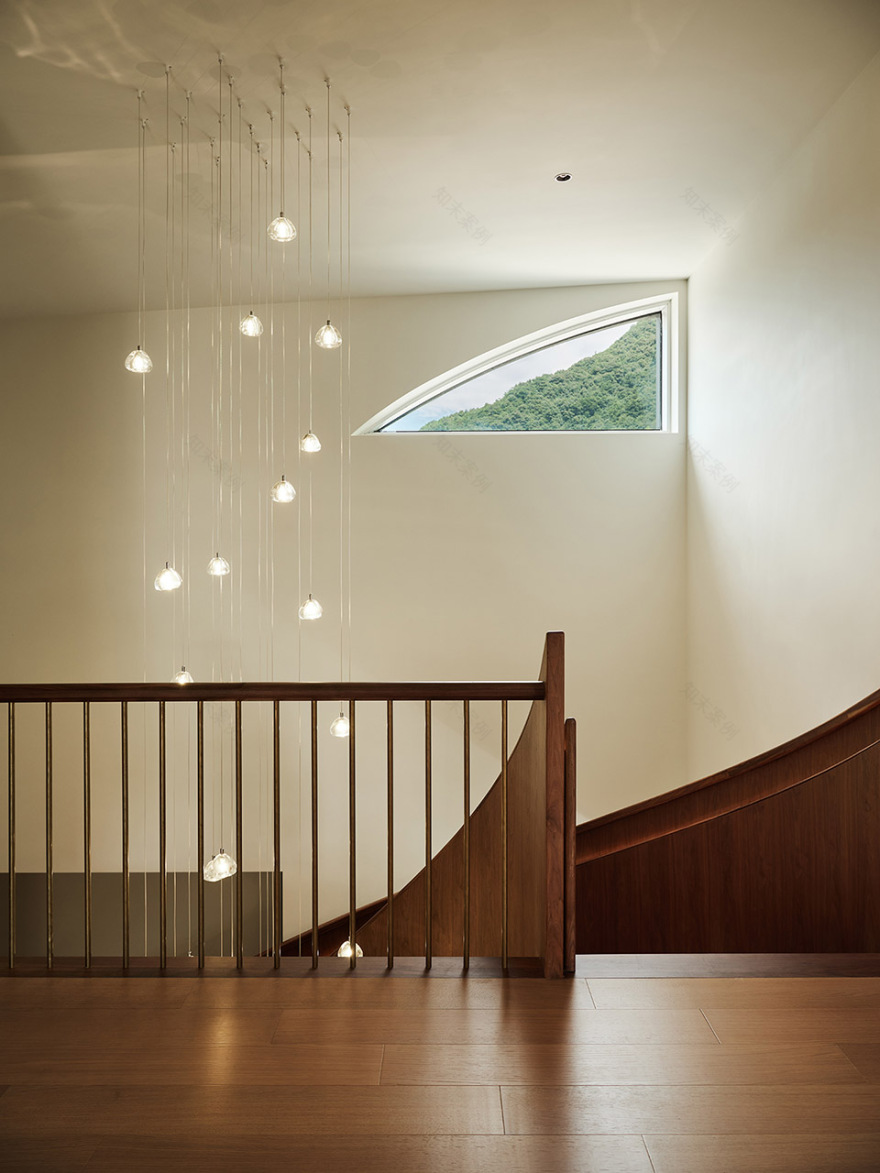
在材料的选择中为了去融入村中的氛围,我们选择了三种色调的石材,灰色、暖白色、绿色,对应的是村中常见的屋顶、土墙、植物。在处理上,主要的灰色细点麻石,我们开了波浪槽口,让它在日光中是可以变化的,暖白色的莱姆石则做了自然喷砂面,让它在晴雨中是可以变化的,绿色大理石则显得稳定做了柔光处理,显得稳定。院墙我们也采用了两种不同材料。沿路的院墙是灰色线条纤维板,稳定不会变色。而内侧的院墙则是灰色水洗石,配合着植物景观,会随着时间变斑驳。
In material selection, we sought to harmonize with the village atmosphere by choosing three stone tones: grey, warm white, and green—corresponding to local roofing tiles, earth walls, and vegetation. Each material was specially treated: the predominant grey fine-grained granite was fluted with a wave pattern, allowing it to transform under sunlight; the warm white limestone was sandblasted to shift in appearance with weather; the green marble was softly polished for stability. For courtyard walls, we used two materials: street-facing walls of grey fiber cement panels remain stable and colorfast, while interior-facing walls of grey washed pebble aggregate will develop a natural patina over time, harmonizing with the landscape.
▼三楼衣帽间,Walk-in closet © 单行线建筑空间

▼三楼主卧走廊,Master bedroom corridor © 单行线建筑空间

▼三楼卫生间,Master bathroom © 单行线建筑空间


整体来说,这个房子在乡村是个“新”建筑,但过上舒适的现代生活契合了村民们最朴素的愿望,只是村民们在建造自己的居所的时候会不自觉隅于乡村的惯性,建造出方方正正和双坡瓦顶的新农村住宅。我们的供应商和施工方都是本地人,但是在建造过程中,提供的材料和技术,却是非常专业的。例如我们在布置庭院的叠石时,从山东收了荒料,清洗运送后,使用无人机拍摄,制作出精确的三维模型,设计完毕后,在现场放线校对,最后用吊机吊装调整。一层的深灰色酸洗大理石,也是在现场进行了反复推敲和比较才敲定,让其有较明显的凹凸,但是又很温润,踩上去很舒服。
Overall, this house represents a “new” architectural approach in a rural context. While comfortable modern living aligns with villagers’ fundamental desires, they often unconsciously adhere to conventions—resulting in boxy, double-pitched tiled structures. Though our suppliers and builders were local, their materials and techniques were highly professional. For instance, when arranging courtyard rocks, we sourced rough stone from Shandong, used drone photography to create precise 3D models, designed the layout, set out lines on site, and positioned stones with a crane. Similarly, the dark grey acid-washed marble for the ground floor was finalized after repeated on-site testing—ensuring distinct texture while remaining warm and pleasant underfoot.
▼夜览,Nightview © 单行线建筑空间


正是因为有品质的保证,最终实现的效果是符合甚至超出业主的想象的。最初的目标是其在乡村的度假之地,现在他的妻女也非常喜欢,周末在这里相聚变成了固定节日,因为总能找到一个舒服的角落,安静的呆一阵。同时,他们也经常在此举行朋友的聚会和公司的团建,热闹起来的房子又能化身精致的社交场所,这些都远远超出了他们原本对家的图景。
This commitment to quality ensured the final result met and exceeded the client’s expectations. Initially conceived as a rural retreat, the house has become a beloved gathering place for his wife and daughter. Their weekend visits have turned into cherished rituals, as everyone finds comfortable corners for quiet moments. The family frequently hosts friends’ gatherings and company events here. When filled with people, the house transforms into an elegant social venue—far surpassing their original vision of home.
▼首层平面图,First floor plan © STUDIO MAR

▼二层平面图,First floor plan © STUDIO MAR

▼三层平面图,First floor plan
© STUDIO MAR

▼剖面图,section © STUDIO MAR


▼二层展开图,Second floor unfolded elevation © STUDIO MAR

项目名称:夏叶张宅
功能:住宅
地理位置:浙江省象山县夏叶村
建筑/室内/景观设计:STUDIO MOR
主持建筑师:李乐 李雪冰 倪聪儿 章晨晨
驻场建筑师:李雪冰
业主:宁波卓艺家纺有限公司
施工方: 张全
结构类型:混凝土框架结构
建筑面积:474平方米
占地面积:176平方米
设计周期:2020.12-2023.8
建设周期:2021.07-2025.01
摄影:单行线建筑空间摄影、STUDIO MOR
Project information
Project Name:Xiaye Zhang Residence
Location:Xiaye Village, Xiangshan County, Zhejiang Province, China
Function:Residential
Architecture / Interior / Landscape Design:STUDIO MOR
Architects:Li Le, Li Xuebing, Ni Conger, Zhang Chenchen
On-site Architect:Li Xuebing
Client:Ningbo Zhuoyi Home Textiles Co., Ltd.
Construction:Zhang Quan
Structure Type:Concrete Frame Structure
Building Area:474 m²
Site Area:176 m²
Design Period:Dec 2020 – Aug 2023
Construction Period:Jul 2021 – Jan 2025
Photography:ONE studio , STUDIO MOR, Zhang Yinqi


南京喵熊网络科技有限公司 苏ICP备18050492号-4知末 © 2018—2020 . All photos and trademark graphics are copyrighted by their owners.增值电信业务经营许可证(ICP)苏B2-20201444 苏公网安备 32011302321234号
苏公网安备 32011302321234号客服
消息
收藏
下载
最近