

创作上传
VIP
收藏下载
登录 | 注册有礼
查看完整案例

收藏

下载

分享
墓地形式与社会结构之间的错位
Mismatch Between Cemetery Forms and Social Structure
在谷歌地图上查看城市寺院的航空照片时,人们常常会惊讶地发现,墓地的规模远远超过寺院院落本身。不难想象,如此庞大的墓地范围会侵占寺院的领地,削弱其神圣性。进一步放大图像,可在整齐划分的墓区中看到一些空白区域——这些正是封墓的痕迹——使墓地呈现斑驳杂色的样貌。街景视图显示,由地方法规形成的长而厚重的围墙,对街道界面造成了显著的压迫感。
When viewing temples in urban areas on Google Maps’ aerial photographs, one is often surprised by how the size of the cemetery far exceeds that of the temple precinct itself. It is not difficult to imagine that these vast cemeteries encroach upon the precinct and affect its sacredness. Zooming in reveals blank patches within the neatly ordered plots—evidence of grave closures—giving the cemetery a mottled appearance. Street View shows long, imposing walls shaped by local regulations, exerting significant pressure on the streetscape.
▼项目概览,Overall view © Masao Nishikawa

▼顶视图,top view © Masao Nishikawa
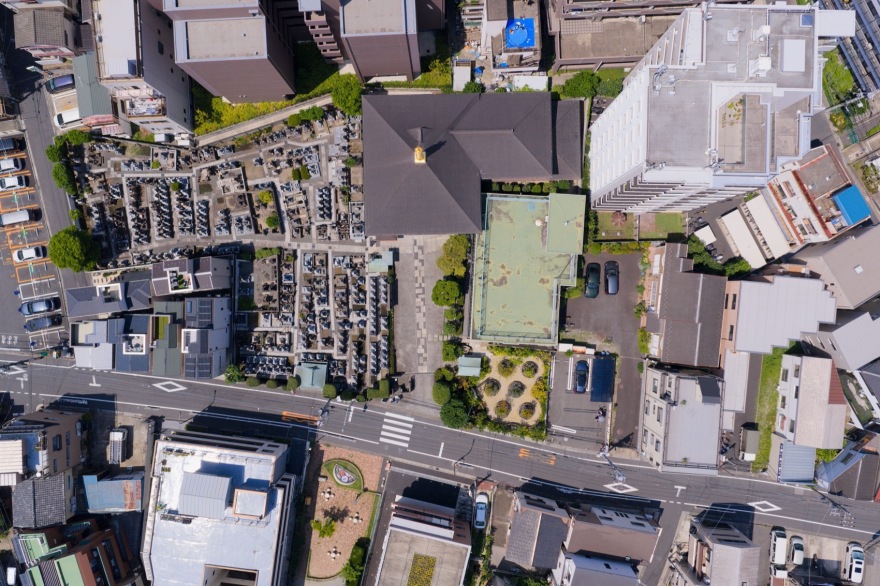
▼场地鸟瞰,aerial view of the site © Masao Nishikawa


近年来,日本的年度死亡人数持续增长,预计到 2040 年将达到 160 万。尽管殡葬设施的需求不断上升,但从江户时代延续而来的传统寺院—檀家制度与现代社会现实——家庭规模缩小、祖先崇拜式微、人口结构变化——之间的错位,导致了如今的景观与制度功能的瓦解。对此,本项目旨在建立一种适应当代社会与家庭状况的殡葬设施,同时恢复寺院院落的神圣性,并为周边街景带来积极贡献。
In recent years, Japan’s annual number of deaths has continued to rise and is expected to reach 1.6 million by 2040. Despite the increasing demand for burial facilities, mismatches between the traditional temple–parishioner system inherited from the Edo period and the realities of modern society—shrinking household sizes, declining ancestral worship, and demographic shifts—have resulted in these landscapes and a breakdown in the system’s functionality. In response, the project seeks to establish a burial facility suited to contemporary social and familial conditions, while restoring the sacred nature of temple precincts and contributing positively to the surrounding streetscape.
▼周边街景,surrounding streetscape © Masao Nishikawa

▼立面,facade © Masao Nishikawa

▼远景,Viewed from a distance © Masao Nishikawa

利用多边形镶嵌进行布局规划
Layout Planning Using Polygonal tessellation
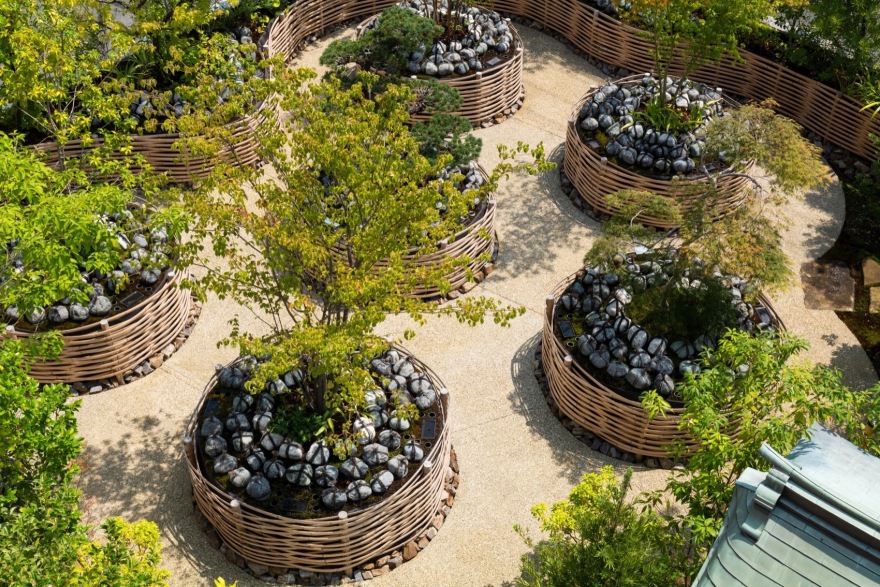
城市寺院可利用的土地极其有限。本项目所在的墨田区正福寺,需要在停车场内约 100 平方米的场地上布置 461 个树葬墓位。树葬的基本形式是前方设置墓碑、后方栽植纪念树。当这一单元组合扩展时,最合理的形态便成为以纪念树为中心的圆形。圆的直径设定为 800 毫米,用以容纳一棵 2 米高树木的根球。其周围以天然石材制成、约 200 毫米大小的墓碑分三圈排列——三圈是保证碑文仍清晰可辨的上限——最终形成包含围栏在内、直径 2300 毫米的“岛屿”。这些“岛屿”必须在 100 平方米的用地内尽可能密集地安置,同时满足法规所要求的 1 米宽通道。数学证明,当平面铺砌时,外周长最小的多边形是正六边形。通过将这些葬礼岛屿按六边形网格进行排列,我们最大化了墓位数量,同时最小化了通道长度。甚至连外缘如披风状的凸出部分也被利用作为额外墓位。设置在各岛屿或凸出部位的供花、供香台呈错落布局,以避免访客彼此背对背。
Available land at urban temples is extremely limited. At Shōfuku-ji in Sumida Ward—the site of this project—an area of about 100 m² within a parking lot needed to arrange 461 plots for a tree-burial cemetery. A basic tree-burial arrangement consists of a grave marker in front and a commemorative tree behind. When aggregated, the most rational form becomes a circle centered on the tree. The diameter of the circle was set at 800 mm to house the rootball of a 2-meter tree. Around it, gravestones made from roughly 200 mm natural stones were placed in three rows—the limit for maintaining visual readability of inscriptions—resulting in a 2300 mm–diameter “island,” including the surrounding fence. These islands needed to be packed as densely as possible into the 100 m² site while ensuring 1-meter-wide pathways mandated by regulation. Mathematics proves that the polygon that minimizes outer perimeter when tiling a plane is the regular hexagon. By arranging the burial islands on a hexagonal grid, we maximized the number of plots while minimizing pathway length. Even the cape-like protrusions along the periphery were used as additional plots. The flower and incense stands placed at each island or protrusion are staggered so that visitors do not face one another back-to-back.
▼供花与供香设施,Offering Stand © Masao Nishikawa

▼平面铺砌,Paving © Masao Nishikawa

作为寺院关键要素的游园空间
A Stroll Garden as a Key Element of Temples
传统寺院历来通过寺院建筑群、庭园、参道,以及绿地、台地、门扉、围栏、灯笼、水钵等附属要素的层层叠加来营造空间深度并维持神圣性,这些元素共同暗示着一条通往圣域的边界。而在城市寺院中,院域不断缩减、墓地不断扩张,使得维持这种神圣的深度愈发困难。因此,尽管“墓园『Sōbon』”本质上是墓地,它仍被规划为附属于寺院院落的游园空间。
Traditional temples have historically created depth and maintained spatial sanctity by layering their temple complex layout with accompanying gardens, approach paths, and supplementary features such as green spaces, terraced slopes, gates, doors, fences, lanterns, and water basins—all suggesting a sacred boundary. In urban temples, however, shrinking grounds and expanding cemeteries have made it increasingly difficult to maintain this sacred depth. Therefore, although Graveyard『Sōbon』is a cemetery, it was planned as a stroll garden attached to the temple precinct.
▼墓园,stroll garden © Masao Nishikawa


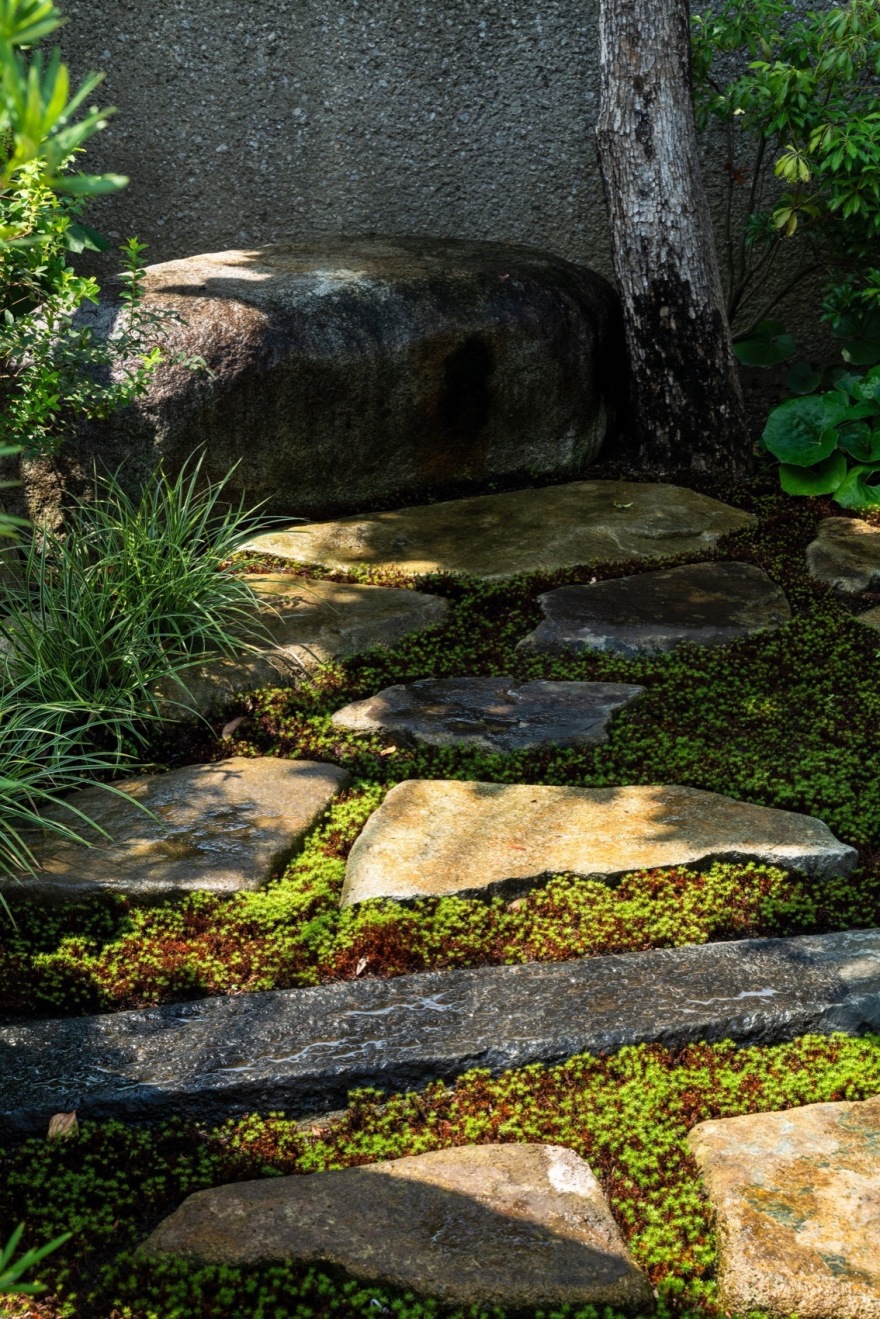
覆着苔藓的踏脚石与一对以绳缠绕的石柱构成了寺院院落与墓区之间的界线。另一块以棕榈绳十字绑扎的“关守石”(sekimori-ishi)进一步划定边界:其上方是由植物覆盖的生者世界,以下则是以墓室呈现的死者领域。多重叠合的界线有助于维持神圣感。每个葬礼岛屿周围的围栏采用“茂垣竹”(shigaramitake)建造,利用了竹材柔韧而坚韧的结构特性。由于破损的竹片需要频繁更换,新鲜的青竹会不时出现,使“墓园『Sōbon』”在任何时刻都呈现不断变化的状态。
Moss-covered stepping stones and a pair of stone pillars bound with rope form a boundary between the precinct and the burial area. A sekimori-ishi stone—tied crosswise with palm rope—creates another boundary: above it lies the living world covered with plants, and below it the realm of death represented by the burial chamber. These layered boundaries help preserve the sense of sacredness. The fences around each burial island are made of shigaramitake, utilizing the flexible and resilient structural properties of bamboo. Damaged slats must be replaced frequently, so newly green bamboo appears intermittently, ensuring Graveyard『Sōbon』is never the same at any moment.
▼石柱,stone pillars © Masao Nishikawa


▼围栏,fences © Masao Nishikawa


▼关守石,sekimori-ishi stone © Masao Nishikawa

▼棕榈绳十字绑扎的“关守石”,sekimori-ishi stone tied crosswise with palm rope © Masao Nishikawa

在城市街景中唤起江户时代的氛围
Evoking the Atmosphere of Edo in the Urban Streetscape
正福寺所在区域曾被称为“江户前(Edomae)”,至今仍保留着少量历史风貌,例如传统餐馆等。据说过去街景中散布着带有轩阵寺式(Kenjinji-style)围栏与关守石的茶屋。通过以这些江户文化的碎片构成树葬景观,本项目并不试图以回避城市的单调围墙将墓地封闭起来,而是希望让其以侘寂(wabi-sabi)与江户美学的精致感参与城市街景。路人看到从轩阵寺式围栏上方伸出的树木时,绝不会想到那里竟是一座墓地。
Shōfuku-ji is located in an area once known as Edomae, where a few remnants of its historical character—such as traditional restaurants—still survive. It is believed that tea gardens with Kenjinji-style fences and sekimori-ishi once dotted the townscape. By composing the tree-burial landscape from such fragments of Edo culture, the project seeks not to enclose the cemetery within plain walls that turn away from the city, but instead to allow it to participate in the streetscape as an expression of wabi-sabi and the refined sensibility of Edo aesthetics. Passersby seeing trees extending above a Kenjinji-style fence would never imagine it to be a cemetery.
▼场地平面,site plan © Love Architecture
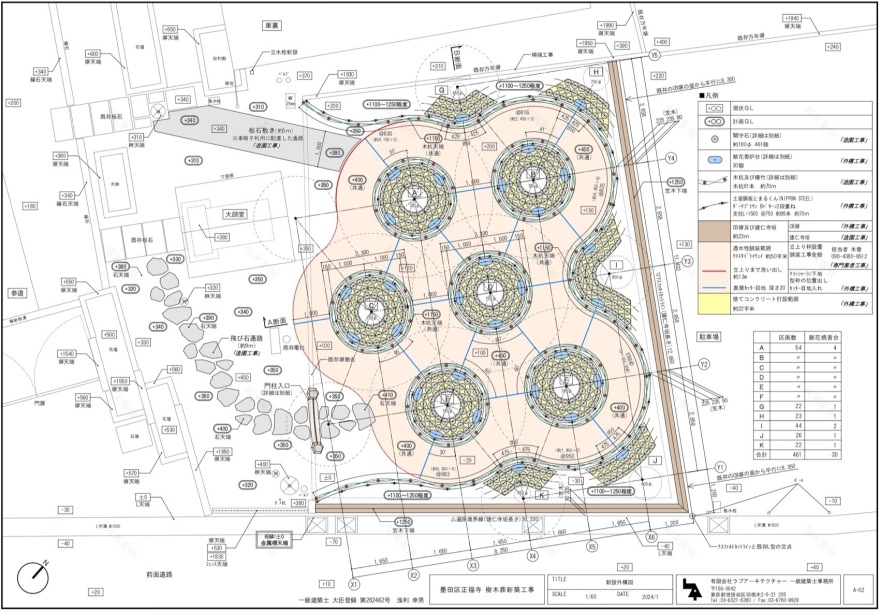
▼总平面和轴测图,master plan and axonometric drawing © Love Architecture

▼立面,facade © Love Architecture

▼剖面,section © Love Architecture

▼剖面细节,section details © Love Architecture

Location: Sumida-ku, Tokyo
Building Use: Cemetery Site Area: 149.27㎡
Completion: November 2024

南京喵熊网络科技有限公司 苏ICP备18050492号-4知末 © 2018—2020 . All photos and trademark graphics are copyrighted by their owners.增值电信业务经营许可证(ICP)苏B2-20201444 苏公网安备 32011302321234号
苏公网安备 32011302321234号客服
消息
收藏
下载
最近