

创作上传
VIP
收藏下载
登录 | 注册有礼
查看完整案例

收藏

下载

分享
鹿特丹市政府已批准 Schieblocks 项目的建设许可。该项目建筑面积达 47,000 平方米,是目前荷兰正在建设的最大私人新建办公楼之一——其首层将容纳多种商业功能,而顶部楼层设置了餐厅与活动空间。该项目由 MVRDV 为开发商 LSI(其将该楼命名为 “The Bluezone Offices”)设计,在铁路旁的一条狭长地带上打造一座高达 61 米、长近 150 米的三维办公“街区”。为使这座体量可观的建筑具有人性尺度感,设计将其分解为一系列色彩丰富的体块,内部充满了微妙(以及一些不那么微妙)的鹿特丹城市意象,使这座新建筑真正体现鹿特丹的城市精神。
▼变化图,change diagram © MVRDV Winy Maas, Jacob van Rijs, Nathalie de Vries
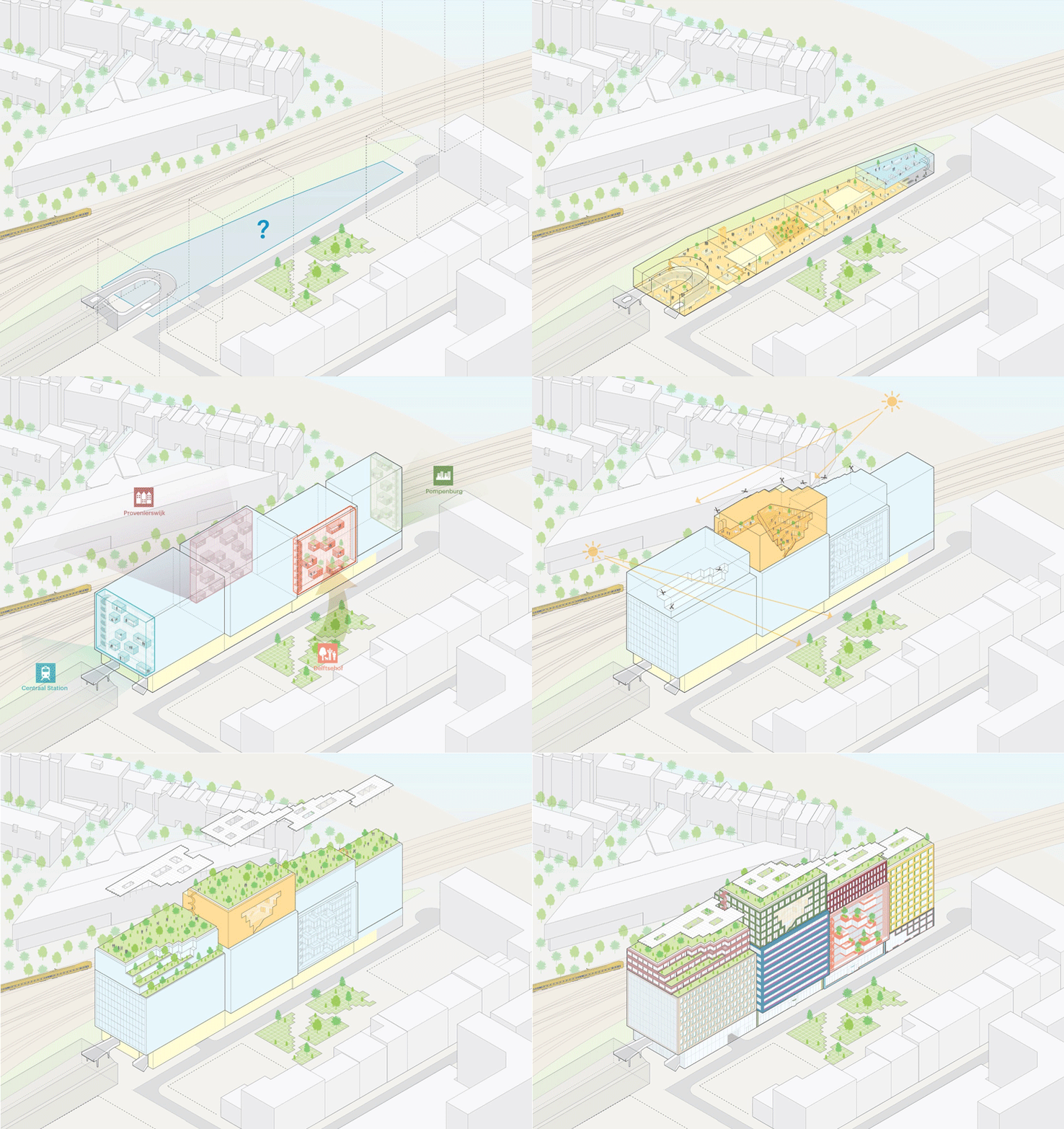
The municipality of Rotterdam has given approval for the Schieblocks, which at 47,000 square metres is the largest private new office building currently being built in the Netherlands – complete with a variety of commercial uses on its ground floor and a restaurant and event space on its top levels. Designed by MVRDV for developer LSI (who markets the building as The Bluezone Offices) the project creates a 3D neighbourhood of offices, 61 metres tall and almost 150 metres in length, on a narrow slice of land alongside the railway line. To give a human scale to this sizeable building, the design is broken up into a series of colourful blocks, packed full of subtle – and some not-so-subtle – references to the city that make the new building truly representative of the spirit of Rotterdam.
▼项目概览,overview of the project © MVRDV Winy Maas, Jacob van Rijs, Nathalie de Vries

该项目位于 Schiekadeblok 街区内,这一街区由一系列小型办公楼组成,是鹿特丹战后“重建时期”的典型样本。20 世纪 90 年代,这里被更大的办公楼包围,如今则成为鹿特丹的文化热点,聚集着各种创意企业、酒吧与俱乐部。鹿特丹市政府目前正制定计划,在保持其独特特质与文化角色的前提下,对 Schiekadeblok 进行进一步的密度提升。鉴于这些规划,使 Schieblocks 的加入尊重邻里原有的特征与历史显得尤为重要。
The project sits within the Schiekadeblok, a city block of small office buildings that has become an exemplar of Rotterdam’s post-war “reconstruction period” and which – after being surrounded by larger office buildings in the 1990s – is now a cult destination within Rotterdam, home to a wide variety of creative businesses, bars, and clubs. The city is currently developing plans to densify the Schiekadeblok, while maintaining its unique character and position within Rotterdam’s cultural life. Considering these plans, it became even more important that the addition of the Schieblocks should respect the character and history of these neighbours.
▼项目鸟瞰,aerial of the project © MVRDV Winy Maas, Jacob van Rijs, Nathalie de Vries

这一过程的第一步是建筑体量的处理,其呼应了沿 Delftsestraat 的 Schiekadeblok 立面。建筑在水平方向被划分为四个部分,每部分包含一个界定清晰的基座层,以及其上一到两个体块,总计为该区域新增 11 个新的“Schieblocks”。这种构成方式呼应了周边重建时期的建筑体量,但将其垂直叠加,象征着鹿特丹的“第二次重建”——城市密度提升的下一阶段。作为在提升密度同时保持城市宜居性的示例,部分顶部体块根据日照角度进行切削,避免在铁路另一侧的住宅上投下阴影。
The first step in this process was the building’s massing, which echoes the façade of the Schiekadeblok along Delftsestraat. The building is divided horizontally into four sections, each with a clearly defined plinth level and one or two blocks above, adding a total of 11 new “Schieblocks” to the area. The resulting composition echoes the nearby reconstruction blocks, but stacked vertically, making the plea for a “second reconstruction”; the next phase of densification for Rotterdam. As an example of how this additional densification can be achieved while maintaining the city’s quality of life, some of the top blocks are carved according to the angle of the sun, preventing shadows being cast on the homes on the other side of the railway tracks.
▼项目近景,close view of the project © MVRDV Winy Maas, Jacob van Rijs, Nathalie de Vries

▼周边,context © MVRDV Winy Maas, Jacob van Rijs, Nathalie de Vries

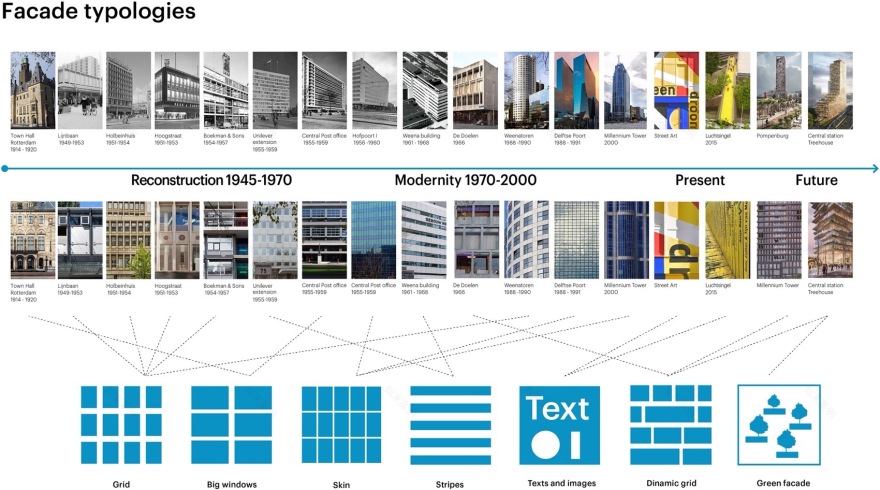
Taking inspiration from Donald Judd’s colourful furniture series, each block combines a fenestration pattern and colour inspired by the historic buildings of Rotterdam. For example, one block incorporates projecting bay windows inspired by the Huig Maaskant-designed Citrusveiling building in western Rotterdam, combined with the bright yellow of the neighbouring (now partially demolished) Luchtsingel bridge. Another merges the sandstone colour of Rotterdam’s city hall with windows that spell “010”, Rotterdam’s dialling code, within an octagonal window shape that references the façade of the of Hofplein 19, just 100 metres further along the railway track. While the appearance of the façades is informed by history, the selection of materials takes a more innovative approach. Of the 11 blocks, two are made with bricks created from recycled material, reducing the embodied carbon of the construction. A further three façades use Building Integrated Photovoltaic (BIPV) panels, taking advantage of the building’s expansive south-facing façade to generate electricity and reduce the building’s operational carbon emissions.
▼色彩与材质调色板,color and material palette © MVRDV Winy Maas, Jacob van Rijs, Nathalie de Vries

▼立面类型学,facade typologies © MVRDV Winy Maas, Jacob van Rijs, Nathalie de Vries
建筑的基座层被设计为高度透明,容纳多种公共设施,以进一步增强街区活力,包括概念店、面包房以及位于自行车停车入口旁的骑行咖啡厅。基座层同时也是通向三层、共 230 个车位的地下停车场的入口。在基座的西端,坐落着项目最独特的设计之一:由于土地权属的特殊情况,基地被邻近 Central Post 大楼的一条车行坡道“切入”。由于 Central Post 被列为历史建筑,该坡道无法拆除——因此设计团队选择用玻璃将其包覆,使这条仍在使用的车行坡道成为一个独一无二的酒吧中心装置。这个被称为 “Wokkelbar”(“螺旋酒吧”)的空间,将成为 Schiekadeblok 夜生活的全新亮点,展现鹿特丹特有的粗粝风格与“能做到”(can-do)的城市态度。
The plinth levels are designed for maximum transparency, hosting a variety of public amenities which will add to the life of the neighbourhood, including a concept store, bakery, and a bike café next to the entrance to the building’s cycle parking. The plinth also provides the entrance to the project’s three-storey, 230-space subterranean parking garage. At the western end of the plinth is one of the project’s most unusual features: due to a quirk of land ownership, the site is intruded upon by a car-parking ramp that is part of its neighbour, the Central Post building. Because of Central Post’s historic status, the ramp cannot be removed – and so instead the design encases it in glass, turning the still-functional car ramp into the centrepiece of a one-of-akind bar. With this unique feature the Wokkelbar (“Spiral Bar”) will become an intriguing new addition to the nightlife of the Schiekadeblok, typifying the gritty, “can-do” attitude that epitomises Rotterdam.
▼基座层,plinth levels © MVRDV Winy Maas, Jacob van Rijs, Nathalie de Vries

▼设计策略,design concept © MVRDV Winy Maas, Jacob van Rijs, Nathalie de Vries

建筑的公共性在顶部楼层得以延续,公众可前往餐厅以及一个两层的社交与文化活动空间,空间围绕一个阶梯式看台展开,以城市景观为戏剧化背景。同时,屋顶设有由 Juurlink & Geluk 设计、覆盖整座建筑的可达绿色景观。绿色屋面促进雨水滞留,并通过连接不同屋面高度的螺旋楼梯形成贯穿建筑南北两端的连续漫步路径。其上方设有支撑光伏板的廊架,在绿色屋顶上营造阳光与阴影交织的动态空间,同时产生可观的额外电力。“MVRDV 创始合伙人 Winy Maas 表示:“在铁路旁这样狭窄的地带中塞进一座建筑是个艰难的挑战——更不用说还要围绕国家级文物打造 Wokkelbar。” “但 Schieblocks 将成为这座城市一道亮丽的风景线。乘火车抵达鹿特丹的人们将看到一个多元、明亮与大胆的城市。而这种大胆姿态,是面向未来的行动号召:从‘wederopbouw’(第一次重建)迈向 ‘tweederopbouw’(第二次重建)。”
The public character of the plinth is matched in the building’s top floors, where the public can visit a restaurant and a two-story social and cultural event space, based around a tribune that serves as a dramatic stage, with a view over the city as a backdrop. Also topping the building is an accessible green landscape designed by Juurlink & Geluk that extends across the whole roof. These green roofs facilitate water retention and, thanks to spiral staircases that connect the different roof levels, a continuous promenade is formed from one end of the building to the other. Raised above the green landscape is a pergola that supports solar panels, creating a dynamic interplay of sunny and shaded spaces on the green roof, while generating a significant amount of additional energy. “Squeezing a building in this narrow space next to the railway was a tough challenge – not to mention the complexity of building around a National Monument with the Wokkelbar”, says MVRDV founding partner Winy Maas. “But the Schieblocks will be a colourful addition to the city. This is how people will see Rotterdam when arriving by train: diverse, bright, and bold. And in its boldness it is a call to action for the future of Rotterdam – from the ‘wederopbouw’, the reconstruction, we must shift to the ‘tweederopbouw’, the second reconstruction.”
▼东立面图和西立面图,east facade and west facade © MVRDV Winy Maas, Jacob van Rijs, Nathalie de Vries
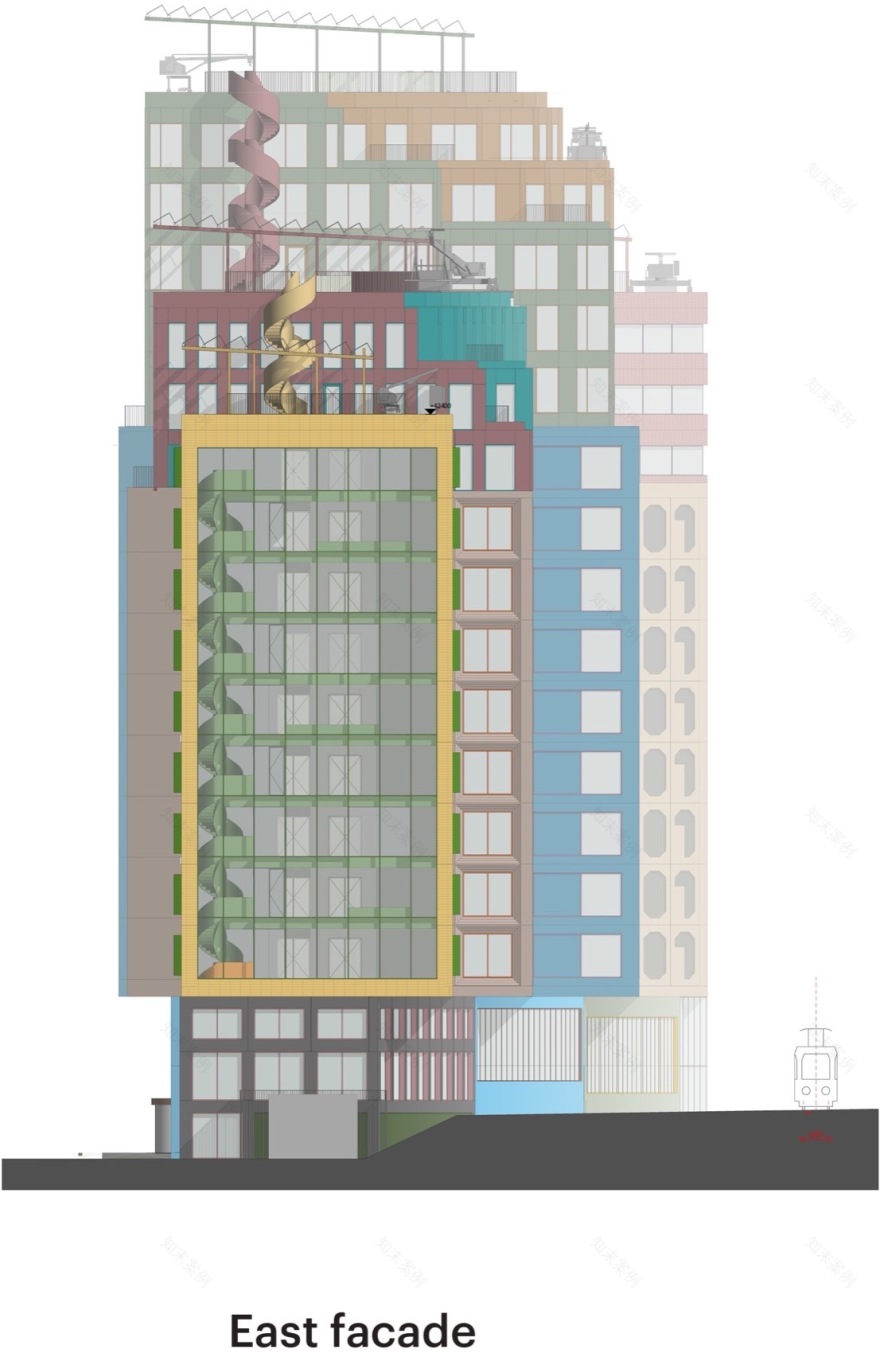

▼北立面图,north facade © MVRDV Winy Maas, Jacob van Rijs, Nathalie de Vries

▼南立面图,south facade © MVRDV Winy Maas, Jacob van Rijs, Nathalie de Vries

Facts
Project Name: Schieblocks
Location: Rotterdam, Netherlands
Year: 2023 –
Client: LSI
Size and Programme: 47,000 m2 offices, retail, parking garage, café, restaurants
Sustainability certificates (targeted): BREEAM excellent, WELL Platinum
Credits
Architect: MVRDV
Founding Partner in charge: Winy Maas
Director: Gideon Maasland
Design Team: Gijs Rikken, Bob de Rijk, Guido Boeters, Piotr Janus, Veronica Della Ventura,
Magda Porcoteanu, Valentina Fantini, Renata Tavares, Amanda Galiana Ortega, Mirco
Fachinelli, Tobias Kalmbach, Yifei Zhang, Bin Wei, Ievgeniia Koval, Rafiq Sawyerr
Copyright: MVRDV Winy Maas, Jacob van Rijs, Nathalie de Vries
Collaborators
Co-architect: SYNRG
Contractor: De Vries & Verburg
Project coordination: De Vries & Verburg
Landscape architect: Juurlink en Geluk
Structural engineer: Swinn
MEP: Vintis
Building Physics: LBP
Environmental advisor: LBP
Interior architect: Concrete
Visualisation: CUUB


南京喵熊网络科技有限公司 苏ICP备18050492号-4知末 © 2018—2020 . All photos and trademark graphics are copyrighted by their owners.增值电信业务经营许可证(ICP)苏B2-20201444 苏公网安备 32011302321234号
苏公网安备 32011302321234号客服
消息
收藏
下载
最近