

创作上传
VIP
收藏下载
登录 | 注册有礼
查看完整案例

收藏

下载

分享
恒大纱厂旧址位于上南路3120号,地处浦东新区“金色中环发展带”沿线,紧邻轨道交通杨思站。恒大纱厂始建于1920年,是上海三林地区最早的工业建筑之一,近100年间其功能也几经变迁,由最早的纱厂到60年代的微型电机厂,而后处于空置状态数年。从民族工业发展的黄金时代到现今的亟待功能转型,工业遗存的再生是实现空间价值回归与带动区域发展的契机,我们也希望能经由此次改造更新使百年纱厂重焕新生。
The former Hengda Spinning Mill site is located at 3120 Shangnan Road, situated along Pudong New Area’s “Golden Middle Ring Development Belt” and adjacent to the Yangsi Station of the Shanghai Metro. Established in 1920, it stands as one of the earliest industrial buildings in Shanghai’s Sanlin area. Over nearly a century, its function has undergone multiple transformations—from its origins as a spinning mill to a micro-motor factory in the 1960s, before lying vacant for several years. From the golden age of national industrial development to its current urgent need for functional transformation, the regeneration of industrial heritage presents an opportunity to restore spatial value and drive regional development. We hope this renovation and renewal will breathe new life into the century-old spinning mill.
▼园区总体鸟瞰,Aerial view of the site © 章鱼见筑

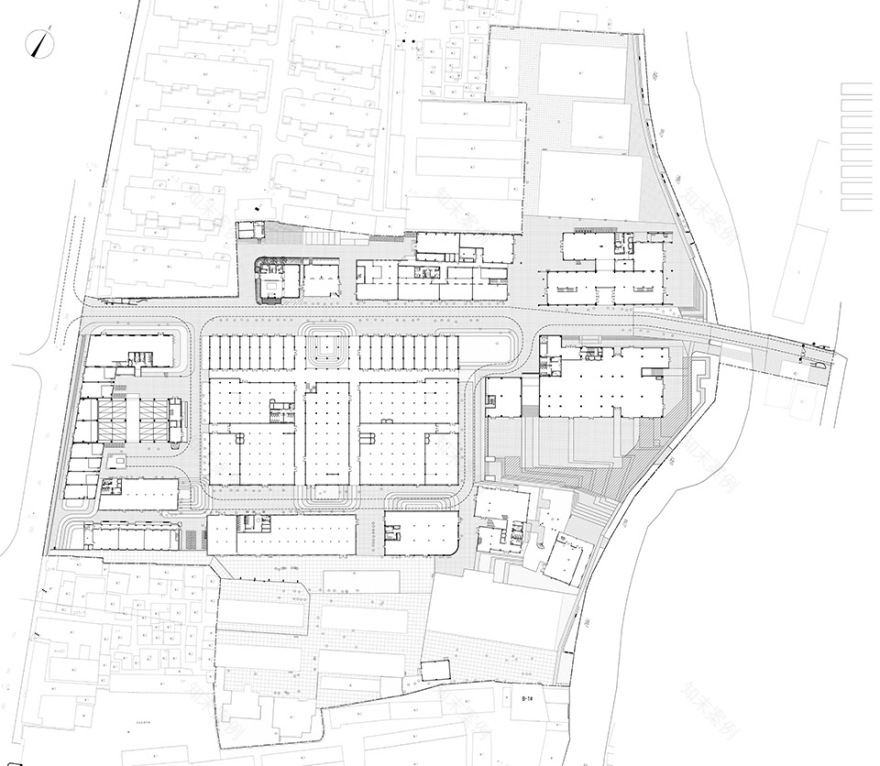
▼园区平面图,Aerial plan of the site © 章鱼见筑

01脉络重塑下的场域再生
Site Regeneration Through Structural Reimagining
恒大纱厂的厂区总面积约四万平方米,改造前仅东西两侧各有一处出入口与城市道路相接。西侧沿灵岩南路的既有建筑界面封闭阻滞,而东侧与城市的联系更加微弱,仅通过一座跨越杨思港的桥梁与上南路连接。当我们探访其中,厂区内部最为主要的一条路径形成了两个主要出入口之间的联系,两排高大的香樟赋予了这条街巷独特的场域感,两侧绿树掩映下风貌各具特色的工业建筑也传递着百年纱厂的宏大叙事,造就了这条街巷在空间上的独特可识别性,我们以此作为重要线索,重新梳理整个厂区的空间脉络。▼现状空间梳理,Analysis of the Existing Spatial Structure © 同济原作工作室

Covering approximately 40,000 square meters, the Hengda Spinning Mill site originally featured only two entrances connecting to urban roads—one on each side. The western façade along Lingyan South Road presented a closed, obstructing boundary, while the eastern connection to the city was even more tenuous, relying solely on a bridge spanning Yangsi Port to link with Shangnan Road. During our site visit, the primary internal pathway linking the two main entrances emerged as a key feature. Flanked by two rows of towering camphor trees, this alleyway possesses a distinct spatial character. The industrial buildings lining both sides, each with its own unique appearance and shrouded in greenery, convey the grand narrative of this century-old spinning mill. This creates a uniquely recognizable spatial identity for the alleyway, which we adopted as a crucial thread to re-establish the spatial context of the entire factory complex.
▼建筑与空间关系,Architectural–Spatial Relationship © 章鱼见筑

厂区内留存有各类尺度的建筑三十余栋,在高密度的厂区环境中鲜有公共空间。景观植被现状也因空置多年而杂草丛生,视线阻滞。我们从现状问题着手,深入调研厂区腹地深而路径不畅、绿化繁茂但视线不通、密度高且缺乏公共空间等现状问题;以脉络疏通与公共空间体系的建立为总体设计思路,让工业遗存摆脱闲置化的保护,用更为丰富的活动将其充盈起来,打造一个有温度、可阅读、能感知的活力文创园区。
The site preserves over thirty buildings of varying scales, yet public spaces remain scarce within this high-density industrial environment. Years of vacancy have resulted in overgrown vegetation and obstructed sightlines. We began by addressing existing issues: investigating the deep interior with poor connectivity, lush greenery obstructing views, and high density lacking public spaces. Our overarching design approach focused on unblocking spatial connections and establishing a public space system. This shifts industrial heritage from passive preservation to active revitalization, enriching it with diverse activities to create a vibrant cultural and creative district that feels warm, readable, and perceptible.
▼向史而新的新老对话,Conversation between old & new © 章鱼见筑

灵岩南路是整个厂区唯一与城市街道相接驳的界面,街巷尺度不大,生活气息浓郁,而现状沿街人行空间逼仄、建筑界面封闭;因而优化街巷尺度,将建筑界面打开,让人“进的来”“留得住”成为了设计首要考量的要素。我们尝试重新梳理沿街的建筑界面,通过建筑界面的适当退后与檐廊空间的设计缓解人行道尺度狭窄的空间问题,同时通过玻璃界面与清水砖墙相间隔的材质运用增强首层商业空间的公共性。厂区东临杨思港,是一组更具有趣味性的水岸界面,通过恒大桥链接到上南路上,这种得天独厚的地理特征为厂区提供了约300m长的滨水岸线资源。整合滨水资源,将滨水景观渗透到场地当中去也成为设计的一种愿景。在总体景观设计中,我们梳理贯通了东侧的滨水慢跑道,并梳理开放出一处约1200平方米的公共活动广场与滨水慢行道相联系。
Lingyan South Road serves as the sole interface connecting the entire factory site to the urban street network. Characterized by its intimate scale and vibrant neighborhood atmosphere, the existing street suffers from cramped pedestrian space and closed building facades. Optimizing the street scale and opening up building interfaces to make the space “accessible and inviting” became the primary design consideration. We re-evaluated the street-facing building facades. By strategically setting back the facades and incorporating eaves-covered walkways, we alleviate the narrow sidewalk issue. Simultaneously, the use of alternating glass and exposed brick walls enhances the public nature of the ground-floor commercial spaces.
▼保留工业遗存与水岸互动,Preserving Industrial Remains and Activating Waterfront Interaction © 章鱼见筑

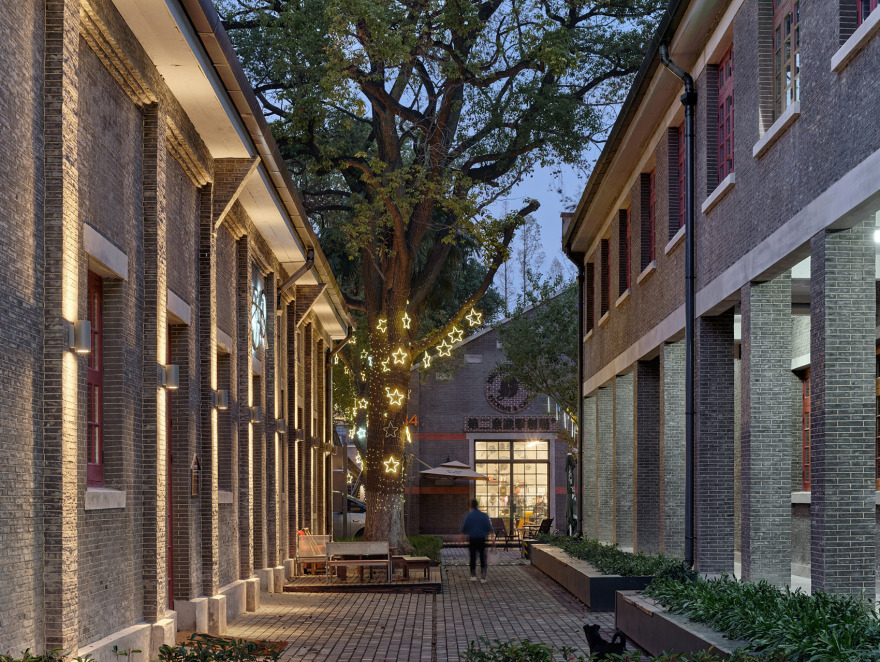
厂区内标志性的景观大道经梳理被我们打造成为一条重要的现代商业轴线。厂区南侧腹地进深较深,缺乏次级路径的带动,亟待路径织补。我们通过拆除部分风貌价值较低、结构安全性较弱以及经研判为后期加建的建筑体量后,梳理打通了靠近场地南侧的部分路径,这条路径刚好由灵岩南路南侧作为起始点,串联起五栋文保建筑,我们将其梳理打造为历史体验轴线。漫步于这条历史街巷之中,两侧保留修缮的历史建筑同街巷空间一起,共同传承了百年纱厂的空间记忆。而这条脉络的疏通也使得靠近腹地东南侧的原有大礼堂建筑更加公共可达,其特征性的山花立面成为这条历史街巷的对景,与保留的水塔构筑物共同作为轴线的收止点。
▼三组空间轴线,Three waterfront interface © 同济原作工作室

Bordered by Yangsi Port to the east, the site features a more engaging waterfront interface. Connected to Shangnan Road via Hengda Bridge, this unique geography provides approximately 300 meters of waterfront resources. Integrating these resources and permeating the waterfront landscape throughout the site became a key design vision. In the overall landscape design, we connected the eastern waterfront jogging path and opened up a 1,200-square-meter public activity plaza linked to the waterfront promenade. The iconic landscape boulevard within the factory grounds was transformed into a key modern commercial axis. The southern hinterland of the factory grounds, characterized by deep depth and a lack of secondary pathways, urgently required path connectivity. By demolishing structures of lower architectural value, compromised structural integrity, and identified as later additions, we cleared pathways near the southern boundary. This route, originating south of Lingyan South Road, connects five heritage-protected buildings, forming a historical experience axis. Strolling through this historic alleyway, the preserved and restored buildings flanking both sides, together with the alley space itself, collectively preserve the spatial memory of the century-old spinning mill. The opening up of this axis also enhances public accessibility to the original Grand Hall building near the southeast corner of the rear area. Its distinctive pediment facade serves as a focal point along this historic alley, while the preserved water tower structure functions as the axis’s terminus.
▼保留水塔作为特色工业景观,Keeping the Water Tower as Industrial Feature © 章鱼见筑

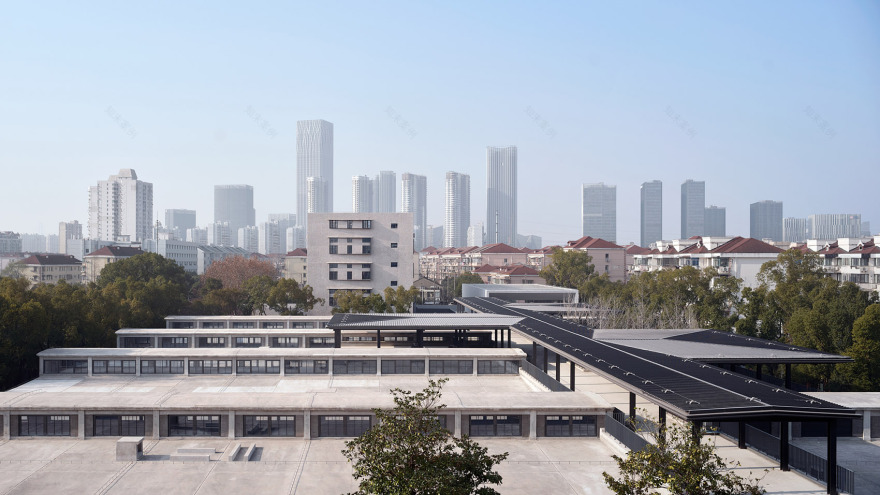
高密度的建成环境中公共空间往往有限,而我们也试图挖掘公共空间的立体性与复合性。在首层公共动线复杂的前提下,我们通过轻介入的手段在体量最大的主体厂房屋顶上方植入了一条游廊体系,并将其定义为未来产业轴线;这条未来轴线将场地西侧的商业展陈空间与东侧新建的办公空间及滨水景观带串联起来,丰富了空间层次,真正实现了向史而新的“叠合生长”。
In high-density built environments, public space is often limited, so we sought to explore the verticality and multifunctionality of public spaces. Given the complex ground-floor circulation, we employed a light intervention to implant a colonnade system atop the largest main factory building. Defined as a future industrial axis, this corridor connects the commercial exhibition space on the site’s west side with the newly constructed office space and waterfront landscape on the east. This enriches spatial layers, achieving a truly layered growth that honors history while embracing innovation.
▼串联建筑的空中游廊体系,the complex ground-floor circulation coneect buildings © 章鱼见筑
02锚固与游离的时空对话
Anchored and Free-Floating: A Spatiotemporal Dialogue
Designated as a cultural heritage site in Pudong New Area in 2017, the factory complex encompasses five buildings. From its densely spaced industrial columns to its signature pediment moldings, every detail bears witness to the century-old factory’s temporal imprint. These defining features serve as anchors within the site, preserved as focal points. The reorganization and arrangement of other architectural spaces revolve around them, creating a contrast between the anchored and the detached—a juxtaposition of old and new. Following careful assessment, we preserved and renovated over ten existing buildings alongside structures like the water tower, all possessing historical significance, thereby maximizing the preservation of the century-old spinning mill’s historical character.
▼历史轴线,historical axis © 章鱼见筑

厂区内面积最大的主体厂房单层面积近9000平方米,内部空间进深较大,仅靠高窗采光难以满足后续功能更新后的使用需求。我们采用去顶成院、去顶成廊的设计手法优化建筑尺度、提升空间品质。位于上南路入口处的原锅炉间建筑,其原有的建筑结构形制尚佳,入口处的花格砖墙及干粘石等材质工艺均具有鲜明的历史风貌特色。我们采用原工艺、原材料对外立面进行修缮复原。靠近杨思港的水塔也作为历史风貌的折射被我们保留下来,水塔本体经结构加固以历史风貌呈现,而为了适应区域更新的需求,我们采用与原结构完全脱离的钢结构体系增设了一部螺旋钢楼梯以及环水塔一周的观景平台。通过景观构筑物的形式为人们提供了一条与历史对话的景观动线,将历史记忆空间化与物质化,打造与园区文化相匹配的特色工业景观。
The largest main factory building in the complex spans nearly 9,000 square meters per floor, featuring deep interior spaces where high windows alone could not adequately meet the lighting demands of its updated functions. We employed a design approach of removing roofs to create courtyards and corridors, optimizing building scale and enhancing spatial quality. The former boiler house at the Shangnan Road entrance retained well-preserved structural integrity, with its entrance featuring lattice brick walls and dry-stuck stone finishes that distinctly embody historical character. We restored the facade using original techniques and materials. The water tower near Yangsi Port was preserved as a reflection of historical character. Its structure was reinforced to maintain its historical appearance, while a new spiral steel staircase and a viewing platform encircling the tower were added using a completely detached steel framework to accommodate the area’s renewal needs. This landscape structure creates a dynamic viewing path for engaging with history, spatializing and materializing historical memory to forge a distinctive industrial landscape aligned with the park’s cultural identity.
▼办公楼北侧入口空间,north entracne of building © 章鱼见筑

▼庭院,courtyard © 章鱼见筑


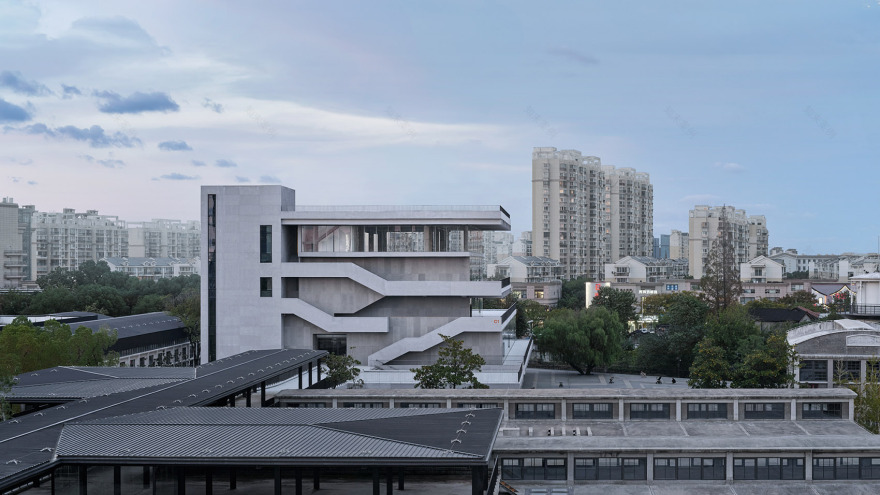
对于建筑品质不佳的既有建筑,我们将通过拆除并新建的策略进一步丰富 场地内建筑形式的多样性。如主体厂房东侧的一组既有建筑风貌不佳且结构安全性较弱,结合园区对公共空间的诉求以及后续办公功能的诉求,我们采用拆除原有零散建筑,新建一栋五层办公楼的策略进行该区域的更新。我们从场地内既有建筑形制溯源,以新的方式呈现时间与空间的剖断面,将均质密梁的结构形式外化,形成朝不同方向出挑的层板,以作为对场地南侧水塔广场以及东侧杨思港多向景观的回应。在水塔广场,经由景观台阶拾级而上,即可到达各层景观平台,而这条路径继续向上又以外化的形式作为办公楼建筑的西立面呈现,在历史轴线的转角处远望,这座建筑并非孤立的存在,而是由地面的景观逐级生长起来的。
For existing buildings of poor architectural quality, we will enhance the diversity of forms within the site through demolition and new construction. For instance, a group of existing buildings east of the main factory hall, characterized by poor aesthetics and weak structural integrity, will be demolished. Aligning with the park’s demand for public space and future office functions, we will replace them with a new five-story office building. Drawing inspiration from the site’s existing architectural forms, we present a new interpretation of temporal and spatial sections. The homogeneous, dense beam structure is externalized, forming cantilevered slabs projecting in multiple directions. This design responds to the multi-directional views toward the Water Tower Plaza to the south and Yangsi Port to the east. At the Water Tower Plaza, ascending through landscaped terraces leads to viewing platforms on each floor. This path continues upward, manifesting as the building’s western facade. Viewed from the historical axis’s corner, the structure appears not as an isolated entity but as one that gradually emerges from the ground through its landscaped terraces.
▼从景观场地逐级生长起来的建筑体,Emerges step by step from the landscape © 章鱼见筑

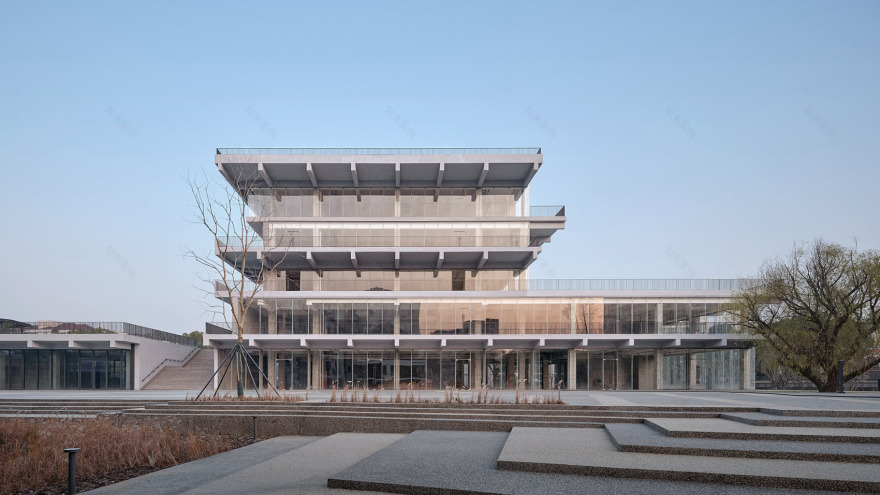
▼回应多向景观的出挑平台,Emerges step by step from the landscape © 章鱼见筑

03更新驱动下的价值回归
Value Restoration Driven by Renewal
从场所出发而又回到场所中去,探究场地本身的脉络,让设计更好的扎根于环境,始终是我们面对城市更新的一种态度,在恒大纱厂的整体更新中,我们创造了一个多样并置的基底,空间变得更具包容性,也为后续的功能置换提供了多种可能。通过架构漫游体系,疏通街区脉络使其成为更具吸引力的城市开放空间;形成社区引领,通过整合历史建筑、引入社区活动强化活力空间与公共服务的融通互动;实现价值回归,通过将封闭街区开放,激发街区功能升级和品质提升,打造文创地标,让百年纱厂重焕新生。
▼复合活化体系,Composite Activation System © 同济原作工作室

Our approach to urban renewal has always been to start with the site and return to it, exploring the site’s inherent context to better ground design within its environment. In the comprehensive renewal of Evergrande Spinning Mill, we created a diverse, juxtaposed foundation that makes the space more inclusive and offers multiple possibilities for future functional transformations. By establishing a navigational framework, we revitalized the neighborhood’s circulation to transform it into an attractive urban open space. We fostered community leadership by integrating historic buildings and introducing neighborhood activities, enhancing the synergy between vibrant spaces and public services. We achieved a return to value by opening up the previously closed neighborhood, stimulating functional upgrades and quality improvements. This created a cultural and creative landmark, breathing new life into the century-old spinning mill.
▼立面细部,Facde details © 章鱼见筑


▼厂房内部通廊,Corridor © 章鱼见筑

▼首层平面图,Plan © 同济原作工作室
▼立面图,Elevation © 同济原作工作室

项目名称:恒大纱厂旧址园区更新
建筑事务所:同济大学建筑设计研究院(集团)有限公司·原作设计工作室
主创建筑师:章明、张姿
建筑设计团队:肖镭、潘思、黄晓倩、费利菊、陆星辰、林敏薇、濮文睿、陶情情、朱彦波、林子轩
结构设计团队:陈泽赳、王金花、牟洁、桑海刚、孙哈逊、王潇、陈文浩
机电设计团队:郭长昭、李鑫(暖通);尚佳家、李朝(给排水);焦学渊、俞超、梁为鹏(电气)
照明设计:杨秀、马玥、顾兴花、章荣立
建设单位:上海三鑫华林企业发展有限公司
项目地址:上海市浦东新区灵岩南路181号
建成时间:2024年
总建筑面积:47576平方米
摄影:章鱼见筑
Project Name: Evergrande Spinning Mill Site Urban Renewal
Architectural Firm: Tongji University Architectural Design & Research Institute (Group) Co., Ltd. · Original Design Studio
Lead Architects: Zhang Ming, Zhang Zi
Architectural Design Team: Xiao Lei, Pan Si, Huang Xiaoqian, Fei Liju, Lu Xingchen, Lin Minwei, Pu Wenrui, Tao Qingqing, Zhu Yanbo, Lin Zixuan
Structural Design Team: Chen Zeju, Wang Jinhua, Mou Jie, Sang Haigang, Sun Haxun, Wang Xiao, Chen Wenhao
MEP Design Team: Guo Changzhao, Li Xin (HVAC); Shang Jiajia, Li Zhao (Plumbing); Jiao Xueyuan, Yu Chao, Liang Weipeng (Electrical)
Lighting Design: Yang Xiu, Ma Yue, Gu Xinghua, Zhang Rongli
Developer: Shanghai Sanxin Hualin Enterprise Development Co., Ltd.
Project Address: 181 Lingyan South Road, Pudong New Area, Shanghai
Completion Date: 2024
Total Floor Area: 47,576 square meters
Photography: ZY Architectural Photography
南京喵熊网络科技有限公司 苏ICP备18050492号-4知末 © 2018—2020 . All photos and trademark graphics are copyrighted by their owners.增值电信业务经营许可证(ICP)苏B2-20201444 苏公网安备 32011302321234号
苏公网安备 32011302321234号客服
消息
收藏
下载
最近