

创作上传
VIP
收藏下载
登录 | 注册有礼
查看完整案例

收藏

下载

分享
在禅宗的寺庙里,“出坡”是僧人重要的修行方式之一,指的是集体参与耕作、清扫、建造等劳动。这一传统源远流长:自四祖道信倡导僧人耕作自养,到百丈怀海禅师确立“一日不作,一日不食”的准则,“农禅并重”便成为中国佛教特有的实践。“出坡”这一联结寺庙建设与日常修行的古老传统,启发了我们对当代宗教建筑形式与建造方法的思考,为设计提供了新的可能性。
In Zen Buddhist temples, “Chu-po”(communal labor)is one of the essential practices for monks, referring to collective participation in activities such as farming, cleaning, and construction. This tradition has a long history: since the Fourth Patriarch Daoxin advocated for monks to support themselves through farming, and later, Master Baizhang Huaihai established the principle of “no work, no food,” the integration of farming and meditation has become a distinctive practice in Chinese Buddhism. This ancient tradition of “Chu-po” which connects temple construction with daily spiritual practice, has inspired our reflection on the form and construction methods of contemporary religious architecture, offering new possibilities for design.
▼建筑外景,Exterior of the Building © 傅英斌

出坡与日常修行
“Chu-po”(communal labor) and Daily Spiritual Practice
项目所在地寺院目前正处于建设阶段,与公众印象中香火鼎盛、设施完善的成熟寺庙不同,其建设过程面临着诸多现实挑战:建设资金紧张、专业施工人员匮乏、场地空间有限等。在这样的背景下,僧众除日常宗教活动外,还承担大量参与寺庙建设与维护的体力劳动——即“出坡”。基于寺庙当前的建设状态及僧人践行“出坡”的传统,同时考虑到研究所将由僧众与工匠共同参与建造,设计选择了经济、易于施工的构造方式。这不仅是可以应对非专业施工力量及特定场地限制的较为务实的方案,其简洁、本质的表达也契合了当代建筑的美学追求。
▼僧众“出坡”,Monastics Participating in Construction through “Chu Po” © 傅英斌
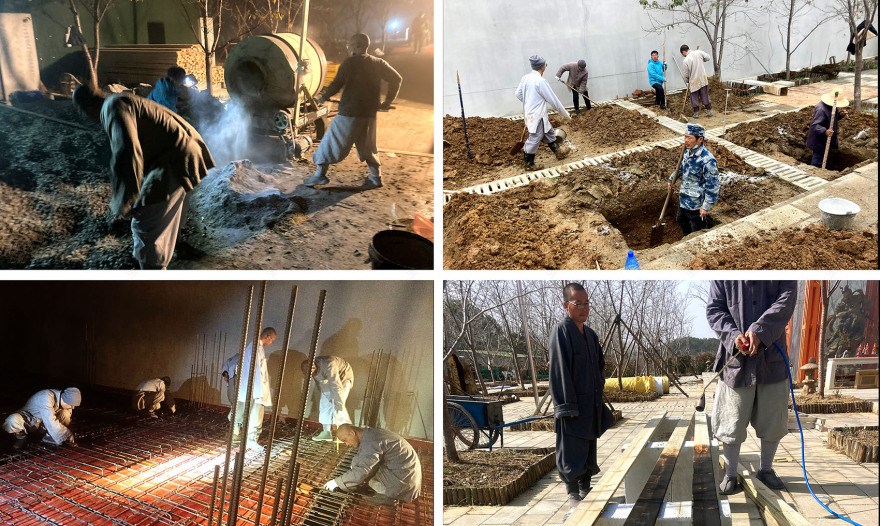
The monastery at the project site is currently under construction. Unlike the public’s impression of mature temples with thriving incense offerings and well-equipped facilities, its construction process faces numerous practical challenges: limited funding, a shortage of professional construction personnel, and constrained site space, among others. Under these circumstances, the monastic community, in addition to their daily religious activities, undertakes a significant amount of physical labor involved in the construction and maintenance of the temple—a practice known as “Chu-po”. Based on the temple’s current construction status and the monks’ tradition of practicing “Chu-po” and considering that the institute will be built through the joint participation of the monastic community and artisans, the design has opted for an economical and easily constructible structural approach. This is not only a practical solution to address the limitations of non-professional construction capabilities and specific site constraints, but its simple and essential expression also aligns with the aesthetic pursuit of contemporary architecture.
▼建筑前的樱花树林,The cherry blossom grove before the building © 傅英斌

空间与日常使用
Space and Daily Use
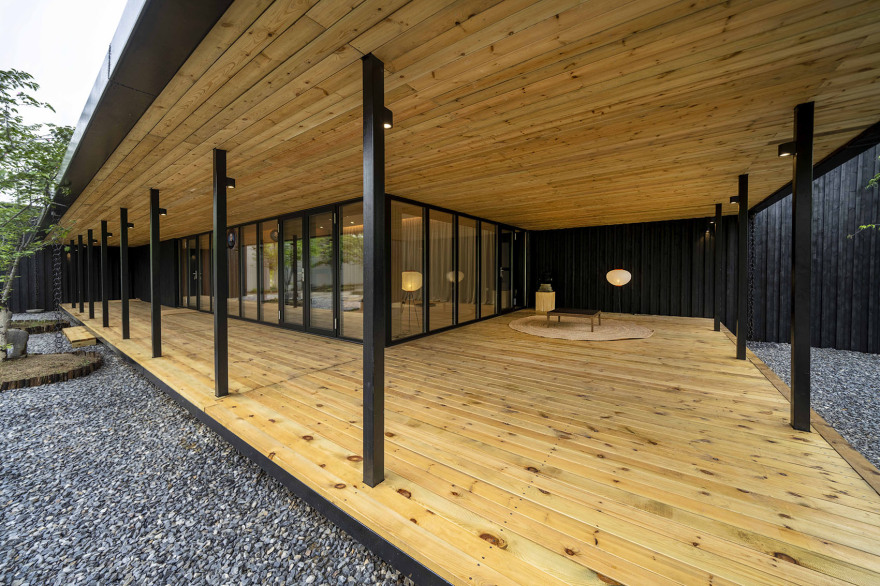
宗教研究所位于寺院东南角,场地原状有一片樱花树阵。根据要求,建筑需紧邻院墙建造,且高度被严格限制在院墙高度范围内。作为服务于僧人日常办公、研究与会议活动的空间,设计需优先满足多功能需求,并契合寺庙的宗教氛围。面对建筑高度的限制,设计策略转向水平方向的延展:主体由一个满足办公、会议和宗教研究等核心功能的大空间构成,外侧则由L型檐廊环绕包裹。檐廊作为建筑与庭院的过渡,通过压低檐口高度和架空沿廊地面使檐廊成为链接室内外的灰空间,由此形成的廊下空间不仅具备遮阳避雨的实用功能,更成为连接室内与庭院的核心场所,它向樱花庭院充分展开,为僧人提供了工作间隙打坐、品茶、休憩的灵活场地。当僧人盘坐于此,视线恰好与庭院樱花树的枝干平齐,原本的空间限制,反而促成了与自然静默对话的契机。
▼轴测图, Axonometric Diagram © 傅英斌-宋嘉工作室

The Institute of Religious Studies is located in the southeast corner of the monastery, on a site originally occupied by an array of cherry blossom trees. According to the requirements, the building must be constructed close to the monastery wall, with its height strictly limited to within the height of the wall. As a space serving the daily office work, research, and conference activities of the monks, the design must prioritize meeting multifunctional needs while aligning with the religious atmosphere of the monastery. Faced with the height restrictions, the design strategy shifts toward horizontal expansion: the main structure consists of a large space that accommodates core functions such as office work, meetings, and religious studies, while the exterior is enveloped by an L-shaped eave corridor. As a transition between the building and the courtyard, the eave corridor is designed as a semi-outdoor transitional space by lowering the eave height and elevating the floor along the corridor. The resulting covered area not only provides practical functions such as shading and shelter from rain but also becomes the core space connecting the interior with the courtyard. It opens fully to the cherry blossom courtyard, offering the monks a flexible venue for meditation, tea drinking, and rest during work breaks. When seated here, the monks’ sightline aligns precisely with the branches of the cherry blossom trees in the courtyard. What was initially a spatial limitation has instead created an opportunity for silent dialogue with nature.
▼材料冷暖色调对比,Material comparison of warm and cool © 傅英斌


材料与建造方式
Materials and Construction Methods
材料的选择是塑造空间氛围和适应非专业施工者参与建造的关键。设计采用“内外有别”的策略:外立面采用经碳化处理的黑色烧杉板,其深沉的色调与寺庙肃穆氛围相融,有效弱化建筑体量,使其隐匿于樱花树阵,碳化层提升了木材的耐候性与抗腐蚀能力,足以应对武汉湿润多雨的气候,降低长期维护成本。内部空间则选用本色木材,其天然纹理与温暖色调为办公、冥想和休憩营造出舒适放松的环境。这种冷暖色调的对比,清晰界定了建筑的内外空间层次。烧杉板的碳化工艺本身作为一种物理防腐方式,减少了对化学防腐剂的依赖,体现了可持续性;木材这一便于施工的材料体系为僧人、工匠共同参与建造提供了切实可行的办法。
Material selection is key to shaping the spatial atmosphere and enabling participation from non-professional builders. The design adopts a strategy of differentiation between the interior and exterior. For the exterior facade, charred timber boards in a dark black hue are used. Their deep tone harmonizes with the solemn ambiance of the temple, effectively softening the building’s visual presence and allowing it to blend discreetly into the cherry blossom grove. The carbonized layer enhances the wood’s weather resistance and anti-corrosion properties, making it well-suited to Wuhan’s humid and rainy climate while reducing long-term maintenance costs. Inside, natural-finish wood is employed. Its inherent grain and warm tones create a comfortable and relaxing environment for work, meditation, and rest. The contrast between cool and warm hues clearly defines the spatial transition between the interior and exterior. The charring process itself, as a physical method of preservation, minimizes reliance on chemical preservatives, reflecting a commitment to sustainability. The timber system, being easy to work with, also provides a practical means for monks and artisans to
▼L型檐廊,L-shaped eave corridor © 傅英斌


宗教氛围的现代营造
The Modern Creation of Religious Atmosphere
在营造宗教氛围方面,设计摒弃了传统寺庙符号,采用了简洁、适用的现代形式,通过克制的建筑语言和精心的材料选择来实现这一目标:黑色烧杉板的沉静立面与深灰色碎石地面相互映衬,结合原有的樱花树阵,共同奠定了静谧的禅修基调。氛围的营造更依赖于抽象化的方式——通过木材的冷暖对比、雨季雨链在墙面留下的水痕、晴日樱花枝影在室内的投影以及庭院景观的渗透,叠加形成内在的宁静与神圣感。这种现代宗教空间的体验,最终体现在日常使用场景中,吻合了禅宗美学中的“空性”与“不假修饰,自然天成”:僧人在压低延伸的檐廊下盘坐休憩,或品茶听雨,或静观庭院树木的四季变迁,建筑本身已融入修行日常,成为承载禅意的静谧容器。
In shaping the religious atmosphere, the design eschews traditional temple symbols and adopts a clean, functional modern form. This goal is achieved through restrained architectural language and deliberate material choices: the tranquil facade of black charred timber and the dark gray gravel ground complement each other, while the existing cherry blossom grove collectively establishes a serene meditative tone. The ambiance is further cultivated through abstract means—such as the contrast between warm and cool wood tones, the watermarks left by rain chains on walls during the rainy season, the shadows of cherry branches cast indoors on sunny days, and the subtle integration of courtyard views—layering to evoke an internal sense of tranquility and sanctity. This experience of a modern religious space is ultimately manifested in daily usage, resonating with the Zen aesthetic concepts of “emptiness” and “unadorned naturalness.” Monks may sit and rest under the low-extending eaves, sipping tea while listening to the rain, or quietly observing the seasonal changes of the courtyard trees. The architecture itself becomes seamlessly woven into the fabric of daily spiritual practice, serving as a silent vessel of Zen contemplation.
▼室外禅修空间,Outdoor meditation space © 傅英斌

▼室内禅修空间,Indoor meditation space © 傅英斌

结语
Conclusion
宗教研究所的落成,不仅是空间的营造,更是一场“出坡”精神的当代实践。以“低技策略”应对现实条件,通过便于僧人操作的建造方式与克制的结构形式,让宗教氛围褪去符号外壳,回归修行本真。当空间成为劳动的容器,建造便不再是手段,而是修行本身,将禅意的庄重与现代建筑的简约完美结合,展现出了“禅意”与“匠心”的深刻对话。
The completion of the Institute of Religious Studies is not merely the creation of a physical space but also a contemporary embodiment of the “Chu-po”(communal labor) spirit. By employing a “low-tech strategy” to address practical constraints, the design adopts construction methods accessible to monastic practitioners and employs restrained structural forms, allowing the religious atmosphere to move beyond symbolic representation and return to the essence of spiritual practice. When space becomes a vessel for labor, construction ceases to be merely a means and transforms into spiritual practice itself. This harmoniously integrates the solemnity of Zen contemplation with the simplicity of modern architecture, revealing a profound dialogue between “Zen essence” and “artisan ingenuity.”
▼僧人盘坐休憩,The Monastic seated in meditation © 傅英斌

▼一层平面图,First floor plan © 傅英斌-宋嘉工作室

项目信息
项目地点:湖北省武汉市
设计时间:2022.10
建成时间:2023.6
面积:120平米
设计单位:傅英斌-宋嘉工作室
主创设计师:傅英斌、宋嘉
团队:赵思源、宋嘉
撰文:宋嘉
摄影:傅英斌
Project Information
Location: Wuhan City, Hubei Province, China
Design Period: October 2022
Completion Time: June 2023
Floor Area: 120 sqm
Design Unit: Fu Yingbin & Song Jia Studio
Principal Designer: Fu Yingbin, Song Jia
Team: Zhao Siyuan, Song Jia
Text: Song Jia
Photography: Fu Yingbin
南京喵熊网络科技有限公司 苏ICP备18050492号-4知末 © 2018—2020 . All photos and trademark graphics are copyrighted by their owners.增值电信业务经营许可证(ICP)苏B2-20201444 苏公网安备 32011302321234号
苏公网安备 32011302321234号客服
消息
收藏
下载
最近