

创作上传
VIP
收藏下载
登录 | 注册有礼
查看完整案例

收藏

下载

分享
项目名称: “再生树”超高层概念方案
设计单位:日建设计
图片数量:18张
旨在成为应对脱碳与多样化工作方式的超高层建筑新标准Aiming for a new standard in skyscrapers promoting decarbonization and diverse work styles
预计到2030年代初期平均气温将上升1.5度,为实现脱碳社会,大幅削减与建筑相关的“全生命周期碳排放”已成为迫切需求。另一方面,近年来人们开始追求能够根据工作方式选择场所与环境、促进人与自然交流的健康型工作场所,同时还需要能够适应时代需求进行改造的建筑方案。
With the average global temperature expected to rise by 1.5 degrees by the early 2030s, there is a strong need to significantly reduce “whole life carbon” associated with buildings in order to achieve a carbon-free society. Concurrently, there is growing demand for wellness-oriented workplaces that allow people to choose the location and environment according to their working style, while also promote communication with others and with nature. Architectural plans must also be adaptable to meet contemporary needs and facilitate renovation work.
▼项目概览,Overview of the project © Nikken Sekkei

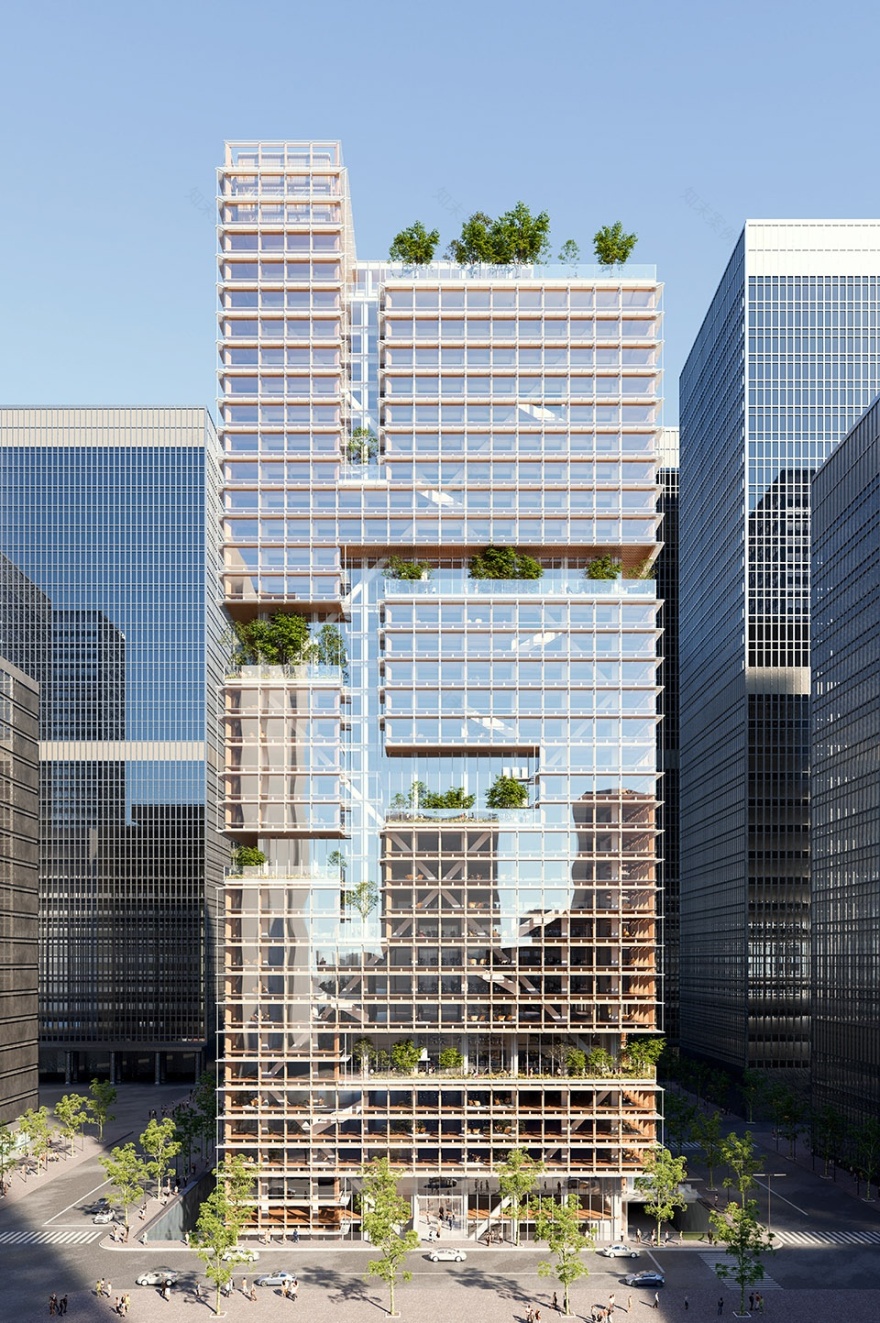
“再生树(Regenerative Tree)”旨在通过建筑、结构及设备的综合性举措,提出解决这些课题的具体建筑模型。其目标并非作为超高层办公楼的特殊个例,而是成为新标准的通用原型。测算结果显示,该原型通过整合这些元素,最多可以削减 40%的全生命周期碳排放。
▼项目剖透视,Sectional perspective © Nikken Sekkei
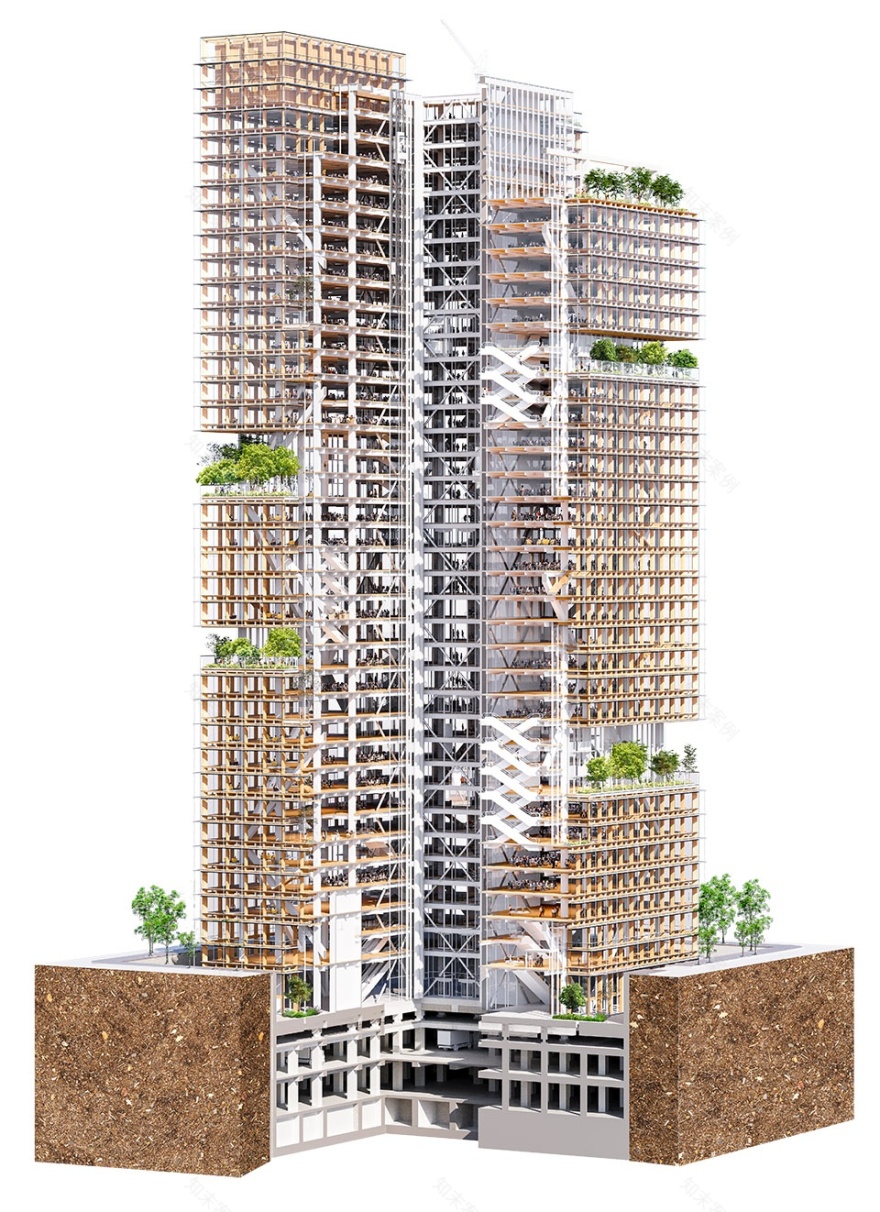
The “Regenerative Tree” is a realistic building model that addresses these problems through an integrated approach to architectural, structural, and MEP design. Our aim is to develop a versatile prototype, that sets a new standard for super-high-rise office buildings, not a special case. It is estimated that incorporating these elements can reduce the prototype’s whole-life carbon emissions by up to 40%. The characteristic features are as follows.
▼立面仰视视角,Upward view of the façade © Nikken Sekkei

框架优化与外围木结构化Optimizing the frame structure and using timber for the perimeter
作为结构方案的优化,通过重新审视宽阔的无柱空间,在室内设置中间柱和抗震构件,既减少了钢材用量,又实现了外围区域及楼板的木结构化以减轻重量。此外还通过采用隔震结构抑制地震时的晃动,并减少钢材用量,力求大幅削减主体结构工程中的CO2排放量。
▼局部结构剖透视,Partial sectional perspective of structure © Nikken Sekkei

CO2 emissions are significantly reduced by optimizing the structure. Intermediate columns and seismic-resistant braces are incorporated to support long-span beams and reduce steel usage. Timber is adopted for the perimeter frame, and cross-laminated timber (CLT) is used for the office slabs to minimize building weight. A seismic isolation system further decreases steel requirements by mitigating seismic shaking.
▼立面细部与外部平台,Façade detail with exterior terraces © Nikken Sekkei
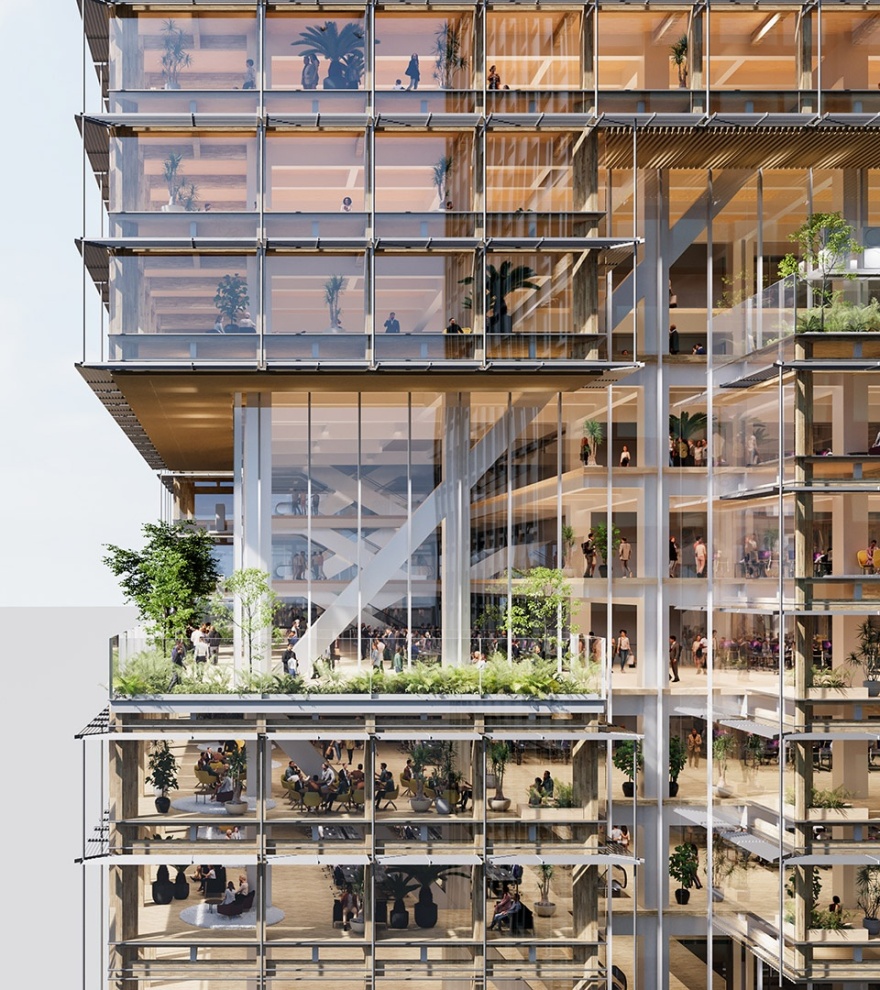
▼支持多样化工作方式,Supporting diverse workstyles © Nikken Sekkei

通过可实现的仿生技术实现高环保性能的设备规划Applying biomimicry for high environmental performance
为提升设备规划的环保性能和彻底实现简化,项目积极引入仿生技术(Biomimicry Design),包括:仿效通过动静脉热交换防止体温下降的“WONDER NET”热回收系统,借鉴人体体温调节机制“排汗”原理的喷雾气化冷却技术,以及从植物为进行光合作用而进化成螺旋状“叶序”获得灵感的自然通风与自然采光。
Biomimetic technology was actively introduced to thoroughly simplify and improve the environmental performance of MEP planning. The heat recovery system mimics the “Wonder net,” a mechanism that prevents drops in body temperature by exchanging heat between the arteries and veins. Evaporative cooling by spraying water is modeled after the human body’s sweating thermoregulation function, while natural ventilation and lighting draw inspiration from the spiral phyllotaxis of plants, which evolved for photosynthesis.
▼室内公共区域,Public space © Nikken Sekkei


此外,作为高效的人流规划方案,取消每层停靠的区间电梯,引入新型运输系统,该系统结合了适合长距离运输的穿梭电梯与适合大规模运输的自动扶梯。这样可在确保运输能力的同时,大幅削减电力消耗量。
Additionally, as part of an efficient people flow plan, local elevators that stop at each floor are being replaced with a new system combining shuttle elevators, which are suitable for long-distance transportation, with escalators, which are suitable for mass transit. This will enable a significant reduction in electricity consumption while maintaining transportation capacity.
▼交通空间,Transportation space © Nikken Sekkei

应对多样化工作方式的建筑规划Planning for diverse work styles
作为应对多样化工作方式的建筑规划,充分利用VOID(挑空),引入阶梯式楼层,以及构建螺旋状共享空间。这些空间与以往的均质性单层空间截然不同,是接纳自然并创造各种活动的空间。中央VOID是具有扩展性的设备通道,将来变更用途时可用作搬运动线。
A central void, “stepped floors,” and spiraling shared spaces are created to accommodate diverse workstyles. These spaces differ from conventional, homogenous single-floor spaces, embrace nature, and foster a variety of activities. The central void is an expandable MEP route and can function as a construction logistics route when the building’s use changes.
▼VOID垂直动线,Vertical circulation of VOID © Nikken Sekkei

▼夜景,Noghtview © Nikken Sekkei

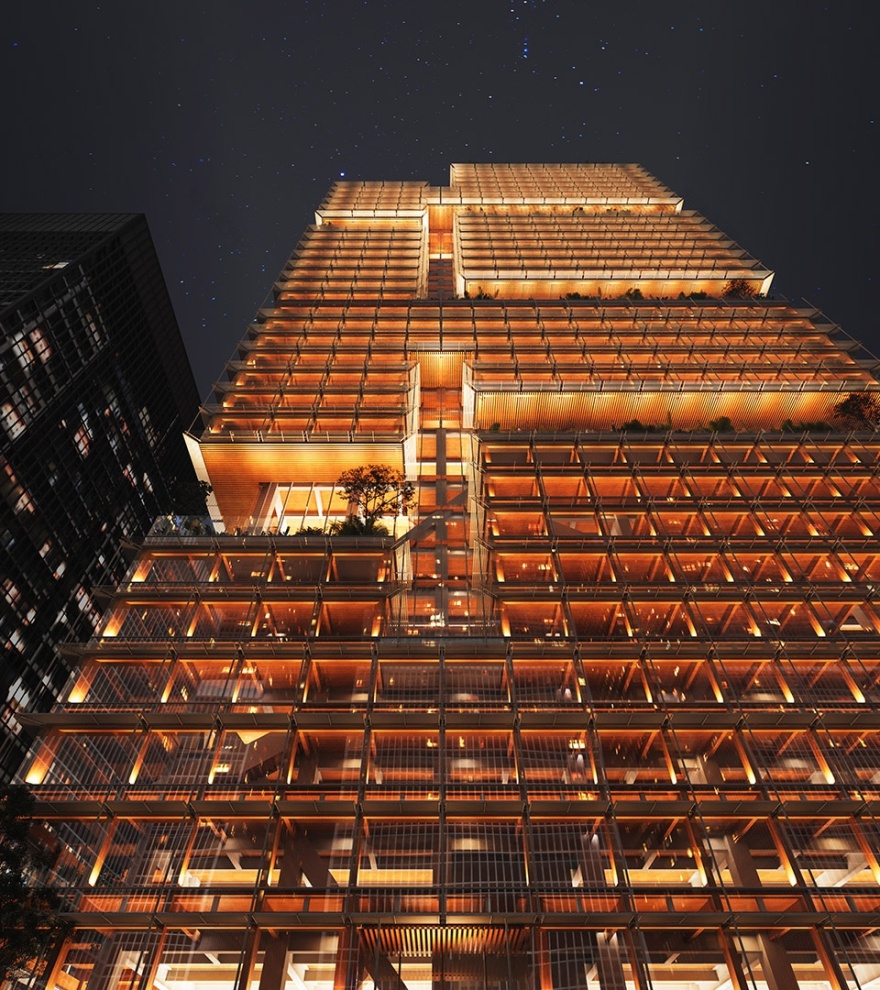
▼首层平面图,Ground floor plan © Nikken Sekkei

▼21层平面图,21st floor plan © Nikken Sekkei

▼立面图,Elevation © Nikken Sekkei

▼剖面图,Section © Nikken Sekkei

南京喵熊网络科技有限公司 苏ICP备18050492号-4知末 © 2018—2020 . All photos and trademark graphics are copyrighted by their owners.增值电信业务经营许可证(ICP)苏B2-20201444 苏公网安备 32011302321234号
苏公网安备 32011302321234号客服
消息
收藏
下载
最近