

创作上传
VIP
收藏下载
登录 | 注册有礼
查看完整案例

收藏

下载

分享
“印象工大·尚盒”是浙江工业大学工程设计集团关于全新建造模式的一次探索。作为建筑工业化与智能建造融合发展的先行试验载体,其建造技术体系为国内首创。集团以毫米级精度控制为技术锚点,希望为建筑工业化的落地提供可复制、可推广的实践样本,引领建筑工业化迈向智能建造新阶段。
“G-CUBE” represents an exploration of a new construction model by Zhejiang University of Technology Engineering Design Group. As a pioneering experimental carrier for the integrated development of construction industrialization and intelligent construction, its construction technology system is an original innovation in China. With millimeter-level precision control as the technical anchor, the Group aims to provide a replicable and promotable practical model for the implementation of construction industrialization, leading the industry toward a new phase of intelligent construction.
▼项目鸟瞰,aerialview of the project © 浙江工业大学工程设计集团
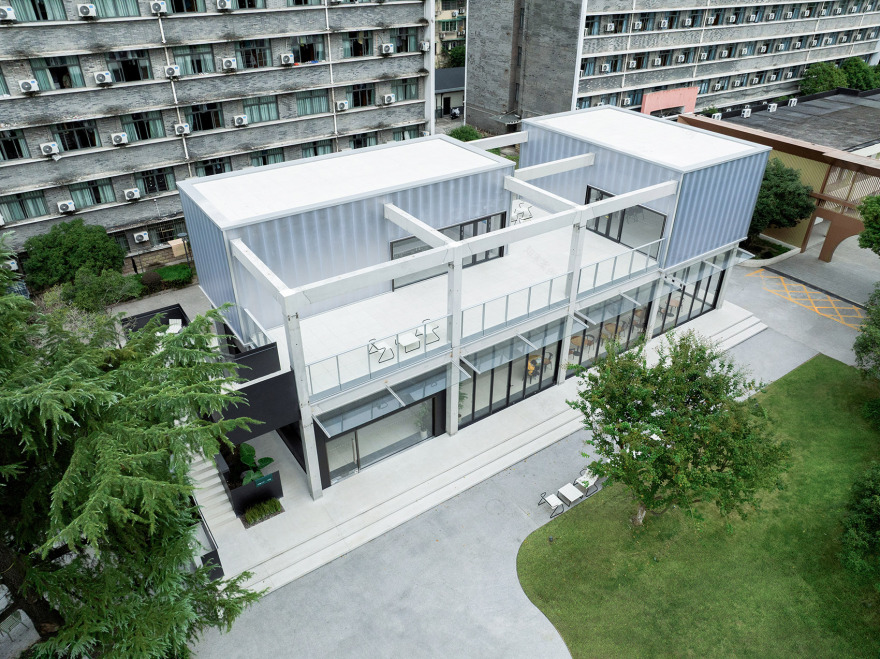
项目位于浙江工业大学朝晖校区,由集团发起捐建并全程主导规划、设计及建造。自主研发的新型装配式连接装置实现国内首个装配式混凝土框架全干式连接,11天完成主体结构施工的效率纪录,不仅破解了传统建造“低效高耗”的行业痛点,更以100%装配率与全过程低碳建造,树立了建筑工业化的实践标杆。
Located at Zhejiang University of Technology’s Zhaohui Campus, the project was initiated, donated, and fully led by the Group in terms of planning, design, and construction. The independently developed new-type prefabricated connection device has realized China’s first full dry connection for prefabricated concrete frames, achieving the record of completing the main structure construction in 11 days. This not only addresses the industry pain point of “low efficiency and high consumption” in traditional construction but also sets a practical benchmark for construction industrialization with a 100% prefabrication rate and whole-process low-carbon construction.
▼项目概览,overview of the project © 浙江工业大学工程设计集团


01 全装配式:像造汽车一样造房子
Full Prefabrication: Building Houses Like Assembling Cars
当前建筑工业化为何遇到瓶颈?核心问题在于技术路径存在缺陷。现有主流工业化模式采用“预制构件+现浇结构”叠合体系,实际应用中既增加建设成本,又延长施工工期,导致工业化本应具备的效率与经济性优势被削弱,成为技术推广的核心障碍。▼结构叠合体系,structure composite system © 浙江工业大学工程设计集团

Why does current construction industrialization face bottlenecks? The core issue lies in flawed technical paths. The existing mainstream industrialization model adopts a composite system of “prefabricated components + cast-in-place structures,” which in practical application both increases construction costs and extends construction periods. This weakens the efficiency and economic advantages that industrialization should inherently possess, becoming a key obstacle to technical promotion.
▼沿街视角,street view © 浙江工业大学工程设计集团

项目正是针对该痛点开展的技术验证载体,聚焦如同造汽车般的“全预制、全拼装”建造体系,通过全流程技术攻关与实证检验,形成系统性解决方案。设计体系以“构件标准化”为核心提升效率。在设计初期控制主体结构的尺寸类型,采用“小规格、多组合”的策略提升工厂预制效率,同时对大构件进行科学拆分。
Targeting this pain point, the project serves as a technical verification carrier, focusing on a “fully prefabricated, fully assembled” construction system similar to automobile manufacturing. Through whole-process technical research and empirical testing, a systematic solution has been formed. The design system takes “component standardization” as the core to improve efficiency. In the initial design stage, the size types of the main structure are controlled, and a strategy of “small specifications with multiple combinations” is adopted to enhance factory prefabrication efficiency, while large components are scientifically split.
▼构件标准化,component standardization © 浙江工业大学工程设计集团

项目主体结构全部采用预制混凝土构件,包括梁、柱、楼板及墙体等核心构件,现场施工仅需完成模块化拼装作业,彻底取消湿作业环节及配套机械设备,实现“全预制、全拼装”的建造模式。该模式达成100%装配率的行业高标准,在工期缩短与成本控制方面实现双重优化。
The entire main structure of the project uses prefabricated concrete components, including beams, columns, floor slabs, and walls. On-site construction only requires modular assembly operations, completely eliminating wet work and supporting mechanical equipment, and realizing a “fully prefabricated, fully assembled” construction model. This model achieves the industry’s high standard of 100% prefabrication rate, realizing dual optimization in construction period reduction and cost control.
▼搭建过程,construction process © 浙江工业大学工程设计集团
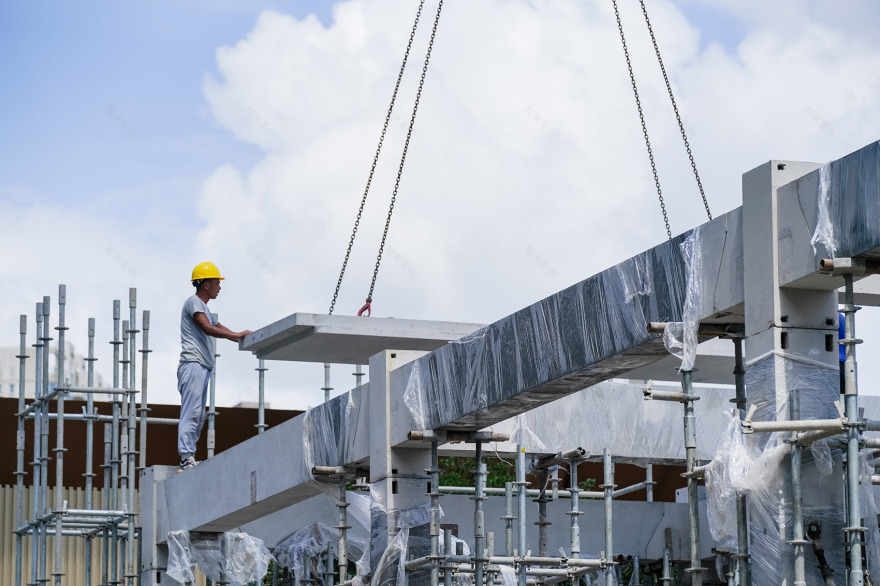

我们围绕核心环节开展三级技术验证,并取得了一系列关键成果:首先,在实验室环境下完成连接件破坏性试验,实测数据表明其力学强度达到甚至超过现浇结构;其次,成功生产出符合毫米级精度要求的混凝土构件,验证工厂化高精度制造的可行性;最后在毫米级容错控制范围内,完成大型构件现场精准安装,通过量化实验数据将高难度装配操作转化为可复制的工程实践。
We conducted three-level technical verification around core links and achieved a series of key results: first, completing destructive tests on connectors in a laboratory environment, with measured data showing that their mechanical strength meets or exceeds that of cast-in-place structures; second, successfully producing concrete components meeting millimeter-level precision requirements, verifying the feasibility of factory high-precision manufacturing; finally, completing the on-site precise installation of large components within millimeter-level error tolerance, converting high-difficulty assembly operations into replicable engineering practices through quantitative experimental data.
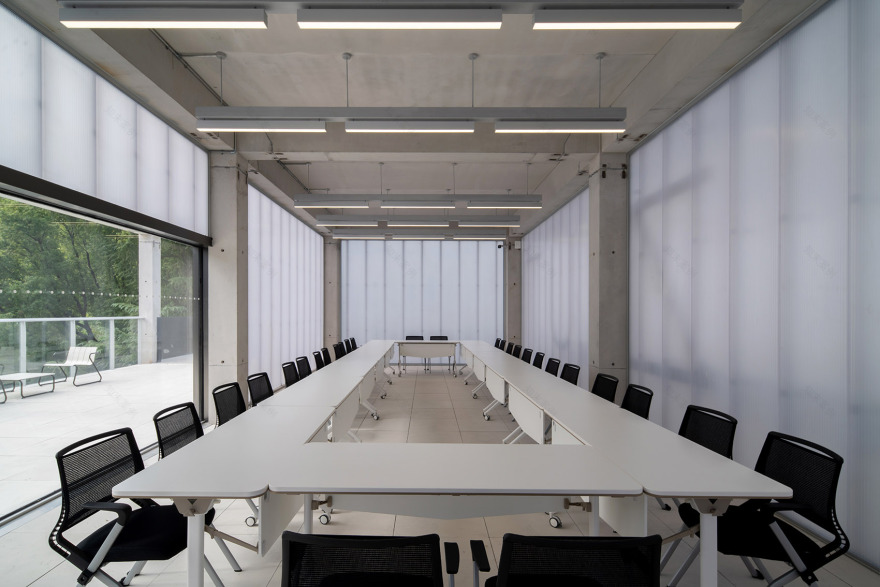
▼室内空间概览,interior space overview © 浙江工业大学工程设计集团


在实际安装时,单边容错精度控制在2毫米范围内,在不依赖辅助定位机械的条件下,仅通过人工吊装完成构件精准就位。实证结果表明,即便在高精度控制要求下,大尺寸预制构件的现场装配仍具备工程可行性。该体系同时实现构件内部钢筋的全干式连接,其成功验证了完全通过干作业完成建筑主体施工的可行性:不仅适用于低层建筑,更可延伸至高层建筑领域。传统现浇工艺可实现的建筑类型,全装配体系均能覆盖,实现全场景适用的技术目标。
During actual installation, the unilateral error tolerance is controlled within 2 millimeters, and precise component positioning is achieved through manual hoisting without relying on auxiliary positioning machinery. Empirical results show that even under high-precision control requirements, on-site assembly of large-size prefabricated components remains technically feasible. The system also realizes full dry connection of internal steel bars in components, successfully verifying the feasibility of completing main building construction entirely through dry work: it is not only applicable to low-rise buildings but also extendable to high-rise buildings. The full prefabrication system can cover all building types that traditional cast-in-place technology can achieve, fulfilling the technical goal of full-scenario applicability.
▼会议室,conference room © 浙江工业大学工程设计集团
从技术发展视角看,未来AI系统可实现建筑结构向标准构件的自动拆解,所有构件经工厂预制、编号后,运至现场按序组装。这种智能化建造模式有望成为建筑行业主流形态。建筑机械领域将同步革新,尤其是吊装设备需向工业化、智能化方向升级;施工现场无需满堂脚手架及大量人工浇筑作业,取而代之的将是大型智能机械臂,实现预制构件如同“造车”般的快速精准组装。
From a technical development perspective, future AI systems may automatically disassemble building structures into standard components. All components will be prefabricated and numbered in factories before being transported to the construction site for sequential assembly. This intelligent construction model is expected to become the mainstream form of the construction industry. Synchronous innovations will occur in construction machinery, especially hoisting equipment, which needs to upgrade toward industrialization and intelligence. On-site construction will no longer require full scaffolding and extensive manual pouring; instead, large intelligent robotic arms will enable rapid and precise assembly of prefabricated components, similar to “automobile manufacturing.”
▼窗景,window view © 浙江工业大学工程设计集团

02结构即空间,形式即功能
Structure is Space, Form is Function
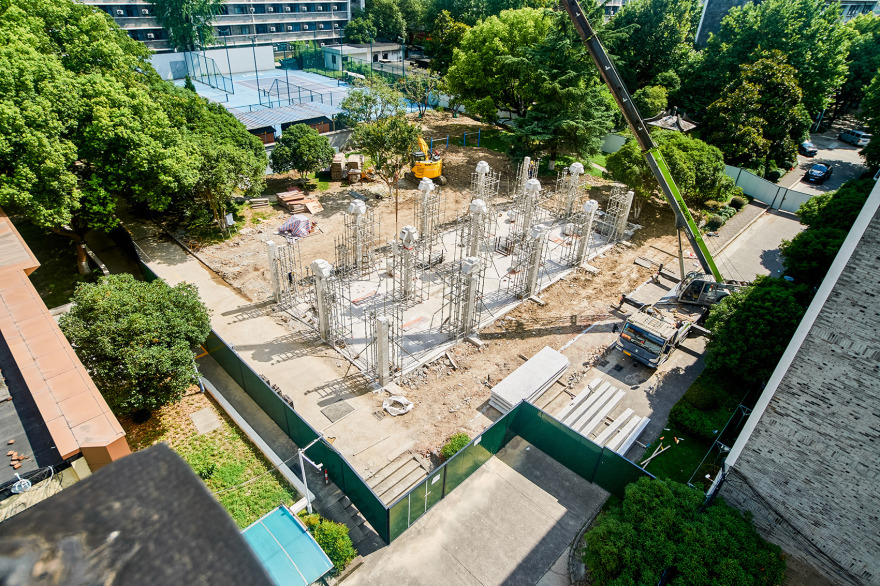
项目秉持“结构-空间-形式”一体化设计理念,将装配式混凝土框架系统同时作为结构承载体系、空间划分网格与立面形态语言,实现三者的高度统一。作为创新性装配式结构的首次试验性建筑,设计在技术创新与成本控制之间寻求平衡,采用6m×4.8m×4.2m的标准化单元模块,通过水平阵列与垂直堆叠完成整体形态构建。
Adhering to the integrated design concept of “structure – space – form,” the project uses the prefabricated concrete frame system as the structural load-bearing system, spatial division grid, and facade form language, achieving a high degree of unity among the three. As the first experimental building of an innovative prefabricated structure, the design balances technological innovation and cost control, adopting standardized unit modules of 6m×4.8m×4.2m to construct the overall form through horizontal arrangement and vertical stacking.
▼采用标准化单元模块装配,adopting standardized unit modules © 浙江工业大学工程设计集团
03场地策略:校园消极空间的激活与重构
Site Strategy: Activation and Reconstruction of Negative Campus Space
设计通过原生性、高通透性的框架结构消解建筑实体边界,实现与校园环境的有机衔接。针对校园公共空间匮乏的现状,采用弹性空间设计与开放性景观营造相结合的方式,构建师生自发聚集、多元互动的公共场域,使这片被遗忘的消极空间重新融入校园活力网络。
▼高通透性的框架结构,highly permeable frame structure © 浙江工业大学工程设计集团

Through a primitive, highly permeable frame structure, the design dissolves the physical boundaries of the building, realizing organic integration with the campus environment. Addressing the lack of public space on campus, the project combines flexible space design with open landscape creation to build a public domain for spontaneous gathering and diverse interaction among teachers and students, reintegrating this forgotten negative space into the campus vitality network.
▼开放性景观营造,open landscape creation © 浙江工业大学工程设计集团

透明性是建筑核心的物理与空间特征。物理透明性通过材料选择与构造设计实现,有效消解室内外空间界限;现象透明性则体现于空间组织与感知逻辑中——以两个矩形体块的旋转叠合为基本形态策略,使内部功能布局与空间组织在立面上形成清晰视觉关联。
Transparency is the core physical and spatial characteristic of the building. Physical transparency is achieved through material selection and structural design, effectively dissolving the boundary between indoor and outdoor spaces; phenomenal transparency is reflected in spatial organization and perceptual logic – adopting the basic form strategy of rotating and overlapping two rectangular volumes, forming a clear visual connection between internal functional layout and spatial organization on the facade.
▼透明性的建筑,transparency building © 浙江工业大学工程设计集团

04无界共生
Unbounded Symbiosis
景观设计以环境协调为旨归:整体铺设的灰色露骨料透水混凝土,点缀自然色调火山岩碎石;建筑边缘以观赏草与蕨类植物进行“柔性衔接”,保留香樟、雪松及十余株桂花延续场地绿意基底。
Landscape design is guided by environmental coordination: gray exposed aggregate permeable concrete is laid throughout the site, dotted with natural-toned volcanic rock gravel; the building edges are “flexibly connected” with ornamental grasses and ferns, preserving camphor trees, cedar trees, and more than ten osmanthus trees to continue the site’s green base.
▼景观设计以环境协调为旨归,landscape design is guided by environmental coordination © 浙江工业大学工程设计集团

植物配置遵循“乡土、适生”原则,以南天竹、十大功劳、红盖鳞毛蕨、山麦冬等本土植物为基底,结合火山岩碎石,点缀穗花牡荆、矮蒲苇、圆锥绣球、狼尾草等适生品种,营造低维护成本的植物空间。场地东南角曾承载集体记忆的露天电影场,现已改造为开放草坪与景墙组合的景观节点,为场地后续使用预留空间。
Plant configuration follows the principle of “local and adaptable species,” taking native plants such as Nandina domestica, Mahonia fortunei, Dryopteris erythrosora, and Liriope spicata as the base, combined with volcanic rock gravel, and dotted with adaptable species such as Vitex agnus-castus, Cortaderia selloana, Hydrangea paniculata, and Pennisetum alopecuroides to create a low-maintenance plant space. The open-air cinema at the southeast corner of the site, which once carried collective memories, has been transformed into a landscape node combining an open lawn and a scenic wall, reserving space for future use of the site.
▼植物配置,plant configuration © 浙江工业大学工程设计集团

05结语:可复制的“盒子”
Conclusion: A Replicable “Box”
“印象工大·尚盒”的实践为建筑工业化瓶颈提供了宝贵的破局思路。从高精度构件制造到现场高效拼装,其探索验证了“全预制”模式的可行性,彰显了行业引领者的担当与创新精神。该实践不仅推动建筑工业化技术迭代,更为智能建造发展夯实实践基础。我们相信,未来建筑工业化将与人工智能深度融合,为建筑业带来全方位革新,从而推动行业高质量发展,为中国式现代化建设贡献力量!
The practice of “G-CUBE” provides valuable insights for breaking through construction industrialization bottlenecks. From high-precision component manufacturing to on-site efficient assembly, its exploration verifies the feasibility of the “fully prefabricated” model, demonstrating the responsibility and innovative spirit of an industry leader. This practice not only promotes the technological iteration of construction industrialization but also lays a solid practical foundation for the development of intelligent construction. We believe that future construction industrialization will be deeply integrated with artificial intelligence, bringing comprehensive innovations to the construction industry, thereby promoting high-quality development of the industry and contributing to the construction of Chinese-style modernization.
▼夜景,nightview © 浙江工业大学工程设计集团


▼总平面图,master floor plan © 浙江工业大学工程设计集团

▼二层平面图,second floor plan © 浙江工业大学工程设计集团

▼立面图,elevation © 浙江工业大学工程设计集团


▼剖面图,section © 浙江工业大学工程设计集团

▼结构细部,detail drawing © 浙江工业大学工程设计集团

项目名称:印象工大·尚盒
项目类型:结构/建筑
设计方:浙江工业大学工程设计集团有限公司
项目设计:2025年
完成年份:2025年
项目地址:浙江工业大学朝晖校区尚德园
建筑面积:390㎡
摄影版权:浙江工业大学工程设计集团有限公司
合作方:浙江新盛建设集团有限公司、浙江省建材集团建筑产业化有限公司、南京中瓴华汇新材料系统工程集团有限公司
客户:浙江工业大学
材料:装配式混凝土构件、聚碳酸酯板、装配式金属集成保温幕墙、UHPC、超窄框折叠门窗
品牌:Buranger 博安固,ELKOM 艾克普,TRM Fold 拓尔玛, 中瓴华汇
结构(主导):应义淼、郑曙光、周嵘、金成、谢启航
建筑:陈宇飏、魏丹枫、王伟栋、金伟国
景观:蔡笑昂、吴绍飞、黄海珠
Project name: G-CUBE
Project type: Structure / Architecture
Design: Zhejiang University of Technology Engineering Design Group Co.,Ltd
Design year: 2025
Completion Year: 2025
Project location: Zhejiang University of Technology Zhaohui Campus
Gross built area: 390㎡
Photo credit: Zhejiang University of Technology Engineering Design Group Co.,Ltd
Partner: Xinsheng Group、ZCIGC、Zhong Ling Hua Hui
Clients: Zhejiang University of Technology
Structure (Leading): YING Yimiao, ZHENG Shuguang, ZHOU Rong, JIN Cheng, XIE Qihang
Architecture: CHEN Yuyang, WEI Danfeng, WANG Weidong, JIN Weiguo
Landscape Architecture: CAI Xiao’ang, WU Shaofei, HUANG Haizhu
南京喵熊网络科技有限公司 苏ICP备18050492号-4知末 © 2018—2020 . All photos and trademark graphics are copyrighted by their owners.增值电信业务经营许可证(ICP)苏B2-20201444 苏公网安备 32011302321234号
苏公网安备 32011302321234号客服
消息
收藏
下载
最近