

创作上传
VIP
收藏下载
登录 | 注册有礼
查看完整案例

收藏

下载

分享
引子
Prologue
我是一名建筑师,妻子是媒体人。这是我们的第一个家,也是我第一次设计自己的居住空间。房子建筑面积75㎡,套内65㎡,房龄30年,是典型的“老破小”。设计目标是在解决实际功能需求的同时,在这个规矩的小户型里创造出清晰、纯粹且丰富的空间。这是一个建筑师自宅的室内改造设计。
I am an architect, and my wife works in the media. This is our first home, and also my first time designing my own living space. With a gross floor area of 75㎡ and a net floor area of 65㎡, this 30-year-old residence is a typical “old, shabby and small” apartment. The design goal is to meet practical functional needs while creating a clear, pure and rich spatial experience within this regular small unit. This is a design of the interior renovation of an architect’s own home.
▼项目概览,Project overview © 崔翔

各自为政
CompartmentalizedSpaces
房子位于北京东三环,是上世纪90年代的砖混板楼。我家在四层,既是顶层也是暖气管道层,户内暖气管道纵横。原始户型为两室一厅,厨房、卫生间与两个南向卧室均由墙体四面围合,各自独立。客餐厅虽南北连通,但中间十余公分高差形成了不必要的区隔。厨房狭长局促,单边长条空间半数沦为走道,加设冰箱后,操作与储藏空间严重不足,仅容一人使用,且缺乏互动。卫生间仅3平方米,需塞下淋浴、马桶、洗手台甚至洗衣机,封闭昏暗。所幸双南卧与南北通透带来了良好的采光与通风,这是难得的优点。
The house is located near the East Third Ring Road in Beijing, a brick-concrete slab building built in the 1990s. Our home is on the 4th floor, which is both the top floor and the heating pipeline floor, with indoor heating pipelines crisscrossing. The original layout is two bedrooms and one living room; the kitchen, bathroom and two south-facing bedrooms are each enclosed by walls on four sides, completely independent. Although the living and dining areas are connected north-south, there is a height difference of over 10cm between them, causing unnecessary division. The kitchen is narrow and cramped—half of the single-sided long space is reduced to a walkway, and with a refrigerator added, the operation and storage space is seriously insufficient. It can only accommodate one person to use, lacking interaction. The 3-square-meter bathroom has to fit a shower, toilet, sink and even a washing machine, being closed and dim. Fortunately, the two south-facing bedrooms and north-south ventilation bring good lighting and air circulation, a rare advantage.
▼房屋原状,Original condition of the house © 崔翔

打破边界
Breaking Boundaries
购房前已确认,厨房和卫生间东侧的两面墙是屋内仅有的可拆除墙体,为改造提供关键可能。基于此,首先拆除厨房隔墙,铲平客餐厅间的高差,将厨房、餐厅、客厅、入户空间重新聚合,形成一个完整、团结且开放的状态。其次,将卫生间隔墙外移一个洗手台深度以扩展空间。拆改后形成“1个公区+3个私区”格局,但公区仅在概念上串联私区,物理空间仍相互独立,仅通过门洞连接,界面封闭导致感知层面的割裂。唯有打破并模糊公私边界,让空间互相渗透,侵占彼此,整个空间才能水乳交融地融合在一起。
Before purchasing the house, it was confirmed that the two walls on the east side of the kitchen and bathroom are the only detachable walls indoors, providing a key possibility for renovation. Based on this, first, the kitchen partition wall was demolished, the height difference between the living and dining areas was leveled, and the kitchen, dining room, living room and entrance space were re-gathered into a complete, unified and open state. Second, the bathroom partition wall was moved outward by the depth of a sink to expand the space. After renovation, a layout of “1 public area + 3 private areas” was formed, but the public area only connects the private areas conceptually—the physical spaces are still independent, connected only by door openings. The closed interfaces lead to fragmentation in perception. Only by breaking and blurring the public-private boundary, allowing spaces to penetrate and overlap with each other, can the entire space blend harmoniously.
▼拆改前后格局对比,Layout comparison before and after demolition & renovation © 崔翔

▼拆除与新建部分示意图,Demolished and newly built parts © 崔翔

▼一个公区+三个私区的空间格局,Spatial layout of “1 public area + 3 private areas” © 崔翔

“体块+板片+杆件” “Block + Slab + Stick”
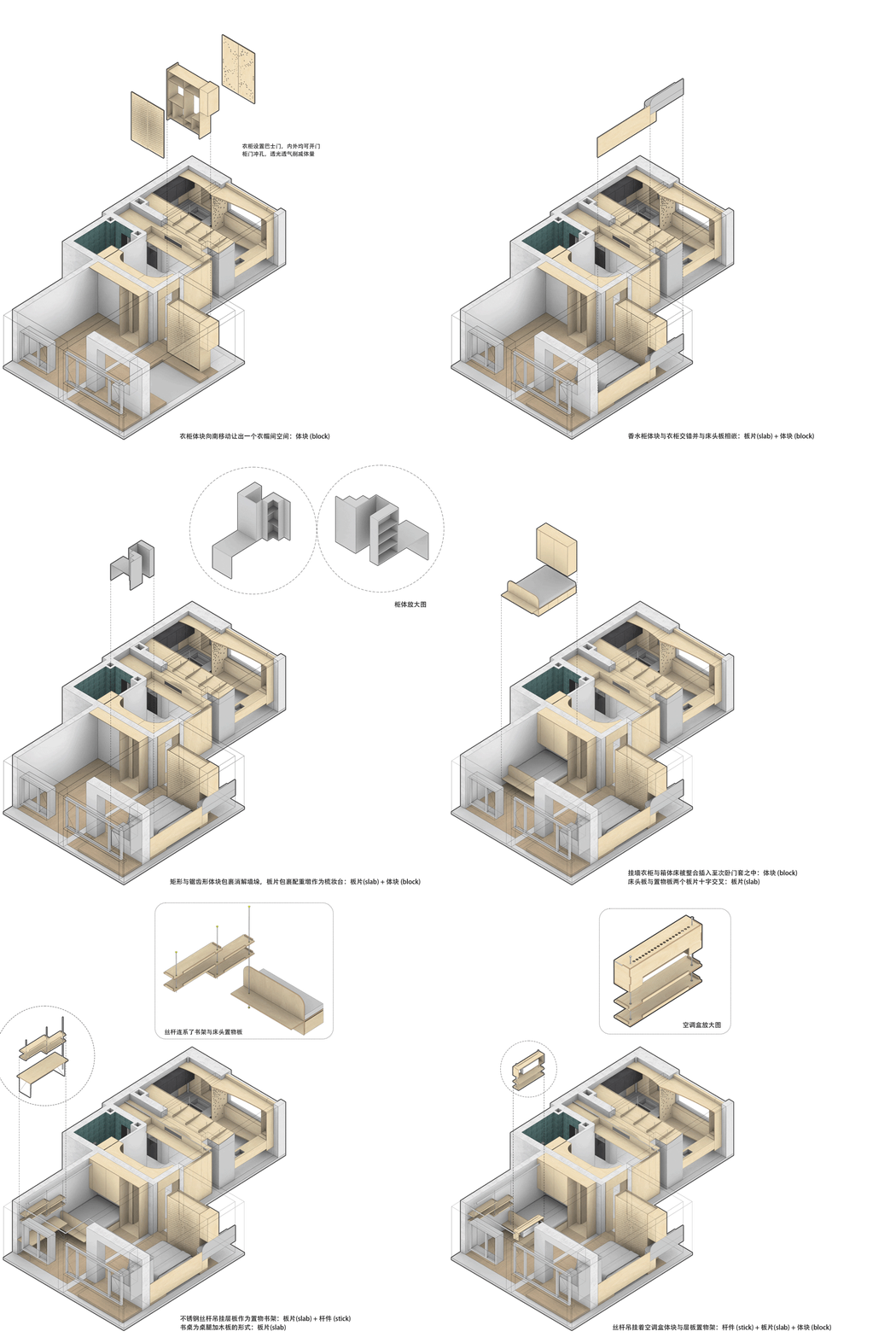
为实现空间效果与功能需求,设计引入源于建构教学的改良方法:将功能与使用抽象为 “体块 + 板片 + 杆件” 三种几何要素,通过梳理三者关系塑造空间。
体块:兼具占据/界定空间和内部容纳的双重属性。将水吧台、洗衣机盒、玄关柜、衣柜、厨电柜、卫浴柜等具容纳功能的部分抽象为纯净体块。
板片:通过表面界定空间,对空间做水平与垂直方向的限定,同时起承托与分隔作用。如吊顶、厨房台面、书架、床头板、门等可视为板片。
杆件:起结构与连系作用,与板片结合形成结构体,也可限定划分空间,本身不承担具体功能。
To achieve both spatial effects and functional requirements, the design introduces an improved method derived from tectonic teaching: abstract functions and usage into three geometric elements—”Blocks+ Slabs + Sticks”, and shape the space by sorting out the relationships between them.
Blocks: Have dual attributes of occupying/defining space and internal containment. Components with containment functions such as the water bar, washing machine box, entrance cabinet, wardrobe, kitchen appliance cabinet and bathroom cabinet are abstracted into pure blocks.
Slabs: Define space through their surfaces, limiting space horizontally and vertically, while playing the role of supporting and separating. For example, ceilings, kitchen countertops, bookshelves, headboards and doors can be regarded as slabs.
Sticks: Serve structural and connecting purposes, combining with slabs to form structures; they can also limit and divide space without undertaking specific functions themselves.
▼杆板体三要素示意图,Three elements: sticks, slabs and blocks © 崔翔

四面玲珑的大家具
A Versatile Large Furniture Piece
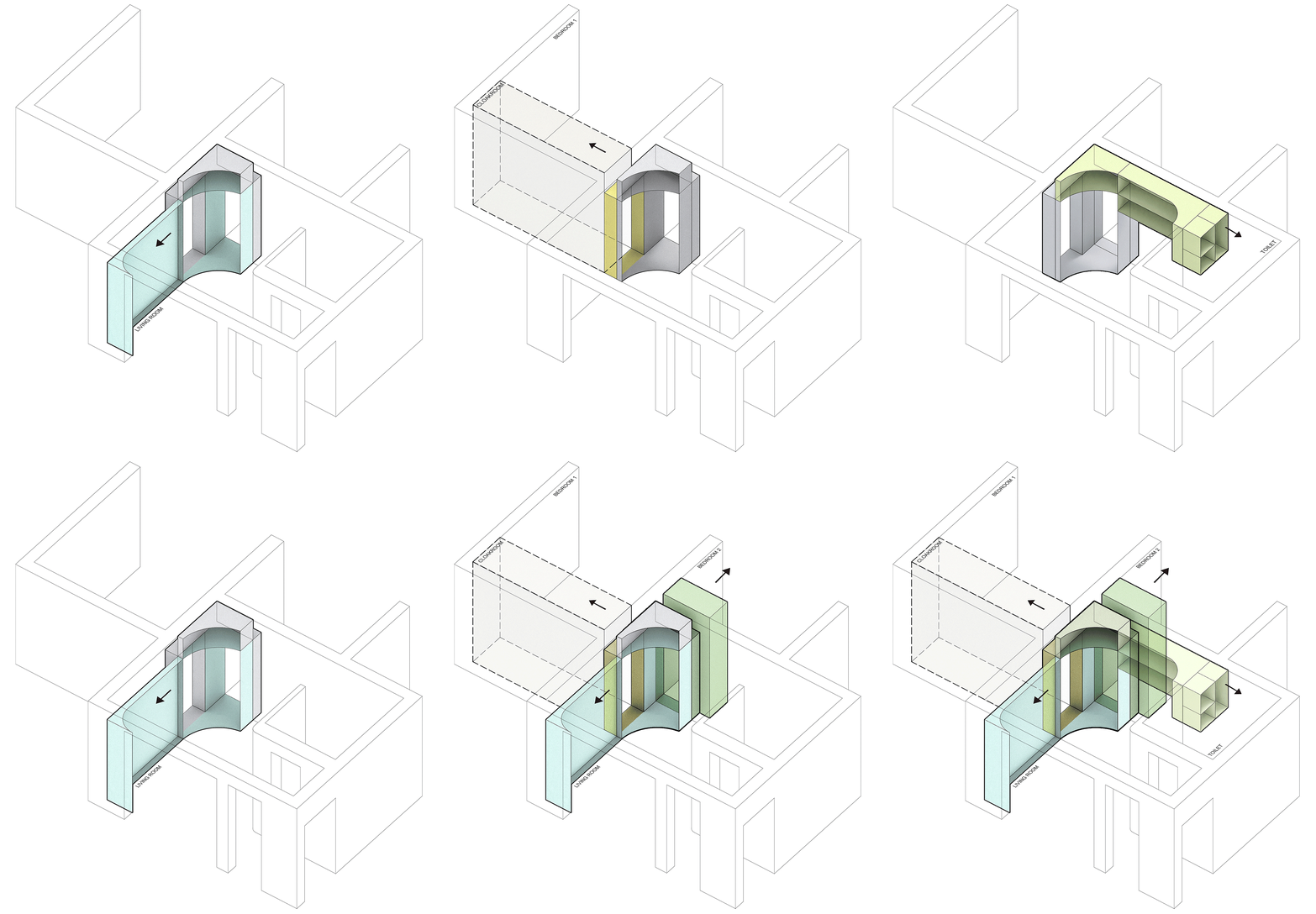
为打破公私边界,在公区与三个私区交接处,以转角门洞为中轴,置入一个向四周延伸的“大家具”。其延伸进入私区的条件由三个体块创造:卫生间方面,借隔墙外移契机,在隔墙端头置入深65cm、高145cm的不锈钢洗衣机盒体,由 1 公分底板与 5mm 厚围合钢板焊接而成,纤薄材质最大化释放内部空间,可容纳两台洗衣机,同时隐藏此处的暖气管道。盒体打开洞口,公区与卫生间上部用磨砂玻璃区隔,通过光线通透保证空间连续。次卧北墙设置 50 公分深衣柜体块,间接增加门洞口深度,延伸公区与次卧的过渡空间;主卧因进深过深,将常规靠墙大衣柜向南移 90 公分,闪出过道作为 “步入式衣帽间”,地面材质与公区一致,暗示其兼具公共属性。借由这些体块创造的条件,大家具分别向三个私区过渡:向次卧伸出套口与衣柜整合;向主卧延伸出衣帽间虚体量;向卫生间伸入置物格落在不锈钢盒子上;同时向公区延伸板片作为沙发背景墙,以圆弧连接客厅角部空间。四部分在转角门洞处交叠,转角处两扇门关闭时平嵌于大家具内,利用套口板材厚度做档口与合页板,消解常规门套。这个枢纽般的大家具,连结四区,消解了各自为政的局面,空间在此处既有融合也有区分,同时也成为视觉路径关键节点。
To break the public-private boundary, a “large furniture” extending around with the corner door opening as the central axis is placed at the junction of the public area and the three private areas. The conditions for its extension into the private areas are created by three blocks:
For the bathroom, taking the opportunity of moving the partition wall outward, a 65cm-deep and 145cm-high stainless steel washing machine box is placed at the end of the partition. Welded with a 1cm-thick bottom plate and 5mm-thick enclosing plates, the thin material maximizes the internal space, accommodating two washing machines while hiding the heating pipelines here. The box opens an opening; the upper part of the public area and the bathroom is separated by frosted glass, ensuring spatial continuity through light transmission. A 50cm-deep wardrobe block is installed on the north wall of the secondary bedroom to indirectly increase the depth of the door opening and extend the transition space between the public area and the secondary bedroom. Due to the excessive depth of the master bedroom, the conventional wall-mounted large wardrobe is moved 90cm southward to free up an aisle as a “walk-in cloakroom”. The floor material is the same as that of the public area, implying its partial public attribute.
With the conditions created by these blocks, the large furniture transitions into the three private areas respectively: extending a sleeve into the secondary bedroom to integrate with the wardrobe; extending a virtual volume of the cloakroom into the master bedroom; extending a storage grid into the bathroom to rest on the stainless steel box; at the same time, extending a slab into the public area as the sofa background wall, connecting the corner spaces of the living room with an arc. The four parts overlap at the corner door opening. When the two doors at the corner are closed, they are flatly embedded in the large furniture. The thickness of the sleeve plate is used to make the stop and hinge plate, eliminating conventional door sleeves. This hub-like large furniture connects the four areas, eliminating the segregated situation. The space here is both integrated and differentiated, and also becomes a key node in the visual path.
▼体块的置入为空间的渗透创造了条件,Block placement creates conditions for spatial penetration © 崔翔

▼四面玲珑的“大家具”,The versatile “large furniture piece” © 崔翔

▼转角门洞是空间交叠与发散的中轴核心,The corner door opening is the central axis core of spatial overlap and divergence © 崔翔

▼转角门洞处的前后对比,Comparison of corner door opening before and after © 崔翔
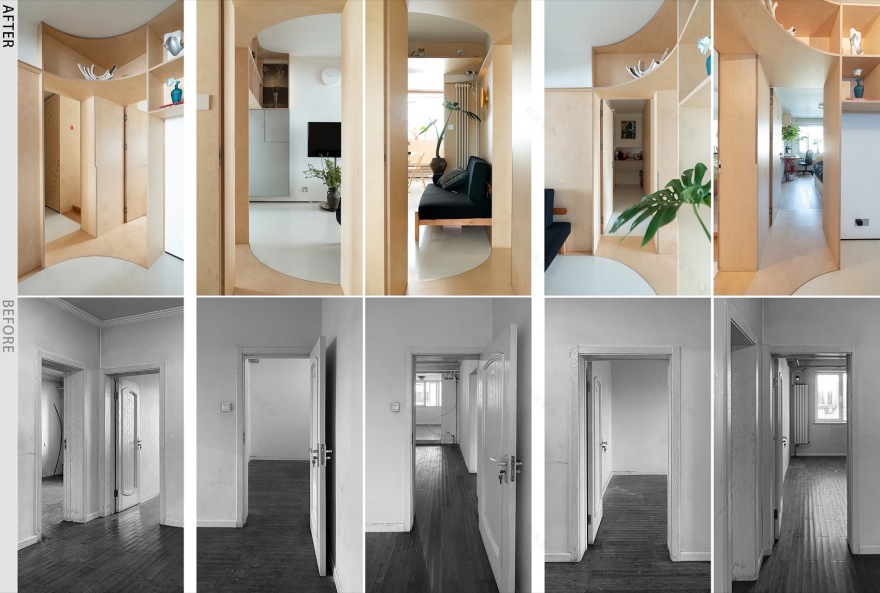
▼两个门洞的整合,Integration of two door openings © 崔翔

一个公区
One Public Area
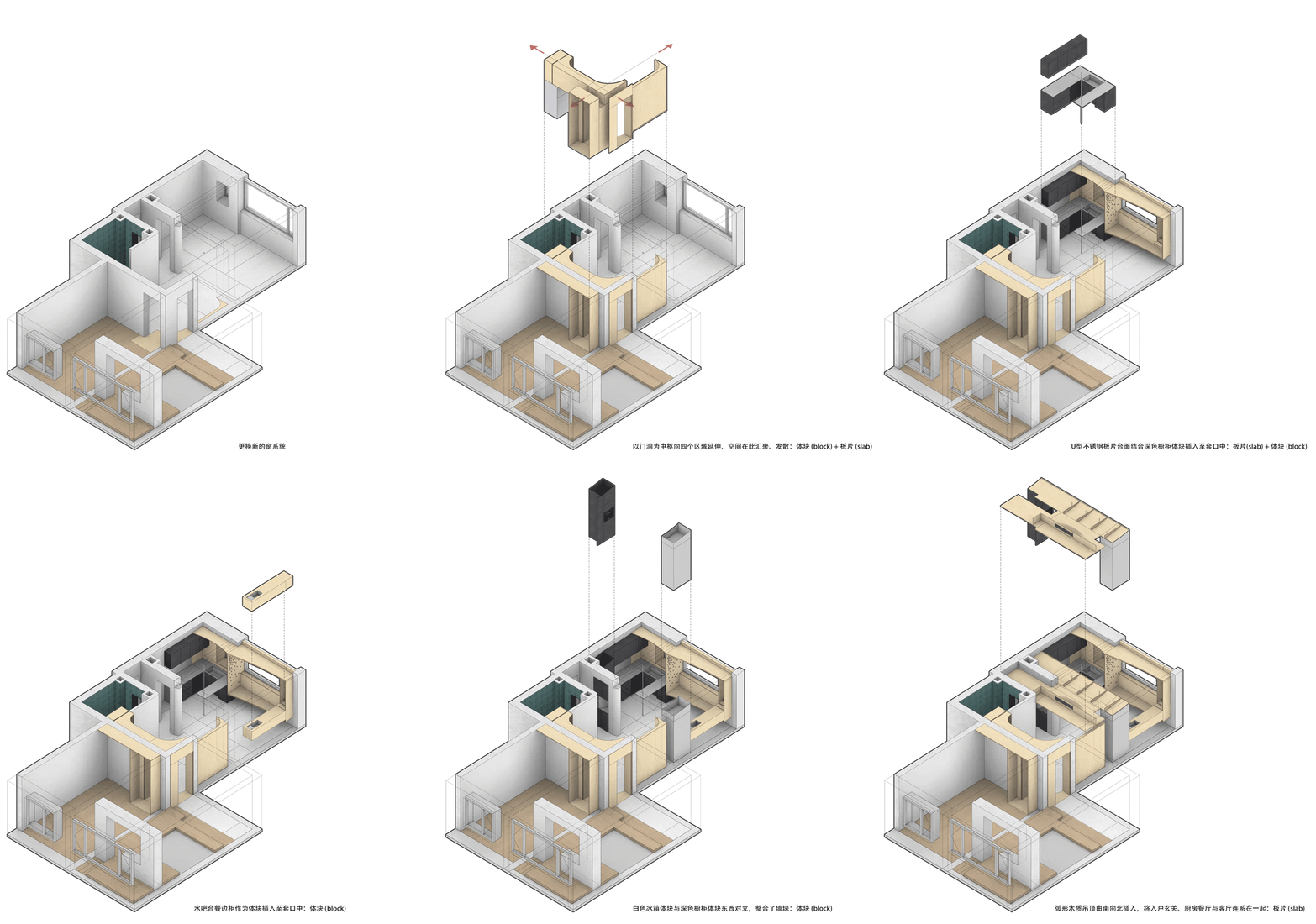
餐厨区域依东西墙对称布局。橱柜吊柜与餐边柜抽象为长条形体块,从各自套口伸出,止于两侧深浅不同的立方体体块——西侧深色立方体整合排烟管井,作为蒸烤箱立柜;东侧浅色立方体利用结构柱深度整合冰箱。厨房操作区由L形橱柜体块和U形不锈钢台面板片构成。8mm厚不锈钢台面与Φ18不锈钢圆杆结合,在一侧悬挑,纤薄钢板压缩垂直空间,增强餐厨通透感。
公区内,梁柱框架将空间分为餐厅、厨房、入口与客厅三部分。为减弱划分、整合区域,在中间梁下插入一片横贯东西的弧形大木板,断开梁柱联系,将各区域拉在一起。木板底标高2.18米,压低的近人尺度衬托南北两侧空间的高。木板在北侧光源处掀起,既引入更多光线进入客厅,又与其他弧形元素呼应。功能上,木板作为吊顶,包覆了风管机、弱电设备、灯具,遮蔽了梁与管道。渐变冲孔作为空调回风口的同时也消解了体量感。木纹南北走向,提示插入方向,强化客餐厅纵深连通感。
整个公区通过体块、板片与杆件的操作,修整原有条件,打破旧有限制。不同限定下的空间相互交叠渗透,在具身感受上将空间揉捏在一起。
The kitchen and dining areas are symmetrically arranged along the east and west walls. The upper kitchen cabinets and sideboards are abstracted into long strip blocks, extending from their respective sleeves and ending at two cubes of different depths on both sides—the dark cube on the west integrates the exhaust pipe shaft as a vertical cabinet for the steam oven; the light-colored cube on the east integrates the refrigerator by using the depth of the structural column. The kitchen operation area is composed of an L-shaped cabinet block and a U-shaped stainless steel countertop slab. The 8mm-thick stainless steel countertop is combined with Φ18 stainless steel round sticks, cantilevered on one side. The thin steel plate compresses the vertical space and enhances the transparency between the kitchen and dining areas.
In the public area, the beam-column frame divides the space into three parts: the dining room, the kitchen, and the entrance with the living room. To weaken the division and integrate the areas, a large arc-shaped wooden board running across east-west is inserted under the middle beam, disconnecting the beams and columns and connecting all areas. The bottom elevation of the wooden board is 2.18 meters; its lowered human-scale sets off the height of the spaces on the north and south sides. The wooden board is lifted at the north light source, not only introducing more light into the living room but also echoing other arc-shaped elements. Functionally, the wooden board serves as a ceiling, covering the air duct unit, weak current equipment and lamps, and hiding the beams and pipelines. The gradual perforation acts as the air conditioning return air outlet while eliminating the sense of volume. The north-south direction of the wood grain indicates the insertion direction and strengthens the sense of depth connection between the living and dining areas.
Through the operation of blocks, slabs and sticks, the entire public area improves the original conditions and breaks the old restrictions. Spaces under different limitations overlap and penetrate each other, integrating the space in terms of embodied perception.
▼连续的弧形套口整合了北侧厨房与餐厅的界面,Continuous arc-shaped opening sleeves integrate north kitchen-dining interface © 崔翔


▼餐厨区的对望,View between kitchen and dining areas © 崔翔

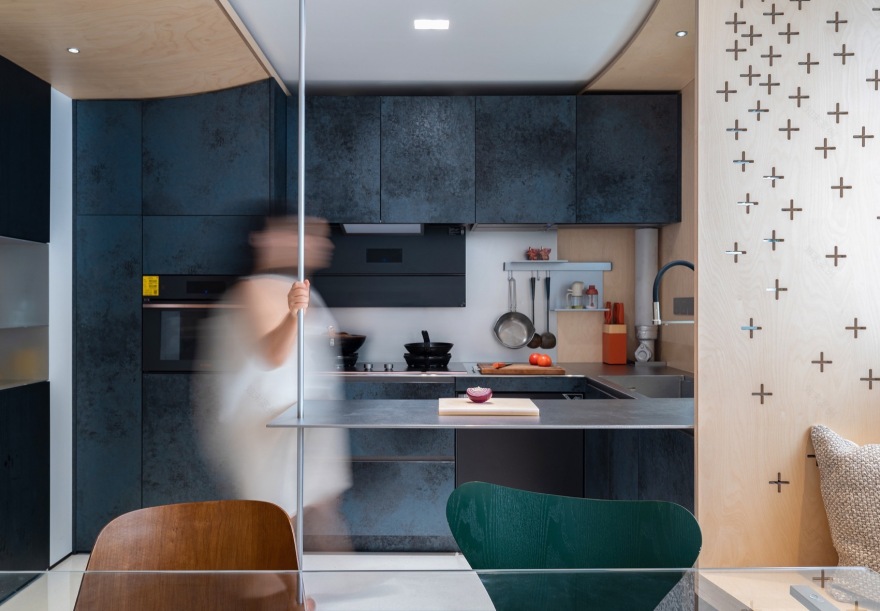
▼弧形吊顶连系了餐厅与客厅,Arc-shaped ceiling connects dining and living rooms © 崔翔

▼客厅空间的内聚,Inward cohesion of living room space © 崔翔

▼打通卫生间与客厅的界限,Breaking the boundary between bathroom and living room © 崔翔
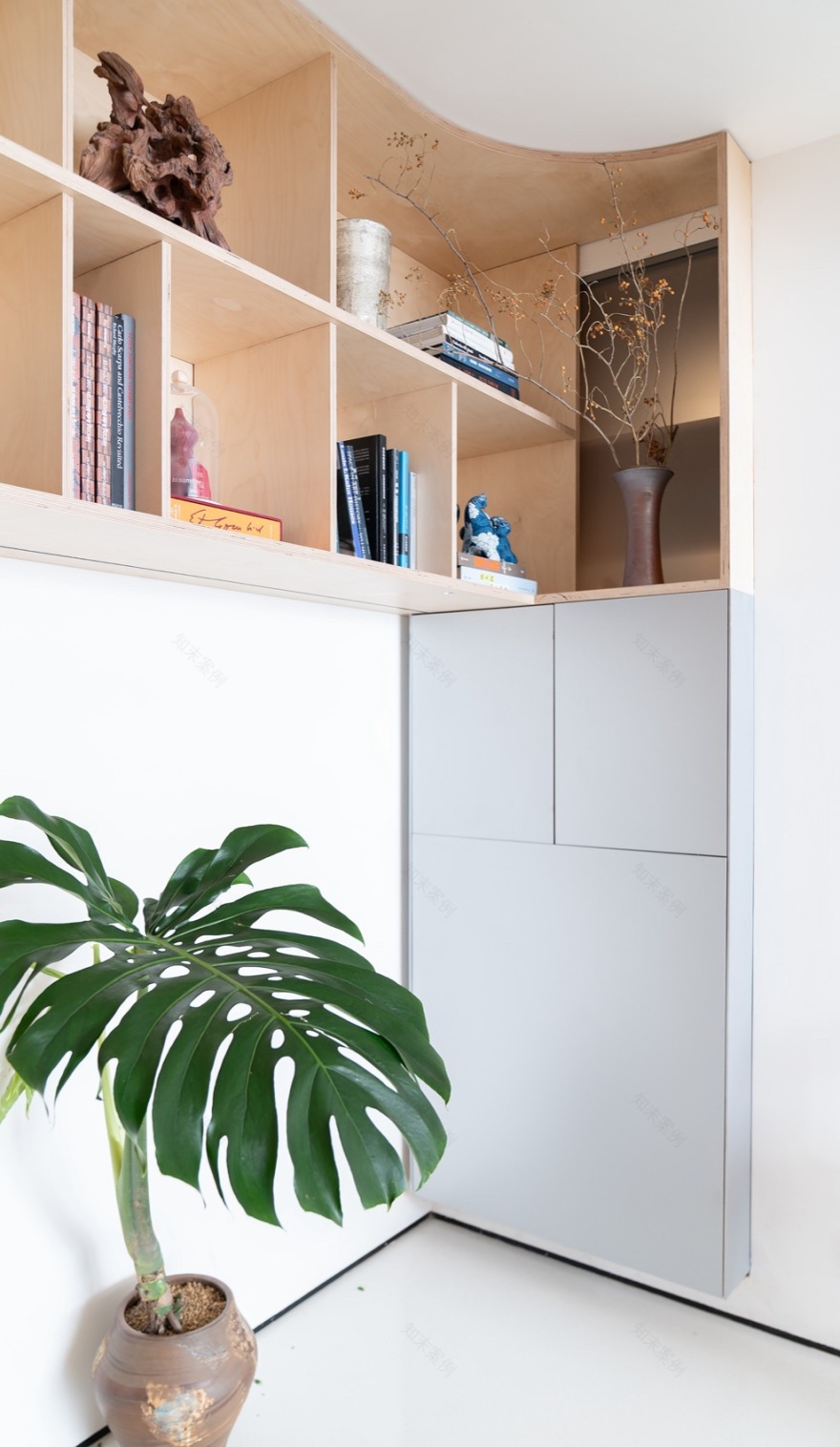
▼餐厨区改造前后对比,Comparison of kitchen-dining area before and after © 崔翔

▼公区部分的空间操作过程图,Spatial operation process of public area © 崔翔
三个私区
Three Private Areas
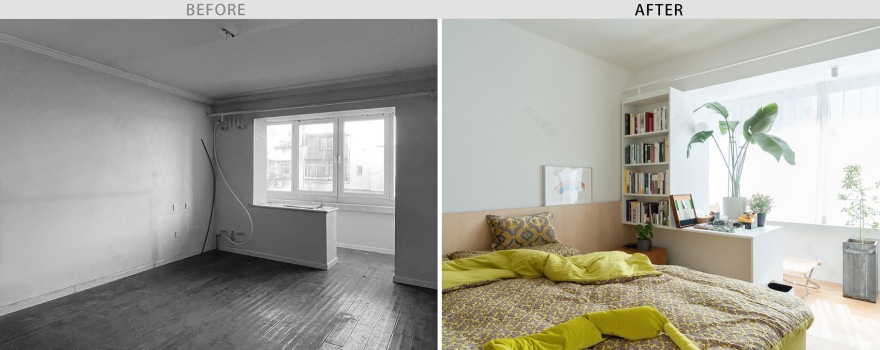
主卧内衣柜体块的置入区分内外。外侧为连通公区的衣帽间,内侧地面抬升为卧室睡眠区。为消解衣柜笨重感,靠东墙垂直插入长条柜体,打通内外,兼作床头柜与首饰台。衣柜内外双侧开门,柜门单双层冲孔板,透光透气,内外的渐变图案,一正一负,互为对照,且冲孔图案对应我们两人的星座。柜门选用巴士轨道,与侧板齐平,保证体量完整。衣柜侧板与墙面夹出 80 公分宽过道,通过一阶踏步进入抬高的睡眠区,净高降低让睡眠空间更具包裹感。利用老房子阳台的配重墩,在墙体内外用板片拼接整合式柜子,墩子表面作为梳妆台,内侧书架与外侧置物格包裹墙垛,形体呈锯齿状消退,拉上窗帘可完全遮蔽墙垛与光线。
The placement of the wardrobe block in the master bedroom distinguishes the inside from the outside. The outside is a cloakroom connected to the public area, and the inside floor is raised as the bedroom sleeping area. To eliminate the bulkiness of the wardrobe, a long strip cabinet is vertically inserted along the east wall, connecting the inside and outside, serving as both a bedside table and a jewelry table. The wardrobe can be opened on both inside and outside sides; the cabinet doors are single-double layer perforated plates, allowing light and air to pass through. The gradient patterns on the inside and outside are positive and negative, contrasting with each other, and the perforated patterns correspond to the constellations of the two of us. Bus tracks are used for the cabinet doors, which are flush with the side panels to ensure the integrity of the volume. An 80cm-wide aisle is formed between the wardrobe side panel and the wall; one enters the raised sleeping area through a step, and the reduced clear height makes the sleeping space more enclosed. Utilizing the weight pier of the old house’s balcony, an integrated cabinet is spliced with slabs inside and outside the wall. The surface of the pier is used as a dressing table; the internal bookshelf and external storage grid wrap the wall pier, and the shape fades in a zigzag pattern. Drawing the curtain can completely shield the wall pier and light.
▼主卧改造前后对比,Comparison of main bedroom before and after © 崔翔
▼主卧的床边细节,Bedside details of main bedroom © 崔翔
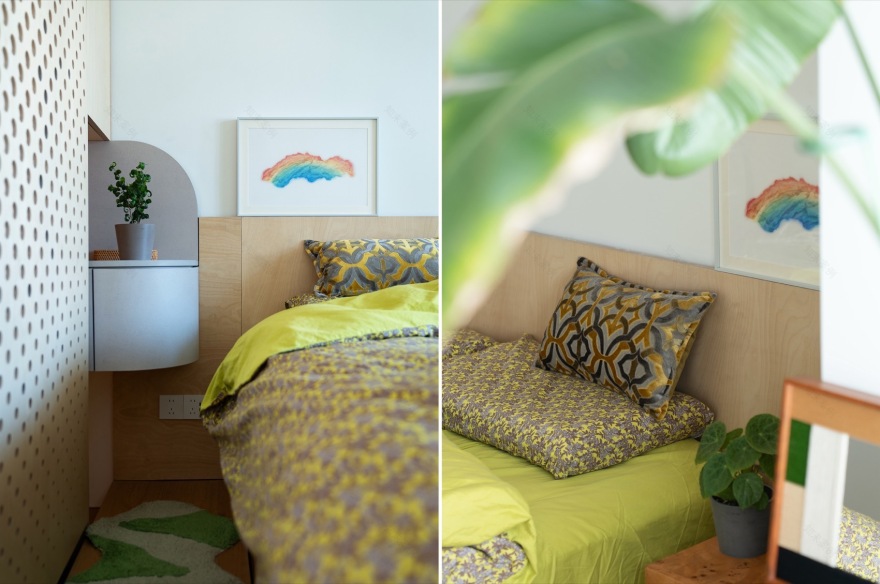
▼星座冲孔图案的柜门,内侧金牛座(左图),外侧双子座,Constellation perforated cabinet door (Taurus inside, Gemini outside) © 崔翔

▼衣柜细节,Wardrobe details © 崔翔

▼两扇齐平的巴士柜门,Two flush bus cabinet doors © 崔翔

▼整合配重墩与墙垛的“zigzag”柜体,”Zigzag” cabinet integrating weight pier and wall column © 崔翔

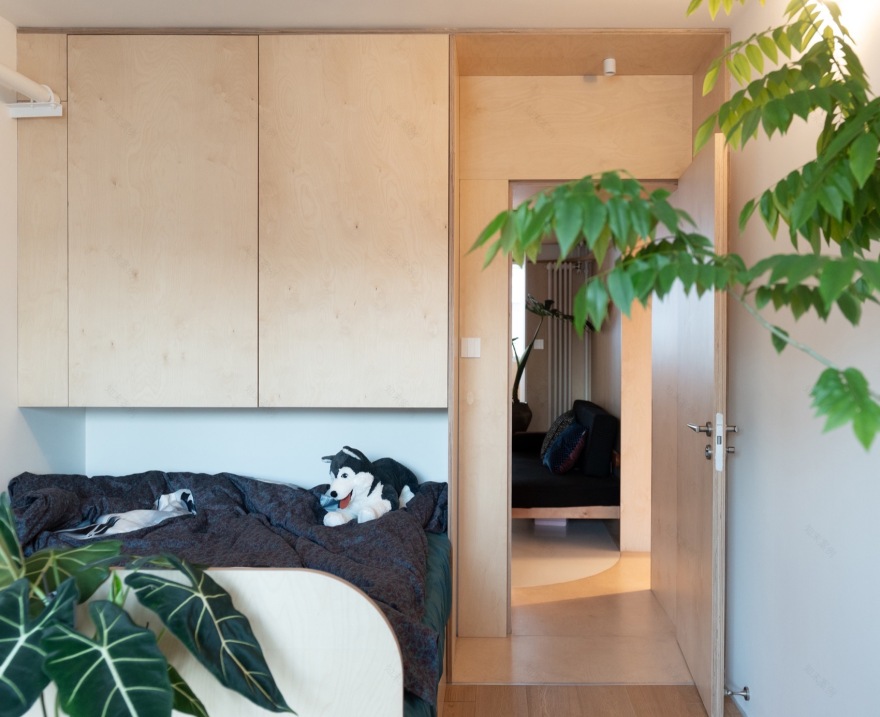
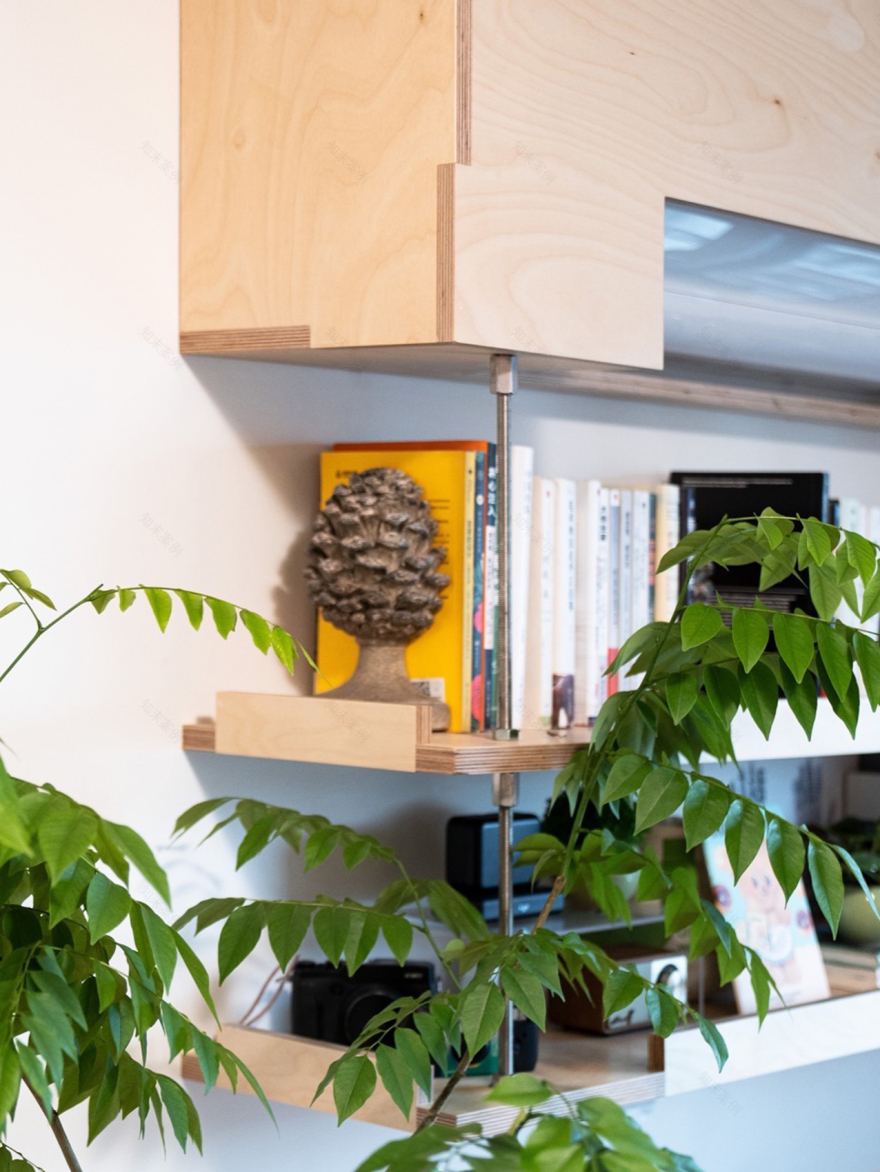
次卧兼具工作区、短期住宿与储物功能。衣柜体块悬挂墙面,床体靠墙伸入衣柜下方,仅留一侧可下床,类似 “炕” 的形式,二者均整合在门套口外侧。床架掀开后可储物,靠过道一侧设三个大抽屉,方便存取日常用品。两人书桌背靠背沿墙面布置,采用桌腿加木板的简约形式。东西墙面各设一组层板书架:西侧为纯粹 “杆 + 片” 体系,丝杆从顶板悬吊连系各层板片,一根丝杆顶天立地,将墙面层板、书桌板与床头层板串联;东侧书架浓缩 “杆 + 片 + 体” 三要素,体块内部包裹空调,丝杆吊起盒子与下方两层板片。
The secondary bedroom serves as a work area, short - term accommodation and storage space. The wardrobe block is hung on the wall, and the bed extends under the wardrobe against the wall, leaving only one side for getting out of bed—similar to a “kang” (traditional Chinese heated brick bed). Both are integrated outside the door sleeve. The inside of the bed frame can be used for storage when opened; three large drawers are arranged side by side on the side near the aisle, facilitating access to daily necessities. The two desks are arranged back to back along the wall, in a simple form of table legs plus wooden boards. A set of laminate bookshelves is installed on each of the east and west walls: the west side is a pure “stick + slab” system, with screw rods suspended from the top plate to connect the laminates, and one screw rod stands from top to bottom, connecting the wall laminates, desk board and bedside laminates; the east side bookshelf condenses the three elements of “stick + slab + block”, with the internal space of the block wrapping the air conditioner, and the screw rods hanging the box and the two lower laminates.
▼次卧改造前后对比,Comparison of secondary bedroom before and after © 崔翔

▼衣柜、门套与床的整合,Integration of wardrobe, door sleeve and bed © 崔翔
▼顶天立地的丝杆连系起了书架、书桌与床头板,Floor-to-ceiling screw rod connects bookshelf, desk and headboard © 崔翔

▼“杆+片+体”构成的空调盒与层板书架,AC box and laminate bookshelf composed of “stick + slab + block” © 崔翔

▼主次卧区域的空间操作过程图,Spatial operation process of main and secondary bedrooms © 崔翔
卫生间由两个大小、颜色不同的空间体互扣构成。小空间瘦高洁白,由墙体东移形成,容纳洗手盆、抽拉柜及大家具延伸进来的洗衣机和置物架套口;大空间设吊顶并内置线性浴霸,标高低于小空间,通铺墨绿色窑变马赛克瓷砖,带来丰富质感。
The bathroom is composed of two interlocking spatial volumes of different sizes and colors. The small space is thin, tall and white, formed by moving the wall eastward, accommodating the sink, pull-out cabinet, and the washing machine and storage rack sleeve extended from the large furniture. The large space is equipped with a ceiling with a built-in linear bathroom heater, whose elevation is lower than that of the small space. It is fully paved with dark green kiln-transformed mosaic tiles, bringing a rich texture.
▼多变质感的马赛克瓷砖,Mosaic tiles with variable textures © 崔翔

▼一分为二的卫生间空间,Bathroom space divided into two parts © 崔翔

小空间的丰富性
Richness in a Small Space
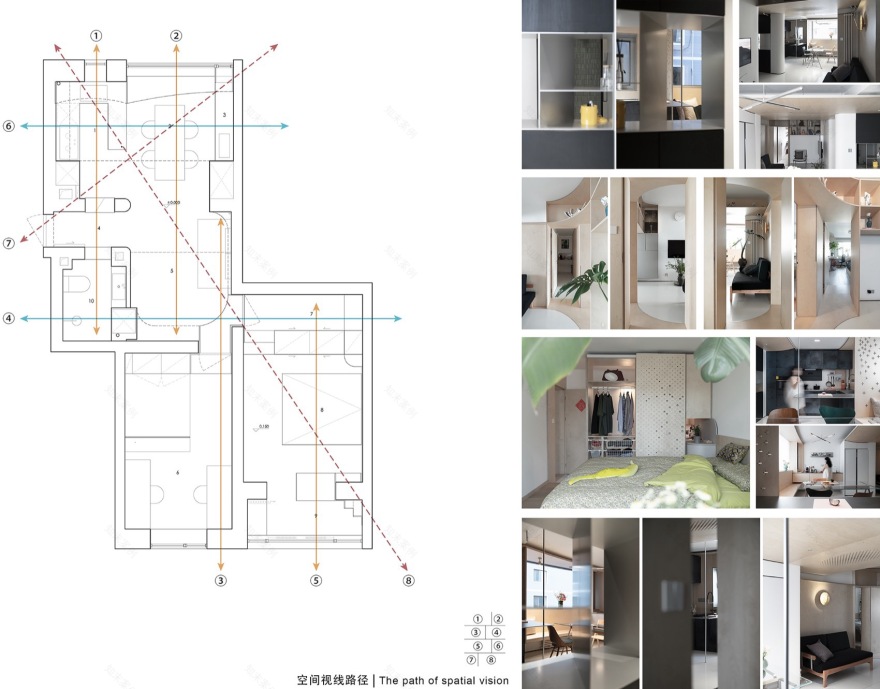
在小尺度的空间内,通过建立层次以达空间之深远,进而提升空间的丰富性。针对房屋格局,重点处理纵向①②③⑤、横向④⑥及对角线⑦⑧这几条视线路径,在路径中置入玄关柜置物格、冲孔衣柜体块、半透卫生间玻璃、弧形门洞套口等通透载体,在遮挡与分隔中保持空间通透。路径②中,中心木板吊顶压低,在垂直向度创造新层次;路径①⑦的层次由玄关柜置物格构建,置物格立板旋转一定角度,引导入户视线看向对角线窗洞,利用视线拉长空间;路径③④中,弧形门洞套口成为关键节点,从内外观看,人对门洞形成1/4圆的印象片段,这些片段在脑海中拼贴(两个1/4圆成半圆,两个半圆成整圆),完成了一次对门洞的蒙太奇式整合,将分离的门洞在感知上连结。
In a small-scale space, the depth of the space is achieved by establishing layers, thereby enhancing its richness. According to the house layout, key visual paths are focused on: vertical ①②③⑤, horizontal ④⑥, and diagonal ⑦⑧. Transparent carriers such as entrance cabinet storage grids, perforated wardrobe blocks, semi-transparent bathroom glass, and arc-shaped door sleeves are placed in the paths to maintain spatial transparency while shielding and separating. In path ②, the central wooden ceiling is lowered, creating a new layer in the vertical direction; the layers of path ①⑦ are constructed by the entrance cabinet storage grid, whose vertical plate is rotated at a certain angle to guide the entrance sight to the diagonal window opening, lengthening the space through vision; in path ③④, the arc-shaped door sleeve becomes a key node. When viewed from inside and outside, people form an impression of a 1/4 circle at the door opening. These impression fragments are collaged in the mind (two 1/4 circles form a semicircle, and two semicircles form a full circle), completing a montage-like integration of the door openings and connecting the separated door openings perceptually.
▼空间视线路径图,Diagram of spatial visual paths © 崔翔
结尾
Epilogue
房子虽小,亦可体面、诗意地居住。居住品质或许可通过昂贵材料与家具装饰达成,但更源于空间与建造本身——来自空间结构的秩序性与丰富性,也来自诚实的建造与清晰的空间操作。家是生活的容器,也是内心的庇护所,承载情感与审美意趣,是高度个人化的空间。
作为建筑师,设计自己的家是梦寐以求的事。能无隔阂地面对自身需求,通过空间表达设计观念与生活理解,是知行合一的幸事。
入住后,当眼之所见、身之所感皆与观念正反馈时,仿佛与空间完全契合。在秩序下心绪被梳理,在空间丰富变幻下内心更充盈,在诚实建造下更真实袒露地面对自我。对于一个创作者来说,能够纯粹地为自己创作并享受其中,最终成果反哺自身,最幸福的事大概莫过于此。
Although the house is small, one can still live in it with dignity and poetry. Quality of living might be achieved through expensive materials and furnishings, but it stems more from space and construction itself—from the order and richness brought by the spatial structure, and from honest construction and clear spatial operations. Home is a container for life and a sanctuary for our inner selves, bearing emotions and aesthetic aspirations—a highly personalized place.
As an architect, designing one’s own home is a long-cherished dream. Being able to face one’s own needs without barriers and express design concepts and life understanding through space is a blessing of integrating knowledge and action.
After moving in, when what I see and feel positively feedback my concepts, I seem to be completely in harmony with the space. Under the order, my mood is organized; under the rich changes of the space, my heart becomes more fulfilled; under the honest construction, I face myself more truly and openly. For a creator, there is probably no happier thing than being able to create purely for oneself, enjoy the process, and finally be nourished by the results.
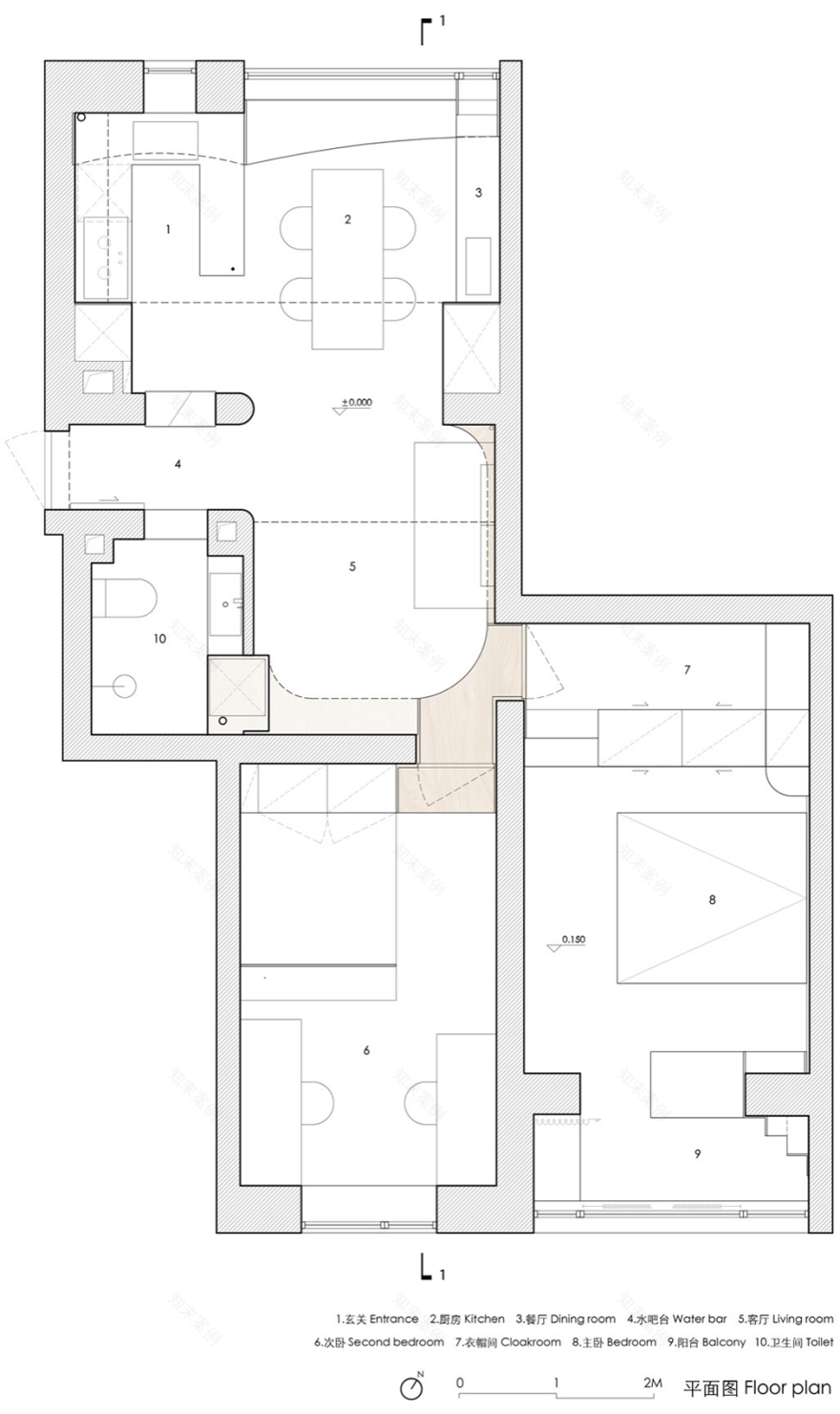
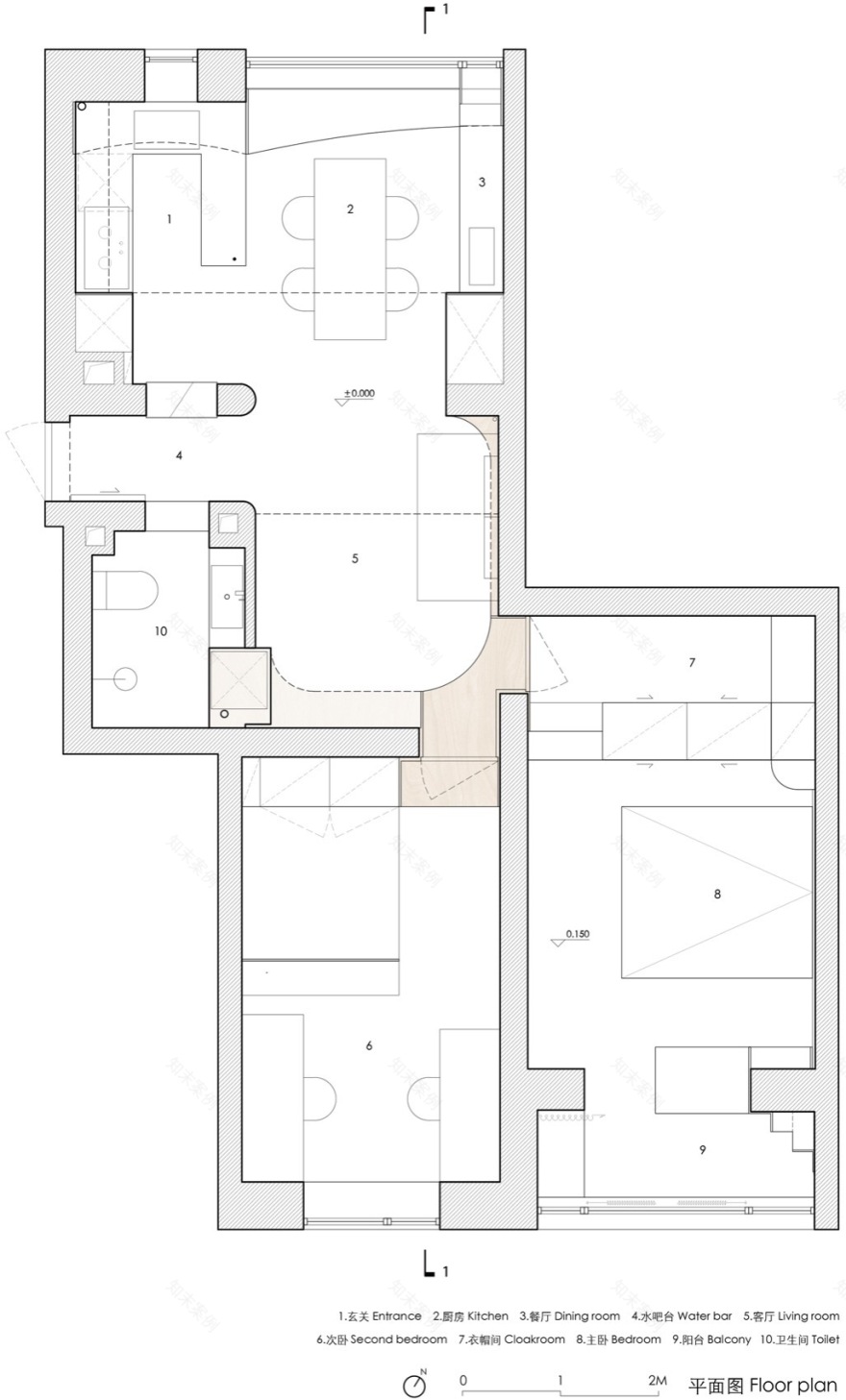
▼改造后的平面图及原始平面图,Renovated floor plan and original floor plan© 崔翔

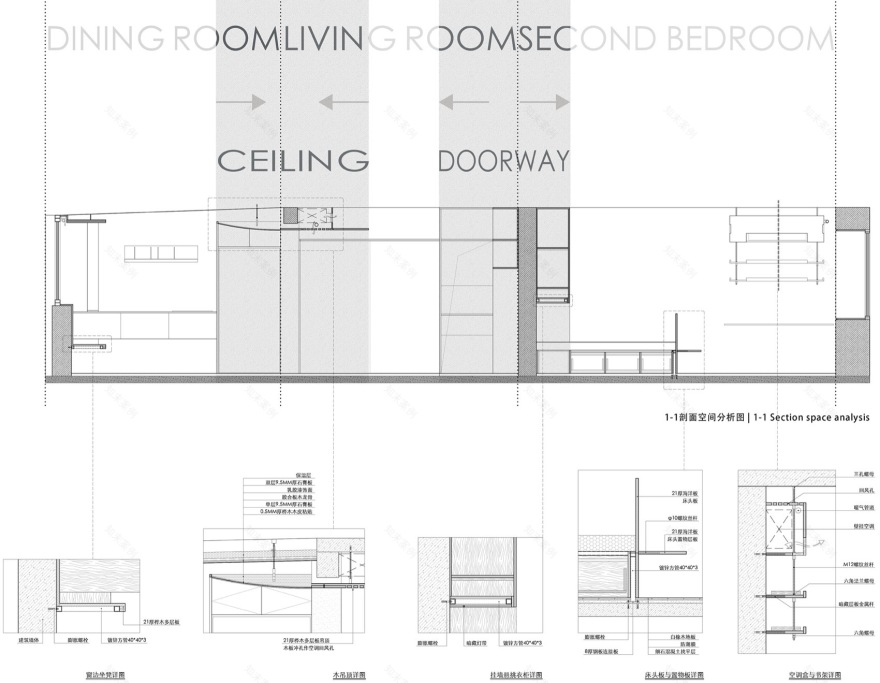
▼1-1空间剖立面图与典型节点构造图,1-1 Spatial sectional elevation and typical node construction diagram © 崔翔


南京喵熊网络科技有限公司 苏ICP备18050492号-4知末 © 2018—2020 . All photos and trademark graphics are copyrighted by their owners.增值电信业务经营许可证(ICP)苏B2-20201444 苏公网安备 32011302321234号
苏公网安备 32011302321234号客服
消息
收藏
下载
最近