

创作上传
VIP
收藏下载
登录 | 注册有礼
查看完整案例

收藏

下载

分享
位于崇明国家级体育训练基地北侧的上海自行车馆,是上海首座符合国际顶级赛事标准的室内场地自行车馆。建筑的初始任务十分明确:填补上海在专业场地自行车馆上的空白,同时成为国家队南方训练基地、国际自盟亚洲世培中心的落脚点,并承载未来世界锦标赛等高等级赛事的可能性。项目先后获得2025年度中国勘察设计协会全国优秀工程勘察设计一等奖、2025年度上海市优秀工程勘察设计一等奖。© AT建筑技艺 + 尹明
Located on the north side of the Chongming National Sports Training Base, the Shanghai Velodrome is the city’s first indoor track cycling venue built to meet the standards of top-tier international competitions. The project’s mandate was clear from the outset: to fill the gap of a professional velodrome in Shanghai, to serve as the southern training base for China’s national team and the Asian World Cycling Center of the UCI, and to provide the capacity to host future high-level events such as the World Championships. The project has received the First Prize of the 2025 National Excellent Engineering Survey and Design Award and the First Prize of the 2025 Shanghai Excellent Engineering Survey and Design Award.
▼项目鸟瞰,Aerialview of the project © 尹明

随着2026年国际自盟场地自行车世界锦标赛的成功申办,以及国际自盟世培中心亚洲分中心的正式入驻,上海自行车馆将进一步推动自行车项目在国内的发展,在世界舞台上展现中国自行车选手的风采和实力。
With the successful bid for the 2026 UCI Track Cycling World Championships and the official establishment of the UCI World Cycling Center Asia Satellite, the Shanghai Velodrome is poised to further advance the development of track cycling in China and showcase the talent and strength of Chinese cyclists on the global stage.
▼周边环境鸟瞰,Aerialview of the surroundings © 章鱼见筑

01结构创新与立面写意
Structural Innovation and Expressive Facade
上海自行车馆屋盖采用轮辐式悬索结构,是国内首次使用的体系。它将刚性结构的整体刚度与柔性结构的轻量优势结合,在满足大跨度需求的同时显著降低结构高度。结构由40榀径向索与钢梁形成主体系,通过伞状撑杆与中央刚性环梁连接。内圈环梁通过张弦结构增强整体刚度,使屋盖如同自行车轮毂般放射展开,与建筑功能象征建立直接关联。
▼钢结构体系构成,Composition of the Steel Structural System © TJAD

The roof of the Shanghai Velodrome adopts a spoke-wheel cable-suspended structural system–the first of its kind used in China. This system combines the overall stiffness of a rigid structure with the lightweight advantages of a flexible one, meeting the requirements of a large span while significantly reducing the structural depth. The structural system is composed of 40 radial cables paired with steel beams, forming the primary framework and connecting to a central rigid ring beam through umbrella-shaped struts. The inner ring beam is further stiffened by a tension–string system, enhancing the overall rigidity of the roof. As a result, the roof radiates outward like the hub of a bicycle wheel, establishing a direct formal and symbolic connection to the building’s function.
▼建筑外观概览,Exterior view of the project © 章鱼见筑

建筑立面以“芦苇”为原型。大尺度三角刚架与屋盖协同工作,既抵抗拉索张力,也承担风荷载使结构更稳定,在崇明大风环境中保持平衡。内外锥形双曲扇形构成连续的起伏,如风吹芦苇般轻盈。铝板与玻璃交替形成虚实层次,材料在光线中转折,生成近似花冠的外观,使体育建筑在力量之外呈现自然的一抹柔性。
The building’s facade takes reeds as its formal inspiration. Large triangular rigid frames work in tandem with the roof, counteracting the tension of the cables while resisting wind loads, ensuring stability in the strong-wind conditions of Chongming. The inner and outer conical, hyperbolic fan-shaped surfaces create a continuous undulating form, as light and airy as reeds swaying in the breeze. Alternating aluminum panels and glass introduce layers of solidity and transparency, their surfaces folding and shifting in the light to produce a crown-like appearance. In this way, the velodrome balances structural strength with a gentle, natural softness.
▼内场与屋面结构,Infield and Roof Structure © 章鱼见筑

02限高约束下的空间复合
Spatial Integration Under Height Constraints
项目地处崇明生态岛,所在位置限高严格,而国内多数自行车馆通常为30-45m。面对极限高度,团队对功能、结构与设备层进行了全面压缩与重组,最终在极限内完成所有专业需求。设计通过下沉内场训练空间(下沉1.2m)、压缩设备层高、优化座席升降等方式,最终将所有需求嵌入26m建筑体量中。空间紧凑但不显压迫,形成极高的空间效率。▼空间高度示意,Spatial Height Diagram © TJAD

The project is located on Chongming Eco-Island, where stringent height restrictions apply, while most velodromes in China typically reach 30-45 meters. Confronted with this limit, the design team undertook a comprehensive compression and reorganization of functional zones, structural depths, and service layers, ultimately meeting all technical requirements within the extreme height envelope. Through strategies such as lowering the infield training area by 1.2 meters, compressing the height of the service and equipment zones, and optimizing the elevation profile of spectator seating, the design successfully accommodated all programmatic and technical requirements within a 26-meter building height. The resulting spaces are compact yet never oppressive, achieving exceptional spatial efficiency.
▼立面结构,Facade Details © 章鱼见筑

相对于长轴跨度130m、短轴宽度110m的屋盖而言,其通常的结构高度一般为1/10,即结构高度需求为11-13m。设计团队通过将立面三角柱纳入受力体系,使用拉索主结构减少钢结构高度,优化张弦结构使环向刚度增强,将屋盖结构高度从12m压缩至8m,实现了限高约束下的极限突破。同时,更紧凑的体量使建筑具备更低的能耗与更快的空调响应速度。最终项目获得国内首个自行车馆绿色建筑三星认证,塑造了专业运动类低碳建筑的新范式。
Relative to the roof span–130 meters along the long axis and 110 meters along the short axis—the structural depth would typically be about one-tenth of the span, meaning a required height of 11–13 meters. By integrating the triangular façade columns into the load-bearing system, adopting a cable-supported primary structure to reduce steel depth, and optimizing the tension–string system to enhance circumferential stiffness, the design team compressed the roof structure from 12 meters to just 8 meters, achieving a significant breakthrough under stringent height constraints. At the same time, the more compact building volume results in lower energy consumption and faster HVAC response. The project ultimately earned China’s first Three-Star Green Building Certification for a velodrome, setting a new paradigm for low-carbon architecture in professional sports facilities.
▼黄昏下的自行车馆,Velodrome at Dusk © 章鱼见筑

03专业赛道的精细打磨
Precision Crafting of the Professional Track
场地自行车比赛的核心构件是木质复合曲面赛道,上海自行车馆赛道由直道、弯道、过渡段和蓝区组成,由11000余根西伯利亚欧洲赤松手工铺设而成。上海自行车馆的赛道遵循UCI国际认证标准,赛道圈长250m,其弯道倾角在最陡处接近45°,使空间成为速度力量的直接载体。赛道并非椭圆式对称,弯道外侧更宽、更陡,形成两个“高点”,赋予了比赛强烈的冲刺戏剧性。赛道内部的准备区面积达2720m²。除专业用作热身、检录、媒体操作空间外,场馆将其日常功能进一步扩展,使其可转换为篮球、羽毛球、乒乓球等训练场地,提升场馆可运营性与城市服务属性。
▼赛道示意图,Diagram of the Track © TJAD


The core element of a track cycling venue is its wooden composite curved track. The track in the Shanghai Velodrome consists of straights, banked turns, transition zones, and the blue safety band, all handcrafted from more than 11,000 pieces of Siberian European pine. Built to full UCI certification standards, the track measures 250 meters per lap, with banking that reaches nearly 45° at its steepest point–making the space a direct embodiment of speed and power. The track is not a perfectly symmetrical oval; the outer sides of the curves are wider and steeper, creating two “high points” that heighten the drama of sprint finishes. The infield preparation area covers 2,720 m². In addition to serving professional functions such as warm-up, staging, and media operations, the venue further extends its everyday usability by enabling the space to convert into training courts for basketball, badminton, table tennis, and other sports. This adaptability enhances both the venue’s operational efficiency and its role as a service facility for the broader community.
▼赛道,Track © 章鱼见筑

04观赛视线的三段式优化
Three-Stage Optimization of Spectator Sightlines
自行车馆最独特的观看体验来自“非环形布座”特性:弯道处倾角过大,座席无法连续布置,直道两端视线条件逐渐变化,传统方案中,出入弯区向来是视线难题。
The velodrome’s most distinctive viewing experience stems from its non-continuous seating layout: the steep banking of the curves makes it impossible to arrange seats around the full perimeter, and sightlines shift progressively toward both ends of the straights. In conventional designs, the transition zones between the straights and the banked curves have always posed significant sightline challenges.
▼弯道处看台视线,Spectator Sightlines at the Banked Curve © 章鱼见筑

设计团队通过将“视点”从单一的起点线扩展为起点线、终点线、全直道三段重点视界,重新推导最佳座席标高,并优化过渡看台的升起节奏,使整体视线达成100%合格率。在弯道处,观众不但可完整观看冲刺,也能保持空间连贯性与结构整洁度。这一策略成为国内自行车馆设计中的一次新的视线建模实践。
The design team expanded the primary “viewpoint” from a single focus on the start/finish line to three key sightlines: the start line, the finish line, and the full straightaway. By recalculating optimal seating elevations and refining the rise of the transitional stands, the design achieved a 100% sightline compliance rate. Even at the banked curves, spectators can fully observe sprint moments while maintaining a clear sense of spatial continuity and structural order. This approach represents a new sightline–modeling strategy in the design of velodromes in China.
▼高度整合的内场空间,Highly Integrated Infield Space © 章鱼见筑

05 三维场地流线的重新组织
Reorganizing Three-Dimensional Circulation Paths
不同于跑道类开放场地,自行车馆的赛道是高度封闭的“立体碗形”,运动员无法直接从场地侧面进出。鉴于崇明地下水位高、木质赛道对温湿环境敏感,建筑采用场地整体抬升策略,将下方层作为训练与功能用房,并设立独立的运动员专用通道,与观众流线分离,避免交叉。
Unlike open running-track venues, a velodrome is a highly enclosed, three-dimensional “bowl,” making it impossible for athletes to enter or exit directly from the sides of the track. Given Chongming’s high groundwater level and the sensitivity of the wooden track to temperature and humidity, the building adopts an elevated-platform strategy: the entire venue is raised, allowing the lower level to house training and support spaces. A dedicated athlete circulation route is established beneath the track, completely separated from spectator movement to avoid any crossover.
▼“立体碗形”赛道,“Bowl”track © 章鱼见筑

首层训练空间紧密衔接休息室、专用通道和内场,构成连续的专业动线体系。在大赛期间,这些房间也可转换为车队休息与器材配置空间,为赛事运行提供高效支撑。
The first-floor training spaces are seamlessly connected to the lounges, dedicated circulation routes, and the infield, forming a continuous and highly efficient professional movement system. During major competitions, these rooms can also be converted into team rest areas and equipment setup spaces, providing strong operational support for event management.
▼赛道内部,Center of the track © 章鱼见筑

06 自然与人工照明的协同调节
Coordinated Regulation of Natural and Artificial Lighting
设计初期,建筑曾提出以漫反射天窗引入自然光,以形成更柔和、节能的光环境。但在专业团队多轮论证后,由于高速骑行对光斑、阴影、亮度均匀性极其敏感,为避免任何视觉误差,最终取消天窗,采用全人工照明设计。
In the early design stage, the building explored the use of diffuse skylights to introduce natural light and create a softer, more energy-efficient lighting environment. However, after multiple rounds of expert evaluation, the strategy was abandoned: high-speed cycling is extremely sensitive to glare, shadows, and luminance uniformity, and even minor visual disturbances can affect performance. To eliminate any potential visual error, the final scheme adopts a fully artificial lighting system.
▼夜景鸟瞰,Aerial Nightview © 章鱼见筑


照度标准按4K/8K超高清转播要求执行:赛道垂直照度超过2400lux、水平照度超过4000lux,准备区达到2000lux。灯具采用国际级防眩设计,并通过智能分控系统实现训练、比赛、清扫、灯光秀等模式切换,使高标准专业照明成为场地氛围的一部分。
Illuminance standards follow the requirements for 4K/8K ultra-high-definition broadcasting: vertical illuminance on the track exceeds 2400 lux, horizontal illuminance surpasses 4000 lux, and the infield preparation area reaches 2000 lux. All fixtures employ international-grade anti-glare design, and an intelligent control system enables mode switching for training, competition, cleaning, and lighting shows, making high-standard professional lighting an integral part of the venue’s atmosphere.
▼夜景照明,Night illumination © 章鱼见筑
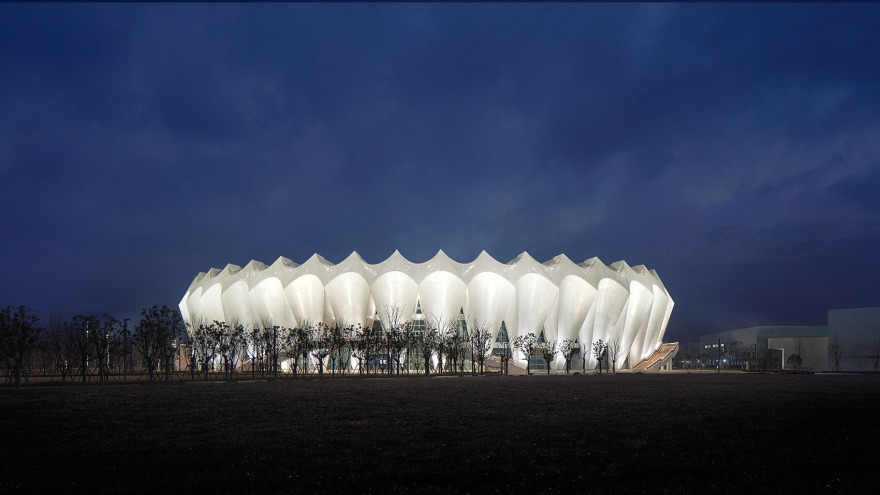
结语:技艺与速度的对话
Conclusion: A Dialogue Between Craft and Speed
作为体育建筑中极具专业门槛的一类场馆,上海自行车馆的设计同时回应了结构创新、高度限制、工艺标准、环境调控等多重约束。它呈现的并非单一专业场馆的图式,而是一种在多元条件下找到融合之道的探索路径——在技术与艺术之间,完成属于“自行车馆”这一特殊类型体育建筑的当代创新表达。
As one of the most technically demanding building types in sports architecture, the Shanghai Velodrome addresses multiple constraints simultaneously–from structural innovation and height limitations to precision craftsmanship and environmental control. What emerges is not merely a template for a specialized venue, but an exploration of how diverse conditions can be integrated into a coherent whole. Between technology and artistry, the project achieves a contemporary architectural expression unique to the velodrome typology.
▼总平面图,Master plan © TJAD

▼首层平面图,First floor plan © TJAD

▼二层平面图,Second floor plan © TJAD

▼三层平面图,Second floor plan © TJAD

▼三层夹层平面图,Second mezzanine floor plan © TJAD

▼剖面图,Section © TJAD


项目获奖信息:2025年度中国勘察设计协会全国优秀工程勘察设计一等奖;2025年度上海市优秀工程勘察设计(公共建筑)一等奖
项目名称:上海自行车馆
项目类型:体育建筑
设计方:同济大学建筑设计研究院(集团)有限公司
项目设计:2019
完成年份:2023
主创建筑师:汤朔宁、钱锋
建筑设计:徐烨、徐星、张春祺、刘洋、史泽道、乔林、龚敏、沈源
结构设计:丁洁民、井泉、张峥、毛俊杰、张月强、曹明敏、李竹君、化明星、王曦、刘仕卿
给排水设计:游博林、杜文华、单晨光、耿军军、李月婷
暖通设计:朱伟昌、唐振中、刘洋、贾琼、张华、许威威
电气设计:李志平、谢文黎、姜宁、陈瑜、尤文捷、郭煜华、奉杰斌、马致祥
景观设计:李瑞冬、项竹君、廖晓娟、翟宝华
幕墙设计:田利军、金绍凯、尹鹏鹏、李根恒
泛光照明设计:杨秀、徐霞青、陈幸如
基坑设计:姜文辉、刘佳星
概算设计:庞晓琳、薛仲磊
绿建设计:忻蕾、郑晓薇、施炜
BIM设计:宋妮蔓、吴尧、陈潇、王宇航 、司晓芸
工艺顾问:中体智联(北京)工程设计咨询有限公司
赛道顾问:大连千森体育设施工程有限公司
标识顾问:上海同衡创意设计有限公司
项目地址:上海市崇明体育训练基地
建筑面积:30966㎡
摄影版权:章鱼见筑、尹明
客户:上海市体育训练基地管理中心
材料:钢、混凝土、铝、玻璃、索
Project Title: Shanghai Velodrome
Project Type: Sports Architecture
Design Firm: Tongji Architectural Design (Group) Co., Ltd.
Design Year: 2019
Completion Year: 2023
Chief Architects: Tang Shuoning, Qian Feng
Architectural Design Team: Xu Ye, Xu Xing, Zhang Chunqi, Liu Yang, Shi Ze - Dao, Qiao Lin, Gong Min, Shen Yuan
Structural Design: Ding Jiemin, Jing Quan, Zhang Zheng, Mao Junjie, Zhang Yueqiang, Cao Mingmin, Li Zhujun, Hua Mingxing, Wang Xi, Liu Shiqing
Plumbing Design: You Bolin, Du Wenhua, Shan Chenguang, Geng Junjun, Li Yueting
HVAC Design: Zhu Weichang, Tang Zhenzhong, Liu Yang, Jia Qiong, Zhang Hua, Xu Weiwei
Electrical Design: Li Zhiping, Xie Wenli, Jiang Ning, Chen Yu, You Wenjie, Guo Yuhua, Feng Jiebin, Ma Zhixiang
Landscape Design: Li Ruidong, Xiang Zhujun, Liao Xiaojuan, Zhai Baohua
Facade Design: Tian Lijun, Jin Shaokai, Yin Pengpeng, Li Genheng
Lighting Design (Exterior Illumination): Yang Xiu, Xu Xiaqing, Chen Xingru
Foundation Pit Engineering: Jiang Wenhui, Liu Jiaxing
Cost Estimation: Pang Xiaolin, Xue Zhonglei
Green Building Design: Xin Lei, Zheng Xiaowei, Shi Wei
BIM Design: Song Niman, Wu Yao, Chen Xiao, Wang Yuhang, Si Xiaoyun
Technical Consultant: CCT Zhilian (Beijing) Engineering Design Consulting Co., Ltd.
Track Consultant: Dalian Qiansen Sports Facilities Engineering Co., Ltd.
Signage Consultant: Shanghai Tongheng Creative Design Co., Ltd.
Project Location: Shanghai Chongming Sports Training Base
Gross Floor Area: 30,966 m²
Photography: Zhangyu Jianzhu, Yin Ming
Video Editing: AT Architectural Craft, Yin Ming
Client: Shanghai Municipal Sports Training Base Management Center
Materials: Steel, Concrete, Aluminum, Glass, Cables
南京喵熊网络科技有限公司 苏ICP备18050492号-4知末 © 2018—2020 . All photos and trademark graphics are copyrighted by their owners.增值电信业务经营许可证(ICP)苏B2-20201444 苏公网安备 32011302321234号
苏公网安备 32011302321234号客服
消息
收藏
下载
最近