

创作上传
VIP
收藏下载
登录 | 注册有礼
查看完整案例

收藏

下载

分享
Aberfeldy New Village, Tower Hamlets Info

Project Details: Unlocking a hidden pocket of land to house a thriving urban community.
Client: Aberfeldy New Village LLP (EcoWorld and Poplar HARCA)
Construction Value: £200m
Completion: 2015 (phase 1), 2017 (phase 2) and 2022 (phase 3)
Location: Tower Hamlets
Awards:
The Pineapples 2022, Award for Community Engagement: Winner
Evening Standard New Homes Awards 2022, Best Regeneration Scheme: Highly Commended
Planning Awards 2022, Award for Stakeholder Engagement in Planning: Highly Commended
NLA Awards 2022, Public Spaces: Winner
NLA Awards 2022, Masterplans and Area Strategies: Shortlisted
NLA Awards 2022, Mixed Use: Shortlisted
British Homes Awards 2021, Regeneration Scheme of the Year: Finalist
NLA Awards 2021, Meanwhile: Shortlisted
WhatHouse? Awards 2021, Best Regeneration Scheme: Gold
Horticulture Week Awards 2019, Best Planting Design: Shortlisted
Landscape Institute Awards 2018, Design for a Medium-Scale Development: Winner
Building Awards 2013, BIM Initiative of the Year: Finalist
Images: Tim Crocker

Community engagement

Social value

Child friendly design

Enhanced public realm

Sustainable drainage
Enhanced biodiversity

New homes

Dual aspect homes

Low energy use

Renewables on site
Where we started
Working with Aberfeldy New Village LLP, a joint venture between Poplar HARCA and EcoWorld London, we are leading the design of the transformation of the Aberfeldy Estate in east London, providing 1,176 new homes, shops, a faith centre, community centre and PCT.
The driving force behind this project is to improve the homes and environment for the local community. Importantly, we committed to rehousing all existing residents within the new scheme, alongside additional new homes and a broad spectrum of community facilities, essential for any urban neighbourhood. Working in collaboration with Bow Arts Trust and make:good, a series of workshops were held to develop design proposals with residents. With a very diverse local population, we used a variety of different methods of engagement to ensure that everyone could understand and buy into our vision for the new Aberfeldy Estate.
The site is located on the northern boundary of the Import Dock, famous for the importing of exotic goods during the 18th and 19th century. This heritage was sadly lost when it was heavily bombed during the war and subsequently redeveloped.

The East India Docks opened in 1806 and were designed by John Rennie and Ralph Walker. This site was nearly obliterated during WWII and since redeveloped. Image published by London County Council

A contemporary warehouse aesthetic is one way we link the present site to its industrial past

The heart of the new neighbourhood is a linear park which features open lawns and varied play spaces
Owned and managed by Poplar HARCA, the estate was situated on a hidden pocket of land – bounded by the A12, A13 and River Lea. Gasholders to the north east and Erno Goldfinger’s iconic Balfron Tower to the west completed the urban context. Initially a very self-contained site was opened up by a new pedestrian crossing over the A13, connecting the community to the south and East India DLR station.
Our brief from the outset was to deliver a new masterplan, transforming the Aberfeldy Estate into a new urban village, drawing out its industrial history and building on its new connections to the wider area. On the strength of our proposals, we were appointed to develop the masterplan, architecture and landscape for the regeneration of the whole estate.
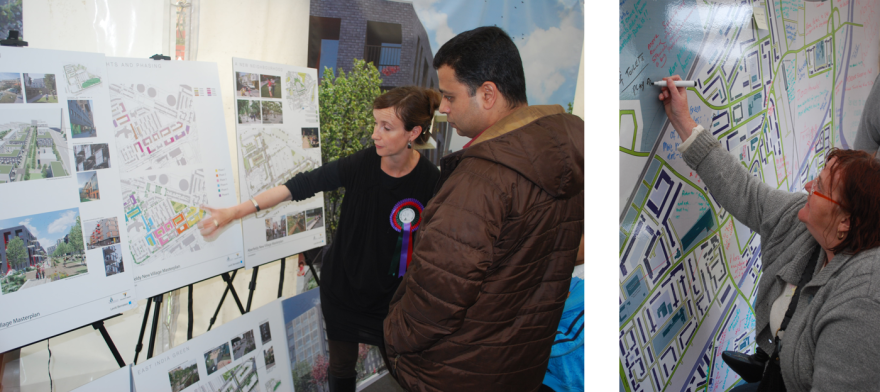
Director Jo McCafferty discusses design proposals with community members, both images ©Poplar HARCA
Design
The key concept of the masterplan was to create a series of new routes in and around the site – bringing people into the centre of the scheme from the nearby busy roads and public transport nodes. Carving these new connections between the buildings will make the whole area much more permeable and welcoming for both residents and visitors. A new street running north to south with shops, community resources, health facilities and a faith centre will reinstate the old high street, creating activity within a new village centre set around a new public square.

Masterplan for Aberfeldy Estate
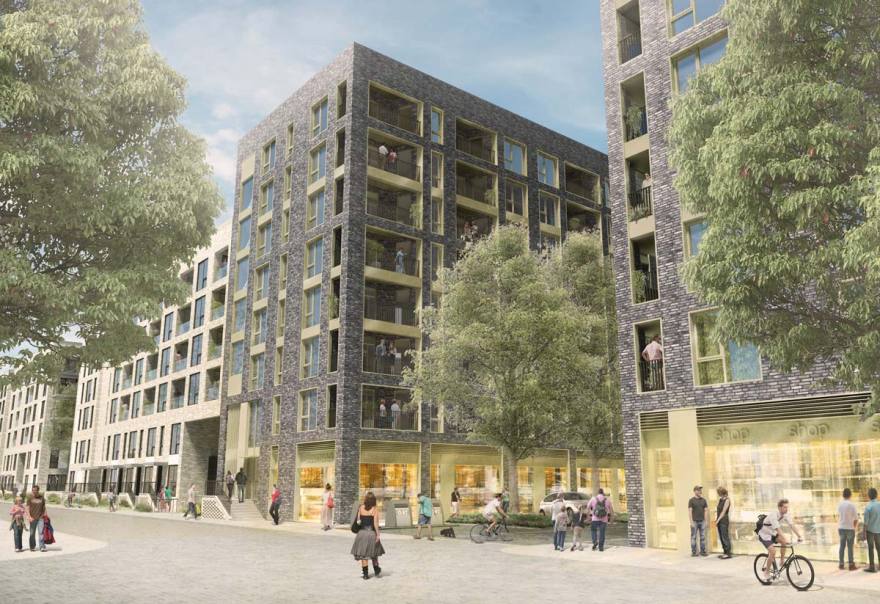
Phase 3 will introduce new shops and community spaces to revive the old high street
Aberfeldy Village is quickly transforming into a vibrant new neighbourhood around a significant new London park at its heart. Housing of all types and tenures has been carefully designed to support development of this mixed, sustainable community – both now and in the long term.
Jo McCafferty, Director
A new linear park sits at the heart of the neighbourhood, with open lawns and varied play spaces, lined with trees and seasonal planting to provide colour all year round. The park is also a key part of the sustainable drainage system and biodiversity strategy, which was developed with the London Wildlife Trust to ensure the new landscape fosters a broad range of species. A continual swale runs along the full length of the park with steps facing south, providing informal seating. Plants for pollinators; brick faced boxes for birds; biodiverse roofs and a variety of trees, shrubs and flowering bulbs will create diverse habitat types that previously did not exist.

Building C ground plan: raised communal courtyards provide defined areas for residents to gather

We worked with the London Wildlife Trust to ensure the linear park would create new habitats for a number of species. New homes are arranged around this linear green space in medium rise, high density buildings ranging from four to ten storeys. Lower, more domestic scale buildings sit adjacent to the neighbouring estate, whilst higher, muscular, robust buildings along the A13 provide a degree of protection to this urban edge.

Section through building C, East India Green and building A: the tallest buildings on the estate sit along the A13 to protect the pedestrian spaces
The site’s illustrious past is made visible through art installations including cast concrete tea crates and brass cotton reels in the landscape and paisley patterns etched in the paving. Crisp detailing and a limited material palette give the buildings a modern warehouse aesthetic.
Core team
Jo McCafferty - Director
Gary Tidmarsh - Consultant
Lotta Nyman - Associate Director
Glyn Tully - Studio Director
Kate Digney - Studio Director
Simon Abbott - Associate
Paul Martin - Technical Design Director
Ben Monteagle - Associate
Clara Bailo - Senior Architect
南京喵熊网络科技有限公司 苏ICP备18050492号-4知末 © 2018—2020 . All photos and trademark graphics are copyrighted by their owners.增值电信业务经营许可证(ICP)苏B2-20201444 苏公网安备 32011302321234号
苏公网安备 32011302321234号客服
消息
收藏
下载
最近