

创作上传
VIP
收藏下载
登录 | 注册有礼
查看完整案例

收藏

下载

分享
Okanogan Passivhaus Cabin






Details
Categories
Featured, New Construction, Passive House
Location
Wauconda, WA
Green Features
the Passivhaus standard
.
Walls: R-75 (2x6 structural wall with a 16" TJIs on the outside, both filled with dense-pack cellulose insulation.)
Roof: R-102 (prefabricated parallel chord trusses, ~34" of loose-fill cellulose)
Floor: R-108 (prefabricated parallel chord trusses, ~30" of dense-pack cellulose)
However, the originally windows we used in the model did not make it into the project. We specified Pazen Enersign windows. These windows have a U-value of 0.13 with a solar heat gain coefficient of .62. By virtue of their incredible performance, these windows can contribute more heat to the cabin over the course of a year than they lose, allowing us to have a glazing area of 50% of the floor area, even in this extremely cold climate, and still meet the Passivhaus standard. However, that performance comes with a very high price tag. During construction lower cost (and lower performance) Sierra Pacific windows (U-0.24, and a lower Solar Heat Gain Coefficient) were substituted, which knocked us out of meeting the Passivhaus standard. Sadly, if the project had started construction just a couple months later, we could have used
Zola Windows
, or
Intus Windows
Onsite Energy
Onsite energy generation is not counted toward meeting the Passivhaus standard, but photovoltaic panels are often found on Passivhaus buildings. Here, a small photovoltaic panel system was designed to be integrated into the roof of the screened porch. Batteries will supply mainly emergency lighting and power the well pump. Solar Hot Water will come from a vaccum tube array, also mounted on the south-sloping screen porch roof.
Mechanical System
A
Zehnder ComfoAir 200
electric heating mats
in the floors of the entry and both bathrooms--about 1,100 watts of heating. (Indeed, about the same as a hair dryer!) With the lower performance windows that were installed, radiant electric panels were also provided in the bedrooms. When first arriving after being away for a time during the winter, a small fire in an efficient wood-burning stove will bring the cabin up to temperature. The stove will also provide supplementary heat during long periods of cold and no sun. There is no furnace as such.
Credits
Owners: Anonymous
Design Team: Rob Harrison, Matt Wasse, Geoff Briggs
Passive House Consultants: Rob Harrison, Matt Wasse
Structural Engineer:
Carissa Farkas Structural Engineering
General Contractor: Mark Gerrish, Bonaparte Builders
Photos: By the owner.
Date
2012
Description
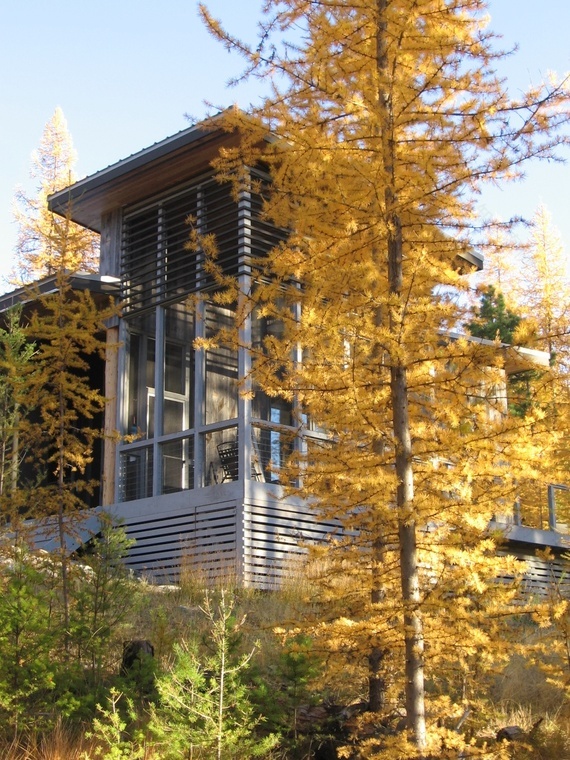
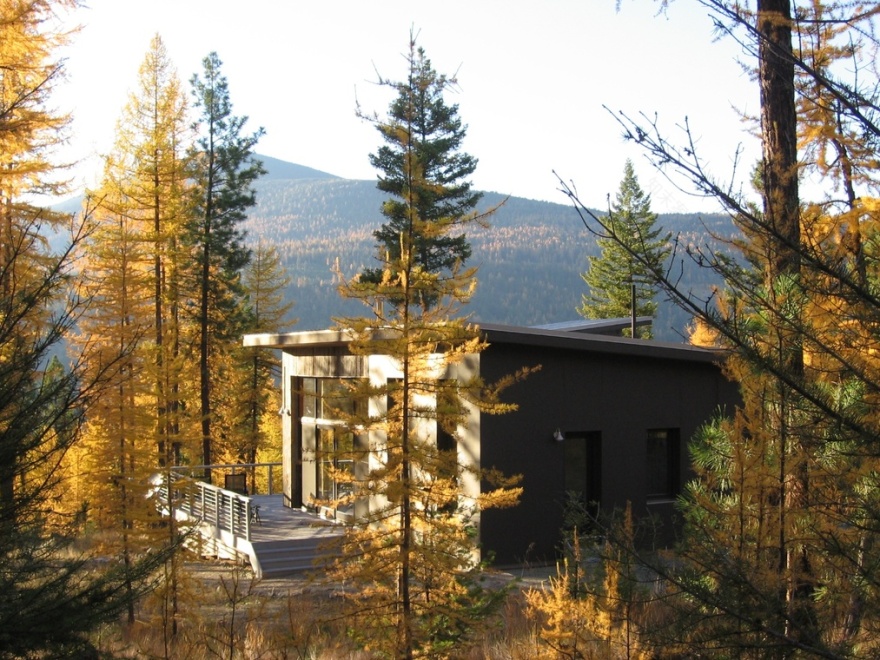
This 1,100 square foot near-Passivhaus cabin sits on a west-facing slope in high desert second-growth fir, Ponderosa pine and tamarack forest near Wauconda, WA. Our clients had been camping on the site for several years, getting to know the site and its seasons. (A strategy we commend!) The cabin is a year-round weekend and vacation retreat for the family for now, and may become a full-time home after retirement.
Like
almost all second homes
, this one carries the inherent contradiction between our and our clients’ interest in making the cabin itself as energy-efficient as possible and the necessity of driving four or five hours to spend time in it–effectively wiping out any reduction in carbon emissions afforded by the design. We have all agreed to acknowledge that contradiction and move on. The cabin will use 70% less total heating energy than it would if it were built to the 2009 Washington State energy code, one of the most rigorous energy codes in the United States. There are also many benefits for us as the architects: The “cabin” format allows us to further explore the design of smaller, more compact houses, as well as the application of the Passivhaus standard in an extreme climate. If we can make it work here, making it work anywhere in the western foothills of the Cascades will be a piece of cake. Please click the “Green Features” tab above for more information on the technical aspects of the project.
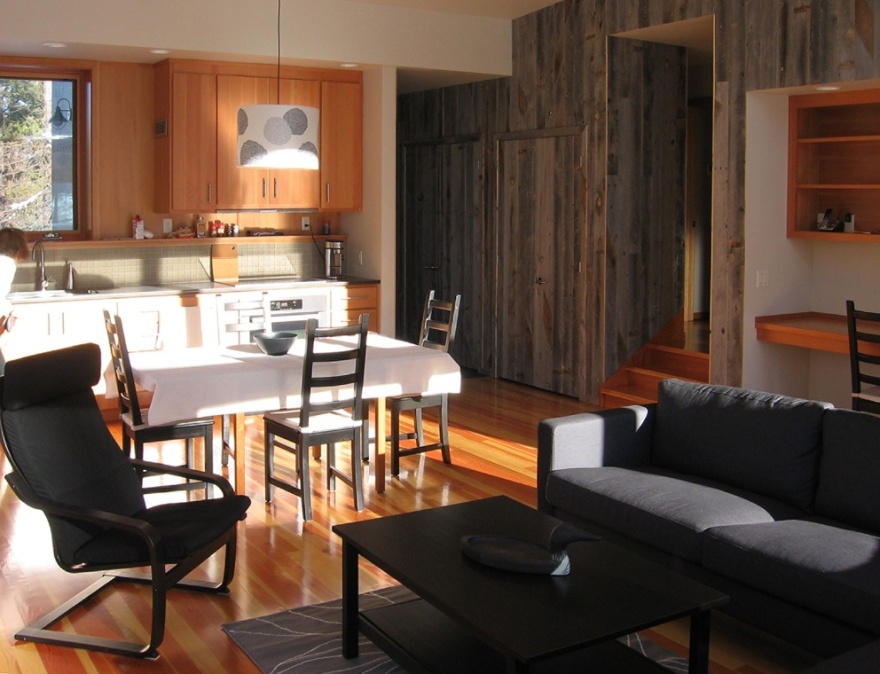
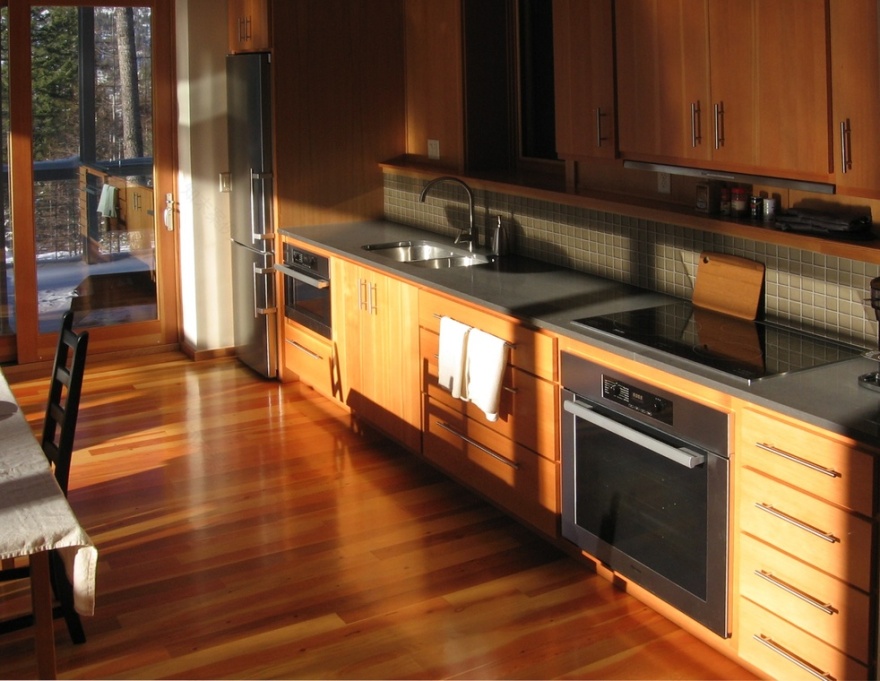
The parking spot is some distance from the cabin. The approach is from the north, along a footpath though the forest. Coming into a clearing around the cabin (for fire prevention, solar access on the south and for view on the west) you walk up a set of steps onto a covered porch, a door onto the screen porch on your right, a fully glazed entry door on your left. The entry has an eight-foot bench with boot storage below, hanging hooks for wet coats and scarves as well as a closet. Stepping into the Great Room, ahead the ceiling rises to the south to a full wall of windows, and to your right the view opens to Bonaparte Mountain to the west through a bank of 8′-0″ windows and a wide lift and slide door that opens onto the deck. Set into the western windows is a solid block of wood and stone that contains the wood stove and a wide-screen TV. The simple galley kitchen is to the right, with an efficient 24″ wide refrigerator, a big sink with a window to the entry over it, an induction cooktop and a recirculating range hood. A door at the far end of the kitchen leads out onto the screen porch. Turning back to the south, ahead and to the left is a bank of storage that includes the entry closet, a stacked washer and condensing dryer, a pantry, and further on, a niche for an electronic piano and bookshelves. Peeking out from that wall of storage, all of which (like the kitchen bank) is covered in reclaimed Wyoming snow fence like the exterior of the cabin, is a short run of three stairs that lead up into the bedroom wing. The two bedrooms are 10′ x 13′–just enough room for a queen-size bed. Both bedrooms have fully-glazed doors that lead out to a patio on the east side of the cabin. The south bedroom has a built-in writing desk. The back-to-back bathrooms are simple, with long vanities, built-in cabinets, and modest showers. (The showers supplement the outdoor shower.) The sound-insulated mechanical room is tucked between the two baths.
The north and east sides of the cabin, with punched openings, have dark painted fiber-cement siding. The more open south and west sides have vertical reclaimed Wyoming snow fence siding. Floors are reclaimed pine, except for the entry and baths which are ceramic tile. Ceilings are painted drywall. The trim, like the kitchen cabinets, is fir.
南京喵熊网络科技有限公司 苏ICP备18050492号-4知末 © 2018—2020 . All photos and trademark graphics are copyrighted by their owners.增值电信业务经营许可证(ICP)苏B2-20201444 苏公网安备 32011302321234号
苏公网安备 32011302321234号客服
消息
收藏
下载
最近