

创作上传
VIP
收藏下载
登录 | 注册有礼
查看完整案例

收藏

下载

分享
Hanham Hall

Hanham Hall
Completed in 2013, Hanham Hall is England’s first large-scale volume house builder scheme to achieve the zero-carbon standard
Clients: Barratt Homes
Information:
Location: Bristol
Start Date: 2008
End Date: 2013
Specialisms: Affordable Homes, Renovation, Net Zero & Low Carbon, Placecraft, Public Spaces, Parks & Play, Factory Made
Collaborators: Kingspan
Awards:
Finalist: Civic Trust Awards | South West Region – Hanham Hall 2016
Shortlist: RIBA Awards | Hanham Hall 2016
Winner: Inside Housing Top 60 Developments Awards | Sustainable Housing Project of the Year – Hanham Hall 2015
Winner: NHBC Quality Award | Pride in the Job. Excellence in On-site Management – Hanham Hall 2015
Highly Commended: RPTI Planning Excellence Awards | Excellence in Planning to Deliver Housing – Hanham Hall 2015
Regional Finalists: Civic Trust Awards | Hanham Hall 2015
Winner: RTPI Planning Excellence Awards | Excellence in Planning for the Natural Environment – Hanham Hall 2015
Winner: Housing Design Awards | Richard Fielden Award for Best Affordable Housing – Hanham Hall 2014
Winner: Inside Housing Sustainability Awards | Sustainable Housing Project of the Year – Hanham Hall 2014
Winner: First time Buyer Awards | Large Development – Hanham Hall 2014
Winner: What House Awards | Best Sustainable Development – Hanham Hall 2014
Winner: What House Awards | Best External Appearance – Hanham Hall 2014
Winner: British Homes Awards | Housing Project of the Year – Hanham Hall 2010
Winner: National Urban Design Group Project Awards | Hanham Hall 2010
One Place, Many Stories

Planning
What were the challenges of building in a fringe green-belt suburban setting?

Architecture
How are Hanham Hall’s housing typologies unique?

Architecture
How did HTA renovate the Grade II listed hall?

Landscape Design
How did the development improve biodiversity in the area?

Sustainability & Building Physics
How did you meet the stringent net zero requirements?

Sustainability & Building Physics
How did Hanham provide a unique and innovative housing solution when benchmarked against a ‘traditional onsite’ building approach?

Communications & Engagement
How did you engage with the local community?

Publication
Distinctively Local responds directly and positively to the government’s Building Better, Building Beautiful Commission

Activity
37/50. HTA at 50 – Hanham Hall 2008-2013

Activity Bringing Nature Home – Post Occupancy Evaluation – Hanham Hall

Publication
Simon Bayliss contributed to the Neighbourhoods of the Future writing an article on the opportunity of our changing needs to drive better quality housing.
Architecture

How are Hanham Hall’s housing typologies unique?
The simple form of the homes is guided by their need to achieve Net Zero Carbon and is a unifying factor across all housing types, from the flats to the garden cottages, to the large townhouses. This enables the homes to be read as a distinctive group that is specific to Hanham Hall. The simplicity of the homes belies the fact they are packed with innovative and novel ideas. Each housing type has a flexible plan, combined kitchen dining spaces traverse the entire ground floor and extensive double height spaces span the top floor in an approach that maximises natural ventilation and light.


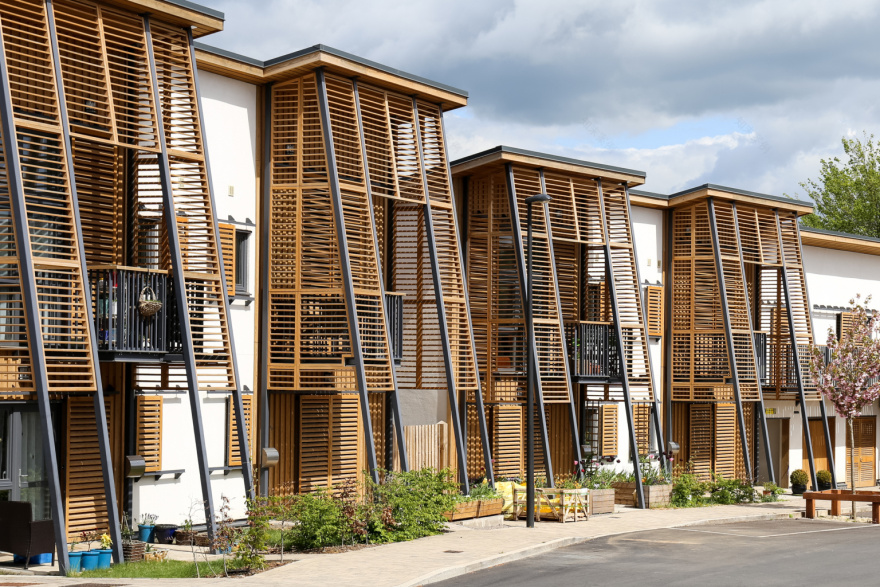
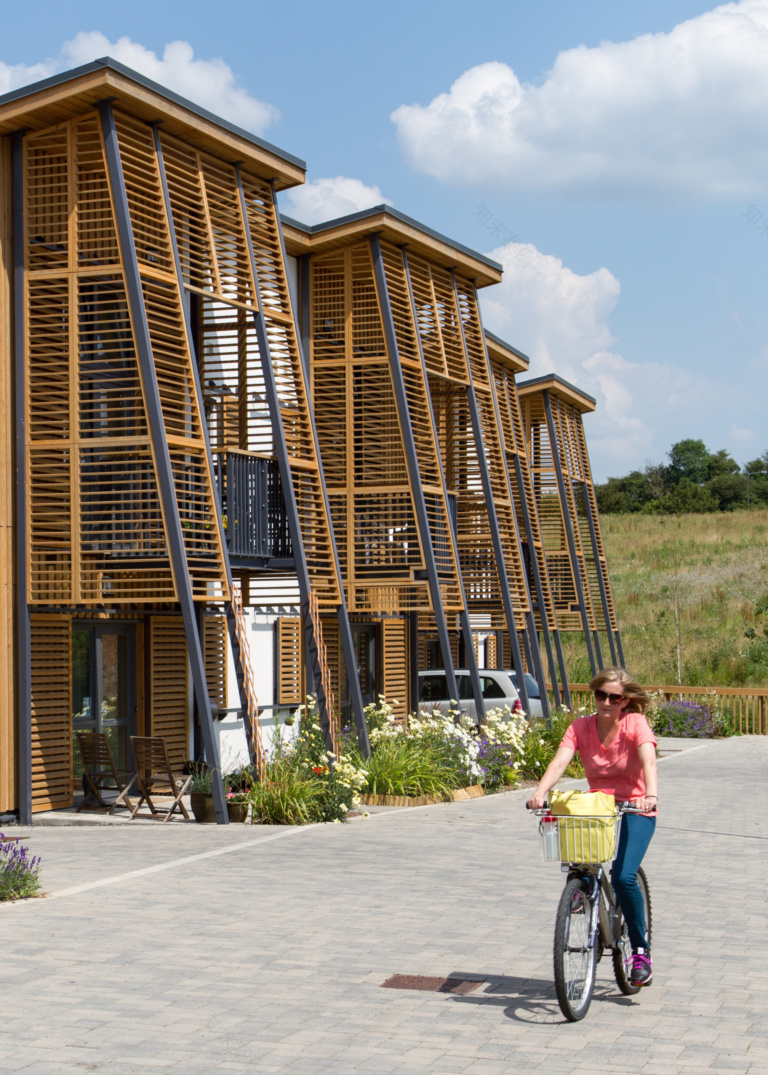
Living spaces open onto generous verandas shaded by timber screens. A crafted response which adds a layer of interest to primary facades. The seductive appeal of the verandas is in their ability to bring access to the outdoors directly into the main living space, they have remained a defining feature of the new homes since the early design stages. We engaged in an extensive process of prototyping with Kingspan to achieve a balcony design that avoided over engineering to reduce the quantum of material required in its construction for positive cost and sustainability outcomes. Outside the homes, the footprint of the sloping timber screen extends beyond the doorway, creating a front porch area facing out onto the street. This, and the verandas, encourage neighbours to interact with each other.


How does the scheme meet local housing needs?
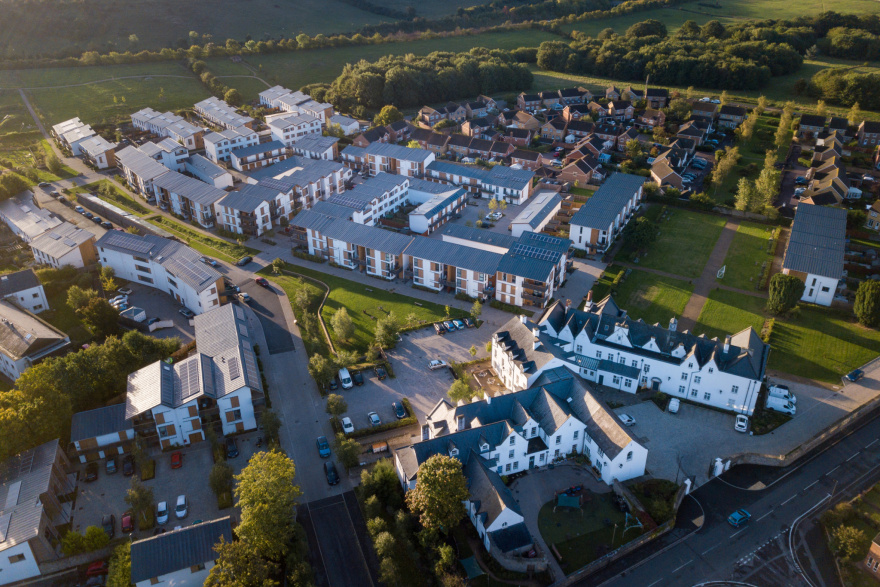
The scheme addresses local housing requirements by providing a wide range of accommodation, from 1 bedroom flats and coach houses to five bedroom houses. These are arranged in terraces, semi detached and detached to create varied urban forms. A significant proportion of the homes are family homes with parking in-curtilage or adjacent to the home. Smaller apartments provide an accessible entry level to the housing market, whilst coach houses provide a good intermediate step between houses and apartments. Hanham Hall is run by its residents, who all have a share in a Community Interest Company set up to manage and maintain the buildings and grounds. It promotes community initiatives such as car-sharing clubs, gardening groups and walking school bus projects. The company empowers residents to shape their community and create the resources they need for a sustainable future.


How did HTA renovate the Grade II listed hall?
There is increasing awareness of the role retrofitting heritage buildings plays in achieving sustainable outcomes. Reusing our existing buildings reduces the materials and energy required to construct new ones, making a positive contribution to our carbon impact.
The Grade II listed Hanham Hall has a long history as a hospital building having been a private care facility before coming into NHS ownership in 1948. It was built as a moated house in the 14th century. Its evolution over the years has defined its V shaped arrangement with the axis of the building running east to west forming the original house and the axis running north to south beginning life as a group of stable blocks, which over time, and successive phases of additions, became tied together via a link building.

Originally built in uncoursed, undressed local pennant stone, the building had a local character and charm, with additional spaces, and layered approaches to construction, evolving over time. We took a restorative, rather than a wholesale retrofit approach to this project, realising that working with the existing fabric and making carefully crafted interventions was a highly sensitive and sustainable approach. The desire to work in this respectful way defined our strategy for the programming of the space which could have easily been given to residential use. Our proposal to create a dedicated community facility with functions including office and co - working space, a creche, farm shop, café and offices for the local community interest company which had been set up to foster development of a strong local network won us the support of Barratt Homes at the competition stage.


We undertook extensive surveys of the building to understand what was there and to find ways to work with it. This included producing 2D drawings of the whole building and detailed features such as carved ceiling mouldings. We photographed each room thoroughly and created thorough data sheets of the fabric and other elements. Our work was informed by collaboration with Historic England and ARUP’s local office.
Informed by research into how to improve the thermal performance of a solid walled building. As it wasn’t possible to change the wall make-up, we made strategic changes to the internal envelope including updating the windows.

The original structure of the building was hewn in a combination of Oak and Chestnut. The replacement of missing portions was achieved through research into 18th century joinery with heritage advisors advocating for a Georgian approach. Working with a carpenter, who relished the opportunity to work on a more traditional building, we ensured that new material was made visible in our works to the building so the story of its repair could be easily seen and understood. Clever scarf joining was used to replace degraded sections allowing us to preserve what we could of the original structure reducing the amount of new material required. Later 20th Century additions of low architectural merit were removed, unless they supported intended future use.
How were sustainable materials used in the design?
The decision to use timber SIPS for construction of the new homes is an approach that favours a naturally occurring, biobased, and therefore renewable, material. This approach has considerable benefits compared to standard masonry construction. As SIPS panels are factory made to match the geometry of the design, wastage is reduced. Delivery of the panels can be reliably scheduled to arrive on site at the correct time, and around other work. The process of installing SIPS is a more specialist skill, therefore construction is carried out by a skilled team, reducing error, and improving on site safety.


The timber screens allowed us to achieve large windows for daylight whilst preventing overheating in predominantly south facing homes. They are instrumental in our ability to achieve Net Zero Carbon. Exposed timber can age quickly when left exposed, necessitating frequent replacement which is unsustainable in the long term. To overcome this, we selected Swedish microlouvre fins that protect the timber. Wood was also heat treated, removing moisture to prevent it from warping. The main construction of the homes was with Self Insulated Panels (SIPS) supporting our approach to achieving Net Zero Carbon by increasing the quantum of timber as natural and renewable material in all new buildings across the development.

Photography - Nick Harrison

Photography - Nick Harrison
How the scheme is successfully managed by residents?
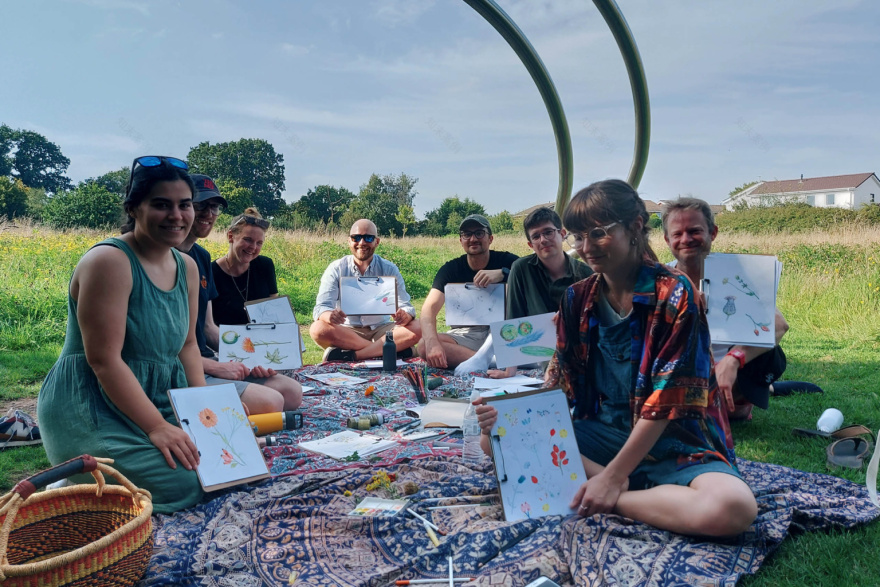
Since completion and occupation, residents have created a Community Interest Company (CIC) that manages and maintains the building and surrounding landscape. The community is active, running its own social media page and staging regular events including an annual summer fair. The focus on sustainability that runs through the design and construction of Hanham Hall extends into the residents’ approach to living, with car-sharing clubs, gardening groups and a walking school bus. The community room in the restored Hall is in use for local events, family celebrations and Parish Council committee meetings.
The key ingredients to this successful scheme is a holistic approach to design and an understanding that people want to be empowered rather than coerced to live sustainably. Beautifully landscaped, open, friendly: Hanham Hall is a place where people aspire to live.


Landscape Design
How does the landscape create a sustainable community
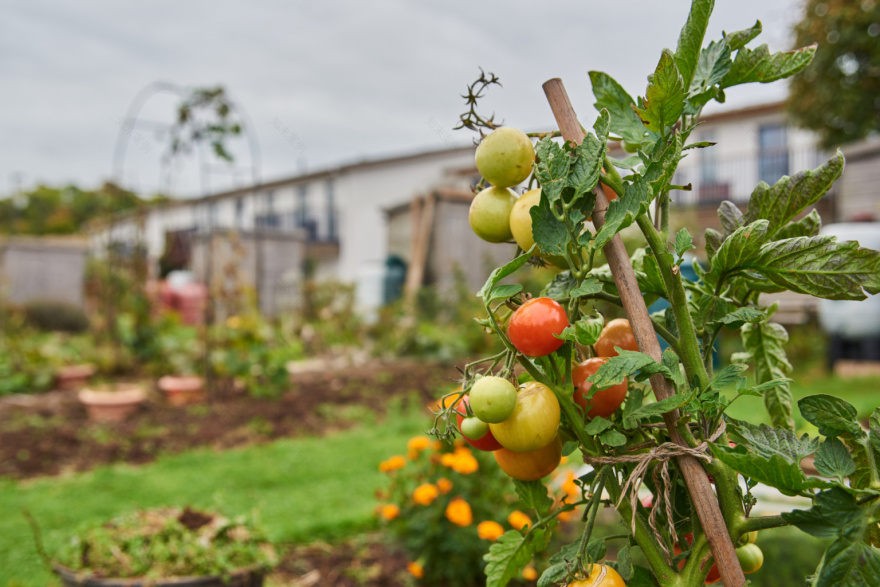
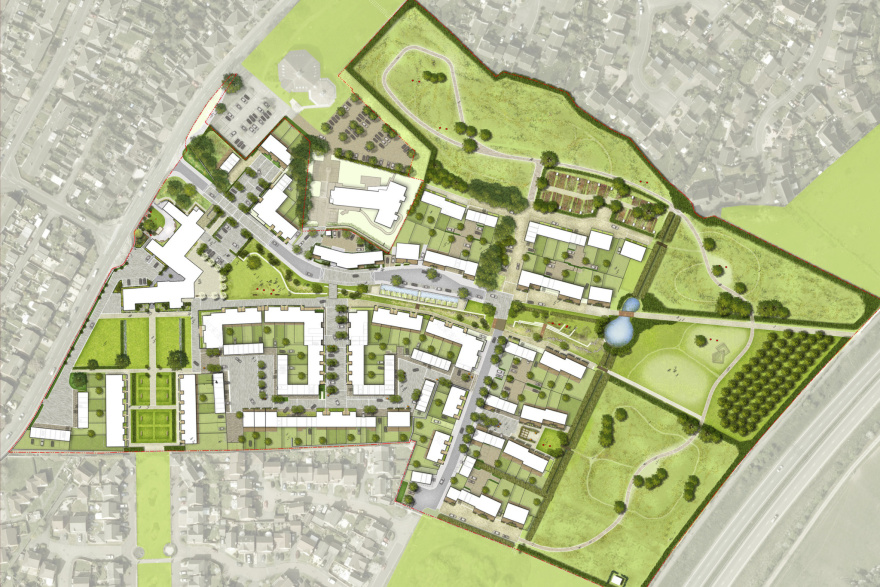
The landscape setting to the new homes creates a sustainable community that is close to nature. Residents are encouraged to use alternative transport to cars. Allotments are provided to grow food and an orchard provides fruit and shade. Biodiversity and wildlife has been promoted by a green spine linking species-rich wildflower meadows to the edge of the site, so that the countryside is drawn into the heart of the development. A series of smaller scale courtyard spaces is created as the focus of the development. Their treatment varies from soft informal greens to more formal and hard mews. The resultant development is contextual in character and appearance, respecting the site’s cultural heritage. It creates a robust and long lasting place that is biodiverse, inspiring and animated and designed to encourage social interaction.

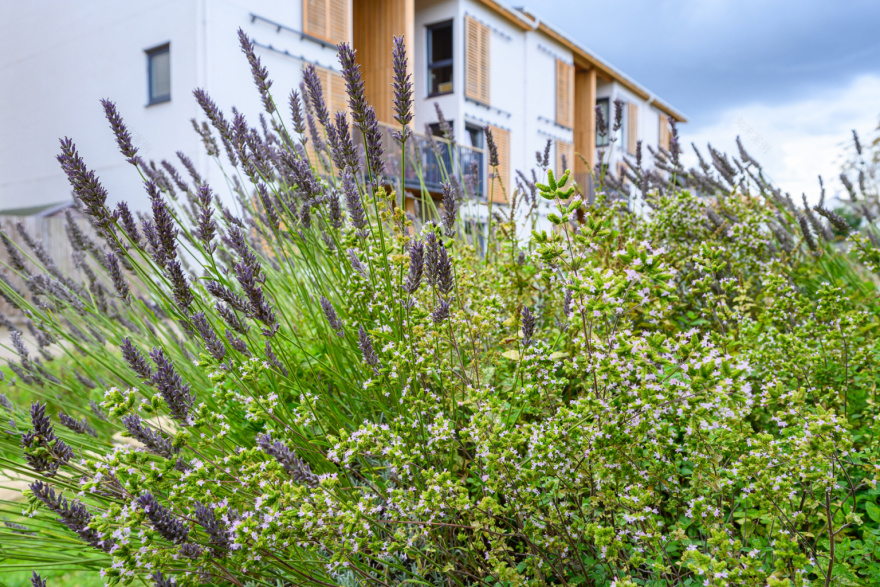

How did the development improve biodiversity in the area
HTA have worked closely with the ecologists at Arup to create a landscape that is an exemplar of biodiversity specific to South Gloucestershire. It contains a wide range of habitats ranging from large meadows, hedgerows to wetlands and ponds to encourage a wide variety of species to the site. These elements draw wildlife into the centre of the development. Residents can pick local varieties of apples, pears and plums from the communal orchard.


Photography - Nick Harrison
Allotments, contained by a hedge made of fruiting edible plants, an orchard and an apiary, allow residents to grow their food and work collectively. At the centre of the site, a series of greenhouses fronted by kitchen gardens are available for the residents to rent. Functional elements such as the SUDs system are incorporated into the neighbourhood spaces and the central amenity space, where it is a prominent landscape feature, a swale defined by a sculptural dry stone wall. The walling material is reclaimed from the site and compliments the historic listed boundary walls that enclosed the former estate. It will also function as a play element, visual attraction and functional part of the SUDs system. A play trail will run through the meadows so landscape, art and play combine as one element.
Sustainability & Building Physics

What makes the scheme sustainable
Constructed from pre-fabricated structural insulated panels with high performance timber windows and insulated doors, all the homes are highly energy efficient – designed to allow residents to reduce their carbon footprint by 60% without any lifestyle changes. External shutters, the thermal mass of the ground floor slabs and wall linings, together with night-time mechanical ventilation, keep the buildings cool in summer. Rainwater harvesting provides enough water to supply the washing machines and WCs, helping to reduce potable water use to 80 litres per person per day, while bike and recycling storage in each unit encourages residents to adopt a greener way of life.


How did you meet the stringent net zero requirements?
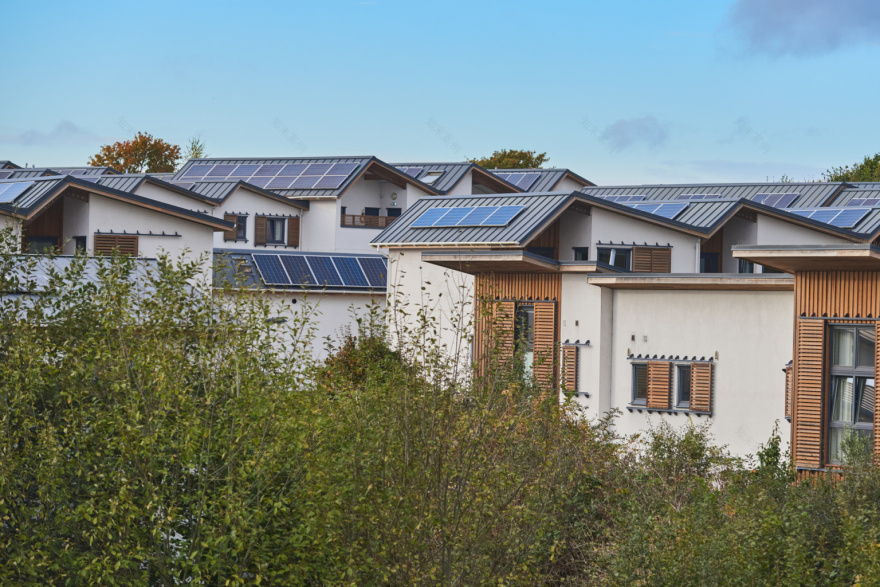
All homes achieve the ‘Zero-Carbon’ standard and well outperform the building regulations. The zero carbon standard is achieved by using a very efficient building envelope constructed using Kingspan TEK Structural Insulated Panels (SiPs) and roof-mounted photovoltaics. Each home will have a Mechanical Ventilation and Heat Recovery system and a minimal heating system. Because of the high insulation levels the need for space heating is much reduced. The Hall, which is a Grade 2* listed building, has been refurbished to a BREEAM standard. The external works are designed in accordance with the CEEQUAL standard. The homes are designed to avoid overheating and use manually-operated shutters to give residents control over their comfort, daylight and security. The homes also meet the Lifetime Homes and the Building for Life standard.

How did Hanham provide a unique and innovative housing solution when benchmarked against a ‘traditional onsite’ building approach?
The decision to utilise SIPs across the Hanham Hall development led to considerable benefits compared with a standard onsite masonry approach. As the panels are pre-cut to match the precise design requirements, deliveries of the panels are reliably scheduled weeks in advance to fit around other site work. The erections were carried out by a small team of highly trained installers, helping to reduce health and safety concerns, whilst the accurate, lightweight panel design meant the outer shells of even the larger homes could be constructed within a couple of weeks. Furthermore, completion dates are reliably predicted as no time was lost waiting for wet trades to dry. Once the shells were wrapped with a breathable membrane, they were weather tight, allowing follow-on trades to begin work at a much earlier stage than a traditional onsite approach would allow.


The scheme has been assessed and ratified against zero carbon energy targets and methodology from the Zero Carbon Hub. High efficiency gas boilers and PV panels were used to reduce annual energy bills significantly, and all other aspects of the development, such as controlling CO2 Emissions, water saving measures, sustainable sourcing of materials, health and wellbeing, security and providing a species rich ecological environment have been completed to Code 6 levels.


Planning
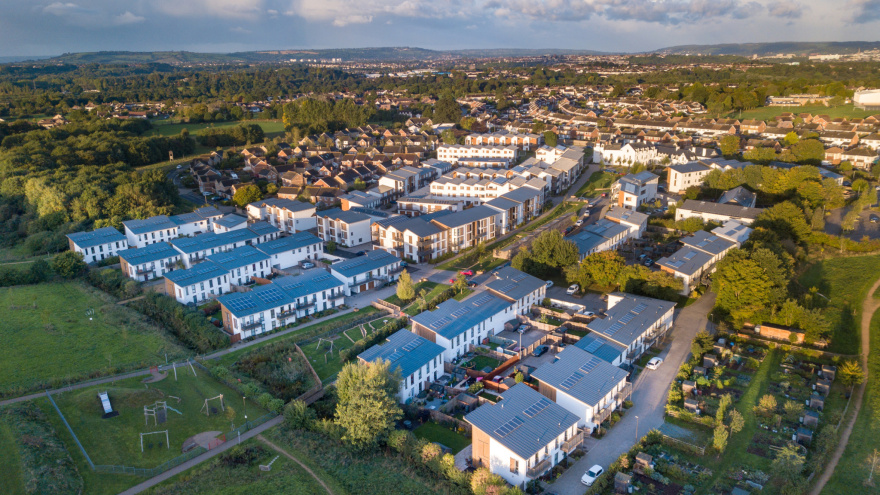
What were the challenges of building in a fringe green-belt suburban setting?
Green belt restrictions and the need to retain views of the Hanham Hills meant more than a third of the site could not be built on. These green areas now provide an array of shared amenity spaces. A new park extends through the site and beyond and includes access to greenhouses, an apiary, allotments, orchards, retained trees and hedgerows, play spaces, a village green, formal gardens, a swale and pond with extensive areas of meadow grass beyond. Street parking is concentrated in the secondary mews roads and rear courtyards ensuring that the main public spaces remain free of vehicular clutter.
What challenges did the planning team overcome?
The biggest challenge at Hanham Hall was to design a scheme that would meet stringent building standard requirements and satisfy all stakeholders. To achieve this balance, we created a structured engagement programme working with a vast range of parties, including our client and design team partners, the Homes and Communities Agency, English Heritage, South Gloucestershire Council as the Local Planning Authority, Sovereign Housing Association, the Green Belt Society, residents, and the supply chain. As the design progressed, the team organised regular briefing meetings with the parish council and held two public consultation events for the wider community.


The consultant planning team put a Planning Performance Agreement in place with the local authority’s planning team, and a partnership approach that both parties enthusiastically embraced was key to the scheme’s success. There was a real sense of a joined purpose being achieved. HTA was a continuous presence in the design progression of the scheme, which was rigorously assessed by the HCA’s design review teams.
Communications & Engagement
How did you engage with the local community?
The local community and local councillors were consulted from the earliest stages of the project with several public events held to get local views at an early stage in the development. Most people were supportive due to the local affection for the historic building that had lain idle for a long period and they were pleased to see it brought back into use. Consultation responses received from The Hanham District Green Belt Conservation Society were supportive of the proposals and the Society was encouraged by the level of consultation and involvement both the Society and local residents experienced which has been unprecedented in their history. Through extensive engagement the team were able to restore the Hall to its former eminence and put it to a good use for the community.
Holly Foskett
Hanham Hall


HTA have been back to Hanham to carry out some Post Occupancy Evaluation (POE). A resident focus group, and subsequent questionnaire, proved that Hanham Hall has a strong sense of community and neighbourhood connectivity. Our POE found that on arrival many residents said their reason for moving was either to downsize or to buy their first home with one of the strongest attractions of the development being the sense of community. One resident said ‘That is one of the great things I love about living here – the community is very strong and vibrant.’

Overall, residents responded positively to questions on active lifestyle citing the surrounding greenery and natural environment as inviting to spend time in. The residents group puts on lots of events both inside and outside that invite people to take a curious approach to their environment: ‘And we’ve got the beehives. They are up in the far corner. We had 60 odd pounds of honey. And we all made books the other day – a local artist came to teach us. Basically if you have ideas we are always welcome to them.’

Our POE surveys found that 82.46% of residents agreed or strongly agreed that the neighbourhood gave them opportunities to stop and talk with people regularly and that 81.82% felt the design of the home and its environment lifted their spirits.
南京喵熊网络科技有限公司 苏ICP备18050492号-4知末 © 2018—2020 . All photos and trademark graphics are copyrighted by their owners.增值电信业务经营许可证(ICP)苏B2-20201444 苏公网安备 32011302321234号
苏公网安备 32011302321234号客服
消息
收藏
下载
最近