

创作上传
VIP
收藏下载
登录 | 注册有礼
查看完整案例

收藏

下载

分享

El Cementerio del Barrio de los Lipanes
Project Data
Full Team
Year
2024
Status
Completed
Size
20,000 sq ft
Location
Presidio, Texas, United States
Partners
Lipan Apache Tribe
Collaborators
Lara Construction, Nakaya Flotte Consulting, Hisa Ota Lighting Design, MAKE Santa Fe
Photographer
MASS
Focus areas
Civic Spaces & Cultural Centers, Memorials & Monuments, Native Communities
Services
Architecture, Engineering, Exhibits & Interpretation, Film & Media, Landscape Architecture
Project Team
Mario Devora, Joseph Kunkel, Prescott Trudeau, Mayrah Udvardi, Annie Wang
Full Team
Project Team
Mario Devora, Joseph Kunkel, Prescott Trudeau, Mayrah Udvardi, Annie Wang
Cementerio del Barrio de los Lipanes Protection Project
The Cementerio del Barrio de los Lipanes restores and protects an Indigenous burial ground while advancing cultural recognition, healing, and land back. The cemetary is a spatial and cultural reclamation of a sacred Lipan Apache burial site in Presidio, Texas. Once fragmented and misused due to centuries of urban development, this site now stands as a powerful symbol of Indigenous resilience, memory, and land stewardship.

1920

1980

2025
For generations, the cemetery has served as the final resting place for Jumano Peoples and the Lipan Apache, who settled in the region in the 1700s after being forcibly displaced from their ancestral homelands. The site endured repeated disruptions as jurisdiction shifted between Mexico and the United States, and the Lipan Apache were driven from their lands by 19th-century U.S. removal policies. Despite being recognized by the State of Texas in 2009, the Tribe remains federally unrecognized, limiting access to critical federal resources.
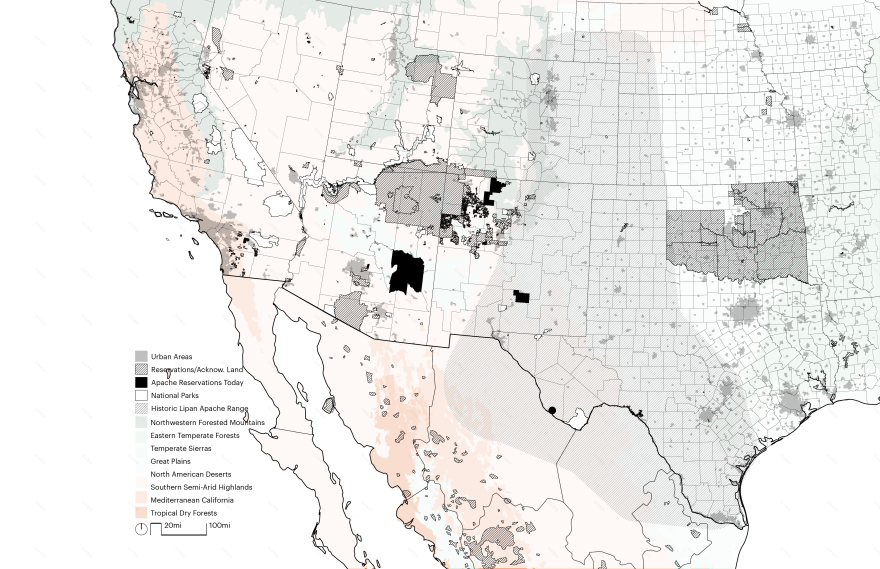


The cemetery’s preservation represents a crucial chapter in the Lipan Apache’s ongoing fight for cultural recognition and tribal sovereignty. After decades of advocacy, the Lipan Apache Tribal Council sought formal designation of the sacred site as an antiquities landmark in 2013. In 2021, the City of Presidio transferred its portion of the land within the cemetery to the Lipan Apache Tribe of Texas, and the site was finally recognized with a Texas Historical Commission marker. This project marks the beginning of a long-overdue journey of healing, visibility, and cultural affirmation.
The cemetery’s redesign reclaims Indigenous history through a respectful, non-invasive approach rooted in trauma-informed, land-sensitive, and culturally grounded design. Key features include a culturally sensitive enclosure that mitigates erosion while signaling the site’s sanctity; gravel pathways, benches, an offering wall, and a marker that contextualizes the history of the cemetery.


Forty-five graves have been identified within the 3,000-year-old mound, with more lying in the outer perimeter. To protect the burials, all interventions are foundation-free, avoiding invasive construction methods and instead honoring Indigenous relationships with the land: a ground-making, not ground-breaking. More than a memorial to the dead, the project honors the lives of preceding and current generations and uncovers the previously erased and unrecognized cultures of Indigenous people.


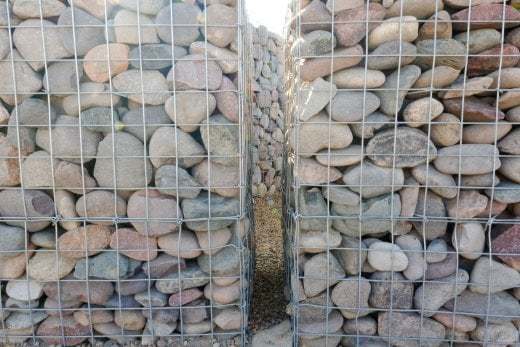
The design revives the sacred geometry of the original burial mound using three core principles: Curved gabion wall segments introduce porosity, facilitating movement into the cemetery while accommodating existing topography and graves. Entrance and exit points are aligned in the cardinal directions, highlighting the importance of the Four Directions in Lipan cosmology. Lastly, the mound’s gradual reformation is symbolized through the rippling of walls out from the site’s central high point, creating a flexible design language that can grow as the cemetery’s original mound is reclaimed over time.
Gabion walls were chosen for their minimal environmental impact, durability, cultural familiarity; and because they extend the language of the burial mound sentinel stones. Corten steel signage along the perimeter offers wayfinding, history, and respectful guidance for visitors. Gravel pathways help visitors navigate their healing journey across the site, and keep the marked and unmarked graves from being disturbed.

Lighting is dark sky compliant, modeling new codes for the region requiring 2200k or less downlight emittance. This is particularly important for the Big Bend Region, one of the world’s largest migratory corridors.
Existing vegetation, including creosote, desert willow, and prickly pear cactus has been preserved to the greatest extent possible. These plants are sacred medicines to the Lipan and their roots are intertwined with their ancestors.


Ongoing collaboration with the cemetery committee and Presidio-area descendants was crucial to ensure the design, construction, and interpretation process was Native-led. The development of the trilingual interpretive signage —in Lipan Apache, Spanish, and English—created an opportunity for collaboration between descendants, Tribal leadership, and language revitalization scholars.
In March 2024, the Cementerio del Barrio de los Lipanes reopened to the public. Members of the Lipan Apache Tribe, descendants, and community members gathered to honor the site and celebrate the completion of its first phase—a milestone in the ongoing journey toward healing, recognition, and the reclamation of unceded Indigenous land.
南京喵熊网络科技有限公司 苏ICP备18050492号-4知末 © 2018—2020 . All photos and trademark graphics are copyrighted by their owners.增值电信业务经营许可证(ICP)苏B2-20201444 苏公网安备 32011302321234号
苏公网安备 32011302321234号客服
消息
收藏
下载
最近