

创作上传
VIP
收藏下载
登录 | 注册有礼
查看完整案例

收藏

下载

分享

LSE Saw Swee Hock Student Centre
London
UK
The Saw Swee Hock Student Centre at the London School of Economics is a multifunctional building with a large music venue, pub, learning cafe, union offices, prayer centre, dance studio, careers library and gym. The project is located at the knuckle - point convergence of the network of narrow streets that characterise the LSE city centre campus. A public space at the threshold of the Student Centre is positioned on axis with St Clement’s Lane, to pull pedestrian street life into and up the building.
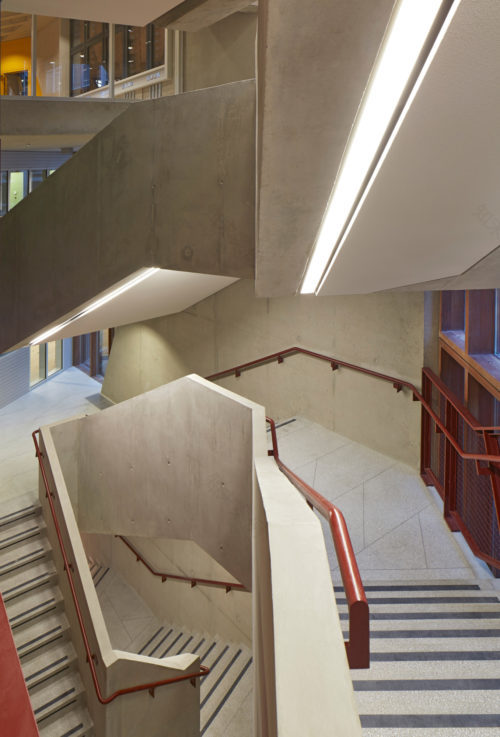
The design intention was to create an active Student Centre, the character of which should be contemporary, inviting, welcoming and even provoking to its users. Inside the building open stairways spiral around the central lift shaft that forms a skewering pivot - point at the centre of gravity of the plan. These wide stairs with slow steps make a flowing continuous ribbon of movement from street to roof garden, a vertical building working as a single organism.
Area: 6,000m2
Address: Houghton St, London WC2A 2AE, UK
↗︎
Client: London School of Economics
GPS: 51.5144° N, 0.1174° W
Competition: 2009
Start Year: 2009
End Year: 2015
Category: Education University Public Competition Winner Completed
Awards: RIAI Triennial Gold Medal shortlist, People’s Choice Award - The Best Building in London over Last 10 Years, Westminster Society Biennial Award for Architecture, The European Union Prize for Contemporary Architecture - Mies van der Rohe Award finalist, Civic Trust Award - Special Award for Brick, RIBA Award London Building of the Year, Brick Awards - Supreme Winner, Brick Awards - Best Education Building, Brick Awards - Use of Brick and Clay Products, Concrete Society Award - Best Building (Education), Leaf Awards - Public Building of the Year, RIBA Stirling Prize finalist, RIBA Award, RIAI Award - Best International Award, Irish Building and Design Award - International Award, Irish Concrete Society - International Award, AAI Award
Exhibitions: Difficult Sites: Architecture Against the Odds London, 11.10.2024 - Spring 2025; Expo 2020 Dubai - Ireland’s Pavilion: The Architecture of Creative Learning Exhibition Dubai, UAE, 23 January to 31 March 2022; The European Union Prize for Contemporary Architecture - Mies van der Rohe Award 2015 Exhibition - Wrocław Wrocław, Poland; The European Union Prize for Contemporary Architecture - Mies van der Rohe Award 2015 Exhibition - Leuven Leuven, Belgium
Irish Design 2015 Capsule Exhibition ‘Connections’
The European Union Prize for Contemporary Architecture - Mies van der Rohe Award 2015 Exhibition - Waterford
Waterford, 13 - 21 Oct 2015
The European Union Prize for Contemporary Architecture - Mies van der Rohe Award 2015 Exhibition - Dublin
Dublin
American Academy of Arts and Letters 2015 Awards: O’Donnell + Tuomey
Dublin, 29 Oct – 9 Nov 2015
Designs of the Year 2015
London, 25 - 31 March 2016
246th Summer Exhibition
London, UK, 9 Jun - 17 Aug 2014
Irish Design 2015 Design Island
Dublin
Ireland at Venice 2012
Dublin
The Vessel 2012
Venice, Italy
GA Exhibition ‘Emerging Future’
Tokyo, Japan
New London Architecture – London School of Economics Competition Designs
London
Related Media:
Material Matters podcast
Casabella Lecture, 01.12.2020
Mackintosh School of Architecture Lecture, The Index of Influence: O’Donnell and Tuomey, 23.10.2020
Rencontre avec O’Donnell + Tuomey, 06.11.2019
O’Donnell and Tuomey’s Saw Swee Hock Student Centre
Saw Swee Hock Student Centre - EU Mies van der Rohe Award Finalist, 2015
Brick: John Tuomey on the LSE Student Union
The site is located at the knuckle - point convergence of the network of narrow streets that characterise the LSE city centre campus. The public space at the threshold of the Student Union on axis with St Clement’s Lane, creates a place of exchange; a spatial bowtie that intertwines circulation routes, splices visual connections between internal and external movement, and pulls pedestrian street life into and up the building. We have developed a site specific sculptural concept for the architectural design. The folded, chamfered, canted and faceted façade operates with respect to the Rights of Light Envelope and is tailored in response to specific lines of sight along approaching vistas and from street corner perspectives. The surface of the brick skin is cut out along fold lines to form large areas of transparent glazing framing views in and out from street to room. Like a Japanese puzzle, our design is carefully assembled to make one coherent volume from a complex set of interdependent component parts. Our analysis of the context has uniquely influenced the first principles of the design approach.

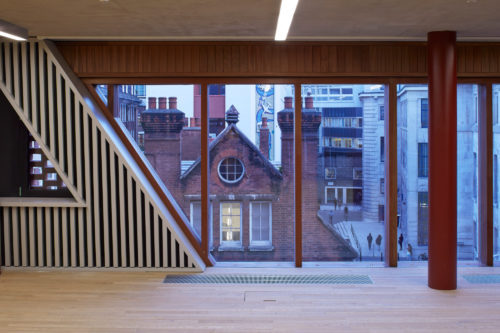
London is a city of bricks. The existing buildings on and adjacent to the site are built in bricks of varied and lively hue. Our design relates to the resilient characteristic of the city’s architecture with familiar materials made strange. The exterior walls are clad with bricks, used in a new way, with each brick offset from the next in an open work pattern, wrapping the walls in a permeable blanket that will create dappled daylight in particular spaces and, at night, when all the lights are on inside, the building will be seen from the streets like a glowing lattice lantern.
The faceted facade of the building is composed of both solid and perforated brick areas and glazed screens. The perforated planes are constructed from a single leaf of brickwork with spaces in the flemish bond pattern to allow light to both infiltrate the interior spaces and filtrate out at night to create a pattern effect. The openwork brickwork is constructed in front of glazed screens that seal the building and incorporate opening sections to naturally ventilate the building. The extent of perforation has been developed to maximise daylight into the building.

Our design refers to the robust adaptability-in-use of a lived-in warehouse. Open work steel trusses or ribbed concrete slabs cross the big spaces with solid wooden floors underfoot. Lightweight partitions made of clear and coloured glass and timber have sliding screens for flexibility in use. Circular steel columns prop office floors between the large span volumes and punctuate the open floor plan of the café. Stairs are made of terrazzo and plate steel. Concrete ceilings contribute thermal mass with acoustic clouds suspended to soften the sound. Every landing has a bench or built-in couch. There are no closed-in corridors. Every hallway has daylight and views in at least one direction. Every office workspace has views to the outside world. The basement floor area is lit from clerestory windows and roof lights to allow for daytime use. This building does not feel like a hotel, an office, or an academic institution. It is fresh and airy, heavy and light, open and clear, sculptural and social.






南京喵熊网络科技有限公司 苏ICP备18050492号-4知末 © 2018—2020 . All photos and trademark graphics are copyrighted by their owners.增值电信业务经营许可证(ICP)苏B2-20201444 苏公网安备 32011302321234号
苏公网安备 32011302321234号客服
消息
收藏
下载
最近