

创作上传
VIP
收藏下载
登录 | 注册有礼
查看完整案例

收藏

下载

分享
The Panopticon House
Cape Otway, Victoria

The
Panopticon House
project is a hybrid of modernist and
classical rural villa ideals, exploring the house as figured object versus the
disappearing enclosure. Located in rural
Victoria, on a prominent hilltop with panoramic views across the surrounding
landscape, the Great Southern Ocean, Bass Strait and the Tasman Ocean. The site
and program recall the classical villa however a key element of the client
brief was to minimize interruption to the views of the surrounding landscape.
The house was in effect to become a device for seeing out – a ‘Panopticon’,
whose primary function was that of observation.

Jeremy Bentham’s original 18th century
Panopticon has been used as a model for a wide range of institutional
buildings, including the reading room of the Victorian State library. However,
was latter criticized by Michel Foucault and others as mechanism for
manifesting and reinforcing power imbalances. In the context however, the
relationship between the observer/observed, is that between
architecture/landscape, emphasizing
the potential of architecture as a device for seeing.

This desire recalls the Farnsworth House, itself
arguably a continuation of the classical villa tradition - however with the
critical departure of the introduction of the ‘free plan’ into the villa type
and the ambition of dissolving the relationship between interiority and
exteriority. Located on the highest point on the site, the Panopticon House
adopts these strategies, elongating and folding the free plan back on itself to
provide panoramic views in all directions, while capturing a central courtyard
providing shelter from prevailing winds on the exposed site.

The pure geometries of the plan, a repeating square figure
of the 20x20m square plan, 10x10m square courtyard and offset square of the
south-western terraces, recalls the geometric explorations of the neo-classical
ideal, while exhibiting traces of bi-axial symmetry both recalling and
departing from this tradition. The form of the house and the undulating
folding roof, is produced by extruding view lines from key strategic points in
the surrounding landscape of to a single panoptic point within the courtyard,
producing compression/expansion in section to provide spatial articulation
within the free plan, introducing implied rooms and directing the gaze to keys
views of the landscape beyond the building.
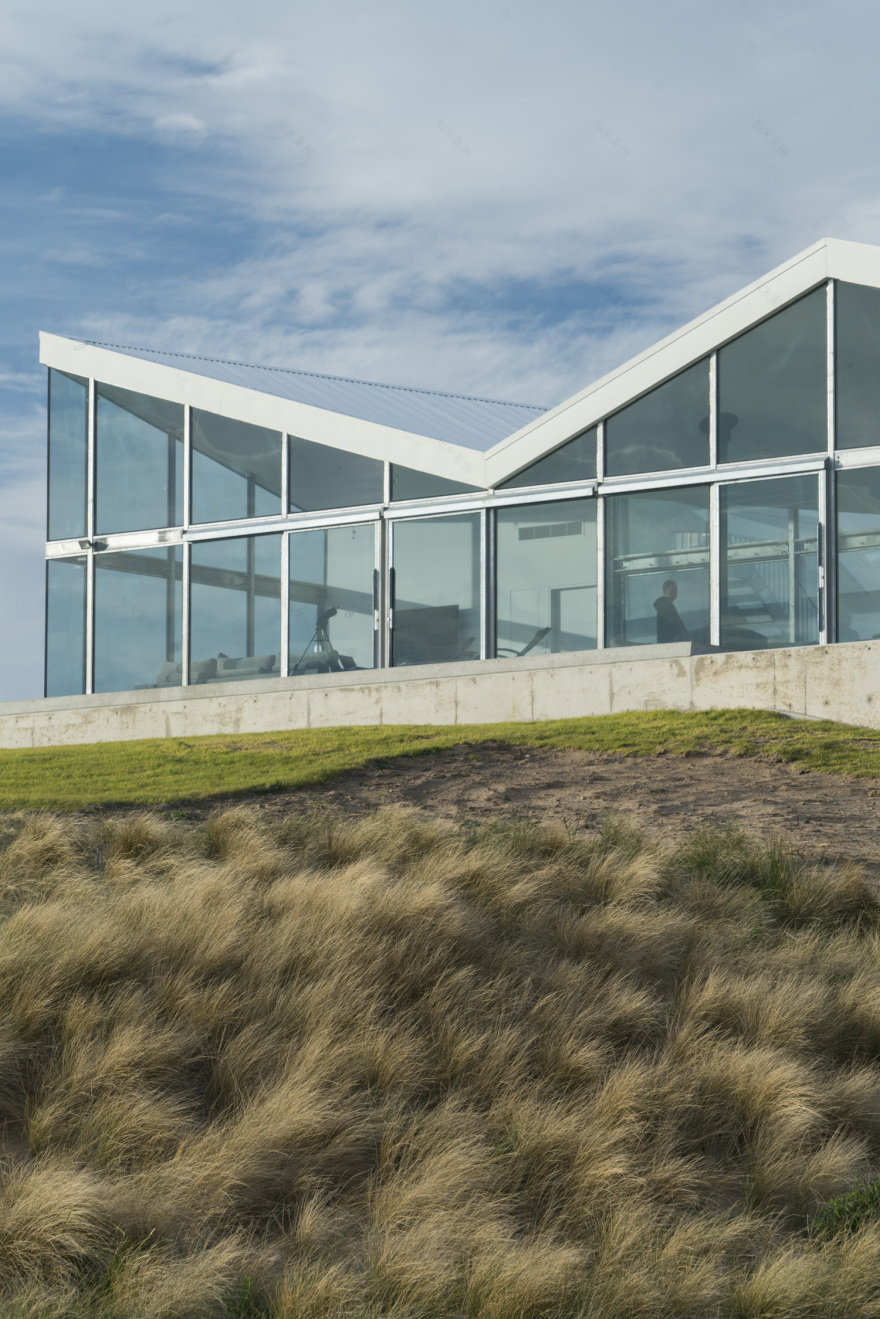
The house does not seek to blend with the site or be
‘part’ of the landscape – it is consciously a figured object in the field, like
the classical villa and the local vernacular of the rural shed. The form of the
Panopticon House hints at an aggregation of gable shed forms – suggesting a
linkage to this venular language while departing from it. The project
negotiates being seen and the seeing from as a point of departure, hybridising
classical and modernist villa typologies to produce a novel third type that
negotiates viewing to and viewing from in as a balanced conceptual
counterpoint.
From the outset the project looked to emulate the robust
language of Australian rural/industrial shed typologies, providing a long term,
robust building suited to its rural setting. To reflect this a simple and
durable pallet of off-form concrete, galvanised steel, fibre cement sheeting
and Sheet metal roofing was adopted. The
project’s primary structure is a series of radiating galvanised steel portal
frames, which are exposed within the glazed walls as columns supporting
galvanised steel windows/doors. Hot dip galvanised steel, provides a durable
finish requiring minimal maintenance, developing a patina over time, while
withstanding the extreme environmental conditions on site.

The project demonstrates a range of innovative
sustainability strategies, that with input key technical consultants moved
beyond tick-box solutions and tackle engagement with sustainability both with
the broader context and with detailed measurable outcomes. The sites history as
a patrol lease had led to extensive deforestation, the project served as a
catalyst for reforestation of the site; In
partnership with the Local chapter of Landcare, in excess of 25 000 Manna Gum
and Messmate Eucalypt trees have been planted across the site. Providing
expanded range for vulnerable endemic flora and fauna, and critically connects
up remnant stands of original forest, enabling wildlife corridors throughout
and across the site. The stitching
together of these corridors leverages the benefits of the project beyond its
immediate site and into the surrounding district.

The building is 100% off grid with a 30Kw PV solar array +
battery bank, with a 3kw wind turbine to be installed latter in the year. As a
glass house in an Australian climate, thermal comfort was carefully considered.
Every room allows cross venting, sliding door on are adjusted by a few
centimetres to control air flow and the temperature internally the resident note
that living in the house is like sailing a ship, and it has taken time to learn
and to master. The house is equipped
with AC, however it has seen limited use and on the hottest days, the PC array
generates more power than can be consumed by the HVAC system. When in operation
the house is 100% carbon neutral. If the tree planting program is considered
the project overall is Carbon Negative, to a reduction in carbon emissions of
the equivalent of 3.5 x the average Australian houses.

The Panopticon House project negotiates modernist and
classical rural villa ideals, exploring the house as figured object versus the
disappearing enclosure, to produce a novel third type that negotiates viewing
to and viewing from in as a balanced conceptual counterpoint.
Builder:
Roberts Builders
Images:
TM
Photo
南京喵熊网络科技有限公司 苏ICP备18050492号-4知末 © 2018—2020 . All photos and trademark graphics are copyrighted by their owners.增值电信业务经营许可证(ICP)苏B2-20201444 苏公网安备 32011302321234号
苏公网安备 32011302321234号客服
消息
收藏
下载
最近