

创作上传
VIP
收藏下载
登录 | 注册有礼
查看完整案例

收藏

下载

分享
Mopy’atã Ra’yraé Cultural Center
Aracruz, ES, Brazil
image: Grupo Fresta | © all rights reserved
Location: Aracruz, ES, Brazil
Phase: design development
The Tupiniquim, an indigenous people of Espírito Santo, after centuries resisting colonization and corporate exploitation of their territory, now champion their cultural and linguistic revival through a new youth space. Aldeia Pau Brasil, in partnership with Grupo Fresta, presents the Mopy’atã Ra’yraé Cultural Center: a circular, multifunctional venue for performances, exhibitions, and audiovisual production. A space of hope and resistance.
Project leader: Otávio Helena Sasseron
What is still needed to proceed?
Finance Still 100% of € 39,830
Skills Stuff Hands Support
The project
Introduction
The Tupiniquim people have inhabited Espírito Santo since ancient times, settling between Camamu (Bahia) and the São Mateus River, with a rich culture connected to the Piraqueaçu mangroves. Portuguese colonization in the 16th century began a process of cultural domination, worsened by Jesuit influence in subsequent centuries and, in the 20th century, by predatory logging, coal and mineral extraction that devastated traditional territories and displaced indigenous communities.
In 2024, building on a partnership begun in 2017 with projects like the Women’s House, Tupiniquim leaders and Grupo Fresta (with experience in community architecture since 2008) conducted participatory workshops to design the Mopy’atã Ra’yraé Cultural Center. This space symbolizes indigenous resistance and serves as a platform for youth identity strengthening, integrating traditional cultural practices with contemporary approaches while promoting environmental education for the preservation of the indigenous land’s ecosystem.

Impact
The space, designed for the village youth, will host gatherings, ethnotourism activities, audiovisual production, and musical rehearsals/performances – particularly the traditional drum circle.
The new structure faces the village’s main square alongside other key public buildings like the Women’s House, channeling the square’s movement through its wraparound verandas toward the central circular volume.
Core activities unfold in this multifunctional central space – permeable to the public for meetings, performances, and exhibitions – while the outer perimeter contains modular areas for restricted functions: instrument storage, audiovisual production, exhibition support, restrooms, and a small kitchen.
The diversity of roof forms, volumes, and materials expresses local identity, emerging from democratic discussions in participatory workshops that honor Tupiniquim heritage through youth empowerment.
The Mopy’atã Ra’yraé Cultural Center stands not just as a space to perpetuate Tupiniquim language/culture and environmental education (promoting indigenous land reforestation and ecological memory), but also as a crucible for youth creativity and occupation – a place of hope for the future.


Core team
About Grupo ][ Fresta:
Founded in 2008, Grupo ][ Fresta consists of four architects and one sociologist: Anita Freire, Carolina Sacconi, Luan Carone, Otávio Sasseron, and Tais Freire, respectively, working on architectural and sociocultural projects. As needed, the group collaborates with other architects and professionals.
Grupo ][ Fresta works closely with communities to understand their needs and identities, co-creating architectural programs through participatory processes. This approach has guided their urban projects with residents’ associations in Heliópolis (São Paulo’s largest favela), a municipal daycare in Rio Pequeno, and especially their work with Indigenous communities (Guarani, Tupi, and Tupiniquim villages in São Paulo and Espírito Santo) and riverside communities in Canavieiras (Bahia), Novo Airão (Amazon), and Marujá (Cardoso Island State Park).
Building on their ongoing partnership since 2017 – which included an agricultural shed and Women’s House – Grupo Fresta reunited with Pau Brasil Village leaders in March 2024 to conduct participatory workshops for the co-design of the Mopy’atã Ra’yraé Cultural Center.
Connect:
Instagram: @grupofresta

Grupo Fresta team
image: Grupo Fresta | © all rights reserved
Image gallery

Cultural center from above
image: Grupo Fresta | © all rights reserved
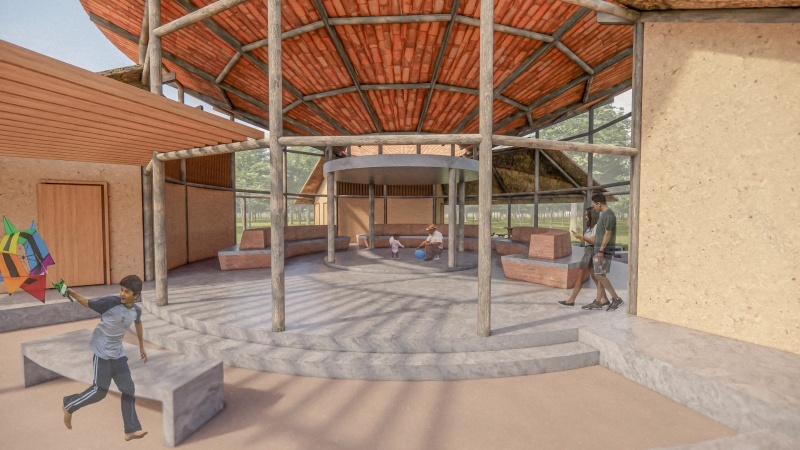
Entering the cultural center image: Grupo Fresta | © all rights reserved
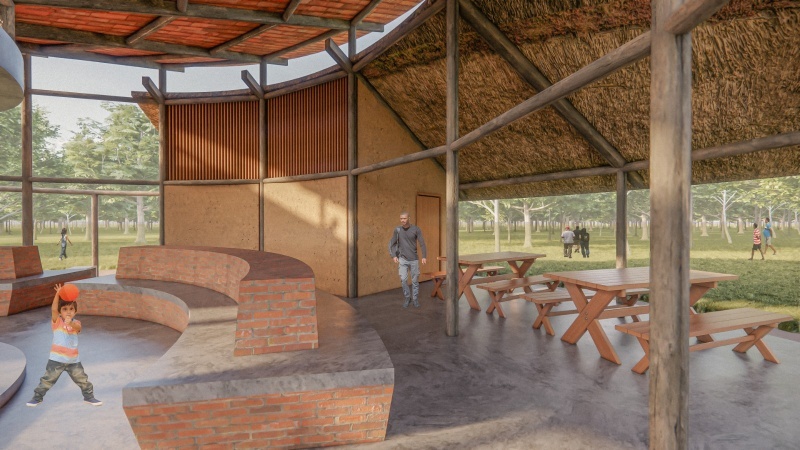
Inside the cultural center image: Grupo Fresta | © all rights reserved

map of the Tupiniquim Guarani Indigenous Land
image: Grupo Fresta | © all rights reserved

agricultural shed project in Aldeia Pau Brasil
image: Grupo Fresta | © all rights reserved

Women’s House project in Pau Brasil Village image: Grupo Fresta | © all rights reserved

Women’s House (building built by Grupo Fresta in Aldeia Pau Brasil) image: Pedro Napolitano | © all rights reserved
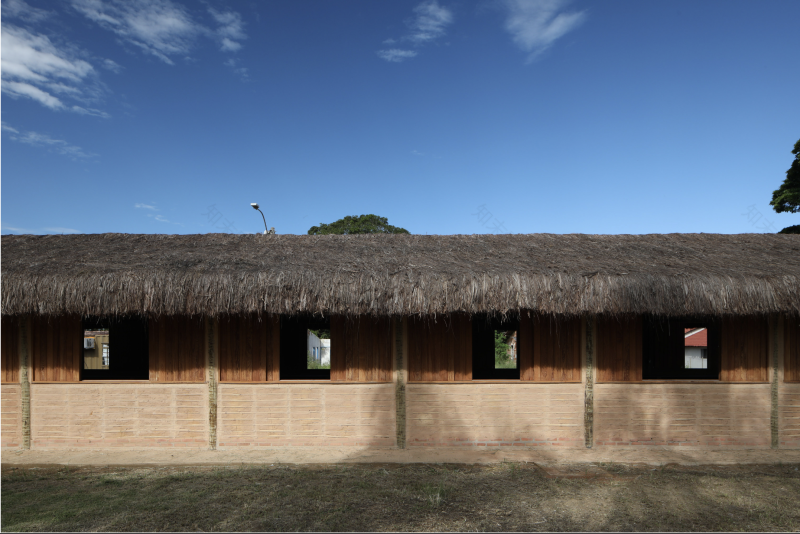
Women’s House (building built by Grupo Fresta in Aldeia Pau Brasil) image: Pedro Napolitano | © all rights reserved

Women’s House (building built by Grupo Fresta in Aldeia Pau Brasil) image: Pedro Napolitano | © all rights reserved

Women’s House (building built by Grupo Fresta in Aldeia Pau Brasil) image: Pedro Napolitano | © all rights reserved

participatory workshop in the Tupiniquim Guarani Indigenous Land image: Grupo Fresta | © all rights reserved

Participatory process with the Pau Brasil village community image: Pedro Napolitano | © all rights reserved

Participatory process with the Pau Brasil village community
image: Pedro Napolitano | © all rights reserved

Participatory process with the Pau Brasil village community
image: Pedro Napolitano | © all rights reserved
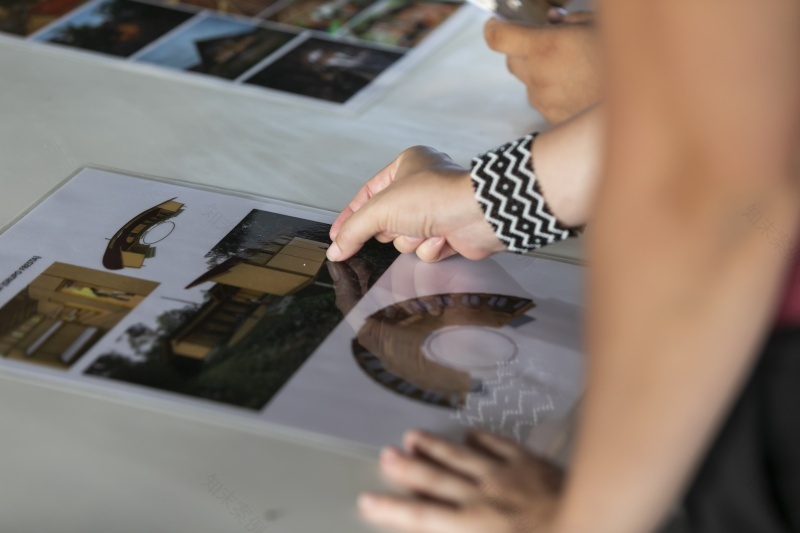
Participatory process with the Pau Brasil village community
image: Pedro Napolitano | © all rights reserved

Participatory process with the Pau Brasil village community
image: Pedro Napolitano | © all rights reserved

Participatory process with the Pau Brasil village community
image: Pedro Napolitano | © all rights reserved

collective design of the cultural center in the participatory workshop
image: Pedro Napolitano | © all rights reserved
Technical drawings

Site plan and architectural implementation of the cultural center
image: Grupo Fresta | © all rights reserved

flows from the main square passing by the Women’s House image: Grupo Fresta | © all rights reserved

Plan of the Cultural Center
image: Grupo Fresta | © all rights reserved

Section A of the Cultural Center
image: Grupo Fresta | © all rights reserved
Section B of the Cultural Center
image: Grupo Fresta | © all rights reserved
Help bring our project to life!
Finance: Still 100% of € 39,830 Support
Where are we now
The village has already secured the land, completed the topographic survey, and cleared the terrain. The Grupo Fresta team has traveled to the site to conduct participatory workshops with the community and has also developed a preliminary architectural study, providing the village with technical drawings and educational visuals to support fundraising efforts.
Now, Grupo Fresta and the leaders of Pau Brasil Village are seeking funding to finance:
- The executive project, including all necessary engineering plans.
- The construction budget, to be implemented in phased stages.
An indication of our team’s capacity:
40% expertise already found
5% builders already found
Finance: € 39,830
Expected Outcomes from Funding:
- Completion of the cultural center as a vital space for preserving Tupiniquim heritage.
- Training indigenous youth in cultural/environmental stewardship
- Income generation through community ethnotourism and audiovisual production.
- Raising awareness for the protection and reforestation of the indigenous land’s traditional territory.
- Revitalization of the Tupi Litorânea language through educational programs.
南京喵熊网络科技有限公司 苏ICP备18050492号-4知末 © 2018—2020 . All photos and trademark graphics are copyrighted by their owners.增值电信业务经营许可证(ICP)苏B2-20201444 苏公网安备 32011302321234号
苏公网安备 32011302321234号客服
消息
收藏
下载
最近