

创作上传
VIP
收藏下载
登录 | 注册有礼
查看完整案例

收藏

下载

分享
Florian
Busch
Architects
Ota Culture Centre
Ota, a small city about 100km northwest of Tokyo, is a place with a convoluted history. During the Edo period, an important thoroughfare connecting Edo with Nikko brought a disproportional amount of cultural heritage. In the years before and during the second World War, some of Japan’s most notorious warplanes were manufactured here by a company later dissolved and regrouped into a car producer – Ota’s most prominent employer today. Together with agricultural production, the car industry has made Ota one of the most affluent places in the area. And yet, the city seems to have surrendered coherent urban integrity to haphazard, if any, interventions.
One of these interventions was a call for a cultural centre on the square north of Ota’s central station, an area that is scheduled to undergo compromised urban reordering to undo years of –mostly because of its central location– almost charmingly unregulated small-time building.
On this central square in front of the station, a nationwide competition called for a new building combining library and museum. Perhaps the most compelling aspect of the project was the inherent contradiction between the speed and efficiency of a thoroughfare and the slowing down of a museum and library.
An ecotone is a transition area between two biomes.[1] It is where two communities meet and integrate.[2] It may be narrow or wide, and it may be local (the zone between a field and forest) or regional (the transition between forest and grassland ecosystems).[3] An ecotone may appear on the ground as a gradual blending of the two communities across a broad area, or it may manifest itself as a sharp boundary line.
—wikipedia
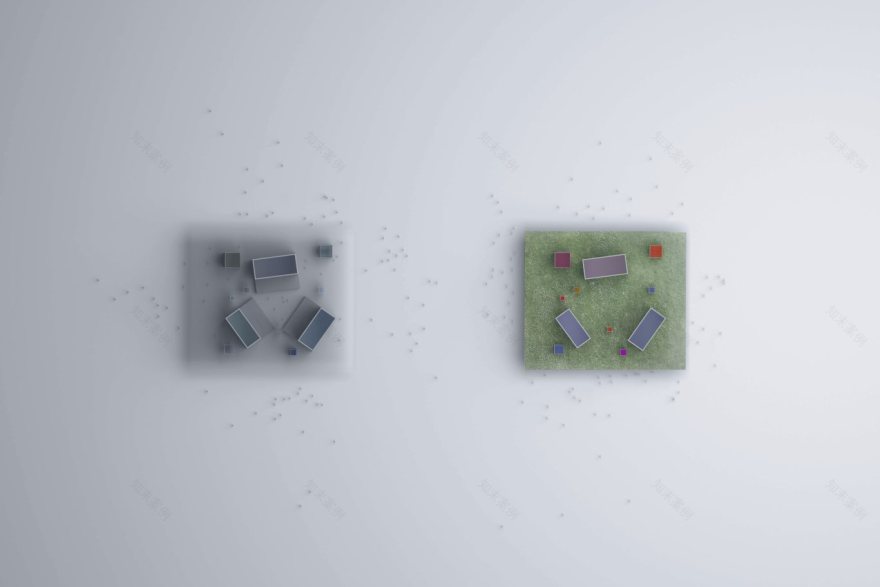
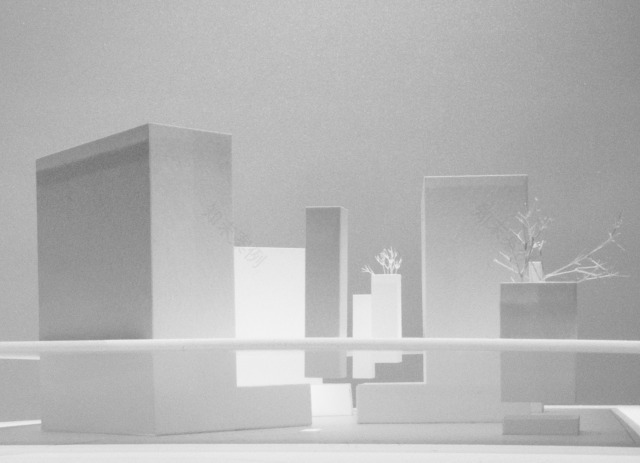
In a move that does not negate but negotiate the existing condition of urban non-order, we proposed a series of volumes that could have been there already only to combine them with a new layer raised five metres above ground. While the volumes house the ‘hard’ functions of museum and library, the space defined by the new layer cutting through them is a continuum of flexible cross-programming.
Both roof and ceiling, this layer is an ecotone giving a new meaning to discrete volumes: it turns them into parts of a continuous multilayered public space accessible for all. Here, Ota escapes the duality of private buildings versus public streets: Below the roof, the urban surrounding flows in and out an urban foyer, above, a large urban garden becomes a new realm of its own.
Where the city, pursuing a strangely anachronistic policy, has decided to cut down major trees around the station, this garden becomes an ever more needed agent of artificial wilderness. Rather than curated greenness –the widespread (and strangely universal) assumption that an area of nicely groomed green comfort is a valuable public space–, the project proposes to locally define the manifold potential of public space: The inserted layer’s core quality is its double-sided-ness with which it juxtaposes and weaves public programmes; it is a public ceiling-roof defining a spatial and functional complexity beyond the museum-library-hybrid.
Instead of the conventional closure of a museum or library, our proposal is an urban place where speed and standstill are cross-fertilising in a diverse environment.
Ota, Gunma Prefecture, Japan, 2014
Type
Public, Cultural, Library, Museum/Gallery
Status
Competition
Team
Florian Busch, Sachiko Miyazaki, Momoyo Yamawaki, Akira Miyamoto, Suguru Takahashi, Antoine Vaxelaire
Structural Engineering: OAK (Masato Araya)
Environmental Engineering: Kankyo Engineering (Takafumi Wada)
Size
GFA: 2,600 m²
Structure
Reinforced Concrete, Steel




南京喵熊网络科技有限公司 苏ICP备18050492号-4知末 © 2018—2020 . All photos and trademark graphics are copyrighted by their owners.增值电信业务经营许可证(ICP)苏B2-20201444 苏公网安备 32011302321234号
苏公网安备 32011302321234号客服
消息
收藏
下载
最近