

创作上传
VIP
收藏下载
登录 | 注册有礼
查看完整案例

收藏

下载

分享

Rwanda Institute for Conservation Agriculture
Project Data
Full Team
Year
2023
Status
Completed
Size
3,400 acres
Location
Gashora, Bugesera District, Rwanda, Africa
Partners
Howard G. Buffett Foundation, Rwanda Institute for Conservation Agriculture, Government of Rwanda
Collaborators
Arup, Transsolar, Remote Group, Costwise, MEW Consultants LTD, Arabella, Conspectus, Inc., PEBL Design
Photographer
Iwan Baan
Full Team
Architecture
Bethel Abate, Kelly Alvarez Doran, Giorgio Azzariti, Christian Benimana, Giovanni Bortolotti, T.J. Burghart, Alejandra Cervantes Enríquez, Martine Dushime, Rene Gasana, Symphorien Gasana, Josh Greene, Chris Hardy, Kristen Henderson, Genna Kalvaitis, Alba Mukundwa Karenzi, Taylor Klinkel, Anton Larsen Payá, Catherine Lie, Erinn McGurn, Noella Nibakuze, Anibal Niyitanga, Jean Luc Ntwali, Nadia Perlepe, Nicki Reckziegel, Alan Ricks, Deb Rosenberg, Amani Rwibasira, Jean Paul Sebuhayi Uwase, Aziz Farid Shyaka, Lamy Subira, Kelly Umutoni, Ines Uwimbabazi, Jean Paul Uzabakiriho, Jamie Wiberg
Engineering
Will Arnold (seconded from Arup), Cameron Bailey, Jean Damascene Sekamana, Zani Gichuki, Rosie Goldrick, Nelson Habintwari, Serge Iradukunda, Nadine Ishimwe, Jenny Kay, Harriet Kirk, James Kitchin, Tilly Lenartowicz, Jacques Maniraruta, Aimable Mukire, Sherryen Mutoka, Hervé Gilbert Ngenzi, Paterne Niyonkuru, Andre Ntivuguruzwa, Asyncrite Nyinganyiki, Shakira Nyiratuza, Claire O’Reilly (seconded from Arup), Okechi Opoko, Obed Sekamana, Richard Shumbusho, Munguakonkwa Taka Hubert, Darryl Tanner, Clemence Twambazimana, Christian Uwinkindi
Landscape Architecture
Sierra Bainbridge, Jonathan Blaseg, Greg Dahlke, Melissa Flatley, Jessi Flynn, Joe Christa Giraso, Therese Graf, Taylor Sinclair, Patrice Uwizeyimana
Interior Design, Furniture, and Signage
Lotte de Raadt, Maaike Hengeveld, Niels Joseph Maria Datema, Jean Claude Kwitonda, Christelle Muhimpundu, Paulien Nabben, Theophile Ndoreyaho, Amie Shao, Miguel Roldán Signes, Carissa Tan Tije, Pim Van Baarsen
Media
Thatcher Bean, Elsemieke de Boer, Tracy Keza, David Mutabazi, Gabriel Nyirijuru, Joelle Riffle
Construction
Anathole Abimana, Zawadi Imani Barasa, James Blackman, Nolaste Dushimerurema
Claudine Ishimwe, Edmond Kalimba, Yvanie Kamikazi, Azarias Kuradusenge, Janvier Rutsobe, Adam Saltzman, Jean Luc Shema Karuyonga, Dieudonne Shimirwa, Alain Tuyishime
View Less
View More

The Rwanda Institute for Conservation Agriculture (RICA) is the first climate-positive campus in the world. Located on a 3,400-acre peninsula in Rwanda’s Bugesera District, it is an agricultural landscape, an ecological restoration effort, and an educational model rolled into one.
Rwanda is the most densely populated country in continental Africa, and approximately 80 percent of its people depend on farming for their livelihoods. Yet nearly one in five Rwandans remains food insecure, and nearly all arable land is already in use. The population is expected to double by 2050, placing extraordinary pressure on farmland and ecosystems. Climate change, soil erosion, deforestation, and biodiversity loss compound these risks, undermining water, crops, and public health. Meeting Rwanda’s ambitious goal of food independence will require a new approach—one that increases productivity while sustaining ecological health.
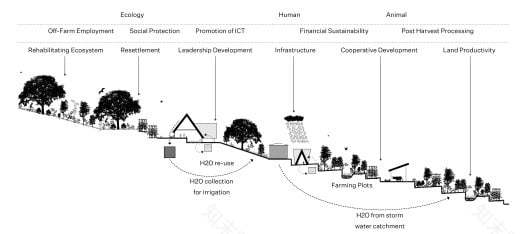
RICA was founded to respond directly to this challenge. Initiated and funded by the Howard G. Buffett Foundation with support from the Government of Rwanda, the university equips the next generation of agricultural leaders with the skills to combine scientific knowledge, business acumen, and ecological stewardship.
Its philosophy is grounded in Conservation Agriculture and One Health—recognizing the interconnected well-being of people, animals, and ecosystems. The curriculum emphasizes experiential learning: students not only study soils, crops, and livestock but also manage farms as businesses, develop value-added enterprises, and lead cooperatives. By linking education with practice, RICA aims to generate sustainable livelihoods for farmers while restoring the ecological systems agriculture depends on.

MASS partnered with RICA from the inception, playing a comprehensive role that spanned land use planning, architecture, engineering, landscape design, construction, film production, and furniture design and fabrication.
The task was not simply to design buildings, but to align the physical campus with RICA’s educational mission and the ecological realities of its site. The process began with an intensive year of planning and research, engaging faculty, government ministries, local farmers, and international experts to define the curriculum, map the site’s ecological conditions, and establish the framework for a campus that would embody the principles it sought to teach.
MASS worked to ensure that every aspect of the campus—which ultimately comprised 20,000 square meters of buildings and 1400 hectares of landscape—would serve as a living laboratory for education, conservation, and community.

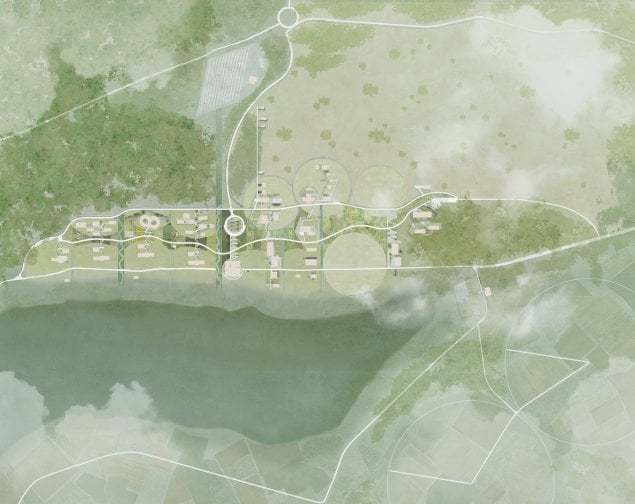
The masterplan was shaped by the “One Health” philosophy, linking soils, crops, livestock, and communities into a single integrated system. The curriculum and campus were developed in synchrony, allowing pedagogy and physical space to reinforce one another.
Students begin with hands - on experience managing smallholder - style farms in small cohorts and gradually advance to specialized agricultural enterprises—such as poultry, dairy, irrigation, mechanization, and value - added processing—arranged across the site in a sequence that mirrors their progression through the program. A central path connects these enterprises with academic buildings, creating a social and ecological spine for campus life. The result is a landscape where every classroom extends into a farm, and every farm into a classroom.

Beyond education, the masterplan addresses ecological restoration at scale. The Bugesera site, degraded by decades of deforestation, overuse, and erosion, is being transformed into a mosaic of productive farms and restored habitats. Water management systems infiltrate rainfall, wetlands are buffered, and native species are restored. Along the central path, an arboretum serves not only as a teaching tool but also as a repository of native species, reinforcing the principle that agriculture and conservation can coexist.


RICA was designed to model both provenance—through local material sourcing—and performance—through environmental efficiency and resilience.

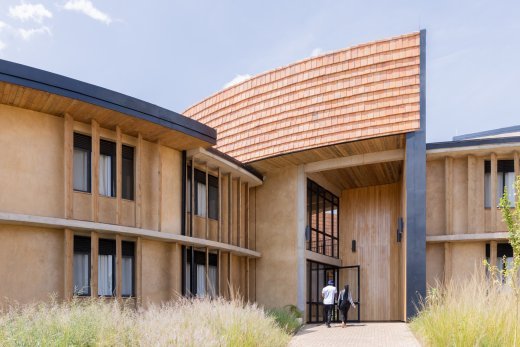
To minimize the project’s carbon footprint, the team built a supply chain rooted in local sourcing. 90% of the budget was spent within 500 miles of the site, and 96% of materials were sourced within Rwanda. Across the campus, 69 off-grid buildings were constructed using rammed earth, compressed stabilized earth blocks, locally quarried stone, wood, and terracotta—materials that both reduce environmental impact and celebrate place.

Engineers developed a low-cement soil mix harvested from the campus for site-made earth blocks; foundations use stone masonry to minimize concrete; and roofs employ regionally sourced softwoods to catalyze a fledgling timber industry. By considering every stage of the process—extraction, manufacturing, transport, and installation—RICA achieved an embodied carbon footprint 58% below the global average for institutional projects.

Pim Van Baarsen

Pim Van Baarsen

Chris Schwagga

Chris Schwagga
That ethos extends to the smallest scale.
MASS’s furniture atelier collaborated with over 85 artisans and cooperatives to craft more than 3,300 custom pieces of furniture using native timber species and sustainably sourced materials such as clay, wood, textiles, and papyrus. This not only reduced the carbon footprint associated with importing goods but also created opportunities to invest directly in local economies. Every bench, desk, and table reflects the campus’s broader mission: that abundance can be hand-built, hyperlocal, and deeply reciprocal.

The campus is also optimized for Bugesera’s hot, arid climate. Passive strategies—including natural ventilation, daylighting, shading, and thermal mass—eliminate the need for air conditioning while maximizing comfort. Shaded façades, carefully oriented roofs, and cross-ventilation balance cooling with daylight. A 1.5MW solar array, paired with on-site water and wastewater treatment, makes the campus fully off-grid. A variety of irrigation types across diverse demonstration plots supplement the curriculum.
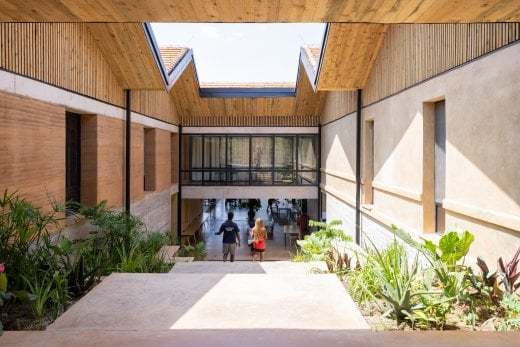


The landscape functions as a living system—harvesting water, recycling nutrients, building soils, and restoring biodiversity. Learn more


RICA’s campus is surrounded by one of the last remaining patches of savannah woodland outside Rwanda’s national parks. These woodlands are now protected and integrated into the design of the school itself. The plan integrates ecological and agricultural systems at four interconnected scales: agroforestry, which layers agricultural planting for productivity and resilience; marshland restoration along the lake edge; savannah woodland preservation and reintroduction to regenerate native habitats; and cultivated crops that sustain the campus’s working farms.
While these systems require initial maintenance, over time their diversity allows them to self-regulate, compounding benefits until they evolve into stable, flourishing ecosystems. This transition from maintenance to stewardship enhances crop yields, strengthens resilience to pests and disease, improves soil and water quality, and supports both ecological and human well-being.

Working with local ecologists, the MASS team developed a biodiversity succession plan to restore conditions for native species. Ecological corridors connect woodlands and wetlands, enabling the movement of animals, insects, and water.
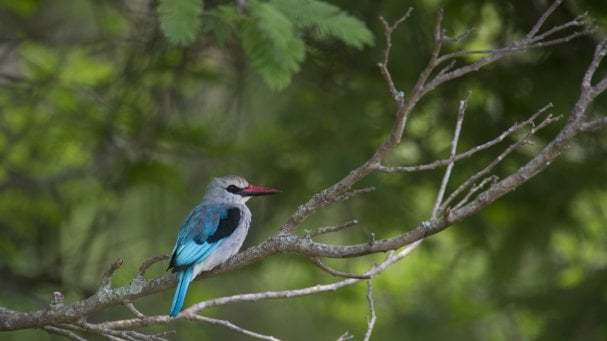
Apex species were prioritized to regenerate ecosystems and attract wildlife such as the grey-crowned crane, once common in the region. The restored ecosystem supports soil regeneration, carbon sequestration, and climate resilience, while also improving agricultural yields.

Gaël Vande Weghe

Gaël Vande Weghe

Gaël Vande Weghe

Gaël Vande Weghe
Gaël Vande Weghe

Gaël Vande Weghe

Gaël Vande Weghe

Planting such a diverse landscape required extensive effort. MASS’s landscape team procured and propagated over one million plants, integrating native species with ecological value as well as agricultural value. Some were widely known within the region, while others demanded careful planning and investigation. An on-site nursery enabled propagation at scale, supplemented by sourcing directly from adjacent fields and farmers. Where grasses and groundcovers were abundant, plants were divided and transplanted without disrupting existing ecologies.

The result is a restoration effort both ambitious and rooted in local practice. Within its first 15 years of operation, the landscape and longer term land planning are projected to offset all embodied carbon from construction and the limited amount from operations, transforming into a long-term carbon sink and contributing to the campus’s goal of becoming climate positive by 2044.


The construction process itself was leveraged as a vehicle for impact.
More than 2,500 people were employed over the course of construction (nine out of ten from the surrounding Bugesera district), ensuring that investment directly supported the local community. Eventually directly managing the largest phase of construction, the MASS team brought the design values into the construction process, providing training and administering public health procedures during the pandemic. These skills continue to ripple outward: one cooperative formed by workers trained in rammed-earth techniques now carries their expertise to projects across Rwanda.
Procurement was equally place-based, with 90% of the budget spent within 500 miles. By prioritizing local suppliers, the project stimulated regional economies, supported livelihoods, and ensured the campus could be maintained by those who built it. Construction was not just the means to an end, but a demonstration of how investment in infrastructure can catalyze broader social and economic development.
MASS also provided communication and media support to the nascent RICA team during the project’s construction — documenting the early parts of the institution’s formation, student life, as well as the construction process.


As students, faculty, and visitors move through the campus today, they encounter a resilient system that embodies the values it teaches. Farms, fields, and classrooms are interwoven with ecological corridors and restored habitats; building and furniture celebrate local craftsmanship; and the daily rhythms of study, farming, and community life mirror the holistic balance of One Health.

RICA represents a bold experiment in rethinking how agricultural education can catalyze systemic change. It shows that food security cannot be separated from ecological stewardship, and that the spaces where people learn and work can themselves model regeneration and reciprocity. For Rwanda, it is an investment in the resilience of its people and landscapes. For the world, it is a precedent for how design and education can come together to address global challenges. By aligning mission, curriculum, architecture, and community, the Rwanda Institute for Conservation Agriculture offers a living example of how the future of food can be cultivated in harmony with the health of people, animals, and the planet.
南京喵熊网络科技有限公司 苏ICP备18050492号-4知末 © 2018—2020 . All photos and trademark graphics are copyrighted by their owners.增值电信业务经营许可证(ICP)苏B2-20201444 苏公网安备 32011302321234号
苏公网安备 32011302321234号客服
消息
收藏
下载
最近