

创作上传
VIP
收藏下载
登录 | 注册有礼
查看完整案例

收藏

下载

分享
81-83 George Street & 1 Barrack Lane

81-83 George Street & 1 Barrack Lane
81-83 George Street & 1 Barrack Lane
The first Design Excellence competition entry for our Sydney studio, we pushed the possibilities of volumetric modular construction, whilst respecting the unique heritage of the site in Parramatta.
Clients
Freecity
Information
Location: Parramatta, Sydney
Start Date: 2025
End Date: Competition
Specialisms: Build to Rent, Factory Made, Urban Regeneration, Net Zero, Public Spaces, Parks & Play
HTA were invited to participate in a Design Excellence Competition for George Street and Barrack Lane, a heritage-rich site in the centre of Parramatta. Our proposal delivers 352 Build to Rent homes through modular construction, integrated with retail, communal amenity and new public spaces. The design protects the 180-year-old Moreton Bay Fig tree, responds sensitively to surrounding heritage buildings and creates a layered landscape that connects homes, streets and the wider city.
One Place, Many Stories

Architecture
Landscape Design
Architecture

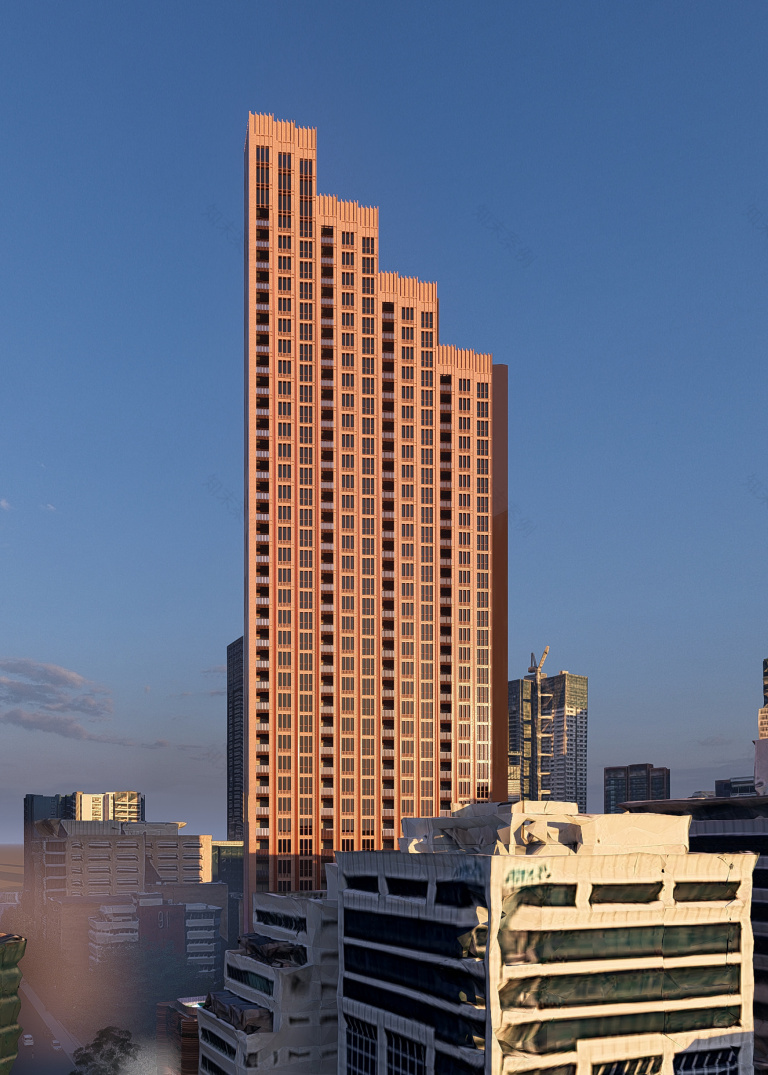
HTA’s architecture strategy for 81-83 George Street and 1 Barrack Lane delivers a Build-to-Rent led mixed-use development of 352 dual key homes supported by retail and resident amenity. Designed for volumetric modular construction, the scheme enables faster delivery, consistent quality and reduced embodied carbon. The design balances a modern modular approach with materials and proportions that respond to Parramatta’s historic context.
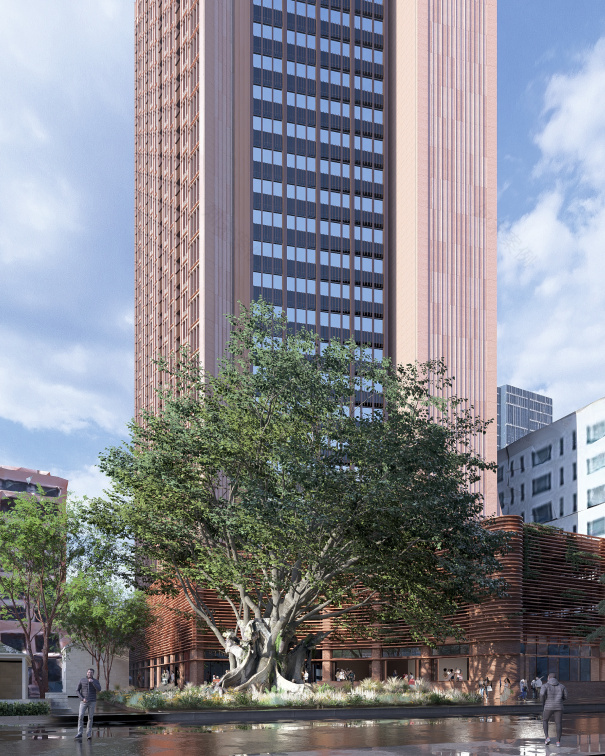
The development is organised as a 42-storey tower rising from a podium that wraps around the 180-year-old Moreton Bay Fig tree. The podium accommodates retail, a residential lobby, parking, plant and communal resident facilities including a pool terrace, yoga deck, edible garden and amphitheatre seating. A rooftop lounge provides panoramic views of Parramatta. The tower steps back at upper levels to allow sunlight into surrounding streets and spaces. Its orientation gives homes good daylight, views and ventilation, while limiting shadow on nearby public areas and heritage buildings.


Apartments are designed to be flexible, with layouts that can function as one larger home or be divided into two smaller, self-contained homes. Typical floors accommodate ten homes, reducing to six on upper levels. Modules are based on a 3.5m width wrapped around a centralised service core. Cross-ventilation is achieved in 61% of homes, with all corridors naturally lit and ventilated. A standardised kit-of-parts approach to layouts, kitchens, bathrooms and balconies supports efficiency, with net-to-gross ratios between 78% and 84%.


Landscape Design

HTA’s landscape design recognises the 180 year old Moreton Bay Fig tree, one of the oldest and largest in Sydney, as a defining feature of the development. The podium and public realm are carefully arranged to protect its root zones, while also ensuring minimal impact on surrounding heritage buildings including Perth House, Warders Cottage and the convict drain. These moves create a civic plaza beneath the tree canopy and integrate heritage into the everyday life of the neighbourhood.
At street level, the George Street frontage is widened to improve accessibility with new seating and planting, while Barrack Lane is upgraded as a pedestrian priority street supporting retail spill out. A modular toolkit of paving, furniture and planting ensures consistency across the public realm.
Communal podium and rooftop landscapes provide shared spaces for residents, including a pool terrace, yoga deck, edible garden and amphitheatre style seating. A rooftop lounge with terrace planting offers panoramic views over Parramatta. Landscaped podium edges incorporate front gardens for duplex homes, adding greenery to the street edge and providing defensible space.
Planting strategies prioritise resilience and environmental performance, using native and adaptive species to reduce irrigation demand and support cooling in hard-surfaced areas. Vertical greening, green roofs and soft landscape increase biodiversity, manage stormwater through permeable surfaces and rainwater capture, and reduce the urban heat island effect.
南京喵熊网络科技有限公司 苏ICP备18050492号-4知末 © 2018—2020 . All photos and trademark graphics are copyrighted by their owners.增值电信业务经营许可证(ICP)苏B2-20201444 苏公网安备 32011302321234号
苏公网安备 32011302321234号客服
消息
收藏
下载
最近