

创作上传
VIP
收藏下载
登录 | 注册有礼
查看完整案例

收藏

下载

分享
Florian
Busch
Architects

© Google
House in Takadanobaba
Shinjuku, Tokyo, Japan, 2010—2011
Not only in the context of a culture so based on the transitoriness of nature, being able to live with the seasons in the middle of today’s Tokyo is true luxury.
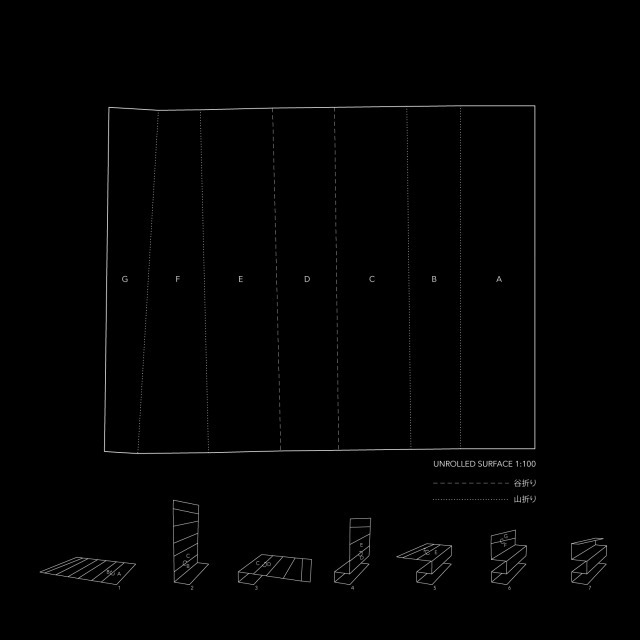
The inside is nothing but a fold of the outside.
—Michel Foucault
The House in Takadanobaba is a departure from understanding housing as enclosing: The urban exterior continues in an open fold of fluidly interconnected spaces for living in the interior of the exterior.
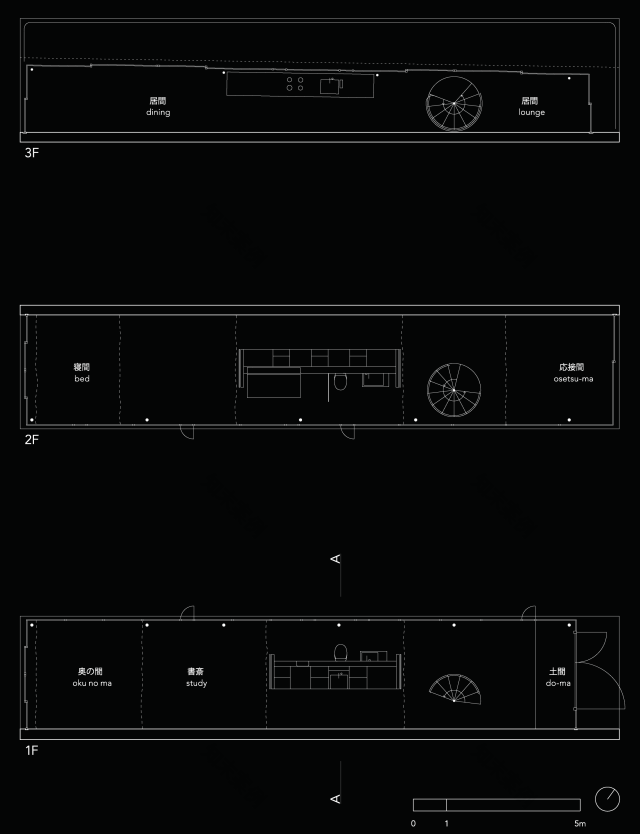
The site for this private residence is an urban gap left over from relentless sub-divisioning, a 22m deep yet only 4.7m wide strip squeezed between built masses in central Tokyo. When the brief asked for a wide open living space where breathing within the confines of the city was possible, we proposed an architecture of the exterior that claims the space around it by extending beyond its limits.
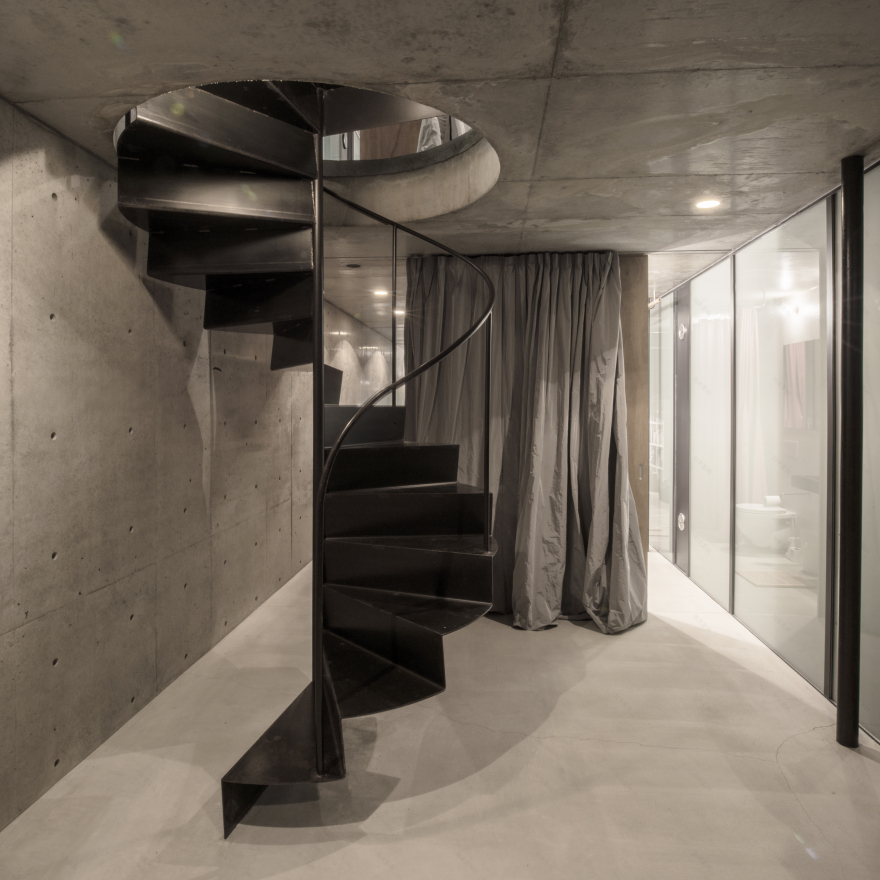
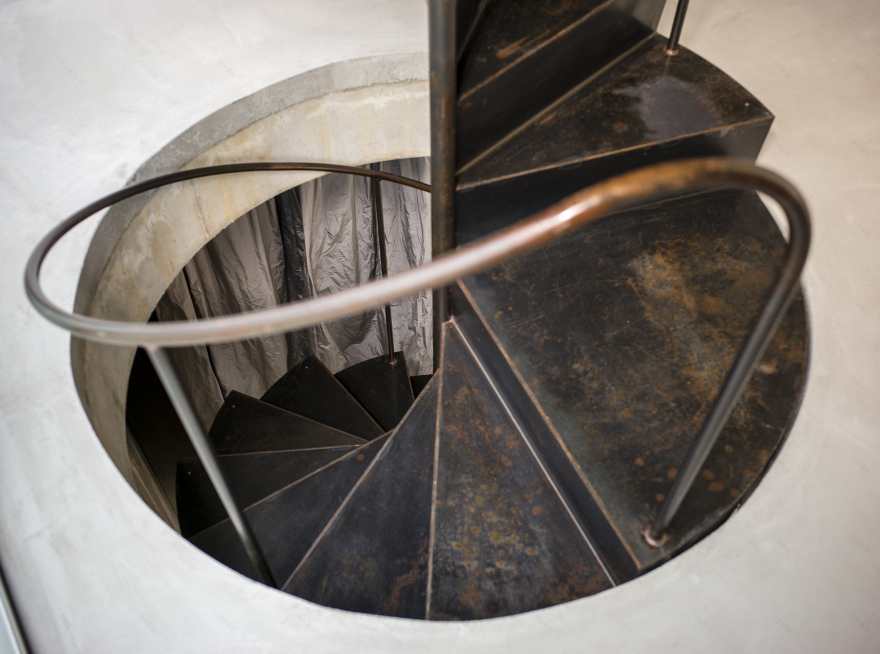
Moving through the building reveals strikingly different atmospheres along the three levels’ alternating orientations. As there are no partitioned rooms, the sites’ unusual depth is felt and emphasised on each level. Soft fabrics countering the hardness of the concrete add layers of ambiguous spatial nuances.
Structural Openness
The conceptual openness is achieved by dissolving structural rigidity into a liberating play of alternating pin connections. The floor-wall-ceiling fold becomes a structurally continuous frame that is held both apart and together by a few incredibly fine steel columns: 80mm diameter on the first and second, 60mm on the third floor. The wall between the columns functions like a tall beam. Lateral torsion by seismic forces is countered by the structure making use of the building’s length of 18 metres. Seismic shear forces are transmitted downward via the concrete fold and the lateral torsion that occurs during earthquakes is countered by the cross-section’s flat beam-column composite.
Urban Field of Folds
In redefining inside and outside, a field of folds might create pervious continuities in a city of gaps freeing us from the suffocating massiveness of our urban environments.
Shinjuku, Tokyo, Japan, 2010—2011
Type
Residential
Status
Completed
Team
Florian Busch, Sachiko Miyazaki, Momoyo Yamawaki
Structural Engineering: OAK (Masato Araya, Tomonori Kawata)
Mechanical Engineering: ymo (Hiroyuki Yamada, Natsumi Tsuchiya)
Environmental Engineering: ymo (Hiroyuki Yamada, Natsumi Tsuchiya)
Textile Design: Yoko Ando
Contractor: Yabusaki Corporation
Size
GFA: 153 m²
Terrace: 26 m²
Structure
Reinforced Concrete

© Hiroyasu Sakaguchi







© Hiroyasu Sakaguchi
publications
My Bauhaus | Mein Bauhaus, 2018
Against the onslaught: Florian Busch on Tokyo’s architectural ecosystem, 2018
FBA | selected works | Vol. 1, 2016
Jutaku: Japanese Houses, 2016
Portrait of Florian Busch in AD: Best of Germany, 2013
Architecture Now! Houses 3, 2013
FBA | selected works, 2012
House in Takadanobaba | Leibal, 2012
L4 House Design, 2012
The inside of the outside – Living in an urban landscape, 2011
Japan Times: Bending the rules with architecture, 2011
南京喵熊网络科技有限公司 苏ICP备18050492号-4知末 © 2018—2020 . All photos and trademark graphics are copyrighted by their owners.增值电信业务经营许可证(ICP)苏B2-20201444 苏公网安备 32011302321234号
苏公网安备 32011302321234号客服
消息
收藏
下载
最近