

创作上传
VIP
收藏下载
登录 | 注册有礼
查看完整案例

收藏

下载

分享
Korean National Museum of World Writing
Incheon, South Korea • 2017
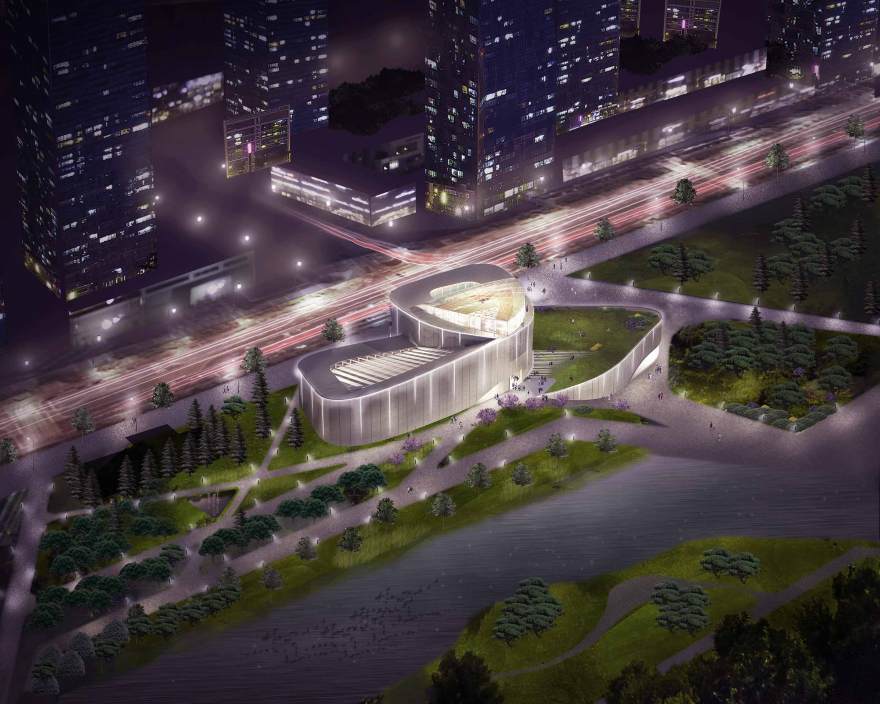
A museum interweaves old materials and new media to reflect the history of writing.
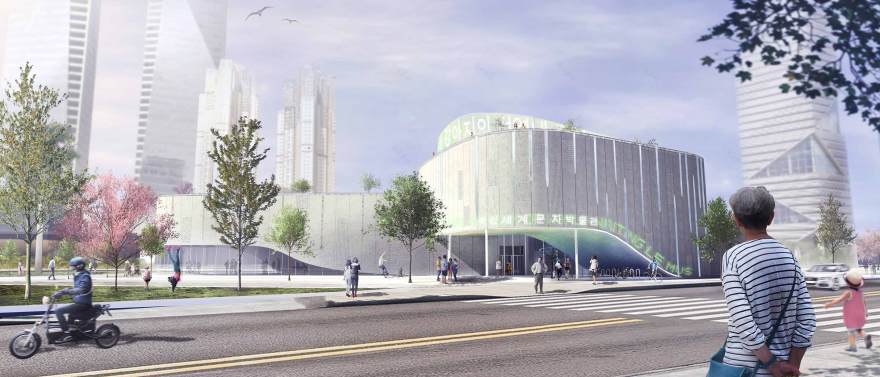
The modern museum does not simply document culture, it creates culture. Etched into the landscape, the National Museum of World Writing is a landmark of Central Park. Its form and its graphic display counterbalance the existing structures. The grounds are continuous with the existing strolling paths while defining a new geometry.
Writing is the organizing force of civilization. The world’s first writers stamped and scratched simple marks into malleable surfaces. Scripts have evolved over millenia as we retrace their forms onto new materials. The National Museum of World Writing engages this history by writing a glyph, an elemental character, into the landscape of Songdo Central Park.
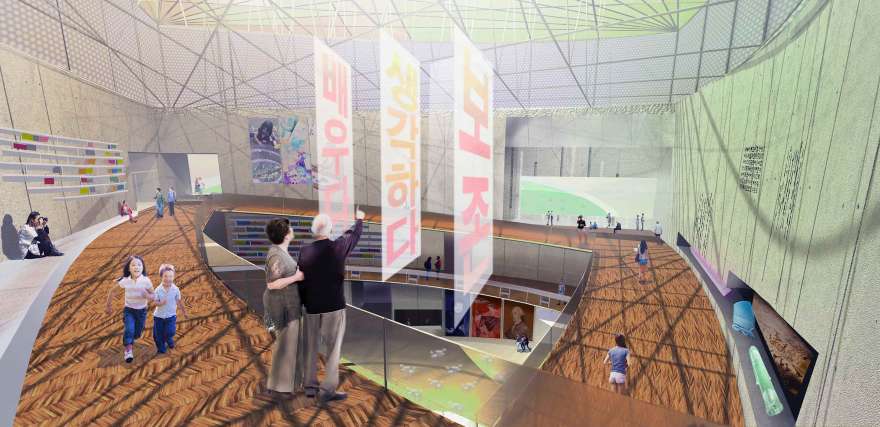
The glyph becomes the concrete foundation wall that shapes and supports the structure. The wall thickens, lifts, and lowers along its looping path to create cores and openings. This infinite loop blends museum, library, and archive functions into a seamless larchiveum experience, with a central atrium open to park visitors. During construction we solicit text contributions worldwide, and selections are cast into the concrete walls. LED displays, also set into the walls, display messages dynamically from around the globe. The contemporary overlays the deep history of text. At its very foundations, the museum signifies the elemental importance of writing.
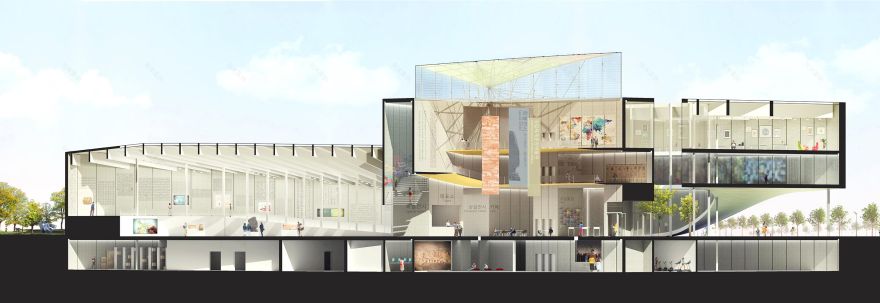
Its form is a trefoil, a continuous mark representing the overlap of 3 programs: public, curatorial, and archival. This sinuous concrete foundation structures all museum functions - rising, falling and breaking apart according to program. Old materials and new media interweave throughout the museum to reflect the history of writing in the structure itself.
The modern museum does not simply document culture, it creates culture. Etched into the landscape, the National Museum of World Writing is a landmark of Central Park. Its form and its graphic display counterbalance the existing structures. The grounds are continuous with the existing strolling paths while defining a new geometry.
Writing is the organizing force of civilization. The world’s first writers stamped and scratched simple marks into malleable surfaces. Scripts have evolved over millenia as we retrace their forms onto new materials. The National Museum of World Writing engages this history by writing a glyph, an elemental character, into the landscape of Songdo Central Park.
The glyph becomes the concrete foundation wall that shapes and supports the structure. The wall thickens, lifts, and lowers along its looping path to create cores and openings. This infinite loop blends museum, library, and archive functions into a seamless larchiveum experience, with a central atrium open to park visitors. During construction we solicit text contributions worldwide, and selections are cast into the concrete walls. LED displays, also set into the walls, display messages dynamically from around the globe. The contemporary overlays the deep history of text. At its very foundations, the museum signifies the elemental importance of writing.
Its form is a trefoil, a continuous mark representing the overlap of 3 programs: public, curatorial, and archival. This sinuous concrete foundation structures all museum functions - rising, falling and breaking apart according to program. Old materials and new media interweave throughout the museum to reflect the history of writing in the structure itself.
DESIGN TEAM
Jordan Parnass
Marijke Huelsman
Elizabet Bereslavskaya
Yvette Liu
Andrew Keung
Simisola Ibikunle
Jeremy Wolin
CONSULTANTS
Collaboration with Mesh Architectures
The modern museum does not simply document culture, it creates culture. Etched into the landscape, the National Museum of World Writing is a landmark of Central Park. Its form and its graphic display counterbalance the existing structures. The grounds are continuous with the existing strolling paths while defining a new geometry.
Writing is the organizing force of civilization. The world’s first writers stamped and scratched simple marks into malleable surfaces. Scripts have evolved over millenia as we retrace their forms onto new materials. The National Museum of World Writing engages this history by writing a glyph, an elemental character, into the landscape of Songdo Central Park.
The glyph becomes the concrete foundation wall that shapes and supports the structure. The wall thickens, lifts, and lowers along its looping path to create cores and openings. This infinite loop blends museum, library, and archive functions into a seamless larchiveum experience, with a central atrium open to park visitors. During construction we solicit text contributions worldwide, and selections are cast into the concrete walls. LED displays, also set into the walls, display messages dynamically from around the globe. The contemporary overlays the deep history of text. At its very foundations, the museum signifies the elemental importance of writing.
Its form is a trefoil, a continuous mark representing the overlap of 3 programs: public, curatorial, and archival. This sinuous concrete foundation structures all museum functions - rising, falling and breaking apart according to program. Old materials and new media interweave throughout the museum to reflect the history of writing in the structure itself.
The modern museum does not simply document culture, it creates culture. Etched into the landscape, the National Museum of World Writing is a landmark of Central Park. Its form and its graphic display counterbalance the existing structures. The grounds are continuous with the existing strolling paths while defining a new geometry.
Writing is the organizing force of civilization. The world’s first writers stamped and scratched simple marks into malleable surfaces. Scripts have evolved over millenia as we retrace their forms onto new materials. The National Museum of World Writing engages this history by writing a glyph, an elemental character, into the landscape of Songdo Central Park.
The glyph becomes the concrete foundation wall that shapes and supports the structure. The wall thickens, lifts, and lowers along its looping path to create cores and openings. This infinite loop blends museum, library, and archive functions into a seamless larchiveum experience, with a central atrium open to park visitors. During construction we solicit text contributions worldwide, and selections are cast into the concrete walls. LED displays, also set into the walls, display messages dynamically from around the globe. The contemporary overlays the deep history of text. At its very foundations, the museum signifies the elemental importance of writing.
Its form is a trefoil, a continuous mark representing the overlap of 3 programs: public, curatorial, and archival. This sinuous concrete foundation structures all museum functions - rising, falling and breaking apart according to program. Old materials and new media interweave throughout the museum to reflect the history of writing in the structure itself.
DESIGN TEAM
Jordan Parnass
Marijke Huelsman
Elizabet Bereslavskaya
Yvette Liu
Andrew Keung
Simisola Ibikunle
Jeremy Wolin
CONSULTANTS
Collaboration with Mesh Architectures







Aerial view
Exterior view
Entrance lobby
Exhibition space
Atrium ramp
Atrium interior
Rooftop
Interior view
Exterior view
Facade
Longitudinal section
Cross section
Exhibition strategy
Floor plans and conceptual diagram
南京喵熊网络科技有限公司 苏ICP备18050492号-4知末 © 2018—2020 . All photos and trademark graphics are copyrighted by their owners.增值电信业务经营许可证(ICP)苏B2-20201444 苏公网安备 32011302321234号
苏公网安备 32011302321234号客服
消息
收藏
下载
最近