

创作上传
VIP
收藏下载
登录 | 注册有礼
查看完整案例

收藏

下载

分享

Maternity Waiting Village
Project Data
Full Team
Year 2015
Status Completed
Size 670 sq m
Location Kasungu, Kasungu District, Malawi, Africa
Partners
The Presidential Initiative for Safe Motherhood
University of North Carolina - Malawi
Bill & Melinda Gates Foundation
The Autodesk Foundation
Academy of Architecture for Health Foundation
Collaborators
Sam Ngoma
Tim White
Mazzetti
Built Environs Ltd.
Photographer Iwan Baan
Focus areas
Healthcare
Housing
Services
Architecture
Engineering
Film & Media
Landscape Architecture
Research & Publishing
Project Team
Kyle Barker
Christian Benimana
Patricia Gruits
Anne Hake
John Maher
Nathalie McIntosh
Michael Murphy
Eva Oppel
Alan Ricks
Jean Paul Sebuhayi Uwase
Amie Shao
Matt Swaidan
Full Team
Project Team
Kyle Barker
Christian Benimana
Patricia Gruits
Anne Hake
John Maher
Nathalie McIntosh
Michael Murphy
Eva Oppel
Alan Ricks
Jean Paul Sebuhayi Uwase
Amie Shao
Matt Swaidan
View Less
View More

Standard government maternity waiting home, circa 2010.
The Maternity Waiting Village in rural Malawi provides a space for expectant mothers to stay in the final weeks of their pregnancies, increasing access to skilled care.
Malawi has one of the highest rates of maternal mortality in the world. One reason for this confounding statistic is the physical distance and difficulty of accessing medical facilities. In 2010, about one in thirty-six women in Malawi had a lifetime risk of dying during pregnancy or delivery, largely from preventable causes.
In response, the President of Malawi launched an effort to build 130 maternity waiting homes nationwide. Maternal waiting homes, which provide a monitored space for mothers starting from their 36th week until delivery, were identified as a solution for increasing access to skilled professionals. These homes are located near health facilities and are designed to address the disproportionate risk that Malawian women—particularly those in rural areas—face during pregnancy and childbirth that could be prevented with better access to healthcare.

MASS
Kasungu Maternity Waiting Village - 2017 African Architecture Awards
The University of North Carolina Project-Malawi had been supporting a hospital in Kasungu, Malawi. As part of its partnership with the Ministry of Health, the initiative committed to building two new homes, and invited MASS to participate. The Ministry of Health had already created some prototypical maternity waiting homes, but they were not working as hoped.
The existing facilities were single-room, barrack-like structures without adequate daylight, ventilation, or sanitation. They were uncomfortable for expectant mothers, and lacked accommodation for the family members and companions who cared for the mothers. As a result, many women were leaving and going back to their own homes instead of completing their pregnancy at the facility.


MASS worked with doctors, nurses, and expectant mothers to develop a family-centered, culturally-grounded model for maternity waiting in Malawi.
The question became not how to design a space for better waiting, but a space where women could be empowered and begin their birth journeys in community. Collaborating with the nurses and staff, we learned that smaller residential groupings would improve social dynamics and connection.
The resulting design divides the existing singular block concept into several smaller compounds clustered around small courtyards. This plan was inspired by the traditional layout of Malawian villages, where family compounds are composed of several small buildings housing branches of an immediate family. The smaller-sized housing blocks create communities that encourage knowledge sharing between experienced and first-time mothers.

To accommodate outdoor activity during both rainy and dry seasons, large roof overhangs provide shade and shelter, around the courtyards—creating spaces for mothers, their attendants, and family members to gather and socialize. Dedicated education areas support workshops around pre- and postnatal care, as well as other training and education. For example, handicraft opportunities help mothers earn income while away from home, making up for the wage loss that often prevents expectant mothers from using maternity waiting homes. The shared spaces also support important social exchanges, and are often activated with dancing, singing, and other events that bring people together.

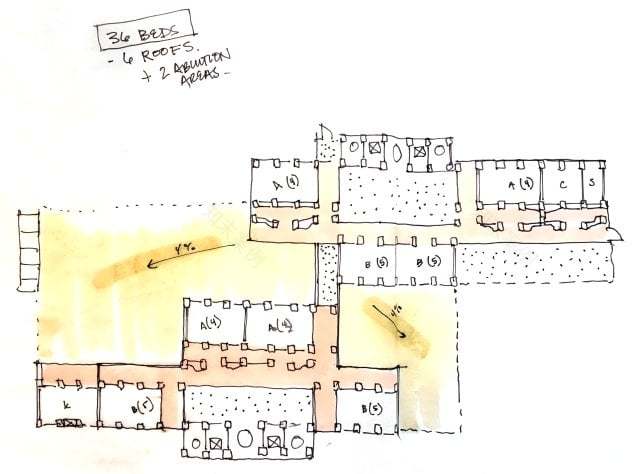

Optimized for daylight and natural ventilation, each sleeping unit is designed to reduce the spread of infectious diseases while providing privacy and comfort. Made of compressed stabilized earth blocks, the walls absorb solar rays during the day and radiate heat at night. A modular design framework and locally sourced materials were key to allowing the prototype to be more easily replicated and adapted to other sites.
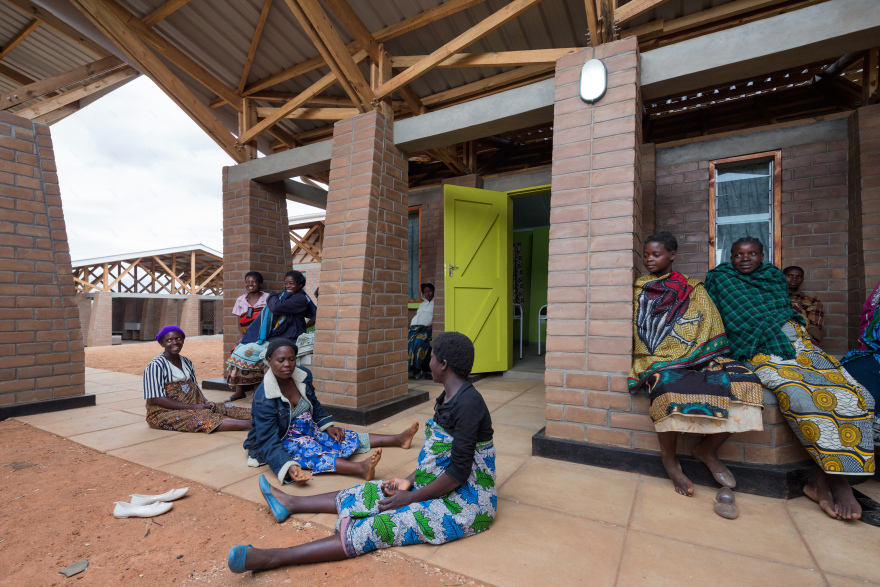


After the Maternity Waiting Village opened in 2015, MASS conducted a post-occupancy evaluation to assess how the design influenced user satisfaction and use.
With support from the Academy of Architecture for Health (AAHF) and UNC-Malawi, MASS led a quantitative research study comparing the Kasungu Maternity Waiting Village to the standard Ministry of Health prototype. The goal was to assess how specific design elements—such as comfort, privacy, and aesthetics—affect mothers’ satisfaction and encourage greater use of maternity waiting homes. Ultimately, the study aimed to demonstrate how thoughtful design can increase facility-based deliveries and contribute to reductions in maternal and infant morbidity and mortality.
Researchers surveyed 300 women across both sites to evaluate their experiences. The “village” model received significantly higher satisfaction scores across most design categories, including sleeping areas, private storage, kitchen facilities, toilets and showers, outdoor space, air and water quality, building maintenance, and thermal comfort. Statistical analysis identified key drivers of satisfaction: toilets and showers, companion spaces, safety, building maintenance, sleeping areas, and private storage.
These findings underscore the critical role that the built environment plays in healthcare access and outcomes—and offer actionable guidance on where to prioritize resources when designing or upgrading maternity waiting homes. In 2018, the results were published in the Journal of Midwifery in a peer-reviewed article titled “Built spaces and features associated with user satisfaction in maternity waiting homes in Malawi.”
南京喵熊网络科技有限公司 苏ICP备18050492号-4知末 © 2018—2020 . All photos and trademark graphics are copyrighted by their owners.增值电信业务经营许可证(ICP)苏B2-20201444 苏公网安备 32011302321234号
苏公网安备 32011302321234号客服
消息
收藏
下载
最近