

创作上传
VIP
收藏下载
登录 | 注册有礼
查看完整案例

收藏

下载

分享
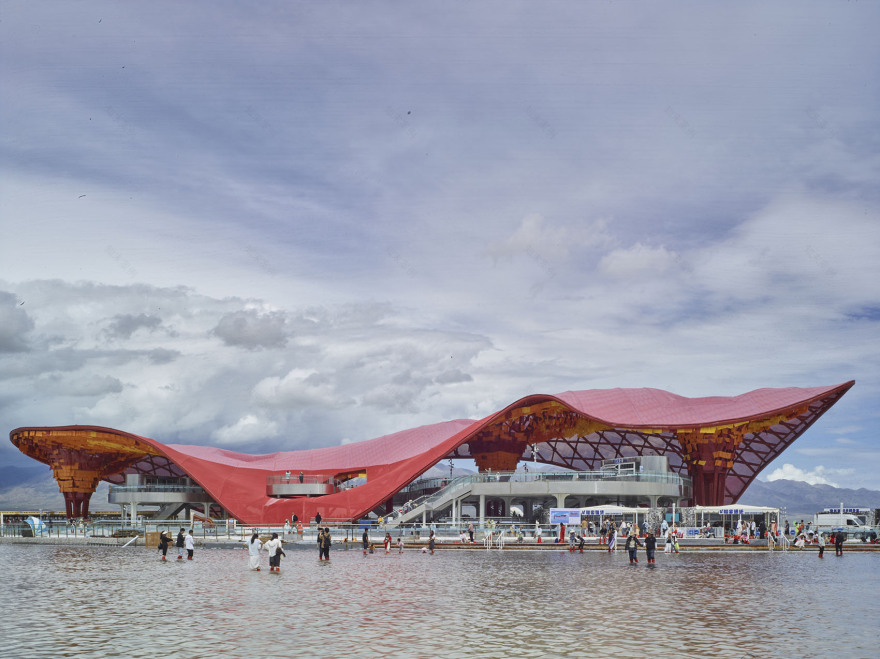
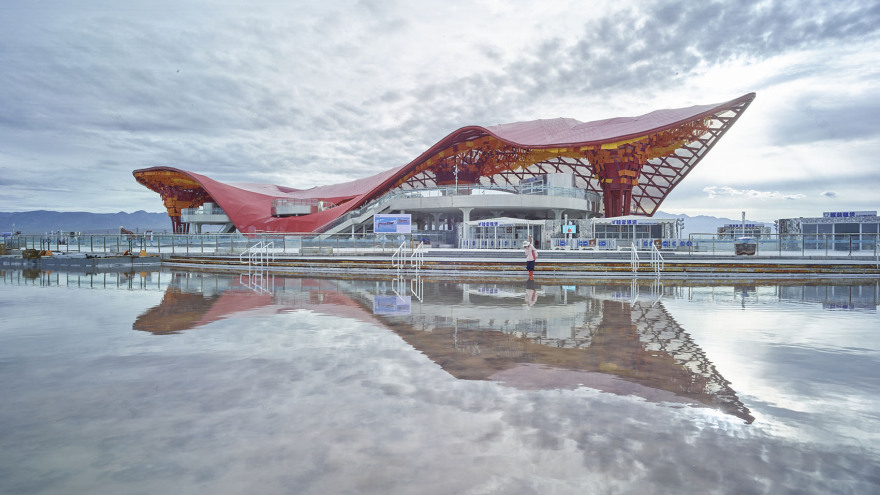
茶卡盐湖观光火车站位于青海省海西州乌兰县的茶卡盐湖景区。作为景区提升的标志性建筑物,项目从景区特色的旅游宣传形象出发,将数字化技术与方案概念、深化设计及建造施工结合,利用预制装配式钢结构和膜结构,打造了交通组织与休闲观光为一体的自由空间。
Chaka Salt Lake Tourist Railway Station is located at Chaka Salt Lake, Wulan County, Qinghai Province. The project as the landmark building of scenic area upgrading and based on the tourism publicity image with the characteristics of the scenic spot is made by prefabricated steel structure and membrane structure and the digital technology of the project combines the concept of the scheme, the design deepening and construction, which creates a free space for transportation organization and leisure and sightseeing.
▼建筑外景,Exterior of the Building ©褚英男
概念缘起——盐湖上随风飘动的红丝巾
Concept Origin – A Red Silk Scarf Fluttering in the Wind Over the Salt Lake
茶卡盐湖被誉为“天空之镜”, 固液并存的卤水湖形成了自然奇观,水映天、天接地,人在湖间走,宛如画中游。项目整体造型来自景区多年来自发形成的标志性打卡形象,钢结构和膜结构共同形成的自由曲面,仿佛盐湖上随风飘动的红丝巾。
Chaka Salt Lake, known as the “Mirror of the Sky,” features a brine lake with solid-liquid coexistence, creating a natural wonder where water reflects the sky, merging heaven and earth, and visitors walking across the lake feel like moving through a painting. The project’s overall shape is inspired by the scenic area’s iconic check-in image formed over years, with a free-form surface of steel and membrane structures resembling a red silk scarf fluttering on the salt lake.
▼红丝巾造型屋面,Red Scarf Roof Design ©褚英男

▼挑出观景平台,Theoverhangviewing platform ©褚英男

▼西北侧立面局部,Northwest elevation detail©褚英男

观光火车轨道延伸到盐湖深处,游客在站台停留休憩,也可以步入盐湖,远眺水天一色和连绵山脉。“茶卡风”的名字来自景区提升设计项目的系列概念——盐、霞、风、雪,其中风站是构筑物体量最大的一站,总建筑面积3996.64平方米,如何将矗立在平静湖面上的巨大钢构筑物(出于盐湖生态保护的需求,只能采用钢结构),做出风的感觉,是个难题,但同时也为设计团队提供了难得的机会,尝试将装置艺术的思路与建筑技术结合。看见风,听到风,留下风的记忆,就是我们希望这个场所能够带给到访人们的体验。
The Station is the largest among numerous station structures, with a total construction area of 3996㎡. Due to the needs of salt lake ecological protection, the building can only adopt a steel structure system. How to give the huge steel structure standing on the calm lake surface a “sense of wind” was a challenge, but it also provided a rare opportunity for the design team to attempt integrating installation art concepts with architectural techniques. “Seeing the wind, hearing the wind, and leaving memories of the wind” is the experience we hope this place can bring to visitors.
▼西北立面全景,Northwest elevation©褚英男

▼西北侧进出站的人们,People entering and exiting the station from the northwest side©褚英男

▼挑出观景平台细节,Theoverhangviewing platformdetail©褚英男


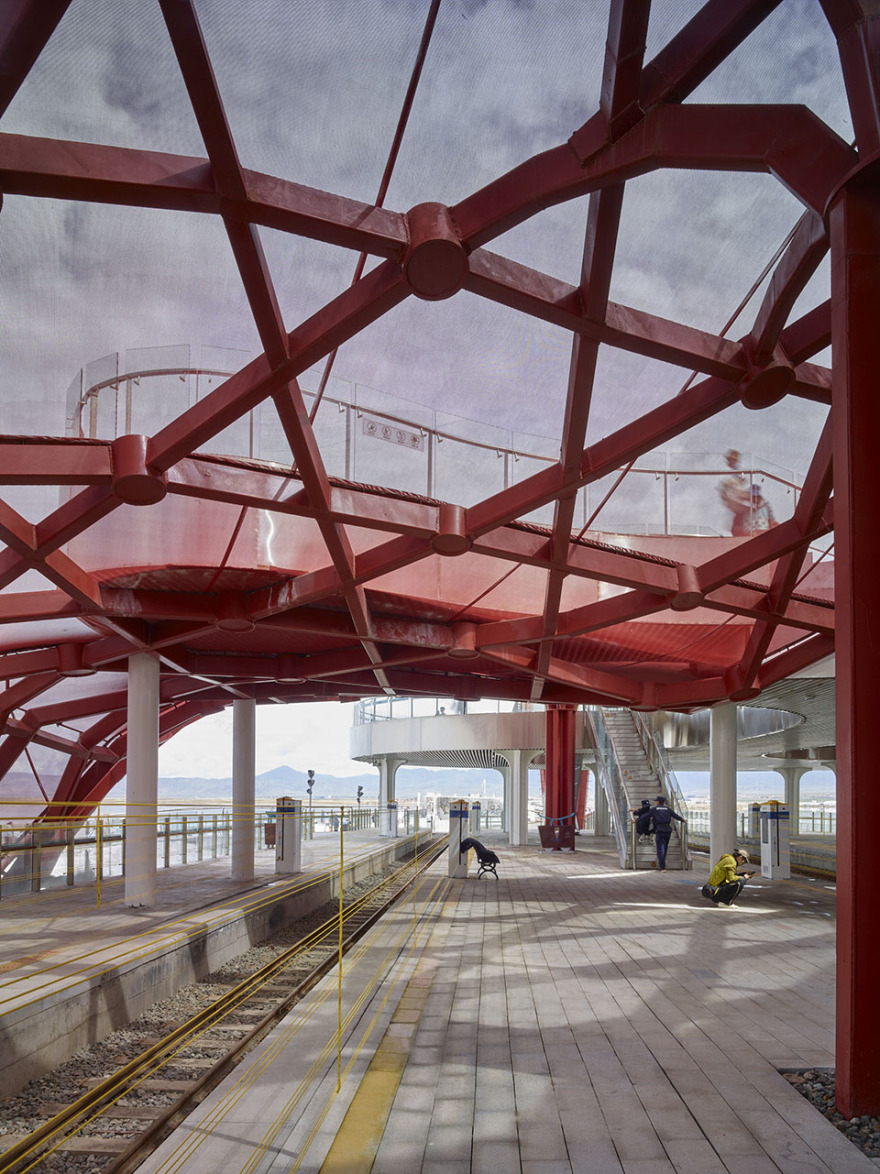
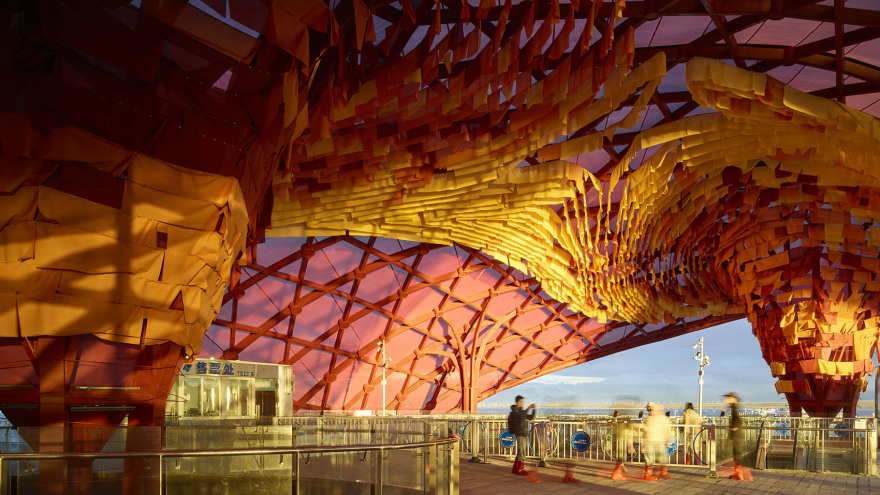
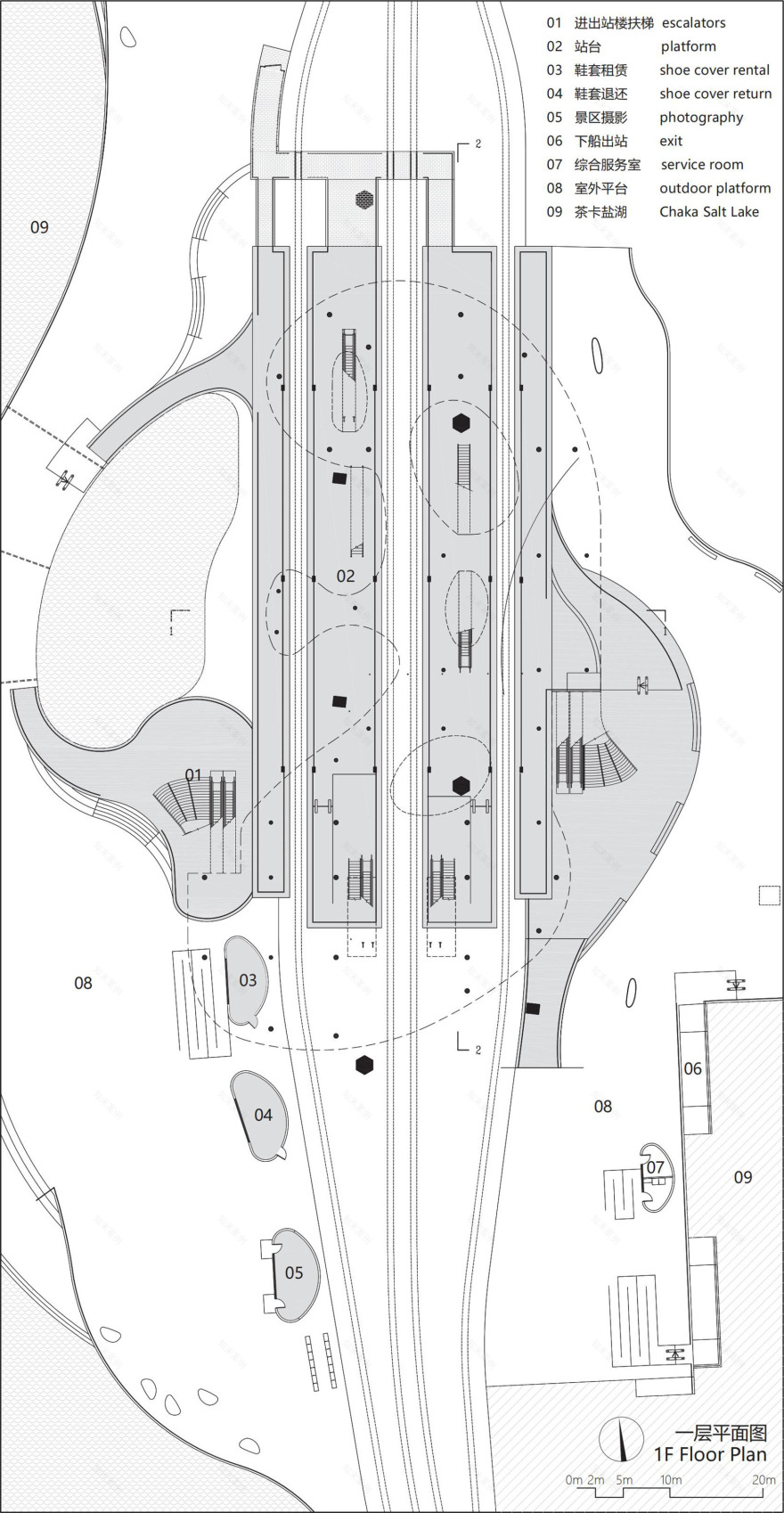
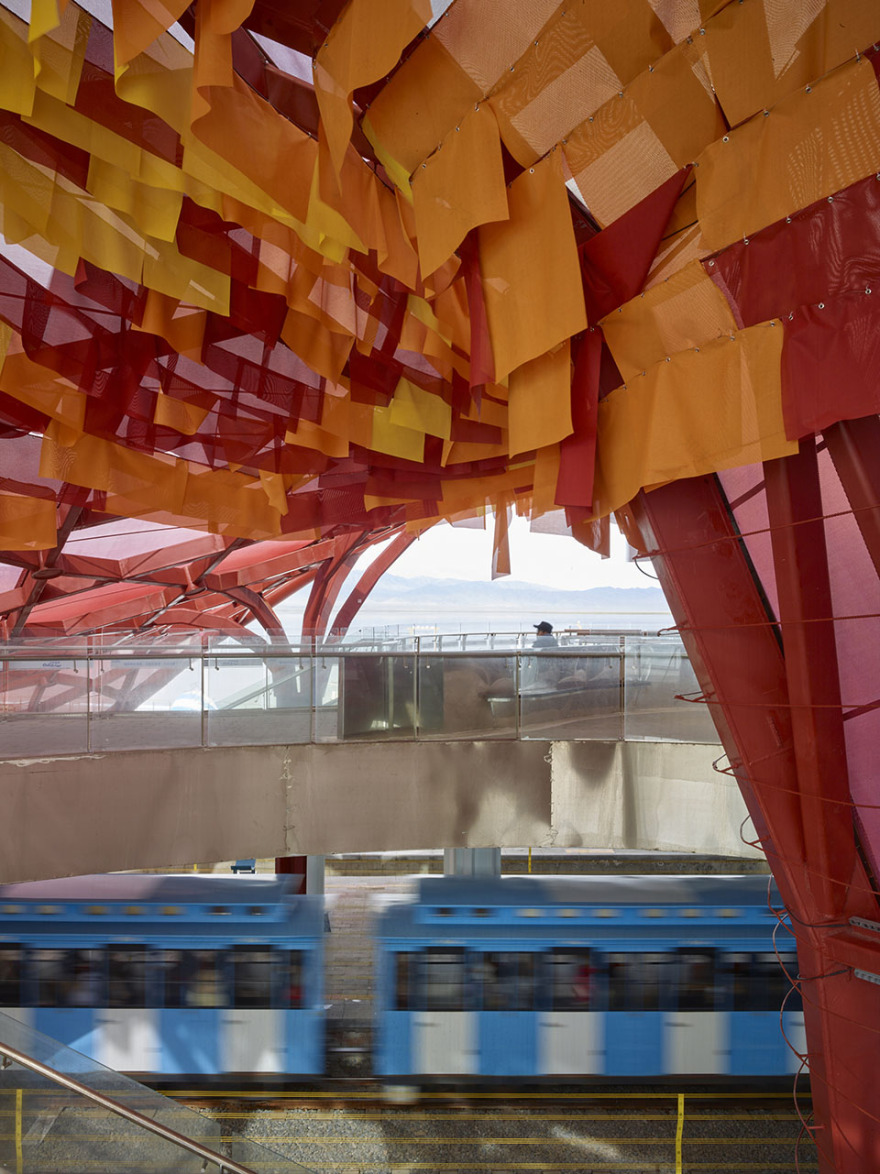
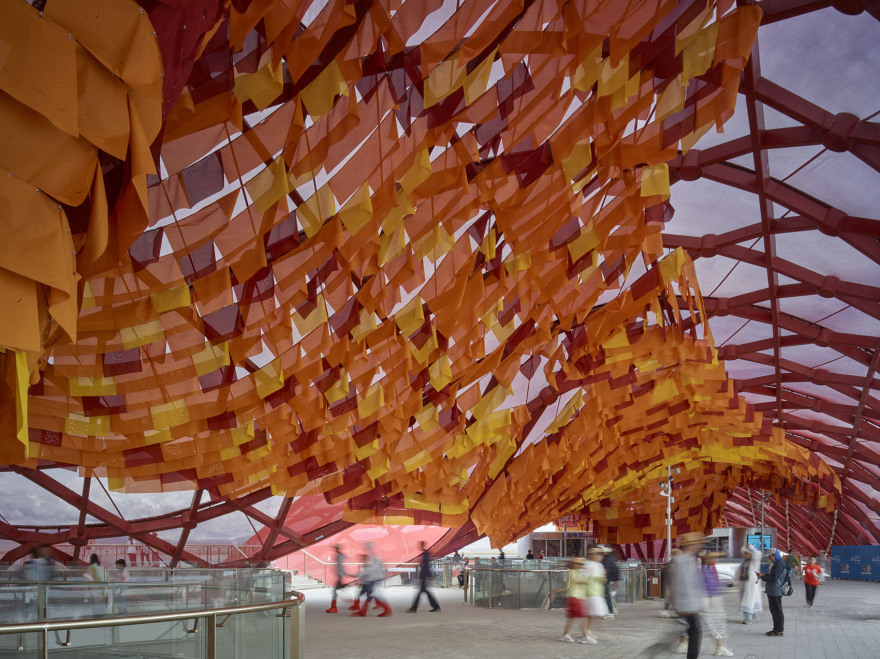
站台分为上下两层,底层架空在3条轨道之上,结合游人进出站和下湖流线设置步梯和电梯,上层主要为停留观光和商业售卖的休闲平台。顶部为整体设计的钢结构和膜结构复合的自由曲面,从湖面远观呈现风中舞动的姿态,走进站台,红橙黄三色的悬挂织物伴随风声翻扬,带来近人的风的体验。
The platform is divided into two levels: the ground floor is elevated above three railway tracks, with staircases and elevators arranged in line with the flow of visitors entering and exiting the station as well as accessing the lake, while the upper floor mainly serves as a leisure platform for sightseeing and retail services; the roof features an integrated free-form curved surface composed of a composite steel and membrane structure, which presents a dynamic posture as if dancing in the wind when viewed from afar across the lake, and when stepping into the platform, hanging fabrics in red, orange and yellow flutter along with the sound of the wind, offering an intimate sensory experience of the breeze.
▼南立面全景,South facade©褚英男

▼轨道与车站,Railways and stations©褚英男

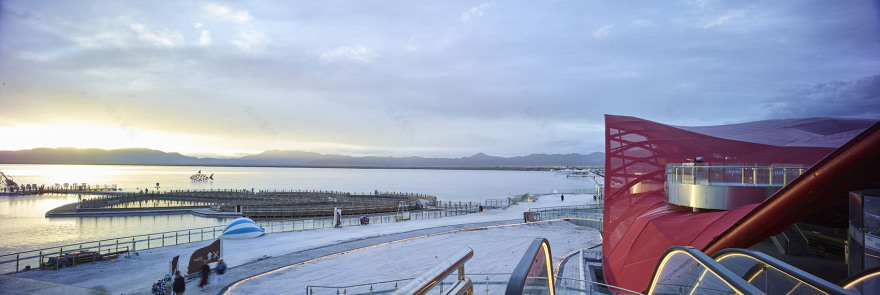
车站轨道本身的走向决定了建筑南北飘动的态势,使东西方向成为很好的观景朝向。场地东面祁连山,西临昆仑山,是绝佳的天然景观,二层平台满足了游客的观景需求。同时,平台也使检票与站台相对分隔,以保证每一个区域都可以满足大量游客的同时使用。
The orientation of the station tracks themselves dictates the building’s dynamic, north-south “flowing” posture, making the east-west direction an ideal viewing axis. Flanked by the Qilian Mountains to the east and the Kunlun Mountains to the west, the site boasts exceptional natural scenery, and the second-floor platform perfectly caters to visitors’ sightseeing needs. Meanwhile, the platform also physically separates the ticket-checking area from the boarding platform, ensuring that each area can accommodate large crowds of visitors simultaneously.
▼站台区透视图,Platform area perspective view©褚英男
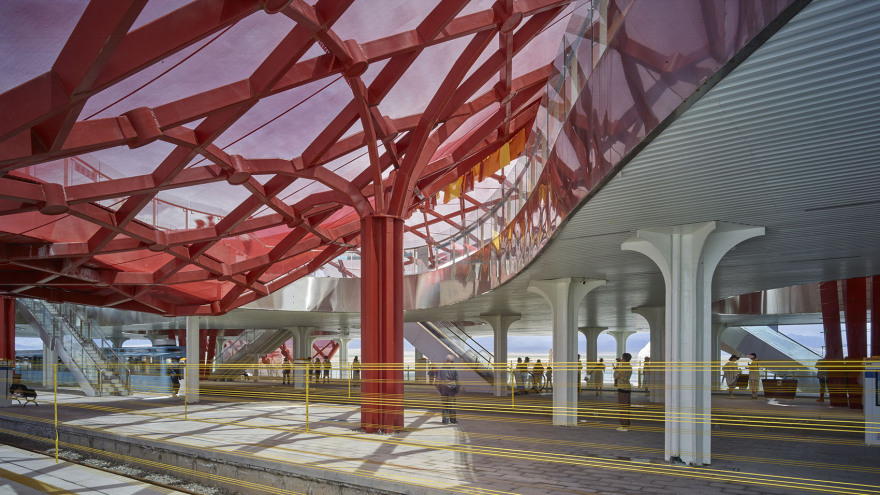
▼站台挑空空间,Platform void space©褚英男

▼站台上等候的人们,People waiting on the platform©褚英男

在承担游客进出站的功能同时,我们希望游客可以在平台上得到更好的游览体验。因此在空间较高的部位和特殊点位打破平台屋面与站台的限定,形成视野开阔的观景区域,并在周边设置商业业态以满足游客需求。将平台的挑出部分与游客的垂直交通结合形成对游客友好的流线缓冲区,起到整个流线的润滑作用,使游客在进出站的同时也可以感受茶卡盐湖本身的自然瑰丽。建筑西侧为最佳景观面,为避免落地的屋面设计遮挡中段的视线,屋面结构在二层局部设计开口,将平台探出,形成独特的观景平台。屋面起伏错落,平台穿插其中,二者交互融合形成有机整体。
While fulfilling its core function of facilitating visitor entry and exit, the platform is designed to enhance the sightseeing experience. At high – points and specific locations, the platform roof and station boundaries are broken to create viewing areas, with commercial facilities nearby. The overhanging sections are integrated with vertical transportation for user – friendly flow buffers, streamlining circulation and allowing visitors to enjoy the lake view during entry or exit. The west side is the main viewing orientation. To avoid obstructing sight lines, the second – floor roof has partial openings, and the platform extends to form an observation deck. The undulating roof and platforms interact and merge into an organic whole.
▼站内观景,Interior viewing space©褚英男
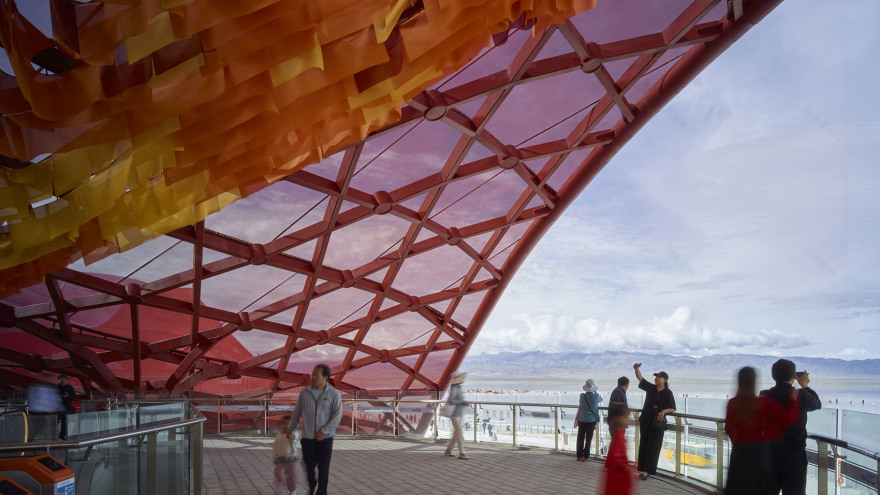
形体建构——数字化设计辅助多层次的形体生成
Form Construction – Multi-layered Form Evolution Aided by Digital Design
整体曲面主要由三个层次构成:主体的钢结构、顶面两种不同性能的膜结构、以及底面悬挂的可以随风飘扬的三种颜色的织物。结合空间、形象和力学的要求,在飞舞的红丝巾的基础上,又参考了雨滴入湖的水面波动,作为曲面形态生成的概念意向。
▼概念分析图,Concept analysis©THAD + THUPDI

The overall curved surface is mainly composed of three layers: the main steel structure, two types of membrane structures with different properties on the top, and three colors of fabrics hanging on the bottom layer that can flutter with the wind. While integrating requirements for space, appearance, and mechanics, the design takes the flying red silk scarf as the foundation and also draws on the ripples on the lake surface caused by raindrops falling into the water, using them as the conceptual inspiration for the curved surface formation.
▼主体结构,Main structure©褚英男

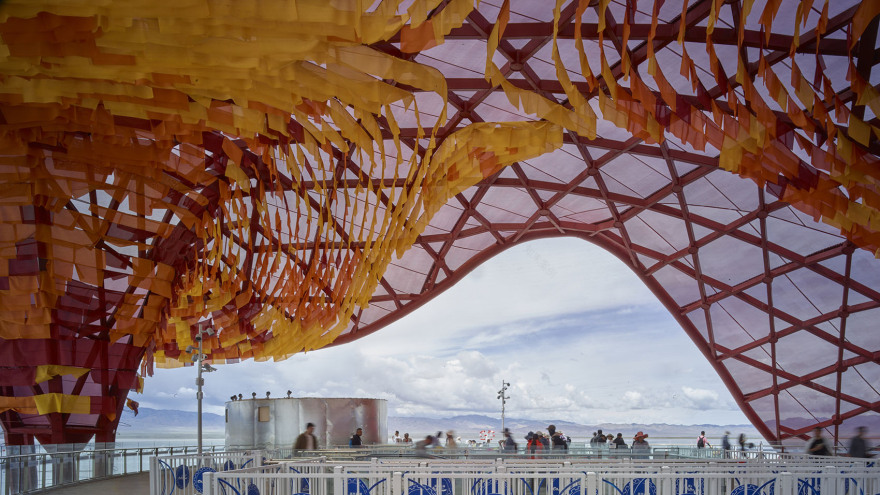
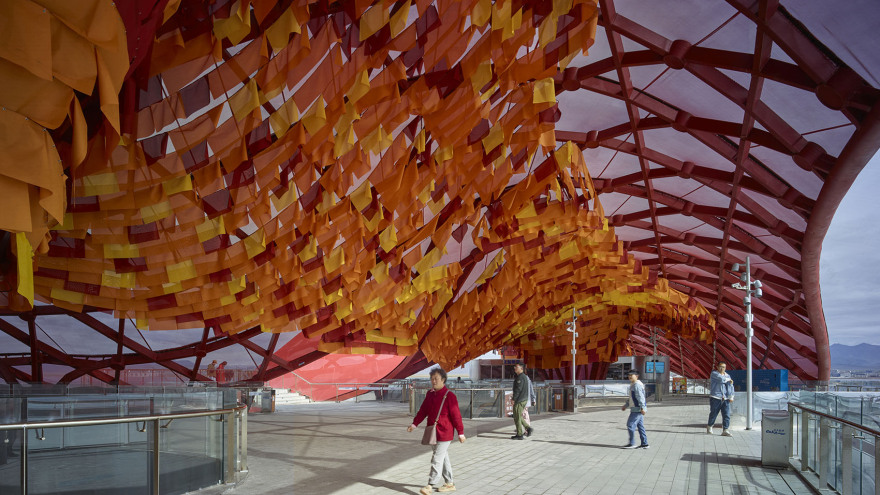
主体钢结构没有简单的采用漂浮的曲型屋面加支撑柱的形式,而是作为整体结构落地贯穿到站台,从而让形态更加有随风飘扬之感。
建筑钢结构部分虽为自由曲面,但生成逻辑明确。首先,受制于铁路的影响,在站台及东西两侧的平台上选取三个位置,作为曲面的落地点。在此基础上,结合初步结构受力分析,设置四个大开花柱进行支撑。通过结构模拟计算壳体局部受力薄弱点位,在不影响曲面形态的前提下,进一步补设三个小开花柱增强整体稳定性。
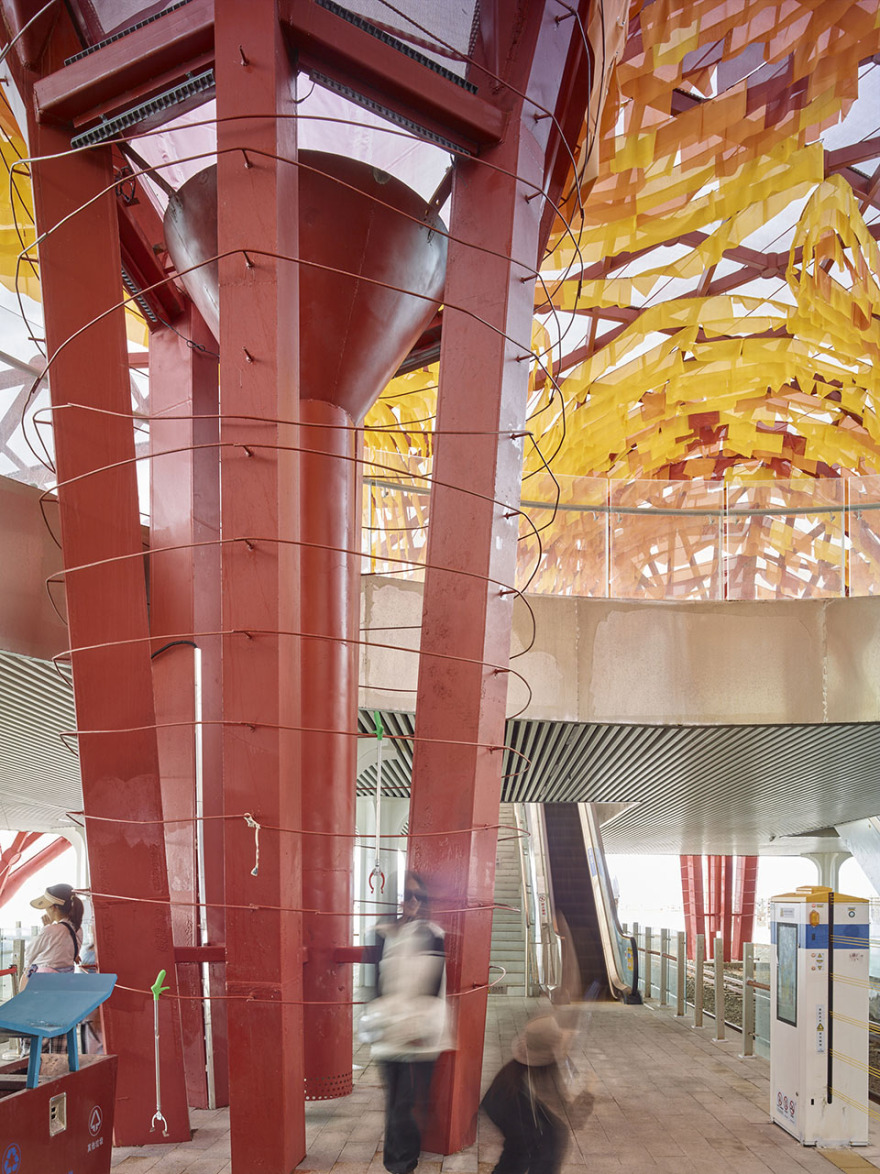
花柱造型受到水滴入湖的时,水面因张力形成的姿态,通过曲面弹力找型,实现花柱和屋顶曲面的相对平滑衔接。
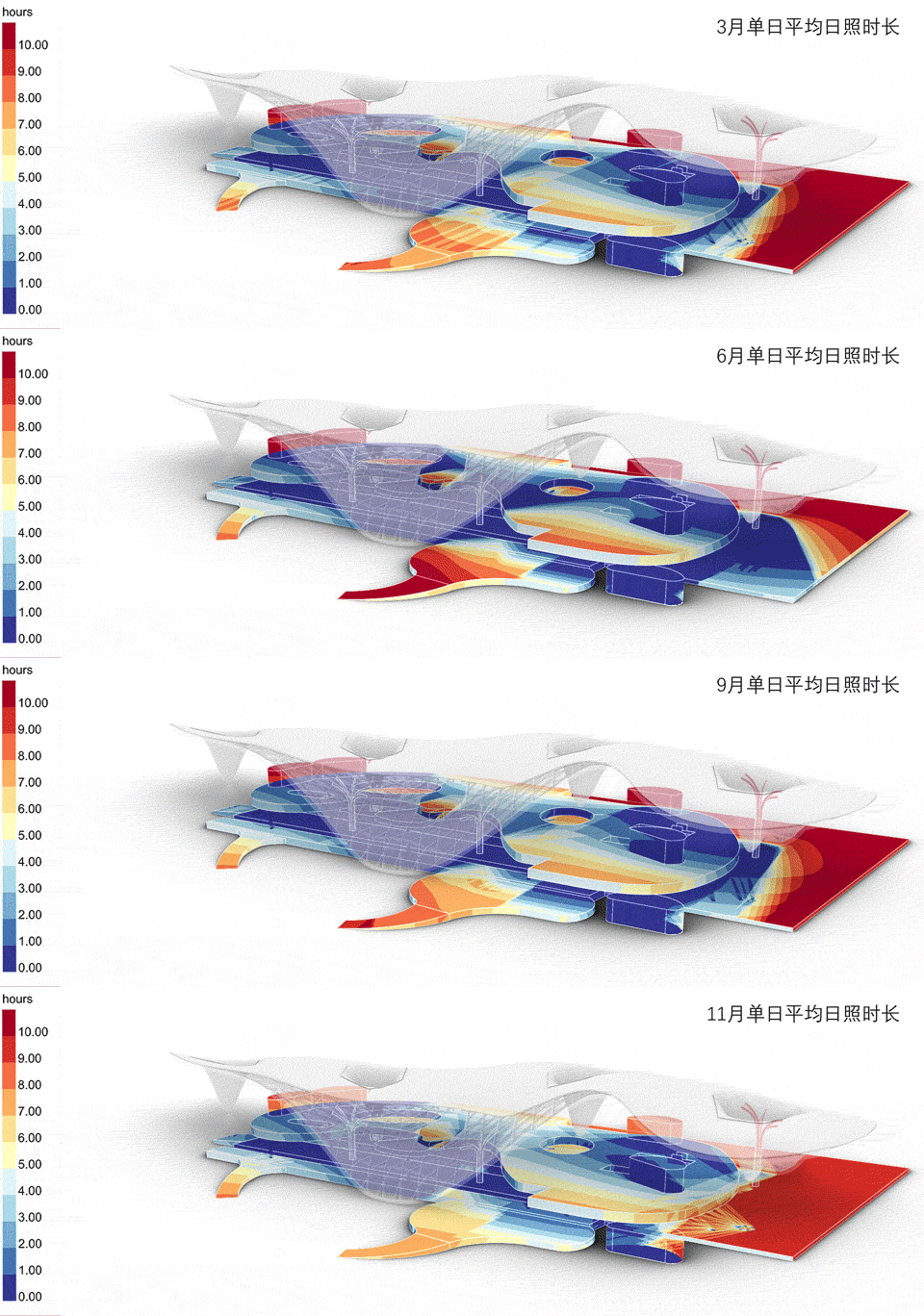
▼日照分析图,Sunlight analysis diagram ©THAD + THUPDI
▼通风模拟,Ventilation simulation ©THAD + THUPDI

Instead of a floating curved roof supported by columns, the main steel structure extends from the ground to the platform as an integrated design, enhancing the building’s “fluttering with the wind” effect. Despite its free-form curved surface, the steel – structure’s generation logic is clear. Constrained by railway – track layout, three grounding points were chosen on the platform and side – platforms. Then, combined with preliminary stress analysis, four large “blooming columns” were installed. After structural simulation, areas of weak local stress were found, and three small “blooming columns” were added for stability without affecting the curved – surface shape. The “blooming columns” are inspired by raindrops on a lake surface, and their shape is determined by the curved – surface’s elastic force to achieve a smooth connection with the curved roof.
▼支撑系统,Support system©褚英男


考虑到施工难度与造价问题,结构采用以直拟曲的形式。在保证结构受力合理的情况下,增设构件使原本约为3m的菱形结构单元模块转变约为1.5m边长的两个三角形与六边形的单元模块,从人视角度得到一个相对近人的划分尺度。顶面膜结构与钢结构共同作用,形成受力整体。设计初期顶面膜结构对比考虑了气枕膜、铝板和单面膜三种材质,▼屋面结构单元划分效果对比图,Comparison of roof structure unit division effects ©THAD + THUPDI

Considering the construction difficulty and cost constraints, the structure adopts a design approach where straight elements simulate curved forms. While ensuring the structural force is reasonable, additional components were added to transform the original rhombus structural unit modules (with a side length of approximately 3 meters) into smaller units: two types of modules, namely triangles and hexagons, each with a side length of about 1.5 meters. This adjustment creates a relatively human-scaled division from the viewer’s perspective. The roof membrane structure and the steel structure work together to form an integrated load-bearing system. During the initial design phase, three materials for the roof membrane structure were compared and evaluated:
▼菱形结构,Rhomboidal structure©褚英男

气枕膜造价高且工艺相对复杂,无法满足工期要求,并且远看丝巾形态不够顺滑;铝板造价低但比较生硬沉闷,和丝带的质感相差甚远;单面膜造价相对适中,并且本身具有一定的延展性,可以使原本以直拟曲的焦点位置平滑过渡,因而成为最终选择。
Air pillow membrane: High in cost and relatively complex in craftsmanship, it failed to meet the construction schedule requirements. Additionally, the form of the “silk scarf” appeared less smooth when viewed from a distance. Aluminum panels: Low in cost but rigid and dull in appearance, which was far from matching the texture of a silk ribbon. Single-layer membrane: With moderately priced cost and inherent ductility, it allowed for smooth transitions at the focal points where straight elements simulate curves. Thus, it was selected as the final material.
▼日光下的网面和结构,The mesh and structure under sunlight©褚英男
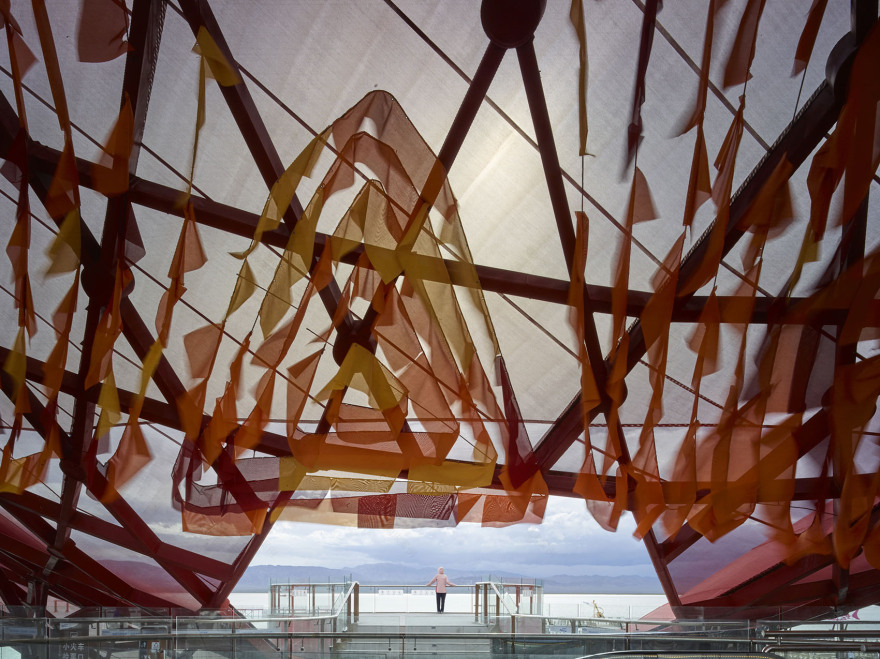
此外,考虑到屋面起伏的形态和结构尺寸受风荷载影响较大,最终采用半透的PTFE膜与不透的PTFE加附膜两种不同的材质,在满足遮阳挡雨的基本功能同时尽量减少风荷载。膜材质本身的张拉力也对钢结构本身有一定影响,二者共同作用,形成整体受力。PTFE加附膜形成的复合材质透光不透雨,为游人提供遮雨区域,悬挂的织物也主要集中在这个区域的下方,避免经常淋雨影响效果。不加附膜的PTFE膜则因其自身材料的特性存在约21%的穿孔率,根据结构模拟,布置在风荷载较大的位置,可以有效的减少风力对结构的影响,也可以让风更流畅的进入站台内部,吹动悬挂的织物。透过膜结构进入内部的光与风弱化了空间的围合感,形成了由透到半透到封闭的过渡。两种膜的分布根据游客在平台上的主要动线进行划分,减小游客在平台上进出站及商业空间受到雨雪天气的影响。
Furthermore, given that the undulating shape and structural dimensions of the roof are significantly affected by wind loads, two types of PTFE membranes were ultimately adopted: semi-transparent PTFE membranes and opaque PTFE membranes with an additional coating. These materials not only fulfill the basic functions of sunshade and rain protection but also minimize wind loads as much as possible. The tensile force of the membrane material itself also exerts a certain influence on the steel structure, and the two work together to form an integrated load-bearing system. The PTFE membrane with an additional coating forms a light – permeable and rainproof composite material, providing a rain – sheltered area for visitors. Hanging fabrics are arranged below this area to avoid rain exposure that could affect their visual effect. The uncoated PTFE membrane has a porosity of about 21% due to its material properties. Structural simulations show that arranging it in high – wind – load areas can reduce wind impact on the structure, let wind flow smoothly into the platform interior, and make the hanging fabrics flutter. Light and wind entering through the membrane structure weaken the enclosure sense, creating a transparent – to – semi – transparent – to – enclosed transition. The two membrane types are distributed according to visitors’ main movement paths on the platform, minimizing the impact of rain and snow on those entering/exiting the station and using the platform’s commercial spaces.
▼PTFE膜材质,PTFE membrane material©褚英男

底面悬挂织物的设计,将大花柱作为涟漪中心,模拟形成类波纹状曲线组,投影至屋面形成织物的整体分布。三色织物随风飘动,白天阳光的变幻和夜间的呼吸式照明设计进一步加强了水波涟漪的感觉。
For the design of the fabrics hanging from the bottom, the large “blooming columns” are taken as the centers of ripples. Curved line groups resembling ripples are simulated and projected onto the roof to determine the overall layout of the fabrics. The three-colored fabrics flutter with the wind; the changing sunlight during the day and the breathing-style lighting design at night further enhance the sense of water ripples.
▼悬挂的三色织物,The hanging tricolor fabric©褚英男
茶卡冬季漫长风力强劲,盐湖区域湿度高腐蚀性强,普通的织物耐久性无法满足要求,因而选用了一种室外遮阳帘材质,耐候性更好。织物在设计之初选用同屋顶一样的全红配色,模拟发现,因为与屋顶颜色完全融合,使得远观时丝带的飘逸感不足。结合当地文化传统,我们选取了经典色彩中的黄色与橙色,与红色搭配。三色膜形成的圈带从开花柱与屋顶连接过渡处的红色起始,随涟漪趋势向外逐层渐变。受限于定制膜材质可选颜色相对固定,无法做到多色的相对柔和渐变,因此转换思路改用马赛克形式,将完整的涟漪环单元化通过调整设定离散随机值做到颜色逐步过度,再通过微调局部单元色块,得到更加多样的颜色变化,使得整体吊挂织物的层次感更加丰富。
▼悬挂织物过程效果对比图,Comparison of fabric hanging process effects ©THAD + THUPDI

The local area has a long, windy winter, and the salt lake region has high humidity and strong corrosiveness. Ordinary fabrics can’t meet durability requirements, so an outdoor sunshade fabric with better weather resistance was chosen. Initially, the fabric was to have the same all – red color as the roof. But simulations showed that full color integration with the roof reduced the ribbon’s flowing elegance from afar. Inspired by local cultural traditions, yellow and orange were selected to match the red. The circular bands of the three – color membranes start with red at the transition joints between the blooming columns and the roof and then gradually transition outward layer by layer following the ripple pattern. Due to the limited color options of the custom – made membrane material, a smooth multi – color gradient couldn’t be achieved. So, the design approach shifted to a mosaic style: the complete ripple rings were divided into modular units, and a gradual color transition was achieved by setting discrete random values. Moreover, the color variation was enriched by fine – tuning local unit color blocks, enhancing the overall layered texture of the hanging fabrics.
▼风中飘荡的织物,Fabric fluttering in the wind©褚英男


建构优化——结构深化找形与细部构造性能化设计
Construction Optimization-Structural Refinement for Form-Finding and Performance-Based Detailed Design
茶卡风形似飘带曲面灵动,采用单层网壳结构形式。网壳在承受竖向重力荷载的工况下,需要有几个竖向支点,如何将形态美和力学美充分结合是建筑师和结构师的追求目标。在经过多次模型迭代优化之后,结构确定用4个大开花柱和3个小开花柱作为主要竖向承重构件,其中大的开花柱不仅承担竖向受力,还承担水平地震力和水平风力,而小的开花柱主要承担竖向力,保证竖向变形竖向刚度满足要求,通过对线性屈曲模态的分析寻找薄壳空间刚度的薄弱点,并对局部采取加强措施。
Chaka Wind features a ribbon-like form with dynamic curved surfaces, adopting asingle-layer reticulated shell structure. When the reticulated shell is subjected to vertical gravity loads, several vertical supporting points are required. The primary goal of architects and structural engineers is to fully integrate aesthetic form with structural efficiency.After multiple rounds of model iteration and optimization, the structure finally adopts4 large blooming columnsand3 small blooming columnsas the main vertical load-bearing components. Among them, the large blooming columns not only bear vertical loads but also resist horizontal seismic forces and horizontal wind loads. The small blooming columns mainly carry vertical loads to ensure that the vertical deformation and vertical stiffness meet the design requirements. Weak points in the spatial stiffness of the thin shell are identified through the analysis of linear buckling modes, and targeted local reinforcement measures are implemented.
▼花柱,Blooming columns©褚英男


由于本单体造型较为复杂,对风荷载作用的响应较难通过规范体型系数确定,设计中我们委托北京交通大学对本单体进行了风洞测压试验。并根据实验报告对本单体施加了12个风向(0°、30°、60°、90°、120°、150°、180°、210°、240°、270°、300°、330°)的第一批风荷载,每个方向按风荷载最大值及最小值分别施加以模拟随机振动下风振影响。
同时为了使本单体结构更为安全,设计过程中我们咨询了相关气象部门,获取了项目当地的主导风向。根据资料显示当地风向主要为西风及西北风。因此设计中我增加了8个风向(160°、170°、190°、200°、220°、230°、250°、260°)做为第二批风荷载。并将150°、160°、170°、180°、190°、200°、210°、220°、230°、240°、250°、260°、270°这13个风向作为主导风向。
▼风洞试验,Wind tunnel testing ©THAD + THUPDI

Given the relatively complex shape of this single building, it is difficult to determine its response to wind loads by using the wind load shape coefficients specified in the codes. In the design process, we conduct awind tunnel pressure measurement teston this building.Based on the test report, the first batch of wind loads was applied to the building corresponding to12 wind directions(0°, 30°, 60°, 90°, 120°, 150°, 180°, 210°, 240°, 270°, 300°, 330°). For each direction, both the maximum and minimum wind load values were applied respectively to simulate the effects of wind-induced vibration under random vibration conditions.In addition, to further enhance the structural safety of this standalone building, we consulted the relevant meteorological authorities during the design process to obtain the prevailing wind directions of the project site. According to the data obtained, the local dominant wind directions are mainly westerly and northwesterly winds. Therefore, we added8 additional wind directions(160°, 170°, 190°, 200°, 220°, 230°, 250°, 260°) as the second batch of wind loads in the design. Meanwhile,13 wind directions(150°, 160°, 170°, 180°, 190°, 200°, 210°, 220°, 230°, 240°, 250°, 260°, 270°) were designated as the prevailing wind directions for the design considerations.
▼织物在不同时间的变化,The fabric changes over time ©褚英男


为抵抗盐湖高腐蚀性的极端环境,结合景区以往的工程经验,主体结构的各个部位进行了相应的加强设计。如基础部分为抵抗地下水、土的强腐蚀性,桩基选择预制桩形式,预制桩和承台均通过掺加防腐蚀矿物掺合料和加大保护层厚度等措施,达到防腐蚀效果;地上钢结构部分采取加厚防腐涂膜等方式,加强钢结构的耐腐蚀性
To resist the highly corrosive extreme environment of the salt lake, and drawing on the scenic area’s past engineering experience, corresponding reinforcement designs have been implemented for all parts of the main structure. For instance, to withstand the strong corrosiveness of groundwater and soil in the foundation section, precast piles were selected for the pile foundation. Both the precast piles and bearing platforms achieve corrosion resistance through measures such as adding anti-corrosion mineral admixtures and increasing the thickness of the protective layer; for the above-ground steel structure components, the corrosion resistance is enhanced by means like applying thicker anti-corrosion coating films.
▼夕阳下的屋面悬挂织物,Fabric hanging from the roof under the sunset ©褚英男
经济性、安全性是衡量一个建筑物性能的重要指标,也是结构工程师追求的目标,茶卡风通过较多次程序及人工迭代优化,做到构件在多种工况下综合应力比在0.8~0.9之间,做到“好钢用在刀刃”上。除了整体的结构优化找形,4个大开花柱也针对顶部的雪荷载进行了特殊设计。大开花柱形态成漏斗状,天然的形成汇聚作用,一旦雪荷载积压将会对主体结构产生极大影响。顶面膜结构对随柱体曲面的下降高度进行了控制,减少了积雪高度,并连接到花柱中心的一个类似放大的雨水管的钢板装置。装置上部为漏斗状收集雨雪,下部连接接直径0.6m的管道。膜结构与装置连接处设置电伴热可以起到加速雪的溶解,进一步减小雪的堆积。
Economic efficiency and structural safety are crucial indicators for measuring a building’s performance, as well as key goals pursued by structural engineers. Through multiple rounds of procedural and manual iterative optimization, Chaka Wind Station has achieved a comprehensive stress ratio of 0.8–0.9 for its components under various working conditions, truly embodying the principle of “using quality steel where it matters most”. In addition to the overall structural optimization for form - finding, the four large blooming columns have also been specially designed to withstand the snow loads on the roof. The large blooming columns are funnel - shaped, which naturally creates a converging effect. Once snow loads accumulate, they will exert a significant impact on the main structure. The roof membrane structure controls the descending height along the curved surface of the columns to reduce the snow accumulation height, and is connected to a steel plate device at the center of the columns, which resembles an enlarged rainwater pipe. The upper part of the device is funnel - shaped to collect rain and snow, while the lower part is connected to a pipeline with a diameter of 0.6 meters. Electric tracing is installed at the joint between the membrane structure and the device to accelerate snow melting and further reduce snow accumulation.
▼夕阳下的站台检票口,The ticket gate at the platform under the sunset ©褚英男

建造落地——精确的工业化预制与容差的手工艺处理
Construction Implementation–Precise Industrial Prefabrication and Tolerance-Accommodating Artisanal Craftsmanship
在数字设计工具和智能建造体系的辅助下,主体钢结构最终分解为1292个网格单元, 2350块形状尺寸各不相同的钢构件,经过工厂的数控加工后,再进行了现场拼装。现代钢结构的工业化预制保证了大型曲面结构从概念方案到落地的精确建造,并且极大缩短了现场施工时间,主体钢结构及膜结构现场施工共计64天,尽量减少了对盐湖生态环境的影响。
Assisted by digital design tools and an intelligent construction system, the main steel structure was ultimately broken down into 1,292 grid units and 2,350 steel components with distinct shapes and dimensions. These components underwent CNC machining in the factory before being assembled on-site.The industrial prefabrication of modern steel structures ensures the precise construction of large-scale curved-surface structures from conceptual design to physical realization, and significantly shortens the on-site construction period. The on-site construction of the main steel structure and membrane structure took a total of 64 days, minimizing the impact on the ecological environment of the salt lake.
▼夕阳下的观景台,The viewing platform at sunset ©褚英男

在整体形态的控制上,项目得益于现代工业化和数字化发展的结构精确控制,与此同时,在游人可以近距离接触的内部,悬挂织物在设计环节同样借助数字化工具,但是在建造环节采取了一种容差的手工艺控制策略。织物的加工和现场人工固定操作,不像钢结构制造般的精确,在控制织物的水波效果的基础上,局部的色彩拼接并没有严格要求工人精准定位,而是可以参考设计方案的同时,根据现场的拼接情况进行一定的调整,织物施工的几天内,设计团队在现场与工人一起配合,对整体效果进行把控,及时进行局部的调整。最终,在近人和远观的角度,通过这种传统的悬挂手工艺感,在坚实的钢结构骨架上实现了柔和放松的效果,与景区大自然的氛围融为一体。
With digital design tools, intelligent construction systems, and industrial prefabrication of modern steel structures, precise construction of large curved surface structures from concept to implementation is ensured. This shortens on – site construction time and minimizes impact on the salt lake’s ecological environment. The design of suspended fabrics relies on digital tools, and during construction, a tolerance – based craftsmanship control strategy is used. While keeping the water ripple effect of the fabrics, local color splicing can be adjusted on – site according to the design. Finally, the combination of traditional suspended craftsmanship and a solid steel structure framework creates a soft and relaxing effect, integrating seamlessly with the scenic area’s natural atmosphere.
▼夕阳下的盐湖,The viewing platform at sunset ©褚英男
结语
Conclusion
茶卡风项目充分利用数字化策略和技术,贯穿了从概念生产到建造落地的始终,探索了精确的工业化控制与容差的手工艺控制的结合,实现了盐湖上自由灵动、随风飘舞的休闲观光站点。
The Chaka Wind Station project has fully leveraged digital strategies and technologies throughout the entire process from conceptualization to construction implementation. It explores the integration of precise industrialized control and tolerance-accommodating artisanal craftsmanship, ultimately realizing a free-flowing, wind-dancing leisure and sightseeing station on the salt lake.
▼开灯后的车站,The station after the lights were turned on ©陈晓娟

▼夜景,Night view©陈晓娟

▼一层平面图,First floor plan ©THAD + THUPDI
▼二层平面图,Secondfloor plan ©THAD + THUPDI

▼立面图,Elevation ©THAD + THUPDI

▼剖面图,Section ©THAD + THUPDI


项目名称 | 茶卡风——茶卡盐湖观光火车站
项目地点 | 青海省海西州乌兰县
建筑面积 | 3997㎡
占地面积 | 5000㎡
设计时间 | 2023年11月至2024年3月
建成时间 | 2024年6月
建设单位 | 青海茶卡盐湖文化旅游发展股份有限公司
设计单位 | 清华大学建筑设计研究院素朴工作室、北京清华同衡规划设计研究院
主持建筑师 | 宋晔皓、陈晓娟
工程主持建筑师 | 解丹
建筑设计人员 | 俞海跃、石磊
专业工程师 | 张劲、刘召军、舒涛(结构);冯亦(电气);陈晨(总工);于亮(审定);
茶卡盐湖景区整体设计项目总负责 | 沈丹
景观设计 | 北京清华同衡规划设计研究院风景园林一所
照明设计 | 清华大学建筑设计研究院同原照明工作室
Project Name | Chaka Wind – Chaka Salt Lake Tourist Railway Station
Project location | Wulan County, Haixi Prefecture, Qinghai Province
Building Area | 3997㎡
Floor area | 5000㎡
Design period | November 2023 to March 2024
Year | June 2024
Construction Unit | Qinghai Chaka Salt Lake Cultural Tourism Development Co., Ltd.
Design Firm | THAD and THUPDI
Lead Architects | Song Yehao, Chen Xiaojuan
Project Architect | Xie Dan
Architects | Yu Haiyue, Shi Lei
Professional Engineers | Zhang Jin, Liu Zhaojun, Shu Tao (Structural); Feng Yi (Electrical); Chen Chen (Chief Engineer); Yu Liang (Review);
Shen Dan, General Manager of Tea Card Salt Lake Scenic Area Design Project
Landscape | Landscape Architecture Division, Beijing Tsinghua Tongheng Planning and Design Institute
Lighting | Tsinghua University Architectural Design and Research Institute Tongyuan Lighting Studio





南京喵熊网络科技有限公司 苏ICP备18050492号-4知末 © 2018—2020 . All photos and trademark graphics are copyrighted by their owners.增值电信业务经营许可证(ICP)苏B2-20201444 苏公网安备 32011302321234号
苏公网安备 32011302321234号客服
消息
收藏
下载
最近