

创作上传
VIP
收藏下载
登录 | 注册有礼
查看完整案例

收藏

下载

分享
Appreciation towards Carlo Ratti Associati + Italo Rota for providing the following description:
国际设计与创新事务所 CRA-Carlo Ratti Associati 联合已故的 Italo Rota(其于 2025 年威尼斯建筑双年展获追授金狮奖),正式发布 MAE 博物馆——一座致力于碳纤维的活态博物馆。该项目为 MAE 打造,MAE 是全球领先的碳纤维生产设备制造商。设计将企业珍贵的档案重新构想为一处探索与发现的空间。博物馆坐落于意大利汽车(Motor Valley)谷核心的Fiorenzuola d’Arda,现已向公众开放。
International design and innovation office CRA-Carlo Ratti Associati, in collaboration with the late Italo Rota, recipient of a posthumous Golden Lion at Venice’s 2025 Biennale Architettura, unveils the MAE Museum, a living museum dedicated to carbon fiber. Designed for MAE, the world’s leading manufacturer of equipment for carbon fiber production, the project reimagines the company’s extraordinary archive into a space for exploration and discovery. Situated in Fiorenzuola d’Arda, in the heart of Italy’s Motor Valley, the museum is now open to the public.
▼建筑外景,Exterior of the building ©Giuseppe Miotto _ Marco Cappelletti Studio

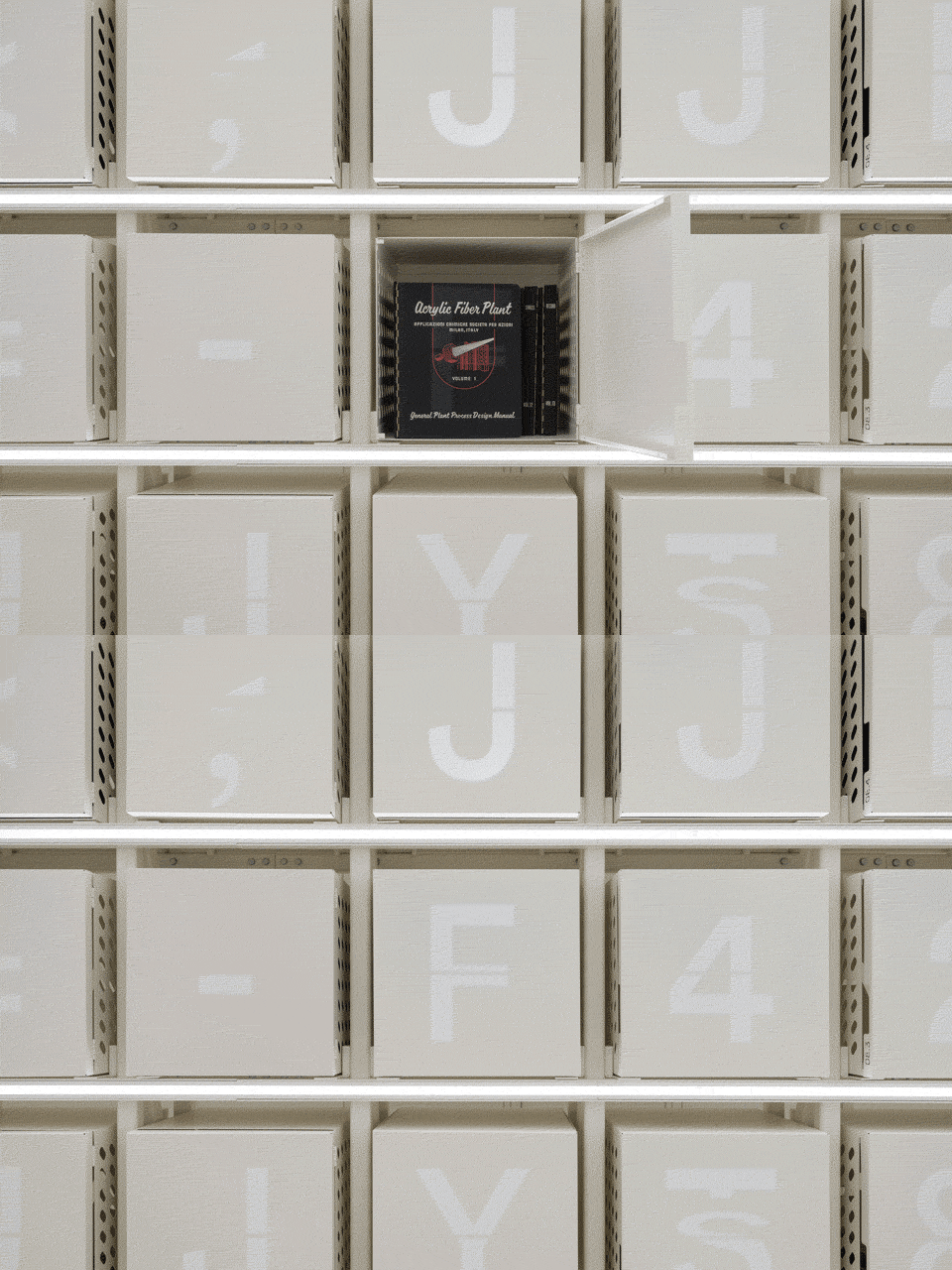
▼存档案的箱子,Box for archival documents ©Giuseppe Miotto _ Marco Cappelletti Studio


在过去数十年中,碳纤维已无处不在:喷气发动机、超级跑车、自行车、飞机、医疗设备等领域皆可见其身影。然而,人们对其制造过程却知之甚少。MAE 博物馆邀请观众跨越这一认知门槛,揭示一种看似日常的聚合物——与服装中所用材料相似的丙烯酸纤维——如何演变为定义我们时代的重要材料之一。
▼档案存放柜,Archive storage cabinet ©Giuseppe Miotto _ Marco Cappelletti Studio
Over the past decades, carbon fiber has become ubiquitous: in jet engines, supercars, bicycles, aircraft, medical devices and many others products. Yet few people know how it is made. The MAE Museum invites visitors to cross that threshold of knowledge and uncover how an everyday polymer – acrylic fiber, similar to that used in clothing – has given rise to one of the defining materials of our age.
©Giuseppe Miotto _ Marco Cappelletti Studio


参观从 MAE 的档案馆开始,这里收藏着全球最具价值的丙烯酸纤维生产相关知识产权。丙烯酸纤维正是碳纤维的前驱材料:在精确控制的加热与氧化过程中,其碳原子会排列成超强晶格结构,从而赋予材料卓越的强度重量比。在博物馆中,由档案箱构成的“档案景观”形成一个结合数字叠加的互动三维矩阵,使观众与研究人员能够深入探索 MAE 独一无二的工业创新与知识产权宝库。档案由此成为一座活态博物馆——一个可阅读、可探询、可激发思想连接的场所。
The visit begins in MAE’s archive, home to some of the world’s most valuable intellectual property related to the production of acrylic fiber. This fiber is the precursor for carbon fiber: when carefully heated and oxidized, its carbon atoms align into an ultra-strong lattice, giving the material its remarkable strength-to-weight ratio. In the museum, the archive made of a landscape of boxes forms an interactive 3D matrix enhanced by digital overlays, allowing visitors and researchers to explore MAE’s unique repository of industrial innovation and intellectual property. The archive becomes a living museum – a place to read, inquire, and connect ideas.
▼切换不同颜色的效果,Switching between different colors ©Giuseppe Miotto _ Marco Cappelletti Studio


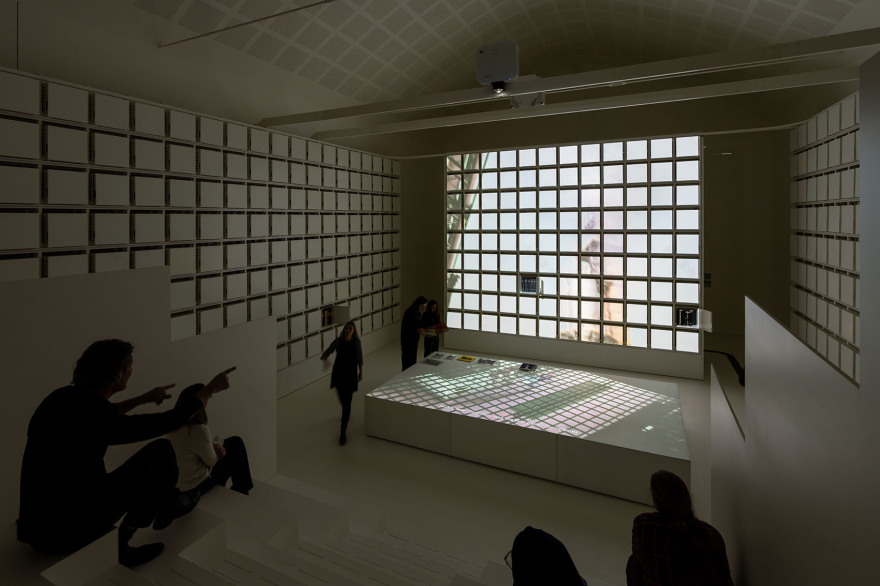
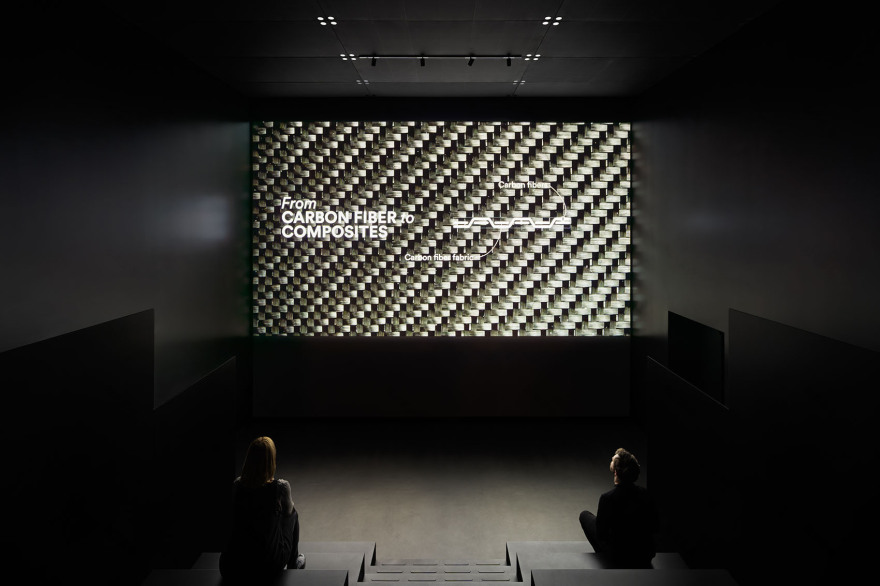
参观动线随后进入“碳化隧道”,通过热与光的演绎,重现丙烯酸纤维转化为碳纤维的过程。在这里,建筑成为传递力量的媒介——压力、压缩与释放被转译为一场多感官体验。来自 MAE 测试设施的实时数据将博物馆与正在进行的研究相连,使其成为一座“活的实验室”。此外,一个沉浸式空间展示了碳纤维潜力的最前沿:一座完整的生产工厂模型在上方投射的增强现实中被“激活”。
The journey continues through the Carbonization Tunnel, where heat and light retrace the transformation of acrylic fiber into carbon fiber. Here, architecture becomes a medium for these forces — pressure, compression, and release — translating the carbonization process into a multisensory experience. Real-time data from MAE’s test facility connects the museum to ongoing research, turning it into a living laboratory. Furthermore, an immersive space unveils the outermost frontiers of carbon fiber’s potential, where a complete mock-up of a production plant comes alive beneath augmented realities projected from above.
▼光的艺术,The Art of Light ©Giuseppe Miotto _ Marco Cappelletti Studio


最终展厅呈现了一系列互动装置与原型,展示碳纤维在当下与未来的尖端应用,包括下一代交通工具、风力发电设备以及航空航天构件。博物馆内部的结构、装置与家具同样基于 Maestro Technologies 的创新数字化建造技术。该公司正致力于通过新型软件打通设计与建造之间的界限,使博物馆既成为展示平台,也成为这一新建造方法的实验场。
The final gallery presents interactive artifacts and prototypes that showcase current and future cutting-edge applications of carbon fiber, from next-generation vehicles to wind turbines and aerospace components. The museum’s internal structures, fixtures, and furniture are also based on innovative digital fabrication through Maestro Technologies, whose evolving mission is to redefine how we build. The company is developing new software that bridges design and construction, positioning the museum as both a showcase and a testing ground for this new approach.
▼零件展览,Equipment parts exhibition ©Giuseppe Miotto _ Marco Cappelletti Studio


由Studio Michbold构思并打造的沉浸式多媒体环境,融合影像、声音与空间照明,引导观众进入关于工业演进与材料转化的叙事。声音既包括回溯艾米利亚-罗马涅油田历史的旁白,也包括如工程先驱 Marco Rovellini 等人的讲述,详细阐释碳化过程。通过定制化投影系统、场景设计与叙事编排,科学流程被转化为动态的视听体验。
▼参观展览的游客,Tourists visiting the exhibition ©Giuseppe Miotto _ Marco Cappelletti Studio

“MAE 博物馆源于我们提升 MAE S.p.A. 档案价值以及思想与生产遗产的强烈意愿——这些遗产伴随着社会的持续转型。通过这一项目,我们希望提升公众对意大利工业力量在国家发展中关键作用的认知,这种作用不仅体现在经济层面,也体现在文化与社会层面。博物馆的开放,是多年热忱工作的里程碑,同时也是新的起点。未来,我们将进一步融入社区、机构与大学,探索不断演进的技术进步本身如何成为一种文化……以及通向未来的入口。”
——Paola Rovellini(MAE 首席财务官兼 MAE 博物馆馆长)
“Archives often rest in silence, yet they contain a quiet power,”“We loved the idea of transforming a secret archive into a living museum, a place where past knowledge can be explored and ignite new paths of future innovation.”
—Carlo Ratti(professor at MIT and Politecnico di Milano, founding partner at CRA, and Director of Venice’s Biennale Architettura 2025.)
“MAE Museum stems from the strong will to enhance MAE S.p.A.’s archive, as well as our heritage of ideas and productions, which have accompanied the transformations of society. Through this project, we aim at raising awareness regarding the crucial role of Italy’s industrial players in supporting the country’s growth, not solely from an economic perspective, but also from the cultural and social standpoints,””The opening of the museum, coming after years of passionate work, is both a milestone and a starting point. Our goal, now, is to increasingly integrate with communities, institutions, and universities to explore how the constantly evolving technological progress is itself culture… and a gateway to the future.
—Paola Rovellini(CFO of MAE SpA and Director of the MAE Museum.)
▼碳纤维自行车,Carbon fiber bicycle ©Giuseppe Miotto _ Marco Cappelletti Studio

▼通道,Corridor ©Giuseppe Miotto _ Marco Cappelletti Studio

MAE 博物馆延续了 CRA 与 Italo Rota 合作打造博物馆与文化空间的一系列实践。此前的联合项目包括米兰的 MEET 数字文化中心、AGO Modena,以及由 Carlo Ratti 策展的第 19 届威尼斯国际建筑展等。
The MAE Museum continues a series of museum and cultural spaces designed through collaborations between CRA and Italo Rota. Previous joint projects include the MEET Digital Culture Center in Milan, the largest cultural center under construction in Southern Europe, AGO Modena, and the 19th International Architecture Exhibition of La Biennale di Venezia, which Carlo Ratti curated.
▼放映室,Projection room ©Giuseppe Miotto _ Marco Cappelletti Studio
CREDITS
Architectural Design: CRA-Carlo Ratti Associati and Italo Rota
CRA team: Carlo Ratti, Andrea Cassi (partner-in-charge), Chiara Morandini (Project Manager), Iratxe De Dios, Francesco Rabuffetti, Ina Sefgjini, Anna Spaggiari, Gary Di Silvio (graphics team), Pasquale Milieri (graphics team)
Construction and Technical Fit-out: Maestro Technologies (Mykola Murashko, Sara Zampieron, Kohei Nakajima, Julio Ramirez, Corrado Castiglioni), Bragoli Costruzioni
Museum Curation: Italo Rota, michbold, Macro
Structures: Ingembp
MEP Systems: Projema
Acoustics: Onleco
Graphic Design, Visual Identity, and Multimedia Installations: michbold + Macro
Multimedia Production and Interactive Installations: Zebra
Lighting Design: Light Follows Behaviour
Sound Design: Lorenzo Montanà, Medora
“Aufschwung” Installation Design: Flavio Manzoni
Images by Giuseppe Miotto / Marco Cappelletti Studio
南京喵熊网络科技有限公司 苏ICP备18050492号-4知末 © 2018—2020 . All photos and trademark graphics are copyrighted by their owners.增值电信业务经营许可证(ICP)苏B2-20201444 苏公网安备 32011302321234号
苏公网安备 32011302321234号客服
消息
收藏
下载
最近