

创作上传
VIP
收藏下载
登录 | 注册有礼
查看完整案例

收藏

下载

分享
位于四川彭州丹景山镇的湔江小火车线性公园,是一条以火车站为核心,有机串联餐饮、展览、亲子、艺术、户外运动、遗产活化与自然景观的综合性旅游动线。其前身为彭白铁路,承载着彭州人深厚的集体记忆。这条1961年通车的39公里窄轨铁路,曾穿行山区,是居民出行、求学、赶集的重要通道。虽于2000年左右停运拆除,却始终是彭州人心中不可替代的情感纽带。2017年,彭州市政府恢复了丹景山段的3.5公里轨道,打造湔江小火车文旅线路,后因疫情与运营问题于2022年再度停运。©UN-GROUP未集建筑
Located in Danjingshan Town, Pengzhou, Sichuan, the Jianjiang Mini-Train Linear Park is a comprehensive tourism route centered around a railway route. It organically integrates dining, exhibitions, family activities, art, outdoor sports, heritage revitalization, and natural landscapes. Its predecessor was the Pengbai Railway, a line that carries the deep collective memories of the Pengzhou people. Opened in 1961, this 39-kilometer narrow-gauge railway once wound through the mountains, serving as a vital corridor for residents traveling for work, education, and local markets. Although the line was decommissioned and dismantled around 2000, it has remained an irreplaceable emotional bond for the local community. In 2017, the Pengzhou Government restored a 3.5-kilometer section of the track in Danjingshan to create the Jianjiang Mini-Train cultural tourism route. However, due to the pandemic and operational challenges, services were suspended once again in 2022.
▼项目鸟瞰,Aerial-view of the project©刘松恺


2024年,在“运营前置”理念推动下,运营团队九陇新创与未集建筑共同启动了彭白铁路复兴计划,湔江小火车线性公园由此新生。我们提出“时光折叠·轨上新生”的主客共享概念,以3.5公里铁轨串联五个站点、四段主题景观,并联动丹景山镇十三个项目节点。小火车如同时空胶囊,引领游客穿行于记忆的蒙太奇。目前,五个主要站点中已有三个初具规模,预计2026年春夏全线贯通。▼场地平面图,Site plan©UN - GROUP未集建筑

In 2024, driven by the philosophy of “Operations-First,” the operations team Jiulong Xinchuang collaborated with UN-GROUP to launch the Pengbai Railway Revival Plan, marking the rebirth of the Jianjiang Mini-Train Linear Park. We introduced the “host-guest sharing” concept titled “Time Folded · Rebirth on Tracks.” This initiative utilizes the 3.5-kilometer railway to link five stations and four themed landscape sections, while integrating thirteen project nodes throughout Danjingshan Town. The mini-train acts as a “time capsule,” leading visitors through a montage of memories. Currently, three of the five major stations have taken shape, and the entire line is expected to be fully connected and operational by the spring or summer of 2026.
▼项目概览,Overview of the project©刘松恺


▼远眺建筑,Distant view of the building©刘松恺
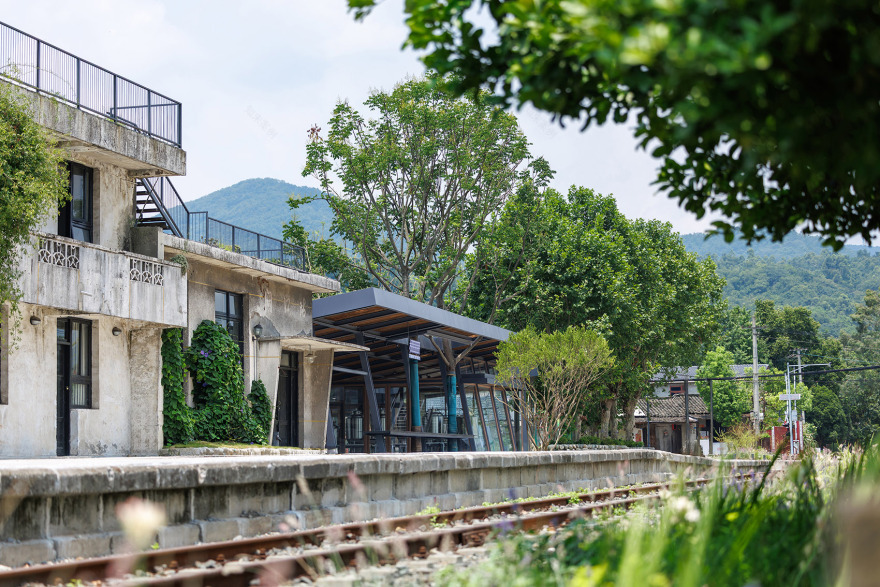
棚朋儿餐厅作为线性公园的首站,毗邻彭白铁路的标志——1961年建成的关口老站。餐厅以“老站新生”为理念,复刻成都人“约三五好友,棚下喝茶”的闲适生活,融合茶咖、精酿、烧烤与川式西餐,为历史站点注入新活力。
▼原始场地,Original site view


As the inaugural stop of the linear park, Pengpeng’er Bistro sits adjacent to a landmark of the Pengbai Railway—the Guankou Old Station, built in 1961. Guided by the philosophy of “New Life for the Old Station,” the bistro recreates the leisurely lifestyle quintessential to Chengdu—”gathering a few friends to drink tea under a shed.” By blending tea and coffee culture, craft beer, BBQ, and Sichuan-style Western cuisine, it injects fresh vitality into this historical landmark.
▼轨道侧立面,Raiway exterior ©刘松恺

▼新与旧的立面对比,Comparison between new & old ©刘松恺

川西坝子的劳动人民历来有着“搭棚棚儿”的习俗,设计紧扣这一地域特色与“老站新生”的主题,特意让出四分之一的红线范围,在原有关口老站一侧延展出一个与之齐高的倾斜半室外棚顶,既作候车区,亦为餐厅核心。一座轻质钢楼梯在不扰动老建筑的前提下,将棚顶与老站屋顶平台相连,使历史空间转化为餐厅的有机延伸。
The working people of the West Sichuan Plain have a long-standing tradition of building “Pengpeng’er” (temporary sheds). Embracing this regional characteristic and the theme of “New Life for the Old Station,” the design intentionally sets back a quarter of the red-line area. An inclined, semi-outdoor canopy—matching the height of the original structure—extends alongside the Guankou Old Station. This space serves a dual purpose as both a waiting area for the train and the core of the bistro. To bridge the gap between eras, a lightweight steel staircase connects the new canopy to the rooftop terrace of the old station without disturbing the historic fabric. This clever integration transforms the historical space into an organic extension of the bistro.
▼化为餐厅的有机延伸,An organic extension of the bistro ©刘松恺


为塑造一个轻盈、通透的“棚棚儿”,建筑主体采用钢结构。棚儿下的钢柱顺势倾斜,与棚儿顶扬起的钢梁呈90度角衔接,轻盈而坚定地“扎根”于站台之上,展现出力与美的平衡。▼棚棚儿钢结构,”Pengpeng’er” steel frame©UN-GROUP未集建筑

To create a “Pengpeng’er” that is both light and transparent, the main structure utilizes a steel frame. Beneath the canopy, the steel columns lean naturally to meet the upward-sweeping roof beams at a precise 90-degree angle. This allows the structure to “take root” on the platform with a sense of delicate firmness, achieving a seamless balance between structural strength and aesthetic grace.
▼半室外棚顶空间,Semi-outdoor canopy ©刘松恺

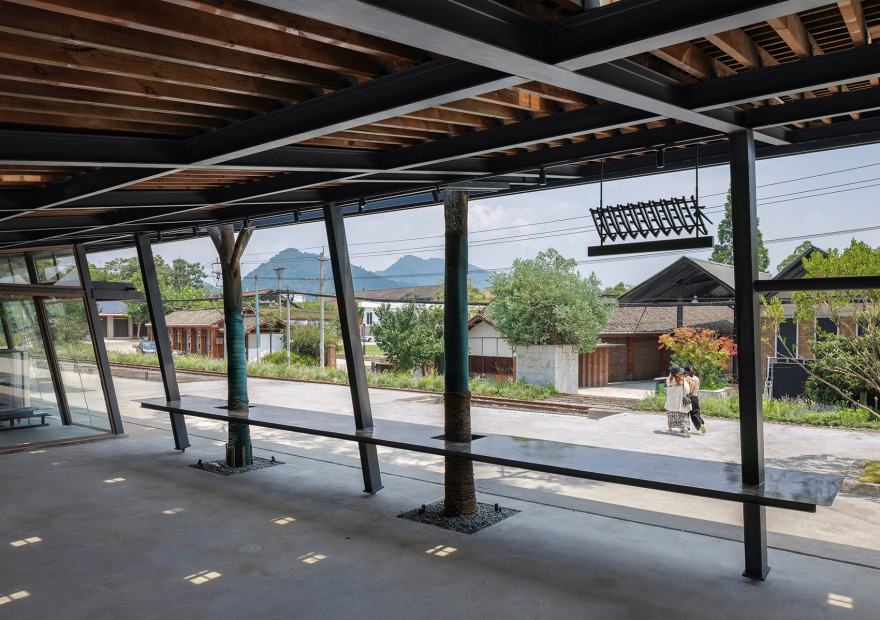
半室外棚棚儿布置瓦片的檩条系统被直接暴露,形成独特的顶部视觉。透明瓦与石板瓦随机穿插,白天阳光渗下,光斑点点;夜晚地上预埋的极小地埋灯透出点点亮光,如星光洒地,日夜浪漫交替。
The purlin system supporting the tiles of the semi-outdoor “Pengpeng’er” is left intentionally exposed, creating a unique visual texture overhead. Transparent tiles are interspersed randomly among traditional slate tiles; by day, sunlight filters through, casting a dappled pattern of light. By night, tiny recessed floor lamps emit a soft glow, resembling starlight scattered across the ground. The result is a romantic transition between day and night.
▼独特的顶部视觉,Unique visual texture overhead ©刘松恺


餐厅前场原有两棵梧桐树,棚棚儿原本为它们预留出破顶的空间。但开挖过程中发现两棵树的根系已空,又在施工中长期暴露,健康状况出现不可逆的衰退。两棵梧桐树被移植至公园内更适宜的环境,并在原址补种了两棵成熟的栾树。两棵树枝桠突破棚儿顶,树梢远眺远处的龙门山,他们成为建筑的一部分,持续生长。
On the platform in front of the bistro stood two original plane trees. The “Pengpeng’er” canopy was initially designed with roof openings to accommodate them. However, during excavation, it was discovered that the root systems were hollowed out; combined with long-term exposure during construction, their health suffered an irreversible decline. Consequently, the two plane trees were transplanted to a more suitable environment within the park, and two mature Goldenrain trees (Koelreuteria paniculata) were planted in their original spots. Now, their branches break through the canopy roof, with their treetops gazing toward the distant Longmen Mountains. They have become an integral, living part of the architecture, continuing to grow alongside it.
▼突破棚儿顶的树,Branches break through the roof ©刘松恺

棚下空间功能灵活复合:现浇清水混凝土吧台以其木纹肌理柔化了材质的冷峻;依托斜柱的悬浮长台既可候车小憩,也适合友人小酌;老站一侧设置的秋千,已成为深受居民喜爱的游戏角落。▼剖面图,Section©UN-GROUP未集建筑


The space beneath the canopy is designed for flexibility and multifunctionality. A cast-in-place fair-faced concrete bar, featuring a distinct wood-grain texture, softens the inherent coldness of the material. A suspended long bar table, anchored to the leaning columns, serves as both a resting spot for passengers waiting for the train and an ideal nook for friends to enjoy a drink. Meanwhile, a pair of swings installed beside the old station has already become a beloved play corner for local residents.
▼清水混凝土吧台,Concrete bar ©刘松恺

10米长的中央现浇吧台是功能与视觉的焦点,同时服务于站台、后侧公园与室内就餐区。在建筑语言上,它独立于主体屋顶,采用半透PC板屋面,嵌入深灰色钢构之中。夜晚,它如灯笼般漫射出暖光,向外传递着温暖的烟火气息。
The 10-meter-long central cast-in-place bar serves as both a functional and visual centerpiece, simultaneously catering to the train platform, the park in the rear, and the indoor dining area. In terms of architectural language, it remains independent of the main roof, featuring a translucent PC (polycarbonate) board roof embedded within a dark grey steel structure. At night, it glows like a lantern, diffusing a warm radiance that radiates the comforting ambiance of “daily life and hearth” to the surroundings.
▼温暖的烟火气息,Daily life and hearth ©刘松恺

场地原有的1.2米高差通过三级台地消化,最低处成为休憩座面。斜柱体系延续至室内,单坡屋顶顺应地形起伏,屋顶形式呼应地形的层层跌落,采用单坡屋面,在保证3.2米舒适净高的同时,营造出富有节奏的空间序列。以中央吧台与庭院为界,两侧的单坡屋顶呈V形,不仅组织了排水,更将整个建筑的“势能”引向核心的吧台区域。
The original 1.2-meter elevation change of the site is resolved through three tiers of terraced platforms, where the lowest level doubles as a seating area for relaxation. The leaning column system extends into the interior, where the single-pitch roofs follow the natural undulations of the terrain. By echoing the cascading layers of the topography, the roof design ensures a comfortable 3.2-meter clear height while establishing a rhythmic spatial sequence. With the central bar and courtyard serving as the boundary, the single-pitch roofs on either side form a V-shape. This configuration not only facilitates efficient drainage but also channels the architectural “momentum” (potential energy) toward the core bar area.
▼富有节奏的空间序列,A rhythmic spatial sequence ©刘松恺


立面以大面积玻璃为主,最大化餐厅的通透性与开放性。为了达到极致的轻薄屋顶观感,所有暖通设备均被预埋于地面之下。在深灰色钢结构与混凝土的基调上,室内大量运用温暖的老木、藤编与实木家具,灵感源自老成都的竹编椅,重塑本地休闲记忆。天花与踢脚线统一采用株木,幕墙铝窗框也选用同色系。
The facade consists primarily of expansive glass panels, maximizing the bistro’s transparency and openness. To achieve a visually ultra-thin roofline, all HVAC (heating, ventilation, and air conditioning) equipment is pre-installed beneath the floor. Against a base palette of dark grey steel and concrete, the interior makes extensive use of warm reclaimed wood, rattan weaving, and solid wood furniture. Inspired by the traditional bamboo-woven chairs of old Chengdu, these elements reshape local memories of leisure. The ceilings and skirtings are unified in beech wood, with the aluminum window frames of the curtain wall color-matched to create a seamless aesthetic.
▼玻璃立面,Glass facade ©刘松恺

▼餐厅室内概览,Interior of the space ©刘松恺


餐厅后侧的三角绿地规划为亲子嬉水乐园,整面折叠门可在适宜季节完全打开,使室内外融为一体。我们也设置了多级室外平台作为室外就餐和休憩空间。
The triangular green space at the rear of the bistro has been planned as a family water-play park. During favorable seasons, the entire folding door system can be fully retracted, seamlessly integrating the indoor and outdoor environments. Additionally, we have incorporated multiple levels of outdoor terraces, providing dedicated spaces for open-air dining and relaxation.
▼可开合的折叠门,Foldable doors ©刘松恺

绿植被系统性地融入建筑:精酿区与包间之间的中庭成为静谧花园;斜柱上方的雨棚设计为连续种植池,叶儿垂下,棚儿下长草;室内卡座区间嵌入连续花池,并在上方悬挂摆放植物的金属网架,构成一幅可随植物生长而变化的“立体绿窗”;包间的餐桌周边亦环绕一圈大叶植物,进一步模糊室内与自然的边界。
Greenery is systematically integrated into the architecture: the courtyard between the craft beer area and the private dining rooms serves as a tranquil garden. Above the leaning columns, the canopy is designed with continuous planters where foliage drapes down, allowing “grass to grow beneath the shed.” Within the indoor booth seating area, continuous planters are embedded, complemented by suspended metal mesh racks above for hanging plants. Together, they form a “3D Green Window” that evolves with the plants’ natural growth. Even the dining table in the private room is surrounded by a ring of large-leaf plants, further blurring the boundary between the interior and nature.
▼绿植被融入建筑,Greenery is integrated into the architecture ©刘松恺


▼模糊室内与自然的边界, Blurring the boundary between the interior and nature ©刘松恺
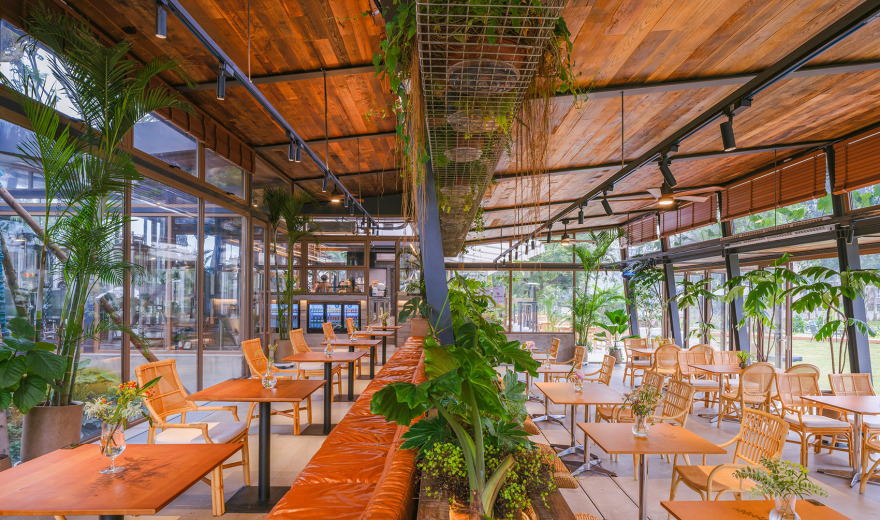

▼庭院, Courtyard ©刘松恺

细节处致敬工业遗存:平台栏杆、大门把手取材自小尺寸铁轨;包间阶梯复用老枕木,以温润的质感和岁月的痕迹唤醒历史记忆;室内单侧卡座采用了内嵌式轨道,方便座椅能根据使用需求灵活移动,增强了空间的适应性。
Details throughout the project pay homage to the industrial heritage of the site. The platform railings and door handles are crafted from small-gauge steel rails, while the steps leading to the private rooms repurpose vintage wooden sleepers (railway ties). Their warm texture and weathered traces awaken long-dormant historical memories. Inside the bistro, the booth seating on one side features an embedded track system, allowing chairs to move flexibly according to functional needs, thereby enhancing the spatial adaptability of the interior.
▼细节,Details ©刘松恺


项目在施工阶段遭遇了不少挑战,其中最具代表性的是中央大吧台的现浇施工。为了确保最终效果,设计团队主导在园区内进行了多次实验性浇筑,通过反复比对不同材料配比与木模板体系的效果,最终确定了最优方案。其中一个混凝土吧台小样被特意保留下来,成为园区内一处独特的景观小品,见证着从实验到实现的完整过程。
The project encountered numerous challenges during the construction phase, most notably the cast-in-place process of the central grand bar. To ensure the final aesthetic, the design team led several experimental pours on-site. By repeatedly comparing the results of different material ratios and wooden formwork systems, they eventually arrived at the optimal solution. One of these concrete bar mock-ups was intentionally preserved as a unique landscape feature within the park, serving as a silent witness to the complete journey from experiment to realization.
▼景观小品, Landscape feature ©刘松恺

如今,随着小火车进入试运行阶段,棚朋儿餐厅也已超越单一的车站功能,演变为深受本地居民喜爱的社区客厅与日常据点。它不仅成功激活了历史站点,更成为连接过去与现在、游客与居民、自然与建筑的活力纽带,为湔江小火车线性公园的全面复兴写下了生动的序章。
Now that the mini-train has entered its trial operation phase, Pengpeng’er Bistro has transcended its singular function as a railway station, evolving into a “community living room” and a cherished daily hub for local residents.It has not only successfully revitalized a historical site but has also become a vibrant bond connecting past and present, tourists and locals, and nature and architecture. In doing so, it pens a vivid prologue to the comprehensive revival of the Jianjiang Mini-Train Linear Park.
▼夜景, Nightviews ©刘松恺


▼总平图,Master plan©UN-GROUP未集建筑

▼平面图,Ground floor plan©UN-GROUP未集建筑

项目名称:棚朋儿餐厅
项目地点:四川省彭州市丹景山镇
项目类型:概念规划、建筑设计、室内设计
业主单位:四川龙门山文化旅游发展有限公司
设计主创团队:UN-GROUP 未集建筑、杨烈
运营团队: 彭州市九陇新创文化旅游发展有限公司
施工图团队:中联西北工程设计研究院
施工单位:彭州市兴彭建筑工程有限公司
结构顾问:iStructure
灯光顾问:陈樱鹦
景观设计:成都漫诗地园艺有限公司
驻场设计师:谢雨桐、于广利、刘阳城
摄影:刘松恺
建筑面积:410㎡
项目设计:2024年8-12月
施工完成:2025年11月
Project Name: Pengpeng’er Bistro
Project Location: Danjingshan Town, Pengzhou, Sichuan Province
Gross Floor Area: 410 m²
Project Type: Conceptual Planning, Architectural Design, Interior Design
Client: Sichuan Longmenshan Cultural Tourism Development Co., Ltd.
Lead Design Team: UN - GROUP, Yang Lie
Operations Team: Pengzhou Jiulong Xinchuang Cultural Tourism Development Co., Ltd.
LDI (Local Design Institute): China United North West Institute for Engineering Design & Research
Construction Firm: Pengzhou Xingpeng Construction Engineering Co., Ltd.
Structural Consultant: iStructure
Lighting Consultant: Chen Yingying
Landscape Design: Chengdu Manshidi Horticulture Co., Ltd.
Resident Designers: Xie Yutong, Yu Guangli, Liu Yangcheng
Photography: Liu Songkai
Design Period: August – December 2024
Completion: November 2025


南京喵熊网络科技有限公司 苏ICP备18050492号-4知末 © 2018—2020 . All photos and trademark graphics are copyrighted by their owners.增值电信业务经营许可证(ICP)苏B2-20201444 苏公网安备 32011302321234号
苏公网安备 32011302321234号客服
消息
收藏
下载
最近