

创作上传
VIP
收藏下载
登录 | 注册有礼
查看完整案例

收藏

下载

分享
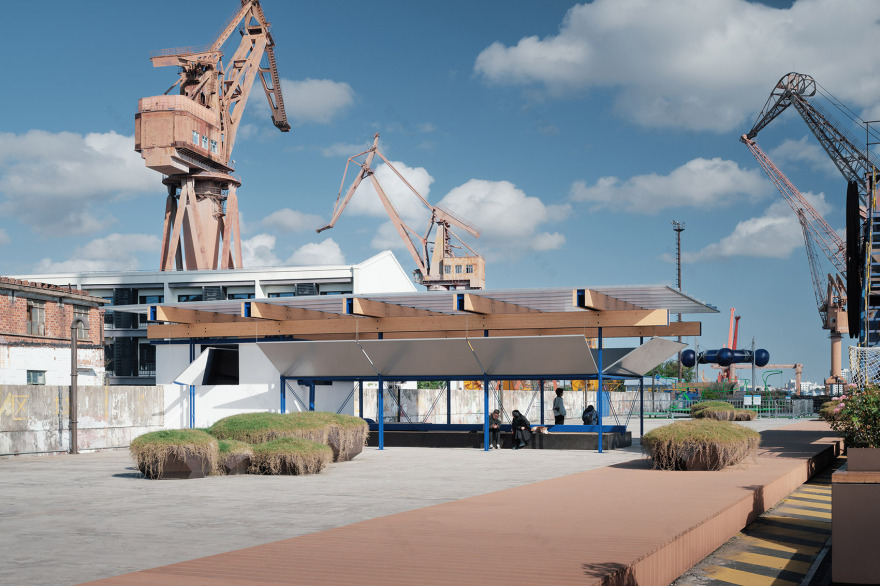
浮舱是2025上海城市空间艺术季(SUSAS)的参展项目,位于上海杨浦区复兴岛船台公园的高桩码头上,作为一处日常供市民游客在江边休憩、以及举办活动时辅佐性公共空间。浮舱的概念源于场地,高桩码头、造船塔吊、水泵房及防汛墙都提示着中华船厂的工业历史场所记忆。整个场地上超尺度的造船工业机械设施,呈现出一种已然静止、但潜在可启动的状态。
©刘国威+陈旸
The Floating Cabin, an exhibit at the 2025 Shanghai Urban Space Art Season (SUSAS), is located on the high-pile dock of the Fuxing Island Shipyard Park in Yangpu District, Shanghai. It serves as a supplementary public space for citizens and tourists to relax by the river and for events. The concept originates from the site; the high-pile dock, shipbuilding cranes, pump house, and flood control wall all evoke memories of the industrial history of the Zhonghua Shipyard. The super-scale shipyard machinery and infrastructure on the site presents a state of being static yet potentially dynamic.
▼项目概览,Overview of the project©陈颢

▼立面近景,Zoom-in to exterior ©陈颢
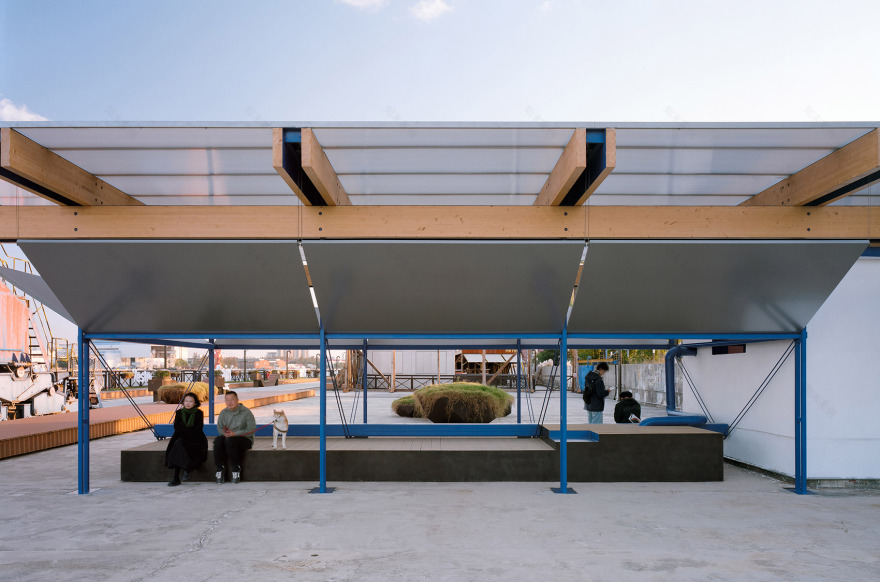

我们希望可以把这种场地气质可以延续到浮舱的设计中,并进而转化为某种穿透固有类型的当代性架构空间。“舱”指向了船舶工业的机械美学,也指向了某种容纳可变内容的功能性空间;而“浮”则是一种悬浮化的架构状态。
We hoped to extend this site character into the design of the Floating Cabin, transforming it into a contemporary architectural space that transcends conventional types. “Cabin” refers to the mechanical aesthetics of the shipyard industry, and also to a functional space that accommodates variable content; while “floating” represents a suspended structural state.
▼悬浮化的架构状态,A suspended structural state ©刘国威


▼船舶工业的机械美学,The mechanical aesthetics of the shipyard industry ©刘国威

水泵房附着于防汛墙上,内部没有楼板,是一处不可进入、与码头下江水相连的工业空间;紧挨着水泵房是一处码头地坪高起的混凝土检修台,容纳了从泵房穿出的原始管道。设计完好保留了水泵房、管道与地坪检修台,并依托于它们完成浮舱的架构。屋顶覆盖下的地面平台,融合了支撑、悬吊与张拉等多种力感关系的要素,构筑出一处既开放通透、又蕴含张力的特殊场所。
The pump house, attached to the flood control wall, has no floor slab inside and is an inaccessible industrial space connected to the river below the dock. Adjacent to the pump house is a raised concrete maintenance platform on the dock floor, housing the original pipes extending from the pump house. The design preserves the pump house, pipelines, and ground maintenance platform, using them to construct the floating cabin’s structure, which integrates elements of support, suspension, and tension, creating a unique space that is both open and transparent, yet imbued with tension.
▼浮舱内望向江侧,View from the Floating Cabin inside towards the river ©陈颢


▼浮舱内望向水泵房,View from the Floating Cabin inside towards the pump house ©陈颢

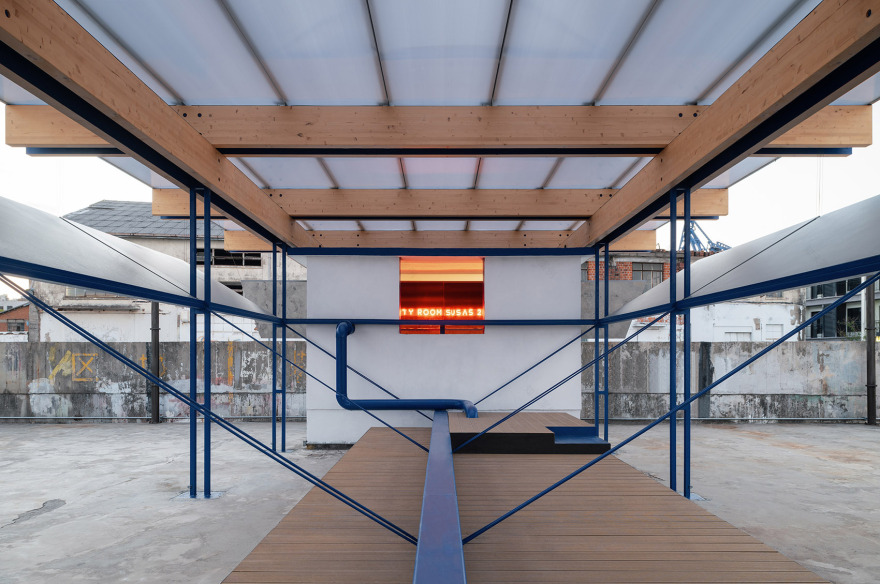
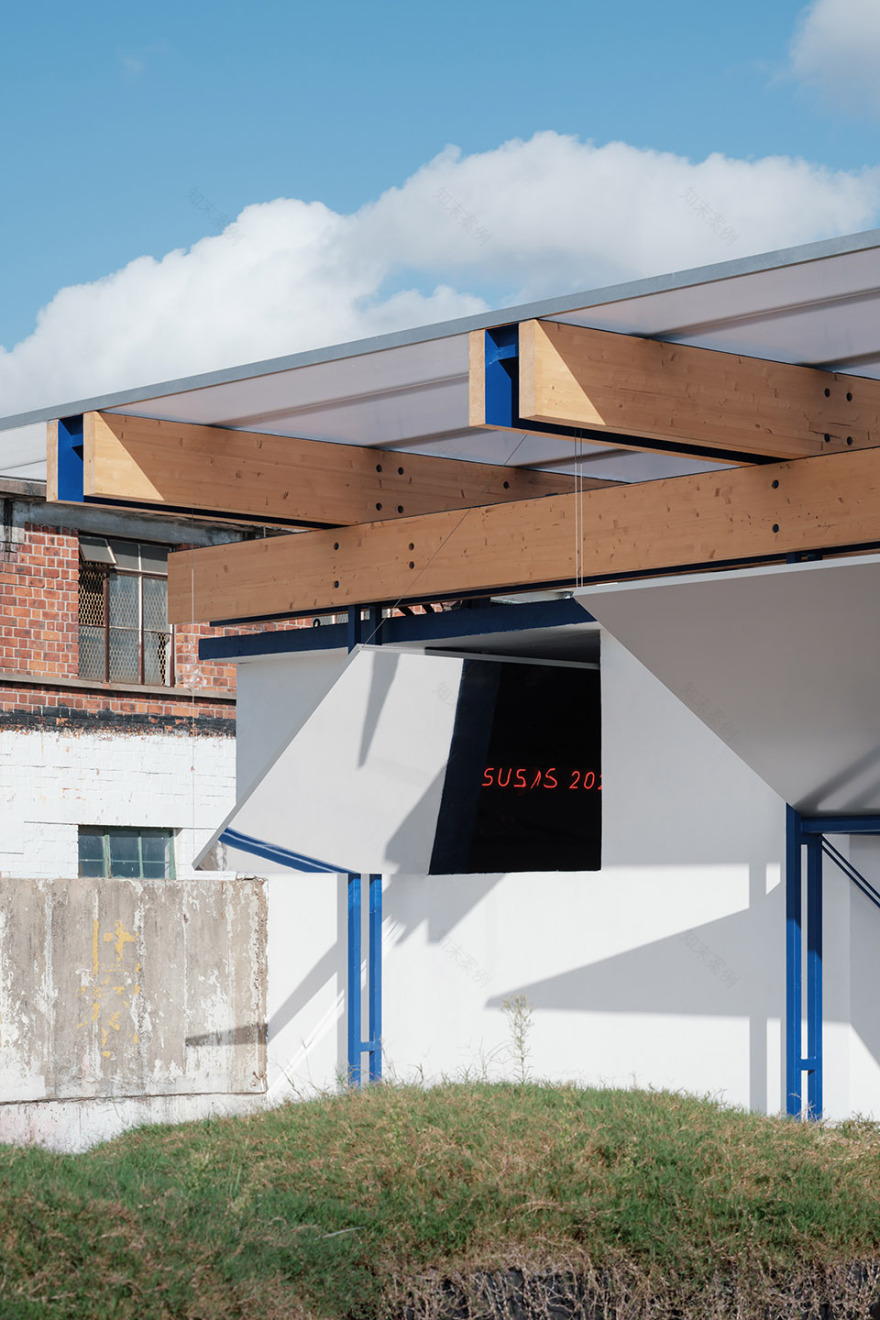
截面50的钢双立柱支撑起屋面的双层搭接胶合木双梁,木双梁中间设置了设备集成带,容纳了机械滑轮系统,并通过拉索悬吊周圈的金属 “舱板”。机械滑轮系统可让每块悬吊的舱板进行定角度翻转。舱板下端高度的斜向钢拉杆,共同构成倒V形剖面的结构,如同悬浮的“船舱”。四组V形拉杆共同“承托”了台面上的钢梁——用于补充整体结构的侧向稳定性。整体钢构件涂刷了场地上随处可见的原始工业构件的蓝色——这是船舶工业中常用的“普鲁士蓝”。
▼结构轴测图,Structural Axonometric©紋建筑
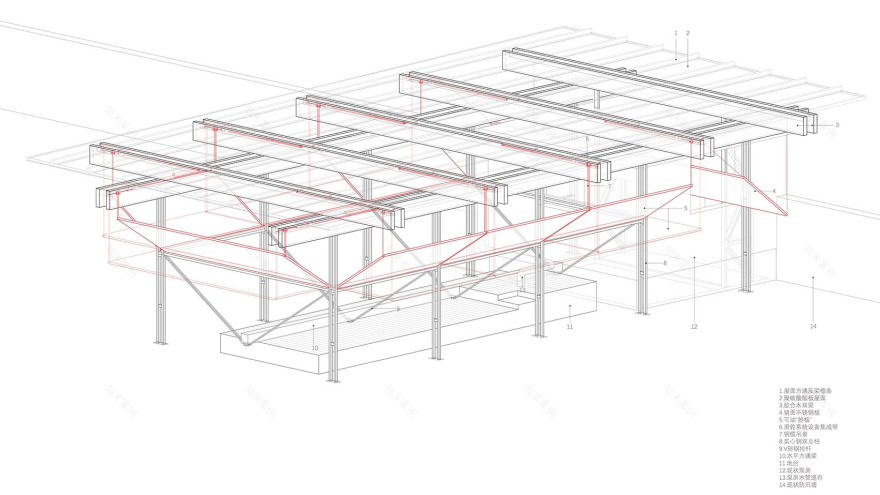
50mm cross-section steel double columns support the roof’s double-layered, overlapping glued laminated timber beams. An integrated equipment zone is installed between the timber beams, housing a mechanical pulley system and suspending the surrounding metal “cabin panels” via cables. The mechanical pulley system allows each suspended panel to rotate at a fixed angle. Diagonal steel tie rods at the lower end of the panels collectively form an inverted V-shaped cross-section, resembling a suspended “cabin.” Four sets of V-shaped tie rods collectively “support” the steel beams on the platform—adding to the overall structural lateral stability. The entire steel structure is painted in the blue of the original industrial components found throughout the site—a “Prussian blue” commonly used in the shipyard industry.
▼浮舱结构细部,Structure detail of Floating Cabin ©陈颢


▼普鲁士蓝色构件,Prussian blue steel structure ©刘国威
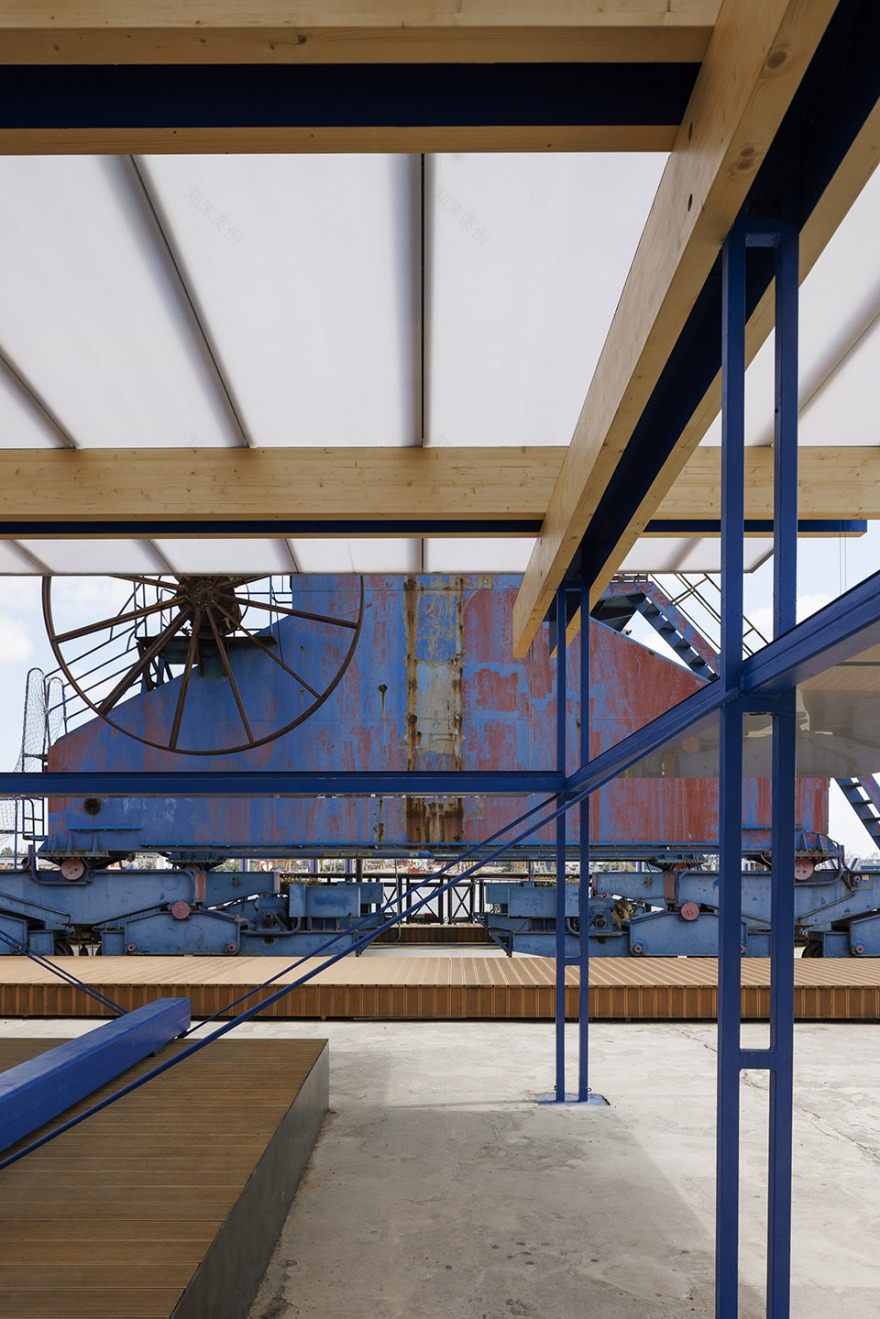
屋面采用半透明聚碳酸酯板而过滤直射光,为覆盖下的空间提供柔和的漫射天光。原码头地坪检修台的高起被包裹成40cm高的木质平台,构成一处可供人躺坐的区域。“浮舱”的新结构在空间关系上依附于水泵房,但在构造力学上又与水泵房轻盈地脱离。在西侧的第八块“舱板”,被木梁拉索悬挂而穿过水泵房的窗洞,并转变了方向而与东侧“舱板”互相平行——由此人们可以站在浮舱内的平台上,看到被镜面不锈钢板反射出的江水及灯光装置。灯光装置文字的”empty room 2025susas”试图提示,水泵房作为一个不可进入的艺术性“空房间”,呈现工业码头的历史记忆。
©陈旸
The roof, made of translucent polycarbonate panels, filters direct sunlight, providing soft, diffused skylight to the space beneath. The original elevated maintenance platform on the dock floor has been transformed into a 40cm-high wooden platform, creating a resting area. The new structure of the “floating cabin” is spatially attached to the pump house, yet structurally detached from it. The eighth “cabin panel” on the west side, suspended by wooden beams and cables, passes through the pump house’s window openings and changes direction to be parallel to the eastern “cabin panel”—allowing people to stand on the platform within the floating cabin and see the river water and lighting installations reflected by the mirrored stainless steel panels. The text on the lighting installation, “empty room 2025susas,” suggests that the pump house, as an inaccessible, artistic “empty room,” represents the historical memory of the industrial dock.
▼不可进入的艺术性“空房间”, Artistic “empty room” ©刘国威

▼浮舱打开过程,Opening process©陈颢
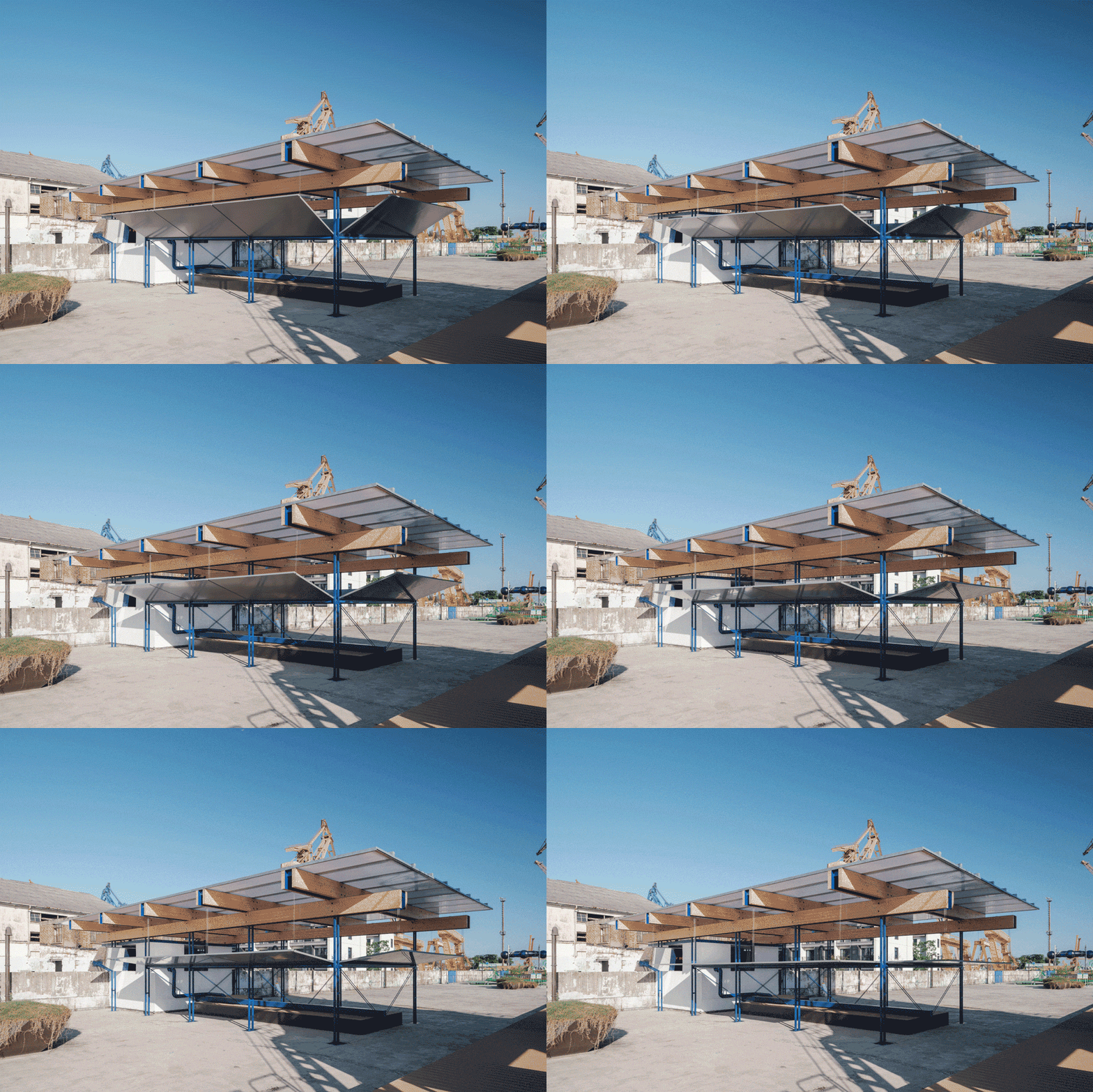
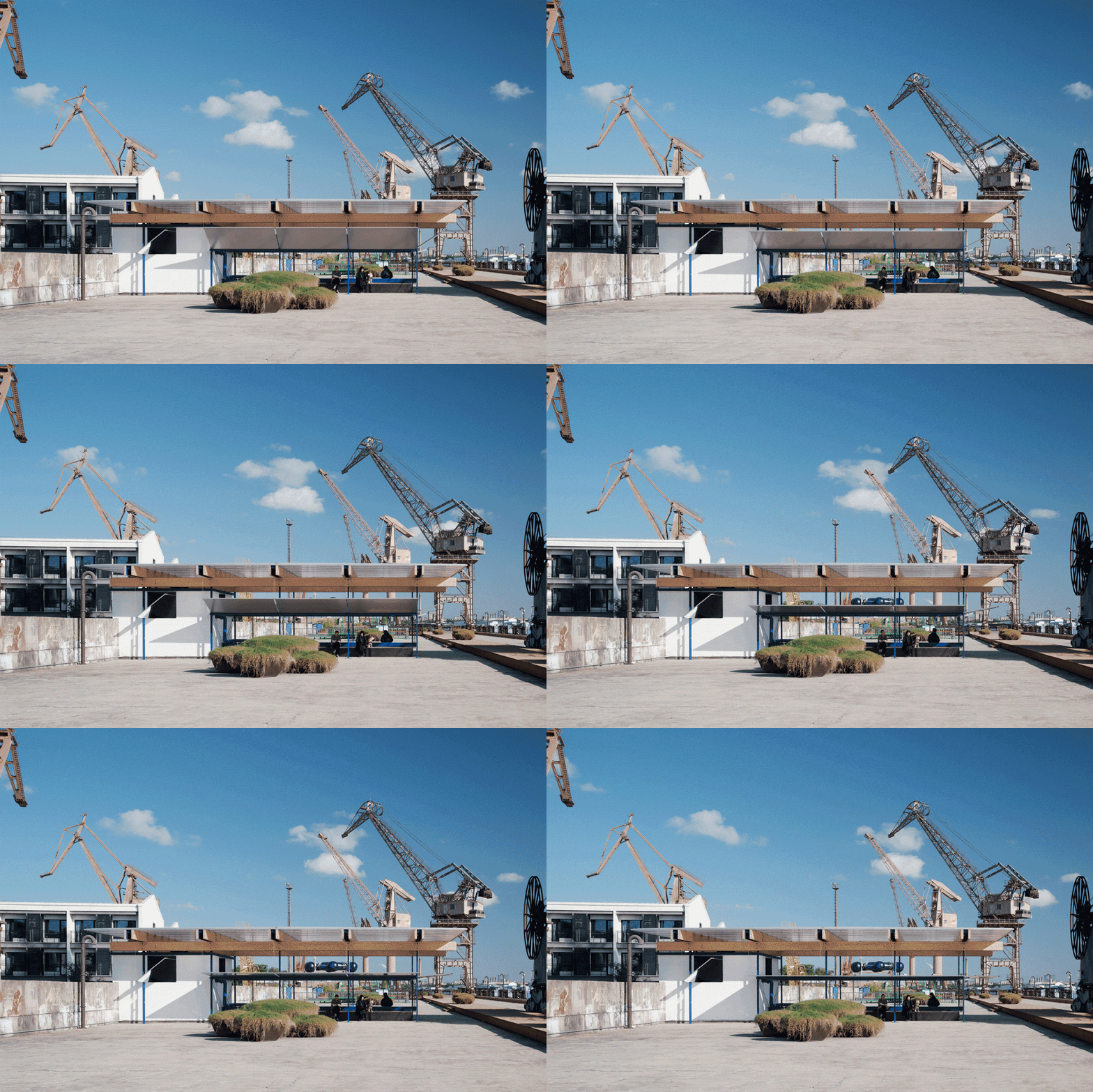
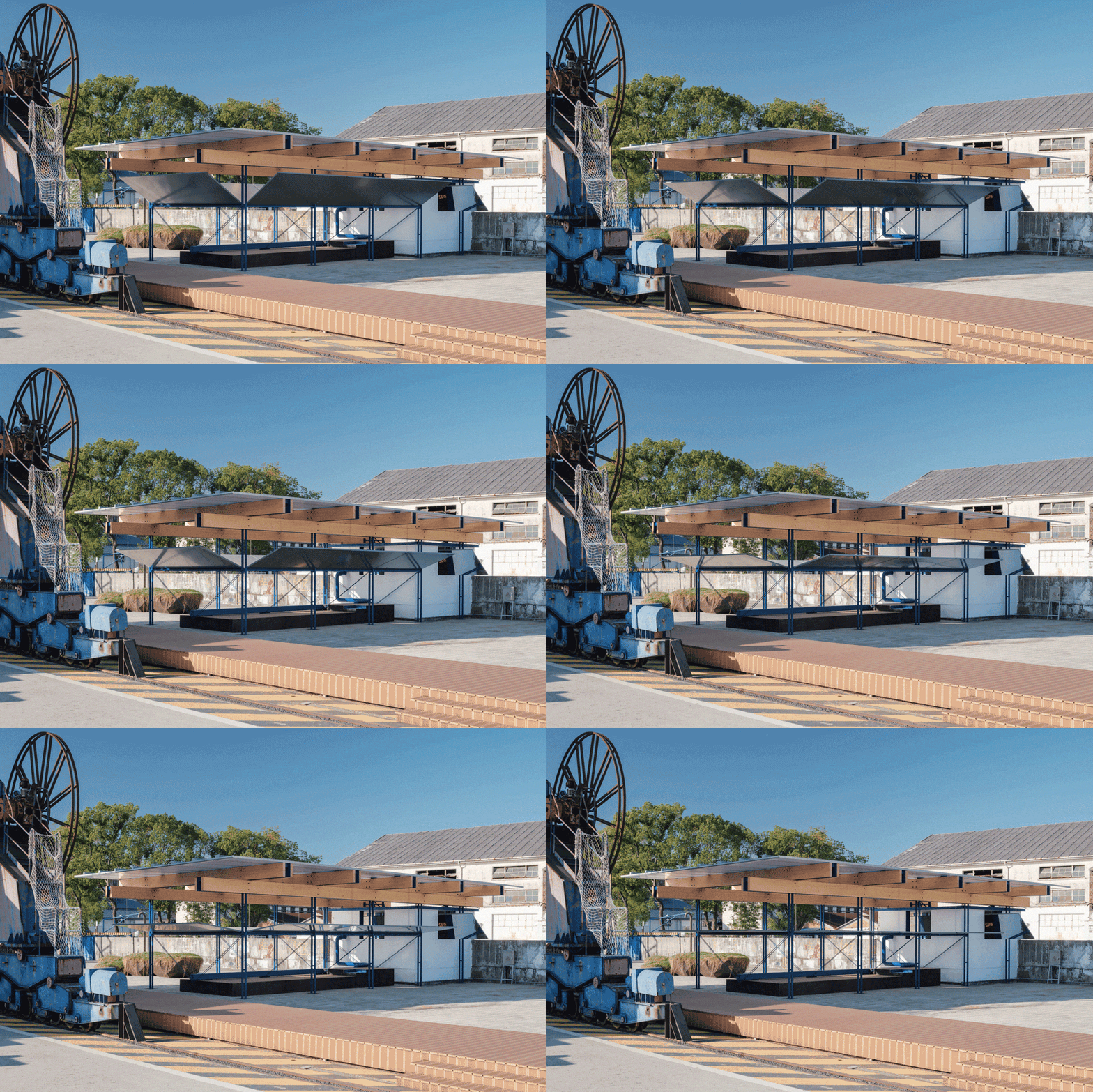
日常状态下,舱板处于斜向上翻状态,整体从外部看如同漂浮的“船舱”,在下方限定出一个较为安定,供人停留休憩的空间,不锈钢面板隐约反射着码上的周遭的日常场景。当机械滑轮系统控制舱板翻转为水平状态时,浮舱变为一个更为开放的架构,水平板作为的功能类似于传统市集建筑的空中置物夹层,可以容纳展陈性物件,亦可容纳绿植而构成绿色空中花园。
In its normal state, the cabin panel is tilted upwards, appearing from the outside like a floating “cabin,” defining a relatively stable space below for rest and relaxation. The stainless steel panels subtly reflect the surrounding everyday scenes on the dock. When the mechanical pulley system controls the deck to tilt to a horizontal position, the floating cabin transforms into a more open structure. The horizontal layers functions similarly to the mezzanine level of the traditional market building, accommodating exhibits or creating a green rooftop garden in the future.
▼供人停留休憩的空间,Space for rest and relaxation©陈颢
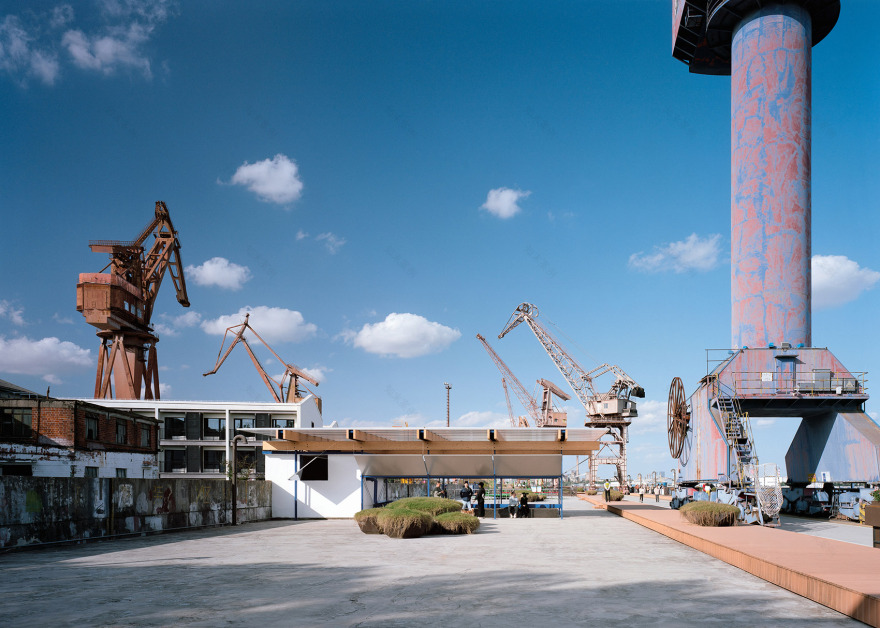

▼浮舱的市集场景,The Floating Cabin market scene ©陈颢


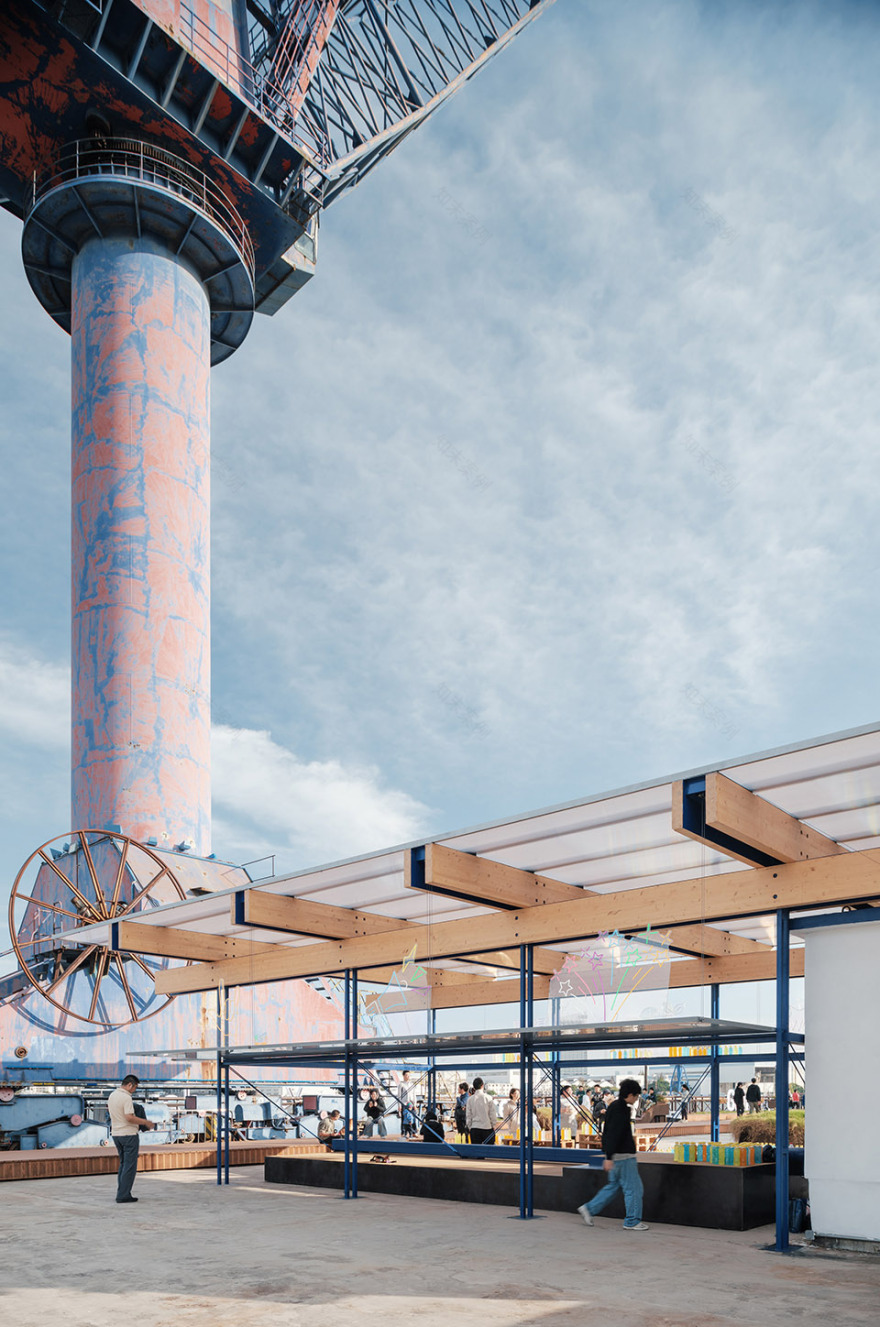
浮舱投入使用后,日常作为市民游客在江边漫步时休憩的空间;亦发生了各种可能性的公共活动,例如弹唱音乐会以及临时市集、快闪展陈等。在浮舱作为“奔跑吧量仔”城市跑步活动的终点站时,舱板转为水平状态后布置了霓虹灯和运动饮料,融合了工业气质的滨江烟火气氛围,为未来事件化轻商业运营提供了可能性的场景。
After its commissioning, the floating cabin serves as a resting space for citizens and tourists strolling along the riverbank; it has also hosted various public events, such as band concerts, temporary markets, and pop-up exhibitions. When the floating cabin served as the finish line for the “Run, Liangzai!” urban running event, the horizontal deck was decorated with neon lights and sports drinks, blending an industrial yet vibrant riverside atmosphere and providing a potential scenario for future event-driven light commercial operations.
▼空间一角,Corner© 刘国威

▼浮舱细部,Details©陈颢

浮舱是一座无明确类型、机器般的架构。这种潜在的可动性,既是对造船厂工业设施的场地特质的捕捉与呈现,也是对变化的城市公共需求的回应。在静止架构所带来的场所知觉之外,浮舱的可动性具备去主动回应当下变化周遭的潜质。当浮舱从舱板斜向的静默悬浮感,慢慢转化为水平向的多层架构感时,它试图在不同事件驱动力的作用下,呈现出变化的物体状态与空间状态,从而迎接当代的不确定性。
The floating cabin is a machine-like structure without a fixed typology. This potential mobility captures and presents the site characteristics of the shipyard’s industrial facilities while also responding to changing urban public needs. Beyond the place perception brought by a static structure, the floating cabin’s mobility possesses the potential to proactively respond to the changing surroundings. As the floating cabin gradually transforms from a sense of silent suspension at an angle to a sense of multi-layered structure at a horizontal level, it attempts to present a changing state of objects and space under the influence of different event-driven forces, thereby embracing contemporary uncertainty.
▼夜览,Nightview©陈旸

▼总平图,Master plan©紋建筑

▼平面图,Ground floor plan©紋建筑

▼南侧立面图,South elevation©紋建筑

▼南侧立面图,South elevation©紋建筑
▼东侧立面图,East elevation©紋建筑

▼南侧剖面图,South section©紋建筑
▼南东侧剖面图,East section©紋建筑

▼细部节点,Detail drawings©紋建筑

项目名称:浮舱
设计方:紋建筑 (Atelier Wen’Arch)
设计团队:沈雯、王伟实、陆泓澎、胡维康(实习)
结构设计:和作结构建筑研究所/ 张准,陈泽赳
结构施工图:同济大学建筑设计研究院(集团)有限公司 /林壮斌、成戎、薛达、姜文辉
施工团队:上海同程建设科技工程有限公司/黄涛、郝言存、任银平、黄运
机械协助顾问:魏源
项目设计:2025
完成年份:2025
项目地址:上海市复兴岛船台公园
建筑面积:144 ㎡
摄影版权:陈颢;刘国威;陈旸/whyseeimage
Project name: Floating Cabin
Design: Atelier Wen’Arch
Team: Shen Wen, Wang Weishi, Lu Hongpeng, Hu Weikang(intern)
Structural Design: AND Office /Zhang Zhun, Chen Zejiu
Structural Construction Drawing:Tongji Architectural Design (Group) Co., Ltd. /Lin Zhuangbin, Cheng Rong, Xue Da, Jiang Wenhui
Construction Team: Shanghai Tongcheng Building Technology & Engineering Co, Ltd. /Huang Tao, Hao Yancong, Ren Yinping, Huang Yun
Mechanical Support Consultant: Wei Yuan
Design year: 2025
Completion Year: 2025
Project location: Fuxing Island Shipyard Park,Shanghai
Gross built area: 144 ㎡
Photo credit: Chen Hao;Liu Guowei;Chen Yang/whyseeimage
Video credit:Liu Guowei;Chen Yang/whyseeimage




南京喵熊网络科技有限公司 苏ICP备18050492号-4知末 © 2018—2020 . All photos and trademark graphics are copyrighted by their owners.增值电信业务经营许可证(ICP)苏B2-20201444 苏公网安备 32011302321234号
苏公网安备 32011302321234号客服
消息
收藏
下载
最近