

创作上传
VIP
收藏下载
登录 | 注册有礼
查看完整案例

收藏

下载

分享

翻译

H R O M A D A
Architecture born from the ground. A community rooted in place
Type: Village Location: Poltava region, Ukraine Status: Concept Year: 2025
Instead of a preface
What is a Ukrainian village? Warm starry nights, the chatter of grandmothers at sunset, the smell of freshly cut grass, and in winter, so much snow that you can’t leave the house.
The Ukrainian village is the cradle of our national identity and cultural memory. This is where folk crafts such as embroidery, weaving, and pottery developed. Here, embroidered towels were hidden from invaders in carved wooden chests from generation to generation — and in them were the destinies of millions of us. Neither historical trials, nor colonial pressure, nor Soviet bans on cultural self-expression could destroy Ukrainians, because the village protected them.
Historically, the Ukrainian village was a center of spirituality and moral values, where faith, work, and symbolic life were woven into everyday life. Rural communities preserved the vernacular, folklore, religious customs, and rituals.
The modern village as a form of self-determination
For many Ukrainians, the village is still a place of strength — it is where their parents and grandparents grew up, where family histories, traditions, and a living connection to the land are preserved.
Ukraine is currently undergoing a transformation of decentralization, in which local communities are given the freedom to shape their own identity, infrastructure, and way of coexisting.
Hromada translates this social idea into a spatial form.
The settlement is designed as an autonomous system where housing, public functions, and landscape form a coherent structure capable of supporting permanent residence, temporary formats, work, and shared daily practices.
Замість передмови
Що таке українське село? Теплі зоряні ночі, гомін бабусі на заході сонця, запах свіжоскошеної трави, а взимку снігу стільки — що не вийти з хати.
Українське село — це колиска нашої національної ідентичності та культурної пам’яті. Тут зростали народні ремесла — вишивка, ткацтво, гончарство. Тут в різьблених дерев’яних скринях із покоління в покоління ховались від загарбників вишивані рушники — а в них долі мільйонів із нас. Ні історичні випробування, ні колоніальні тиск, ні радянські заборони культурного самовираження не змогли знищити українців, бо їх оберігало село.
Історично українське село було осередком духовності і моральних цінностей, де вплітались у повсякденність віра, праця й символічне життя. Сільські громади зберігали народну мову, фольклор, релігійні звичаї та обряди.
Сучасне село як форма самовизначення
Село й досі є для багатьох українців місцем сили — адже саме в селах ростилися батьки і бабусі, саме там зберігаються родинні історії, традиції та живий зв’язок із землею.
Наразі Україна переживає трансформацію децентралізації, у якій локальні громади отримують свободу формувати власну ідентичність, інфраструктуру та спосіб співіснування.
Hromada переводить цю соціальну ідею у просторову форму.
Поселення проєктоване як автономна система, де житло, публічні функції та ландшафт утворюють цілісну структуру, здатну підтримувати постійне проживання, тимчасові формати, роботу та спільні щоденні практики.
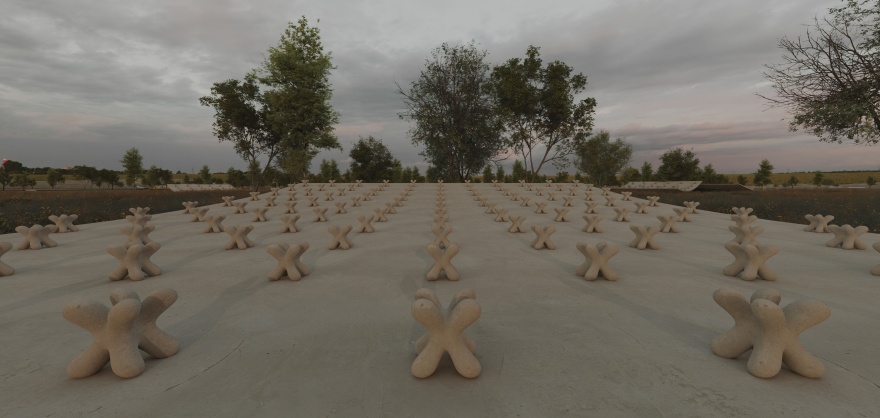
A new spatial model of the Ukrainian village
In this project, we allowed ourselves to indulge in architectural fantasy. Hromada reimagines the archetype of the Ukrainian village as a modern spatial system built on the interaction between land and community. This is a new type of settlement — open, without fences, but deeply private; one in which architecture grows out of the ground and dissolves into it, creating a quiet, sustainable environment for living.
The project is based on the traditional Ukrainian logic of “my yard” and “our common life,” translated into the form of the future. Hromada offers an autonomous village of the 21st century, where space is defined not by a fence, but by the relief, topography, and natural rhythm of the community.
Architecture that begins with the ground
The Poltava landscape — flat, calm, and balanced — forms both the emotional and structural foundation of the project. Here, architecture does not dominate nature; it enters into it.
Buildings are delicately embedded into the terrain, extending its lines and forming a seamless continuity between landscape and built environment. This approach draws on the ancient Ukrainian archetype of the zemlianka — a shelter where the earth provided silence, protection, and a sense of stability.
In a contemporary context, this solution functions as an architectural strategy: – the ground forms natural boundaries for private courtyards; – the soil dampens noise, wind, and heat, creating a soft microclimate; – the relief becomes the primary form - generating element, defining the geometry of the volumes.
As a result, the buildings appear sculpted from the landscape itself: plastic concrete behaves like clay, smooth radii follow the movement of the slopes, and the structures are perceived as part of a natural monolith.
Нова просторовa модель українського села
У цьому проєкті ми дозволили собі архітектурну фантазію. Hromada переосмислює архетип українського села як сучасну просторову систему, збудовану на взаємодії землі та спільності. Це новий тип поселення — відкритий, без огорож, але глибоко приватний; такий, у якому архітектура виростає з ґрунту і розчиняється в ньому, створюючи тихе, стійке середовище для життя.
В основі проєкту — традиційна українська логіка «мій двір» і «наше спільне життя», переведена у форму майбутнього. Hromada пропонує автономне село XXI століття, де простір визначає не паркан, а рельєф, топографія та природний ритм спільноти.
Архітектура, що бере початок з землі
Полтавський ландшафт — рівний, спокійний, врівноважений — формує емоційну й конструктивну основу проєкту. Тут архітектура не домінує над природою; вона входить у неї.
Будинки делікатно занурені в рельєф, продовжуючи його лінії й утворюючи цілісність ландшафту та побудованого середовища. Цей прийом спирається на давній український архетип землянки — прихистку, у якому земля дарує людині тишу, захист і відчуття стійкості.
У сучасному контексті це рішення працює як архітектурна стратегія:
- земля утворює природні межі приватних дворів;
- ґрунт гасить шум, вітер і спеку, задаючи м’який мікроклімат;
- рельєф стає головним формотворчим елементом, визначаючи геометрію об’єму.
У результаті будівлі здаються виліпленими з ландшафту: пластичний бетон поводиться як глина, плавні радіуси повторюють рух схилів, а конструкції сприймаються як частина природного моноліту.

The heart of Hromada
At the centre of Hromada is the main building — a shared space toward which the daily routes of residents naturally converge. It is the quiet core of the settlement, a place of presence and encounter where a sense of community gradually takes shape.
Here, the main public functions are concentrated — spaces for gatherings, rest, and everyday communication. The central building is conceived as an open and accessible structure, a contemporary interpretation of a village square or town hall — a place that sustains internal connections and sets the rhythm of communal life.
Серце Hromada
У центрі Hromada розташована головна будівля — спільний простір, до якого природно сходяться щоденні маршрути мешканців. Це тихе ядро поселення, місце зустрічі й присутності, де поступово формується відчуття спільності.
Тут зосереджені основні громадські функції — простір для зібрань, відпочинку та повсякденного спілкування. Центральна будівля задумана як відкрита й доступна структура, сучасна інтерпретація сільської площі або ратуші — місця, що підтримує зв’язки всередині громади й задає ритм спільному життю.


A space without fences
Each residential building has its own courtyard, shaped by the terrain itself — similar to a traditional village, where the ground naturally defined the boundaries between households. The slopes delicately outline the courtyard space, creating privacy without fences while maintaining the openness of the environment.
This understanding of the ground as a boundary and support formed the basis of the project’s material language. Concrete, soil, and living vegetation interact with each other, and the architectural lines gently repeat the natural terrain, forming a coherent spatial structure of the village.
Silence and presence
Hromada offers a range of living options — from spacious houses to compact formats.
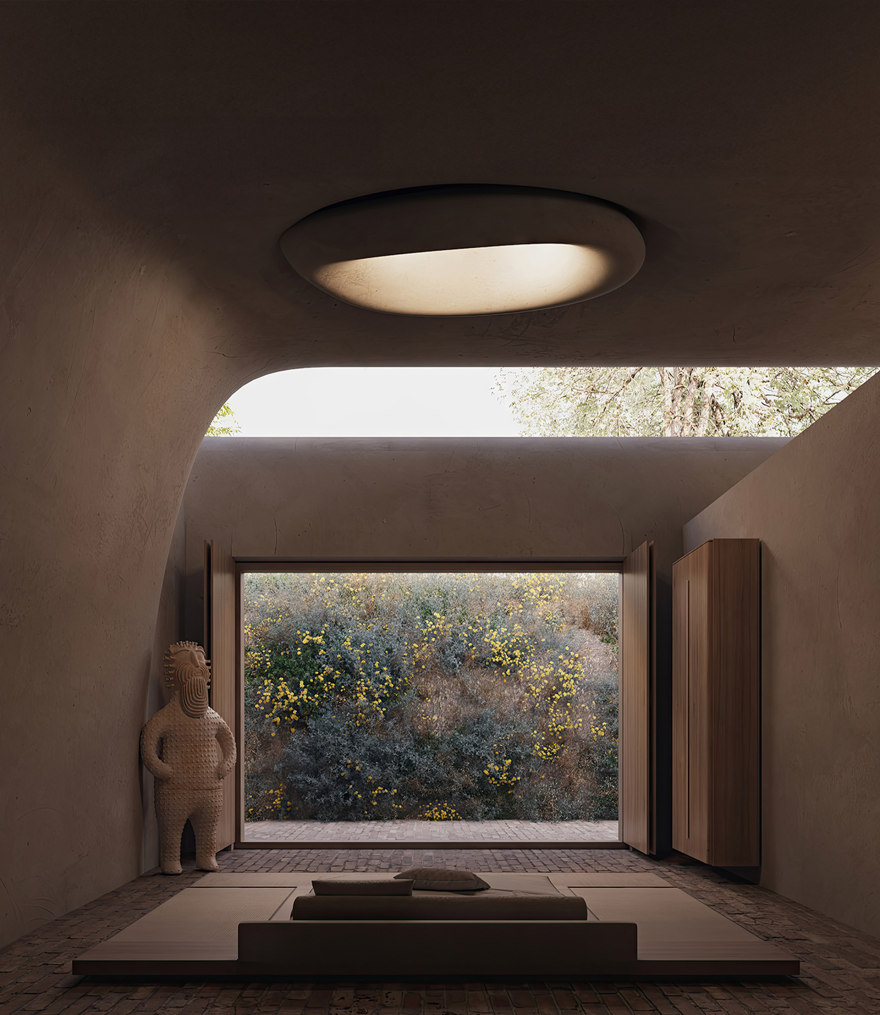
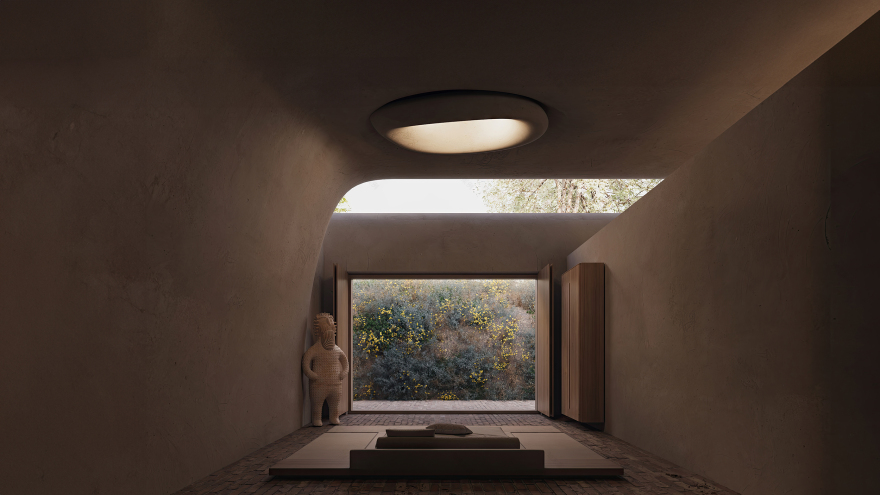
Each house has its own intimate space, designed for silence and solitude. The bedroom windows overlook a green slope densely planted with vegetation. A living “green curtain” that changes with the seasons creates a feeling of natural protection, and the landscape outside the window constantly changes with the rhythm of nature, never remaining the same.
Next to the private area is a shared living space. Here you will find a living room, a work area, and an open space with access to the terrace. The relief, open sky, and surrounding vegetation create a calm atmosphere of closeness and living presence.
Простір без парканів
Кожен житловий будинок має власний двір, сформований самим рельєфом — подібно до традиційного села, де земля природно визначала межі між господарствами. Схили делікатно окреслюють простір подвір’я, створюючи приватність без огорож і водночас зберігаючи відкритість середовища.
Це розуміння землі як межі й опори лягло в основу матеріальної мови проєкту. Бетон, ґрунт і жива рослинність взаємодіють між собою, а архітектурні лінії м’яко повторюють природний рельєф, формуючи цілісну просторову структуру села.
Тиша та присутність
У Hromada передбачені різні масштаби життя — від просторих будинків до компактних форматів.
Кожен будинок має власний камерний простір, орієнтований на тишу й усамітнення. Вікна спалень виходять на зелений схил, густо засаджений рослинами. Жива «зелена завіса», що змінюється з порою року, формує відчуття природної захищеності, а краєвид за вікном постійно змінюється разом із ритмом природи, ніколи не залишаючись однаковим.
Поруч із приватною частиною формується простір спільного життя. Тут розташовані вітальня, робоча зона та відкритий простір з виходом на терасу. Рельєф, відкрите небо й рослинність навколо задають спокійну атмосферу близькості та живої присутності.
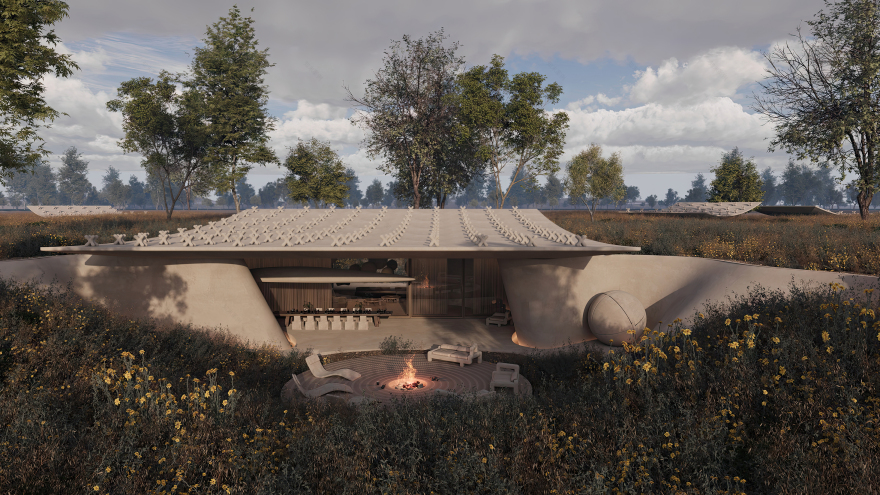


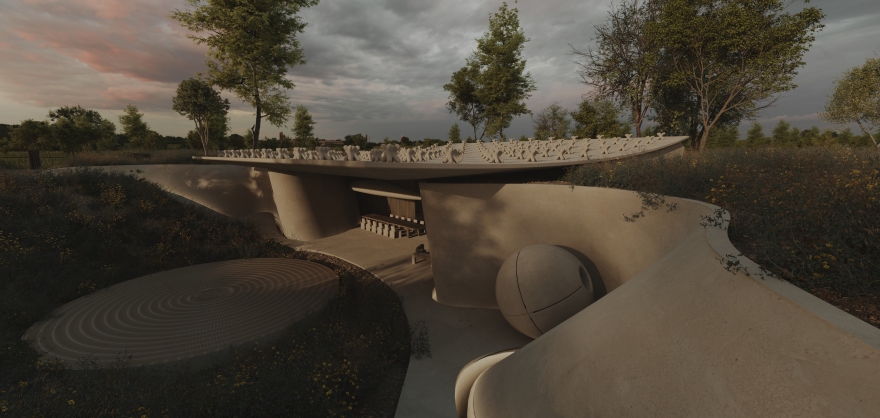
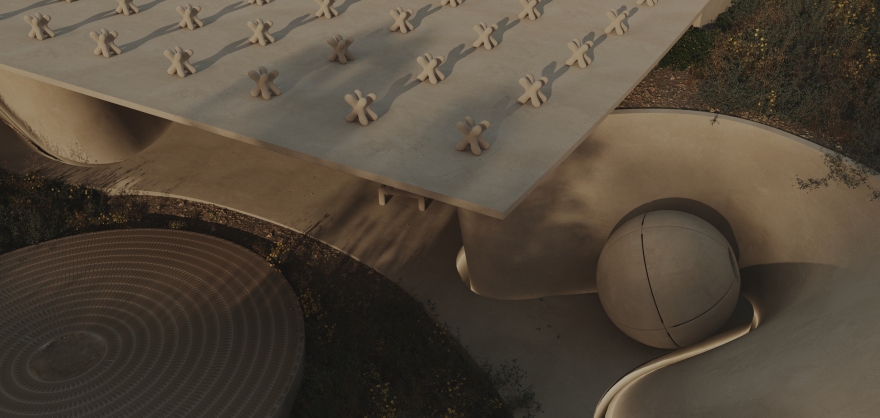




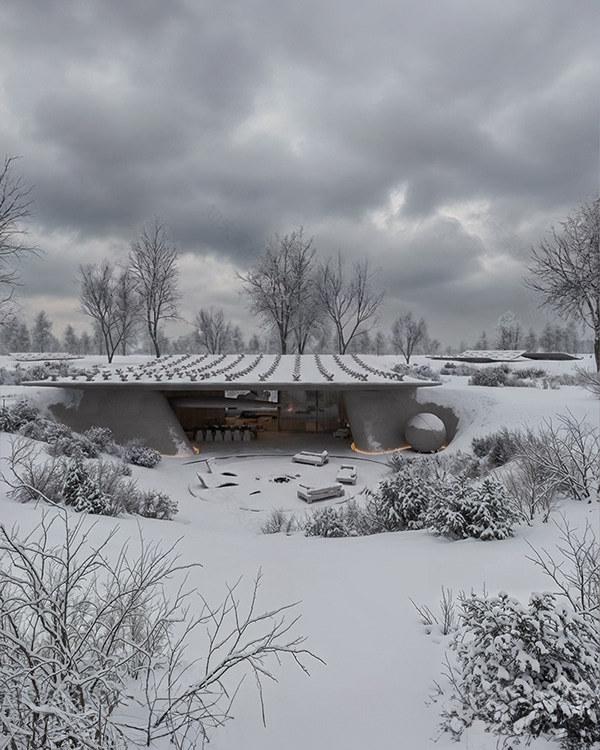
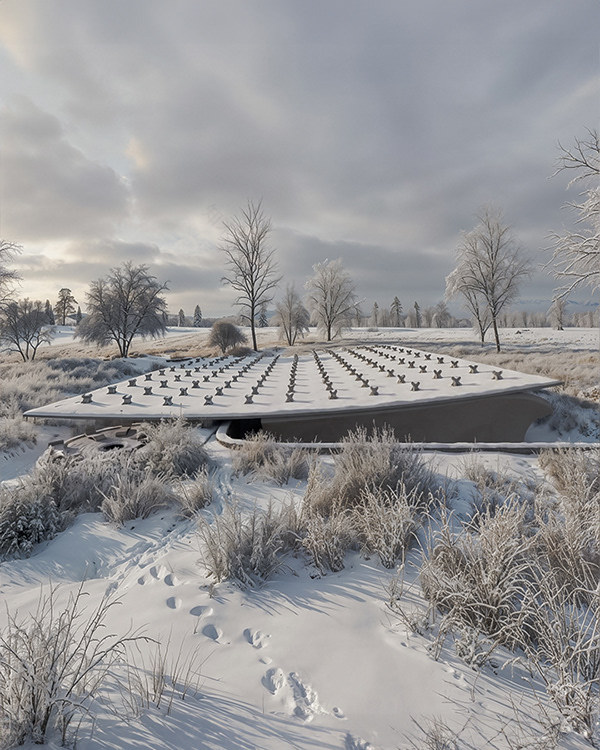
Only the sky above Roofs become another level of village life. Their smooth forms serve as a space for art, hosting a field of Quadropod sculptures (winner of the Red Dot Design Award), which organically grows out of the architecture and reinforces the sense of shared space.
This upper level functions simultaneously as an art park, a public terrace, and a communal square. The Quadropod field becomes a metaphor for the community itself: many small elements that together form a unified system — and in this lies its strength.
Вище тільки небо Дахи стають ще одним рівнем життя села. Їх плавна форма слугує простором для мистецтва — тут розміщене поле скульптур Quadropod (переможець Red Dot Design Awards), яке органічно виростає з архітектури та підсилює відчуття спільного простору.

Цей верхній рівень працює одночасно і як: арт-парк, і публічна тераса, і спільна площа. Quadropod-поле стає метафорою самої громади: багато малих елементів, що разом утворюють єдину систему, і в цьому — її сила.


Author’s note
"I have always been inspired by Ukrainian villages — places where I felt a balance between my own space and shared space. My own yard, the quiet of my home, the opportunity to be alone — and at the same time, openness to neighbors, to conversation, to shared life. In the Hromada project, I wanted to bring back that feeling: that architecture should not separate people, but also not take away their privacy," says Serhii Makhno.
THANKS FOR WATCHINGinstagram|facebook|website
南京喵熊网络科技有限公司 苏ICP备18050492号-4知末 © 2018—2020 . All photos and trademark graphics are copyrighted by their owners.增值电信业务经营许可证(ICP)苏B2-20201444 苏公网安备 32011302321234号
苏公网安备 32011302321234号客服
消息
收藏
下载
最近