

创作上传
VIP
收藏下载
登录 | 注册有礼
查看完整案例

收藏

下载

分享

翻译
Architects:317designstudio
Area:87m²
Year:2025
Photographs:YuChen Chao Photography
Engineering:Xing-Yi Design & Construction Co., Ltd.
Electrical Engineering:Di-Sheng Plumbing & Electrical Engineering
Lighting Engineering:Yu-Chin Lighting Co., Ltd.
Category:Educational Architecture,Educational Interiors
Lead Team:Po Chang Lin,Tsai Yun Kao
Design Team:Kai Hung Yang, Shin Cheng Lai
City:自強里
Country:Taiwan

Text description provided by the architects. An interior space conceived as a forest clearing, centered on the shared ritual of gathering around a campfire. Located in Xizhi District, New Taipei City—an area characterized by frequent rainfall—Qingshan Elementary and Junior High School has long been dedicated to the development of Scouting education. The school envisioned a dedicated Scout classroom that could integrate teaching, hands-on training, and group activities while responding to the limitations of conventional indoor spaces.


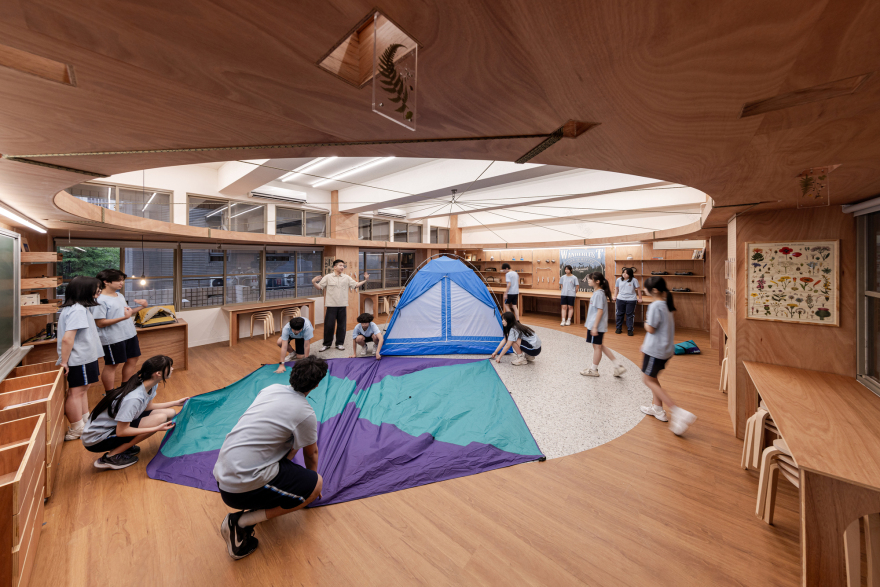
Due to the local climate, outdoor Scouting activities such as survival training, tent pitching, and team-building exercises are often forced indoors. However, existing classrooms were constrained by limited space, insufficient storage, and rigid furniture layouts, making it difficult to support the experiential and action-based learning central to Scouting education.


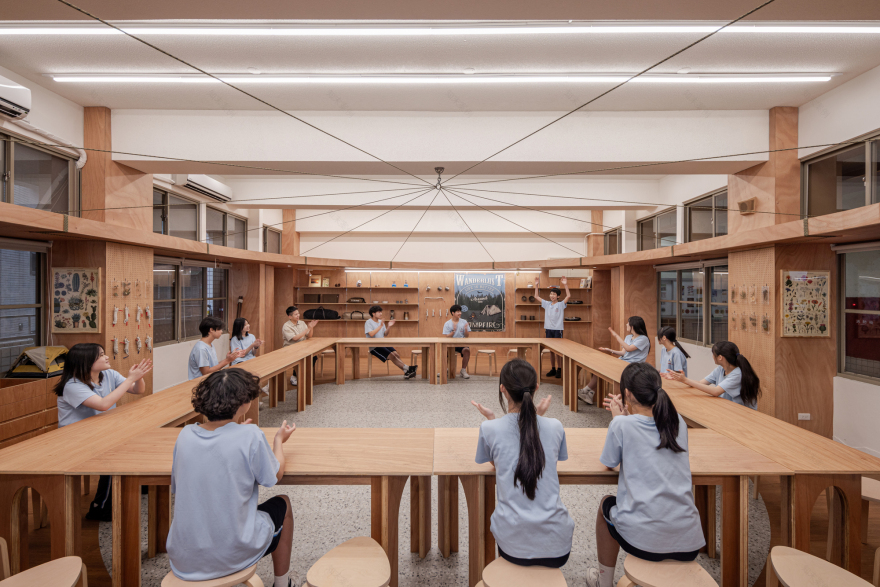
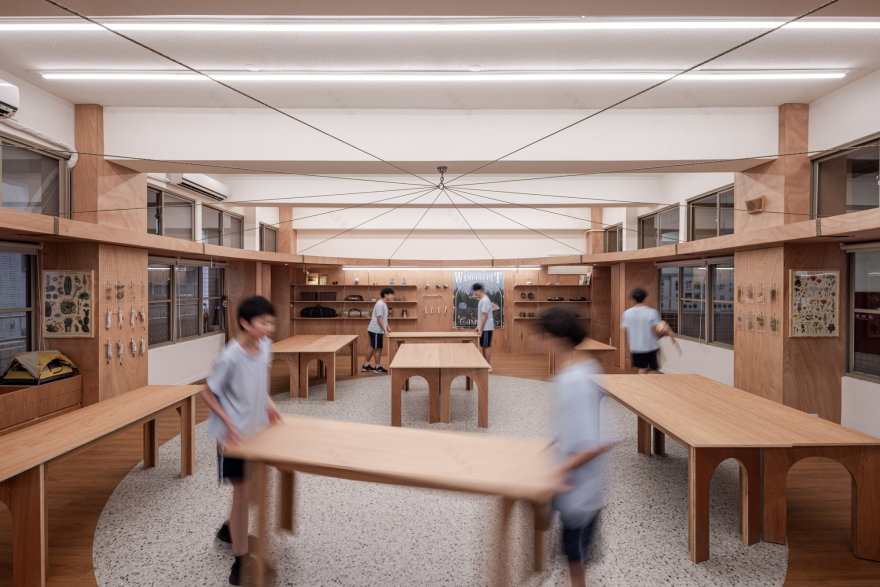
Under the concept of "Qingshan Forest," the project redefines the Scout classroom as an immersive exploration base rather than a traditional learning environment. The spatial organization is structured around a shared central zone inspired by the collective experience of gathering around a campfire within a forest. This center-oriented layout encourages interaction, communication, and group presence, shifting the focus from one-directional instruction to collective participation.


A continuous rope system is woven through the wooden ceiling structure, forming a symbolic tent that frames the central gathering area. Acting as both a spatial organizer and a cultural reference, the rope installation translates Scouting skills into architectural expression while embodying values of unity and inclusiveness. Surrounding spatial elements are arranged like trees around a clearing, defining the perimeter while maintaining visual openness toward the center.

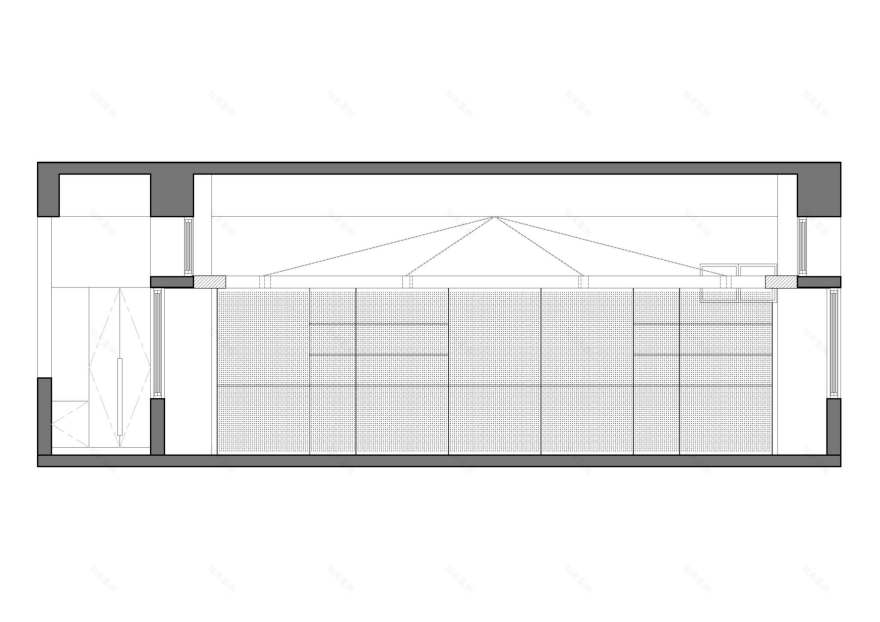
Nature is further introduced through walls and ceilings embedded with acrylic plant specimens handcrafted by students. These elements create an abstract forest layer within the interior, reinforcing the connection to the outdoors while emphasizing student involvement in shaping the space.


More than a teaching space, Aoyama Forest functions as a multifunctional base supporting Scout practices, group activities, club operations, and inter-school exchanges. By translating the ritual of a campfire gathering within a forest into an interior spatial experience, the project allows Scouting values to be learned not only through instruction but through space itself.

Project gallery






南京喵熊网络科技有限公司 苏ICP备18050492号-4知末 © 2018—2020 . All photos and trademark graphics are copyrighted by their owners.增值电信业务经营许可证(ICP)苏B2-20201444 苏公网安备 32011302321234号
苏公网安备 32011302321234号客服
消息
收藏
下载
最近