

创作上传
VIP
收藏下载
登录 | 注册有礼
查看完整案例

收藏

下载

分享
神仙居的山水,像是从李白诗行间漫出的,诗人梦游天姥,见“云霞明灭”“渌水荡漾”。几百年来,朝雾为笔,暮云为墨,在仙景村的粉墙与石径上,静静晕染出一种温润的日常——老人在柿子树下闲话,孩童在檐下追逐。这些细碎的光景,构成了江南村落最柔软的肌理。
The scenery of Shenxianju seems to have emerged from Li Bai’s poetry. For hundreds of years, with the morning mist as the brush and the evening clouds as the ink, in the white walls and stone paths of Xianjing Village, a gentle and serene daily scene has been quietly painted. The elderly were chatting under the persimmon tree, while children were chasing each other under the eaves. These small scenes together formed the most tender texture of the Jiangnan village.
▼场地鸟瞰,Aerial-view of the site ©梁山

▼场地周边环境,Site surrounding environment ©梁山
第一次走入这里时,便被这种日常的浪漫深深打动,那是生活本身在光阴中自然生长的姿态。我们渴望的,是用建筑轻轻托住这份细碎的浪漫,让新的故事依然能从旧的瓦檐下,安静地生长出来。
The first time we entered here, we were deeply moved by the quiet romance of these daily rhythms. It was the natural growth of life over time. What we aspire to is to design spaces that belong to this place—spaces where new stories can continue to grow, within the fabric of the ancient village.
▼项目概览,Overview of the project ©梁山

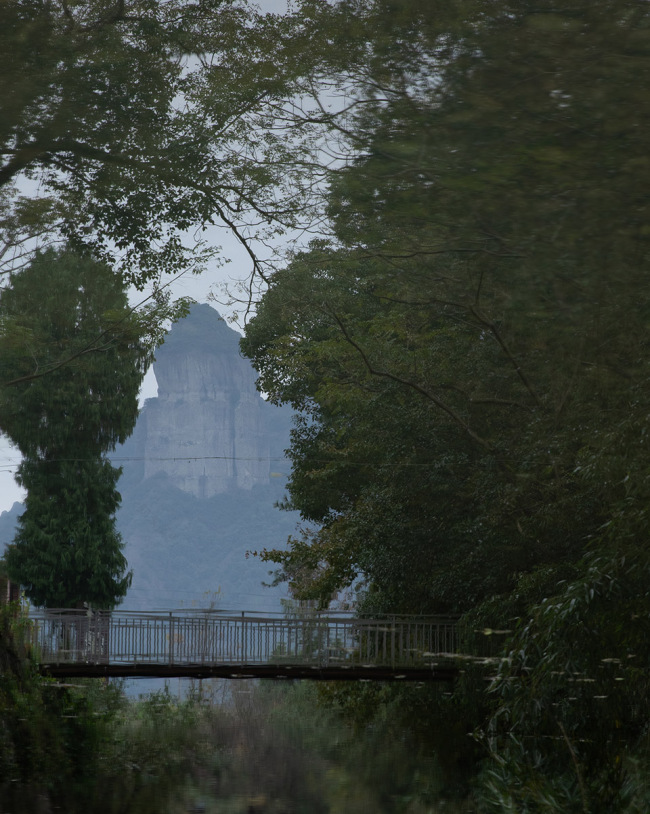
本项目位于浙江仙居县白塔镇仙景村,为改建项目。仙景村,毗邻神仙居旅游风景区北门,风景优美,有着“神仙居脚下第一村”美誉,村内可直接远眺西南方向的饭甑岩。从神仙居山上流淌下来的小溪,从村前穿过,将村落与通往景区的白西线分隔开,维持着村庄的宁静。所有村居顺应着溪水,沿东南向而建,村口的小学和祠堂是村里唯一面向饭甑岩方向的建筑物。▼场地原始状况,Original site ©虚度建筑事务所

The project is a renovation project which located in Xianjing Village, Baita Town, Xianju County, Zhejiang Province. Xianjing Village, adjacent to the North Gate of the Shenxianju Scenic Area, is renowned as “the First Village of Shenxianju” for its beautiful scenery. From the village, one can directly overlook the Fanzeng Peak in the southwest. The small stream flowing down from the Shenxianju mountains passes in front of the village, separating it from the Baixi Road leading to the scenic area and maintaining the village’s tranquility. All of the houses in village are built along the stream facing southeast. The abandoned primary school and ancestral hall next to the school are the only two buildings in the village face toward the Fanzeng Peak.
▼立面东北角,The northeast corner of facade ©梁山
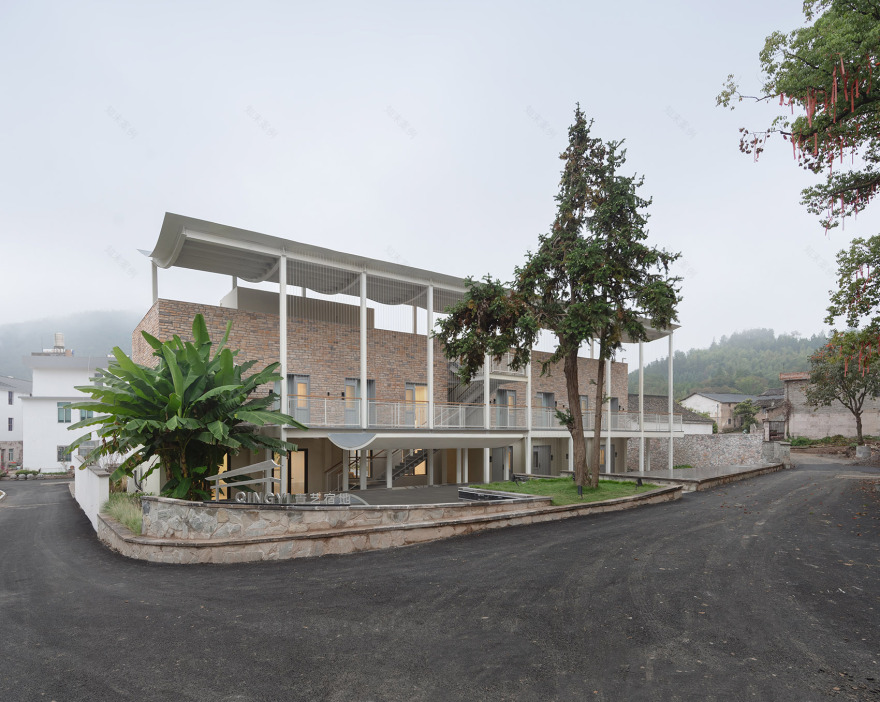
依托着神仙居山脉优美的自然景观,镇政府希望将仙景村整体打造为写生艺术村,政府委托我们对村里的小学进行改建,希望可以吸引青年和艺术家到村里住宿、写生、交流,取名为“青艺宿地”。
Relying on the beautiful natural scenery of the Shenxianju mountains, the town government hopes to transform Xianjing Village into a sketching art village. They entrusted us to renovate the abandoned primary school, hoping to attract young art students and artists to come to the village, stay and do some sketching nearby. The Youth Artist’s Dormitory is named as “Qingyi Lodge”.
▼从接街道看项目,View of from the street ©梁山
村里小学的建筑主体原为上世纪七、八十年代建的砖混结构二层小楼,开间九间,中间一间为楼梯,东西各四间为教室,形制简单,南面敞廊,北面为教室。建筑二层楼板为混凝土预制板,屋顶木结构主体已有坍塌,虽然建筑整体质量粗陋,并不具有老建筑美感和历史建筑保留的价值,但是作为村里唯一的小学,还是承载了一代村民的记忆,我们还是希望可以在保留建筑的整体形制不变的基础上,结合新的功能,赋予老房新生。
The main building of the village primary school was originally a two-story brick-concrete structure constructed in the 1970s-1980s. It had nine rooms, and the one in the middle used to be a staircase. There were four classrooms on each side and an open corridor on the south. The second-floor of the building was made of shoddy concrete prefabricated boards, and the wooden roof had partially collapsed. Although the building was shabby, cheesy and was not worth preserving, as the only school in the village, it still carries the memories of a generation of villagers. We hope to retain the form of the old school, but bring new life to it.
▼从古树平台看项目,View of from the ancient tree platform ©梁山

作为一个面向青年艺术家的民宿和写生基地,需要充分挖掘项目独特的景观优势,如何处理好建筑和饭甑岩的借景关系是我们首要考虑的。
As a dormitory serving young students and artists, it is essential to maximize the potential of the site’s inherent scenic qualities. Our primary consideration is how to get the best view of the Fanzeng Peak from the building.
▼入口,Entrance ©梁山

我们计划拆除破损的木结构坡屋顶,在屋顶面向饭甑岩方向设置景观露台。将原有的教室部分改为单开间的住宿单元,保留原来的窗间墙作为砖混结构支撑,将教室原来的门、窗、连同窗下墙替换为整体可打开的落地推拉们,与南面的敞廊连接,作为每个房间面向饭甑岩的写生外阳台,在原有建筑的北面用钢结构新建北廊作为入户走廊。
We plan to remove the damaged wooden roof and design a viewing terrace on the roof facing the Fanzeng Peak. We transform the original classrooms into dormitory units, retaining the original walls between windows as replacing the old doors and windows with floor-to-ceiling sliding doors. A new corridor made of steel structure is built on the north side of the building as the entrance to dormitory units, while the original corridor on the south is transformed into a balcony for rest and sketching.
▼庭院与阳台,Courtyard & balcony ©梁山

写生阳台大半面宽面向饭甑岩开敞,形成以大自然真山水为背景的天然框景,剩余面宽为写生区,增加了片墙合理控制光线,也增强私密性,同时通过天窗提供更为稳定的全天候光线。在一层则拓展了每户一个写生庭院。
▼阳台形体生产分析图,Generative diagram of balcony ©虚度建筑事务所

The sketching balconies are open towards the Fanzeng Peak. Through the openings on façade, artists can see the beautiful scenery of nature. The left part of the balcony is designed as the sketching area, with partial walls which can prevent direct sunlight and also enhance privacy. We design skylights above the sketching area to provide more stable all-weather light. On the ground floor, each unit has a private courtyard for sketching.
▼天窗下的写生区,Sketching area under skylight ©梁山

青艺宿地作为给青年艺术家、学生的写生、交流基地,除了提供方便写生的住宿单元之外,还希望可以有丰富的空间,促进彼此交流讨论和学习。而原小学建筑是砖混结构,层高和开间都受到了很大的限制,我们设计在原有的建筑体量东南侧加入一个小型多功能交流厅,和原村民之家(本项目建成过程中,村民之家已改为仙景村村咖和餐厅运营)的多功能厅形成联动,可供师生进行写生交流和书画联展。
▼多功能厅生成分析图,Generative diagram of hall ©虚度建筑事务所
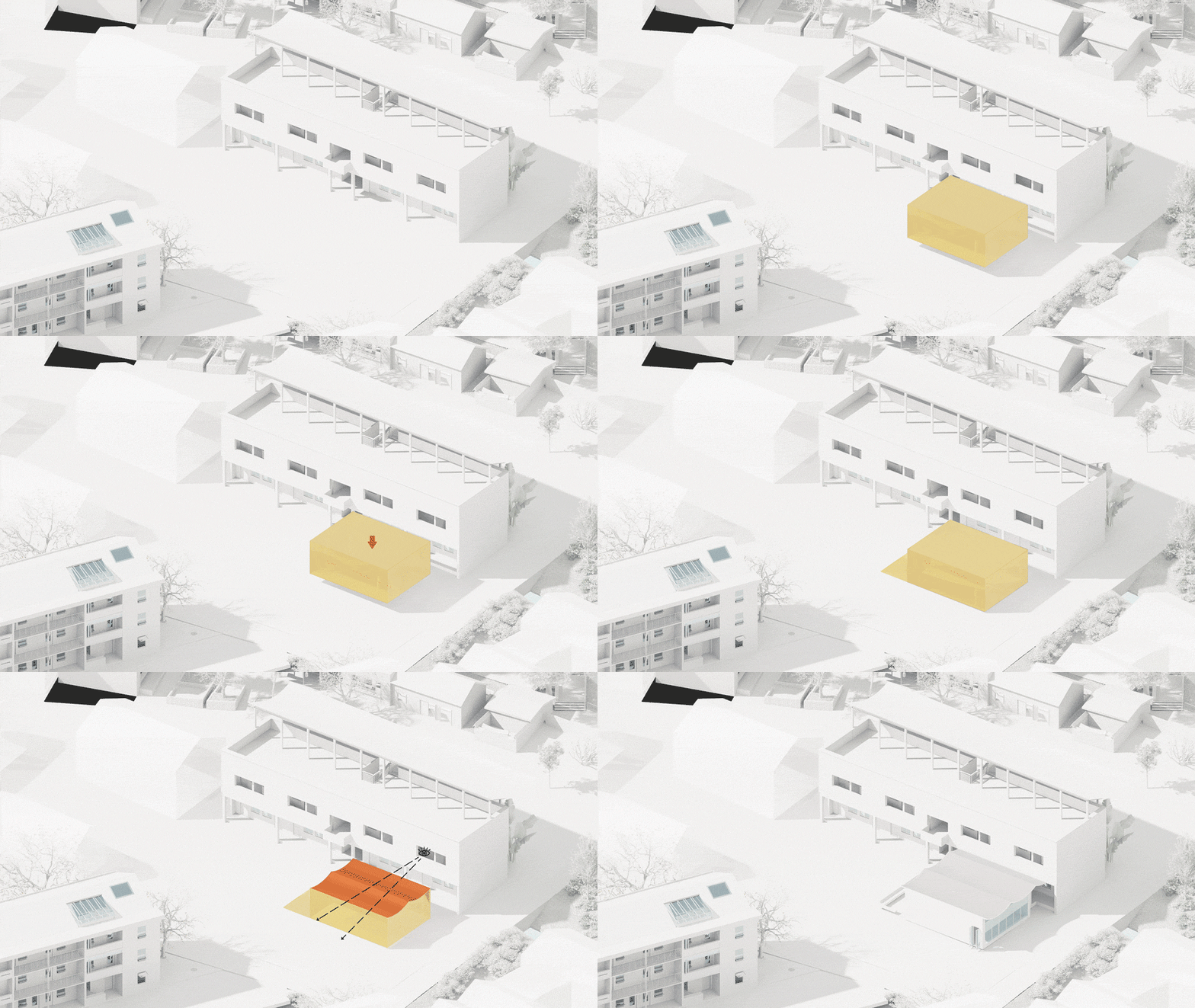
As a place for sketching and communicating for young students and artists, Qingyi Lodge not only provides convenient accommodation units for outdoor painting but also offers diverse spaces that artists can communicate, discuss and learning with each other. However, the original primary school building was a brick-concrete structure with significant constraints in both floor height and width. We have designed a small multi-functional hall on the southeast side of the original structure, which will be linked with the multi-functional room of “the Villagers’ Home” (Another public building in Xianjing village. During the construction of this project, the villages’ home was transformed into a café and restaurant). This new hall provides a place for teachers and students to communicate with each other and hold small informal exhibitions.
▼多功能厅外观,Exterior of multi-functional hall ©梁山
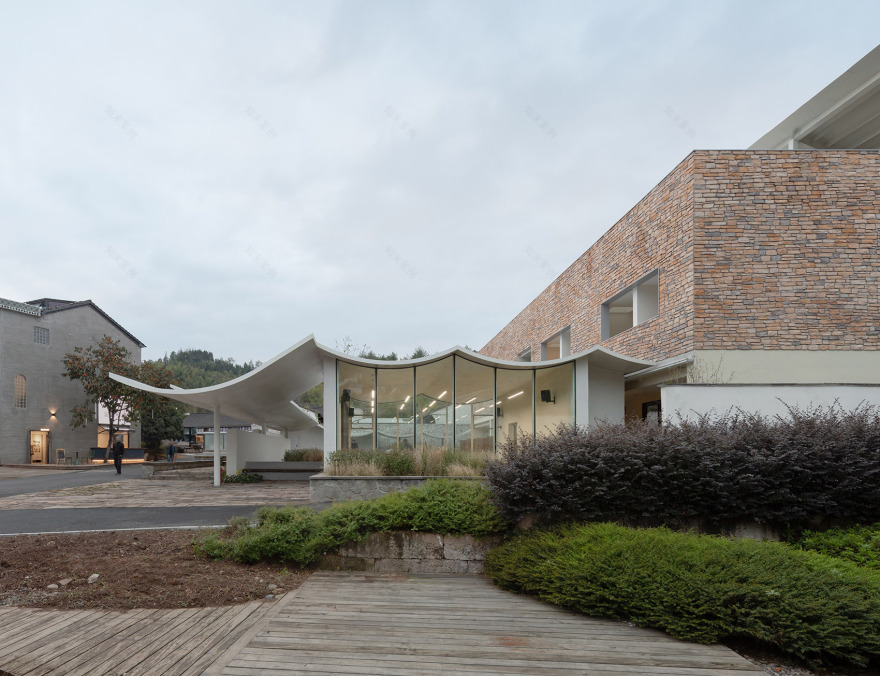
▼室内空间,Interior of multi-functional hall ©梁山

顺应场地原有的高差,多功能厅和室外的交流庭院标高比住宿区低半米,从门厅进入需向下走三级台阶,空间上和入口接待空间形成区隔。下沉的标高和起伏的坡屋顶,减小了多功能厅的体量,既获得了相对开敞的内部空间,又不会遮挡二层住宿单元望向饭甑岩方向的景观视野。
Following the site’s original altitude, the multi-functional hall with its outdoor communication courtyard is half a meter lower than the accommodation area and the lobby. To enter the multi-function hall from the lobby, we need to walk down three steps. The varied functional spaces, arranged on different levels, collectively generate a continuous flow of spaces. The composition of a sunken level and a floating pitched roof minimizes the building’s perceived scale. This strategy ensures an open, spacious interior without compromising the scenic views of the Fanzeng Rock from the second floor.
▼室外交流庭院,Outdoor communication courtyard ©梁山

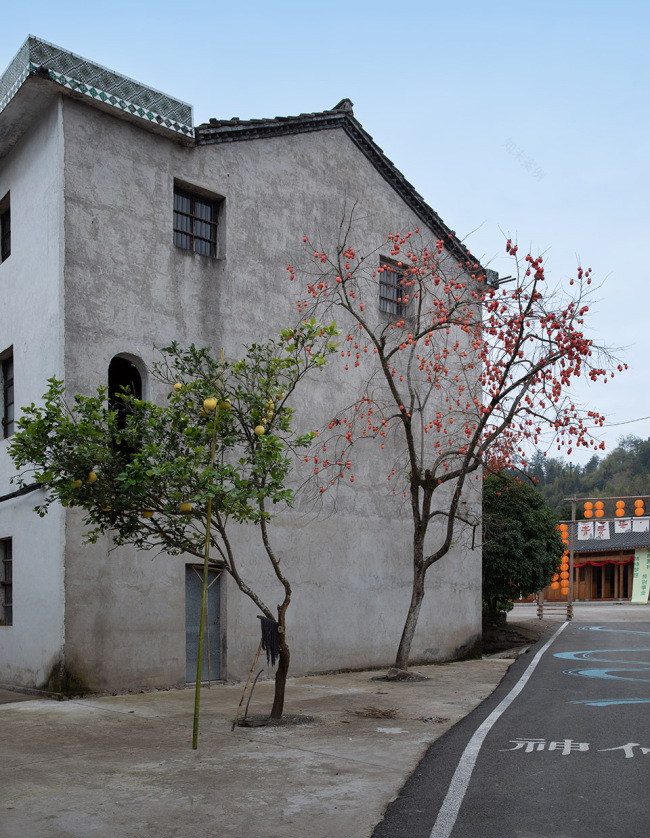
原学校南面是一个不大的操场,以一圈围墙和村路隔开,隔着村路是村居错落的水泥山墙面,山墙前种着两棵树,一棵是柿子树,另一棵是柚子树。到了橙红橘绿的时候,灰色斑驳的山墙前映着火红的柿子和圆鼓鼓的柚子,远处是云雾缭绕的饭甑岩,仿若是走进吴冠中的画中。
There was a small playground at the south of the old school, separated from the village road by a perimeter wall. Across the village road lies a visual composition formed by the gable walls of the villagers’ houses. There are two trees in front of the gable wall, one is a persimmon tree, the other is a pomelo tree. In autumn, against the backdrop of gray, mottled gable walls, persimmons turned red and pomelos ripened, with the mist-shrouded Fanzeng Peak in the distance, evoking the poetic imagery of a painting by Wu Guanzhong.
▼山墙前种着两棵树,Two trees in front of the gable wall ©梁山
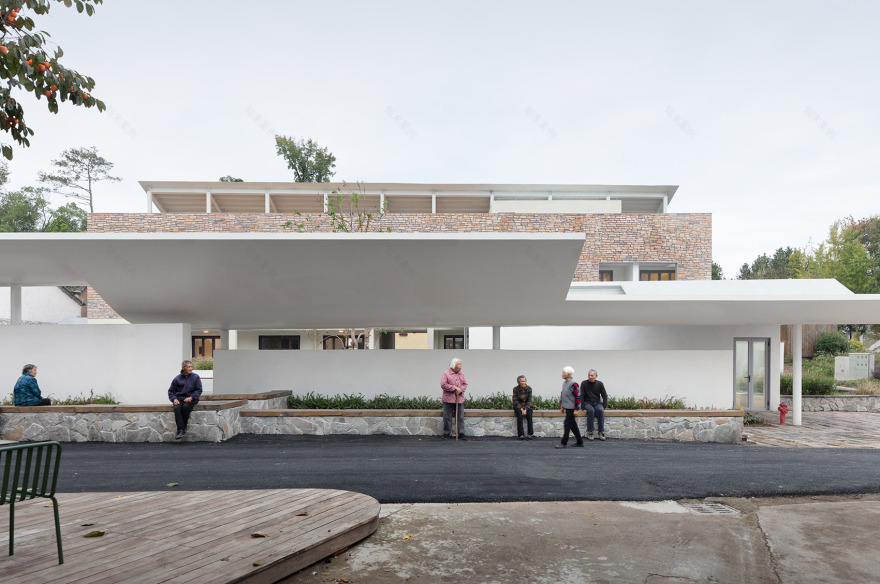
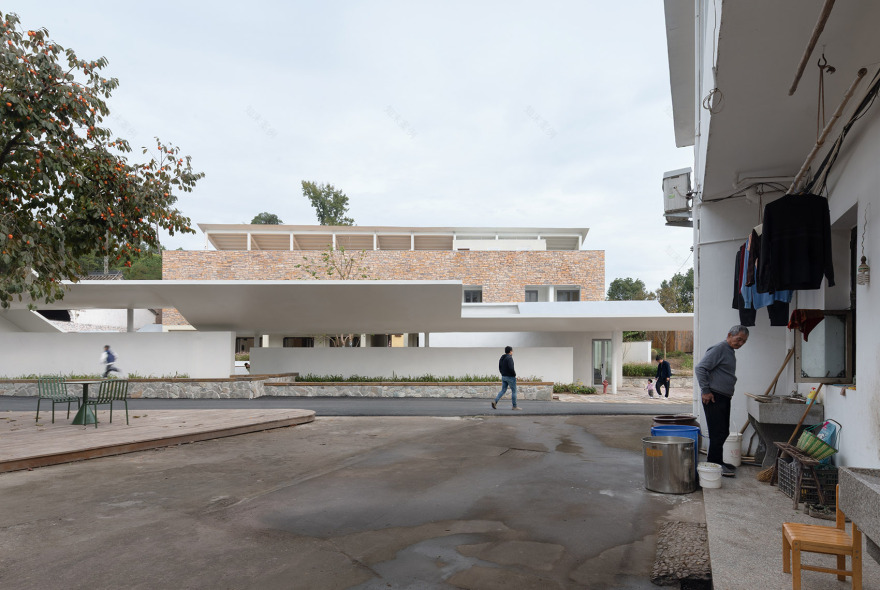
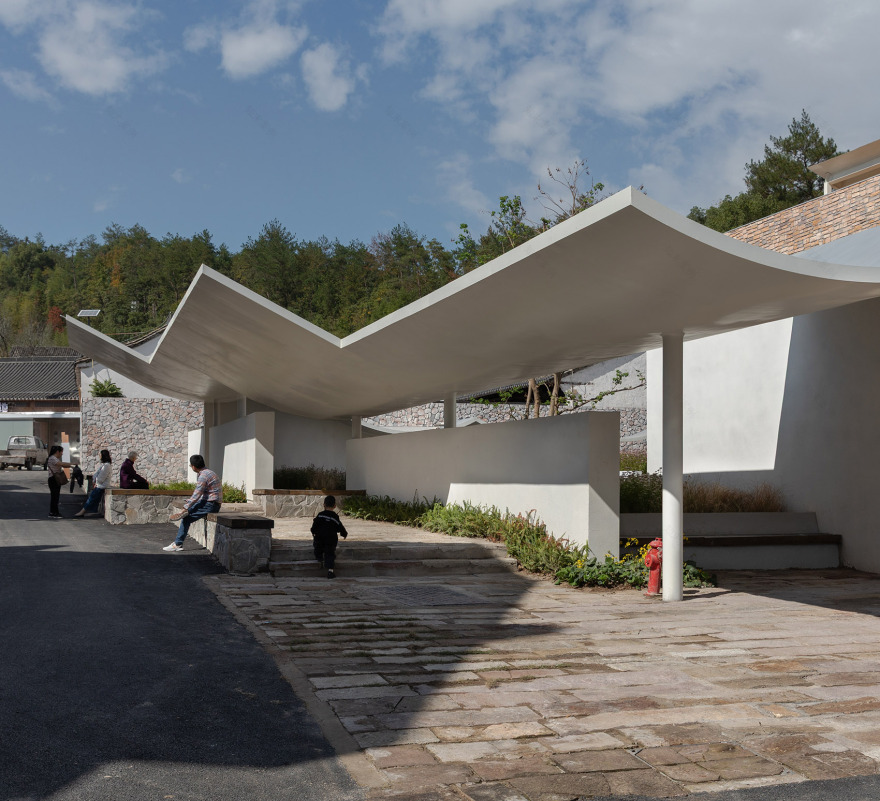
我们在原有的操场围墙上,轻轻地放置上一片片金属屋顶,屋顶微微弯曲,以一种类似村居的形制介入画面的底部,遮盖了村民随意晾晒在家门口的衣物、杂物,起翘的屋顶又适当地露出柿子树前公共活动区的活动。绵延的银灰色屋顶在雨天像起伏的溪水,朦胧地反射着火红的柿子树、斑驳的墙、远处的山岩,扩大了入画的风景。我们采用了钢结构板桁架技术,希望这弯曲屋顶的质地是金属的,是轻薄的,是在熟悉的地方漂浮着的一种陌生感。
▼廊桥草图,Sketch ©虚度建筑事务所

Along the perimeter wall, we gently place a series of metal roofs, which are slightly curved, resembling the shape of villagers’ houses. The curved roofs screen the dried laundries and sundries at the villagers’ doorsteps, while strategically framing the activities under the persimmon tree. Stretching like a meandering stream on a rainy day, the silvery-grey roofs reflect the fiery persimmons, mottled gable walls, and distant mountain ranges, expanding the picturesque scenery. We adopt steel plate-truss technology, 120mm thick curved roofs achieving a metallic, thin, and lightweight texture are designed to defamiliarize the familiar locale.
▼弯曲的屋顶,The curved roofs ©梁山
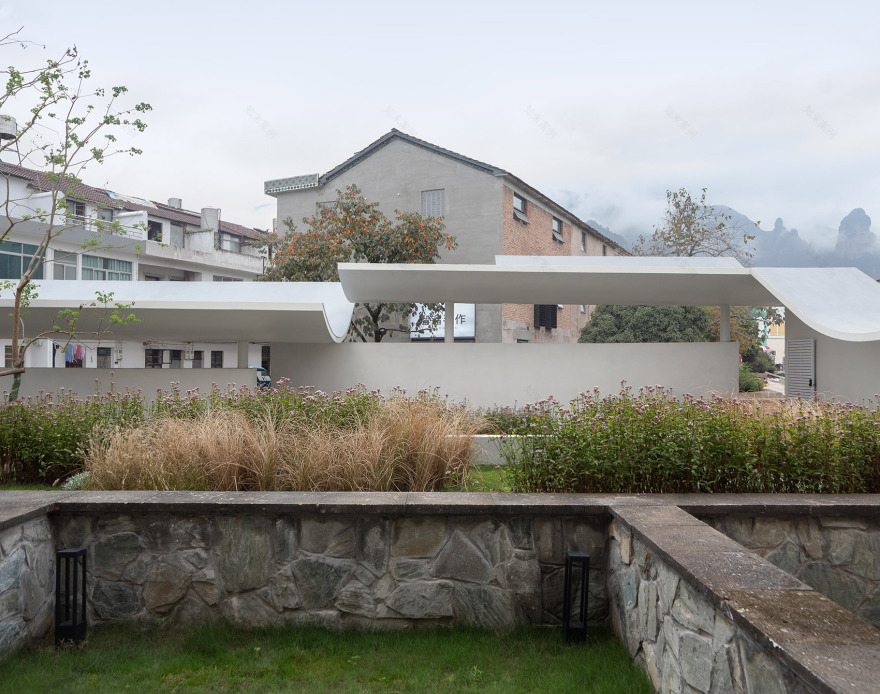
▼柿子树与公共活动区,The activities under the persimmon tree ©梁山

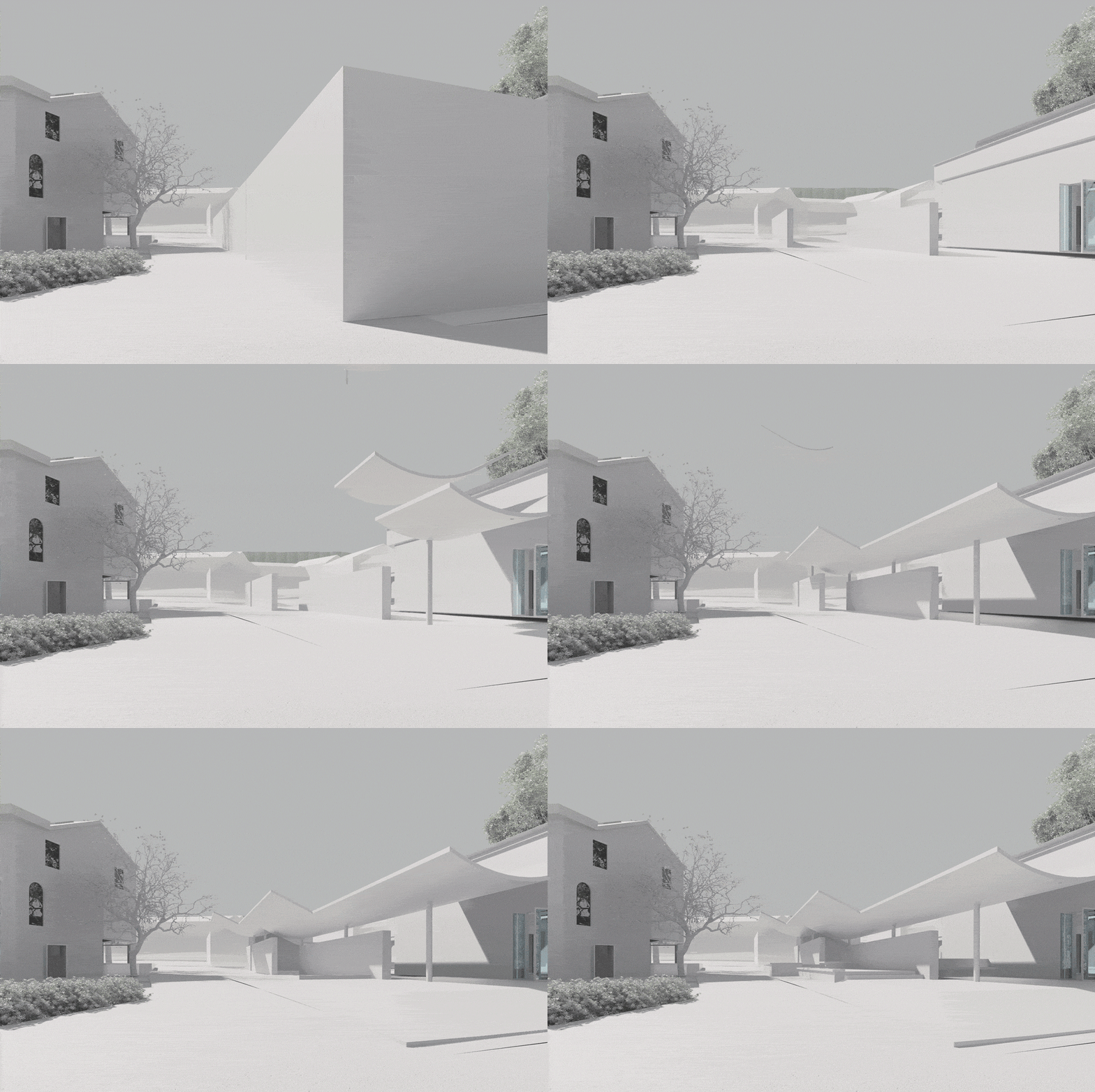
顺着村路往里走,是村里的大食堂和村民广场,那年农历除夕前的杀年猪活动就是在大食堂举行。由于原来小学的围墙距离村路非常近,路口视线狭窄,在村口几乎无法看到村民广场,我们拆除了部分围墙,在反曲屋面下重新插入错落的片墙,形成内外复廊和东向的多功能厅。▼廊桥草图,Generative Analysis of the Corridor ©虚度建筑事务所
Walking along the village path, you can see the public canteen and the villagers’ square, where the annual pig-slaughtering ritual was held before the Lunar New Year’s Eve. As the original primary school’s perimeter wall was very close to the road, the view at the intersection was narrow, rendering the square nearly invisible from the village entrance. We removes part of the perimeter wall and designs several walls of different heights under a curved roof, forming dual-layered corridor system—integrating both internal and external circulation— and an east-facing multi-functional hall.
▼内外复廊,Several walls of different heights ©梁山
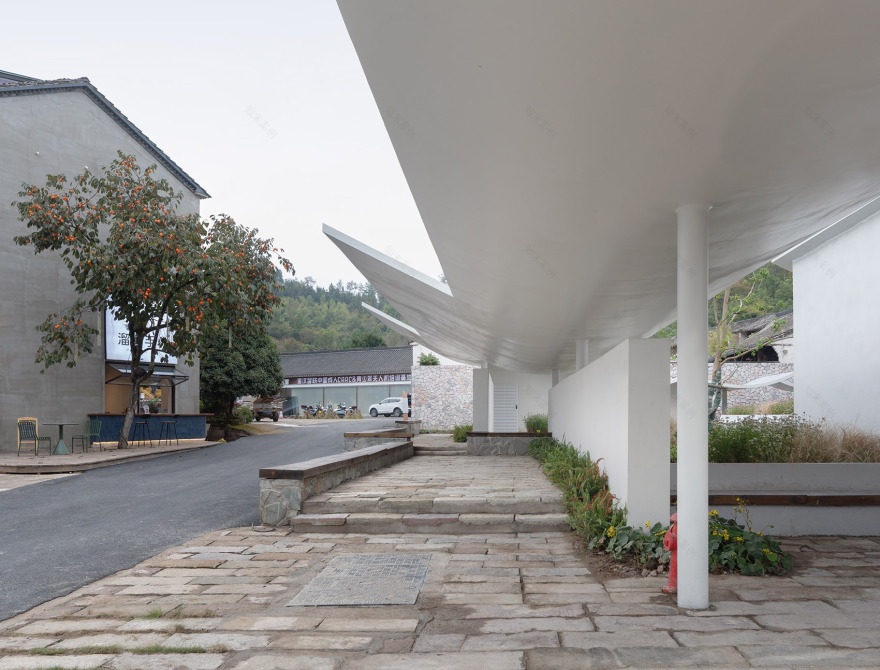
外廊和对面村居的山墙面间、柿子树下空间形成村民歇脚、聊天、晒太阳的场所,是村民广场往村口的自然延伸。内廊是青艺宿地的内部庭院游廊,和村落空间视线通达。
The space between external corridor and the gable walls of the opposite houses has been used as a social pocket for villagers to rest, chat, and bask in the sun, which is a extension of the village square toward the entrance. The internal corridor serves as an interior courtyard walkway for Qingyi Lodge, maintaining visual connectivity with the village public space.
▼外廊座椅,External corridor seat ©梁山

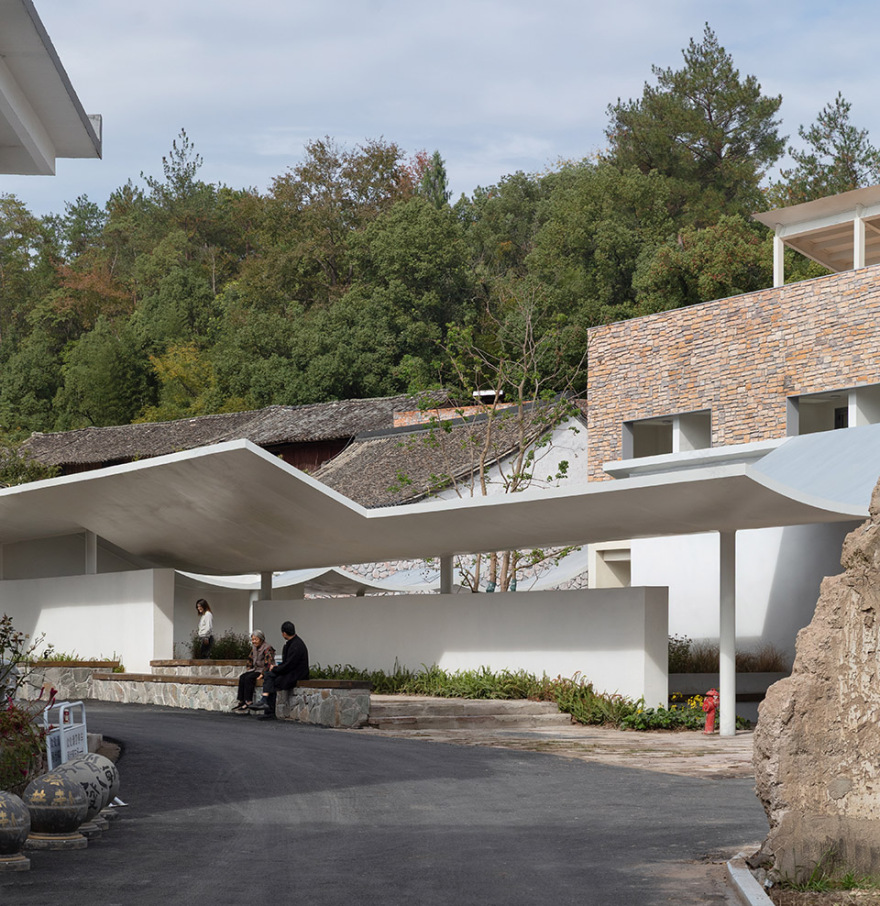
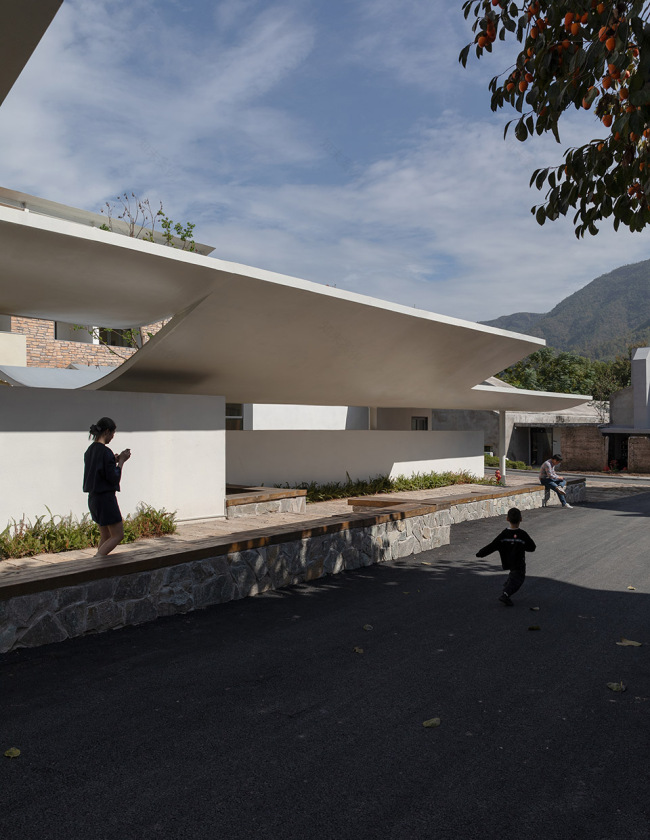
轻薄而漂浮的反曲钢结构屋顶下,高低错落的片墙间,铺上村落各地收集来的老石板,厚实的木头放置在乱石堆砌的矮墙上形成座椅,蕨类和青苔杂植其间。村里晒太阳的老人、干活聊天的女人和游客、来写生的学生、这些陌生新村民都聚在廊下,熟悉和陌生在此处同时铺陈展开,形成通往写生基地多功能厅的独立次入口。三岔路口空间、视线得以打开,沿复廊拾级而上,可以通往村民广场走向村落深处。
▼外廊生成分析图,Generative diagram of outdoor corridor ©虚度建筑事务所
Under the lightweight, curved steel roofs, between the walls of different height, People sit on thick woods placed on low walls made of rubbles. Old stone slabs collected from all over the village are laid, while ferns and moss grow spontaneously in between. Here, the elderly basking in the sun, women chatting during breaks, tourists and art students—both villagers and these newcomers—gather under the corridor. The familiar and the unfamiliar are presented in parallel. The strategic setback of the boundary wall liberates both space and sithtilines at the junction, thereby defining an independent secondary entrance to the multi-functional hall. Climbing up the steps along the corridor, you will be guided toward the villagers’ square and deeper into the ancient village.
▼多功能厅的独立次入口,Secondary entrance to the multi-functional hall ©梁山
▼新老村民聚在廊下,Villagers and newcomers gather under the corridor ©梁山
▼老石板铺地,Stone slabs ©梁山

老话都说“无树不成村”,每个村子的村口总有几棵大树,也总有老人们把枝繁叶茂的大树和村子的兴旺联系起来。仙景村的风水树就在青艺宿地的北面,沿着村口小溪的支流往上大约五十米,小山脉的山脚下有着四棵古树,和土地庙一起是村子的精神象征。
As the old saying goes, “No village is complete without trees.” There are always some old trees at the entrance of every ancient village. For the elder villagers, the flourishing of the old trees is always regarded as the village’s prosperity. In the Xianjing Village, the lucky trees like this are located north of the Qingyi Lodge. Walking up about fifty meters along the stream, at the foot of a small hill, four old trees stand alongside the Earth God Shrine, as a symbol of the ancient village.
▼广场走向村落深处,Toward the villagers’ square and deeper into the ancient village ©梁山
▼内庭院的视线通达,The internal courtyard maintains visual connect ©梁山

▼风水树,Lucky trees ©梁山

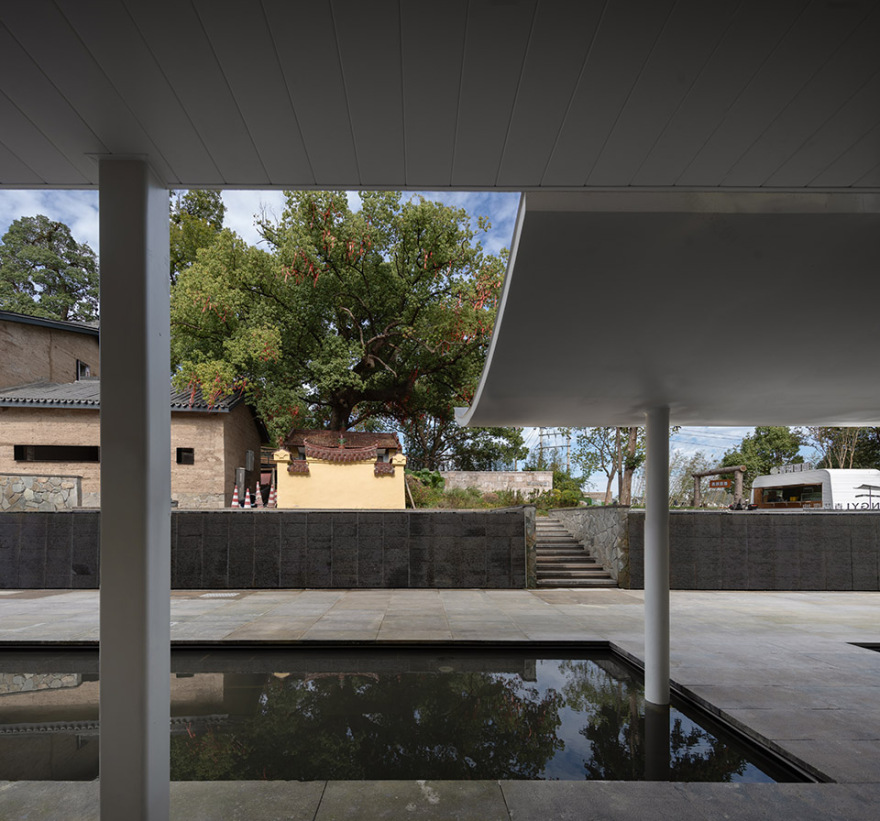
我们选择面向古树的北面作为青艺宿地的主入口,和新建的北面钢结构一起构成青艺宿地的入口空间。由于村落北面是山坡,北高南低,原始高差较大,我们利用村里丰富的山泉资源,设计了高低两个水院,用自然水面而不是围栏的方式,把青艺宿地从自然村落肌理中分割开来。土地庙旁的村口大树,树荫覆盖着一片水面,倒映着远处的神仙居山脉,从水面拾级而下,从山上引来的泉水顺着水墙默默流淌,3米的高差分隔了村口古树平台的村民和游客,形成一个安静的领域,也是内心体验转换的提示。
The north façade with the new steel structure, which oriented toward the Earth God Shrine and big trees, was chosen as the main entrance to the Qingyi Lodge. As the northern part of the village is a hillside, the site descends from north to south. We took advantage of the abundant mountain spring resources in the village and designed two water courtyards at different levels. A natural water feature, serving as a soft boundary, gently distinguishes the Qingyi Lodge from the surrounding village texture. The old trees beside the Earth God Shrine casts its shade over a reflective poor, whose surface mirrors the Shenxianju mountains in the distance. As one descends step by step from the water surface, the spring water drawn from the mountain comes to the view, flowing silently along the water wall. This 3 - meter vertical drop creates an acoustic and visual buffer zone, effectively separating the artists from villagers and tourists. Thereby we establish a quiet domain and signifies a transition into a more contemplative state.
▼高低不同的水院,Water courtyards ©梁山
▼高低不同的水院,Water courtyards ©梁山

水院东南角,有着一丛非常漂亮、饱满的芭蕉树。这是建筑师第一次到现场勘察小学时见到的,荒芜了数十年的校舍后,天然生长出的一丛极具生命力的绿色,巨大的芭蕉叶甚至盖住了学校坍塌的屋顶。村民们说,芭蕉树在仙居无法过冬,每年11、12月间会逐渐枯萎,但是第二年春天又会迅速勃发,迅速变得枝肥叶大。芭蕉的“芭”的意思是干巴,“蕉”就是说它的叶子会焦枯,在佛教教义中寓意着“空性”,也就是事物没有固定不变的实体,是不断变化的。(用古画来表达)这一枯一荣之间的变化,正如村子里的这所小学,从萦绕着孩子们欢笑的校园,到荒芜的危楼,再到改造成艺术家和学生写生绘画的居所,不断变化着不同的使用人群和功能,却又焕发出了新生。
In the southeastern corner of the water courtyard, there is a cluster of very beautiful and plump hardy banana trees. During the architect’s initial site visit, we discovered a cluster of lush hardy banana plants that had grown naturally in the decades after the school abandonment. Their expansive leaves so vigorous that they enveloped sections of the collapsed roof. According to the villagers, the hardy bananas cannot survive the winter in Xianju. They gradually die back around November and December every year, but they will thrive again in the following spring, sprouting vigorous, broad leaves. The character “芭” (bā) implies something dried and withered, while “蕉” (jiāo) suggests scorched, parched leaves. In Buddhist doctrine, the banana plant symbolizes “emptiness” — the concept that nothing has a fixed, permanent entity and everything is constantly changing. This cycle of withering and revival mirrors the story of the village school itself: from a campus echoing with children’s laughter, to a derelict structure, reborn as a lodge for artists and sketching students. It is a place evolving through different users and functions, yet continually finding new life.
▼外廊的芭蕉树,The hardy bananas in outdoor corridor ©梁山

我们觉得这非常的贴切而有趣,便说服业主把这丛芭蕉树保留下来,作为改造重生的“青艺宿地”的精神图腾,并把芭蕉树下的东面第一间房间改造成艺术家工作室。通过局部悬挑,调整了二层钢结构外廊的位置,给芭蕉树留下成长的充足空间,这也给原本完全对称的学校北立面增添了自然的变化。
We thought this was very appropriate and interesting, so we persuaded the client to preserve this cluster of hardy bananas as a spiritual totem for the reborn the “Qingyi Lodge,” symbolizing renewal. Hence, we transform the first room on the east side under the hardy bananas into an artist’s studio.
The architects adjusted the position of the second-floor steel corridor through a partial cantilever, leaving ample space for the growth of the hardy bananas. This intervention result in an organic variation to the school’s otherwise strictly symmetrical northern facade.
▼立面细节,Facade details ©梁山

场地上保留下来的另一棵松树,和土地庙一起作为天然标识物,确定了青艺宿地的主入口位置,偏向东侧的出入口台阶和客房部分外立面的拉索,强化了立面的不对称性,也给北面的水院带来一些当代的设计语言,试图寻找村里年轻人所渴望的时髦city感与古村印象之间的平衡。
Another preserved pine tree on the site, together with the Earth God Shrine, serves as a natural landmark that defines the main entrance to the Qingyi Lodge. The entrance steps, shifted toward the east, and the cables on the facade of the guest rooms enhance the asymmetrical composition of the northern facade. This asymmetry infuses the northern water courtyard with a contemporary language, achieving an equilibrium between the urban sensibility cherished by the village youth and the texture of the ancient village.
▼入户走廊,Entry corridor ©梁山

入住青艺宿地的客人,从北面水院进入场域后,跨过水院沿着北面的外廊抵达首层中间跨——这里原是小学的楼梯间——设计保留了它的开放性,作为进入门厅的室外序厅。
Guests staying at the Qingyi Lodge enter the site from the northern water courtyard. Crossing the water courtyard, they proceed along the northern outdoor corridor to arrive at the central bay of the ground floor. This place was originally the staircase of the primary school. Its openness has been preserved, and it has been repurposed as an outdoor foyer to the lobby.
▼首层入户空间,entry-level space ©梁山

客人倚在这里,抬眼望,迎面是操场改建而成的内庭院,视线掠过庭院、弯曲的廊顶、村居山墙,远远地可以望见饭甑岩。有朦胧的“远”,有孤峰的“高”,还有村落的“深”,借景一岩,满园皆活。
Leaning here and looking up, the guests are met with a view of the inner courtyard, which was transformed from the former playground. Their gaze unfolds across this courtyard, over the curved roofs of the corridor, past the village gables, and into the distance where the Fanzeng Peak rises. There is the hazy “distance”, the “height” of a solitary peak, and the “depth” of a village. This borrowed scenery breathes vitality into the entire garden.
▼楼梯,stairs ©梁山

休憩远望后,向东进入门厅,办理完check in手续后动线从东面出口离开,沿着芭蕉树外的楼梯上二层或前往西面客房入住。或者向外走来到庭院,从庭院东侧的多功能厅,沿着起起伏伏的廊子一路漫游,到西面的楼梯处前往二层或回到水院。
Having rested and enjoying the view, the guests proceed east into the lobby. After checking in they depart through the eastern exit. From there, the staircase beside the hardy bananas leads them to the second floor. Alternatively, they may step out into the courtyard. Passing by the multi-functional hall on its eastern side, they can wander under the undulating roofs, eventually arriving at the western staircase to access the second floor or return to the water courtyard.
▼庭院对饭甑岩的借景,Garden borrowed scenery ©梁山

▼庭院对饭甑岩的借景,Garden borrowed scenery ©梁山

▼廊顶和民居、山的关系,Roofline of the corridor mirrors the village houses and the distant mountain silhouette ©梁山

▼露台,Terrace ©梁山

洄游路径中,通过曲面廊顶的起翘变化,地面石板路的上上下下,庭院空间的疏朗有致,屋顶覆盖的有明有灭,形成丰富而又一镜到底的空间节奏感。最终抵达屋顶露台,从村落最高处望去,远处神仙居山景一览无余。
Throughout this looping path, a rich yet continuous spatial rhythm is created through a series of deliberate variations: the rising and falling curved roofs, the gentle ascent and descent of the stone-paved walkway, the careful modulation between open and intimate courtyard spaces, and the alternating play of light and shadow beneath the roofs.The journey culminates at the rooftop terrace. From this highest vantage point in the village, a panoramic view of the distant Shenxianju mountain landscape unfolds in its entirety.
▼村落总平面,Master plan ©虚度建筑事务所

▼一层平面图,First floor plan ©虚度建筑事务所

▼二层平面图,Second floor plan ©虚度建筑事务所

▼屋顶平面图,Roof floor plan ©虚度建筑事务所

▼剖面图,Section ©虚度建筑事务所

项目名称:仙景村·青艺宿地——原王户小学改建
项目类型:公共建筑、改建、乡建、酒店
设计方:虚度建筑事务所
项目设计:2024.10-2025.11
完成年份:2025.11
设计内容:建筑设计、景观设计、室内设计
主创建筑师:杜洁、许文杰
设计团队:杜洁、许文杰、高敏、宋诚吉(室内深化)、李蕊蕊(客房设计)
驻场建筑师:许文杰、梁山
景观顾问:张泉泉
项目地址:浙江省台州市仙居县白塔镇仙景村
建筑面积:859.27㎡
摄影版权:梁山虚度建筑事务所
施工单位:浙江如其建设有限公司
合作单位:中瀚设计集团有限公司
业主方:白塔镇人民政府
运营方:仙居蓝乡乡村旅游发展有限公司
材料:钢结构板桁架、老石板、青石板、真石漆、玻璃、樟子松、蘑菇石、水刷石
Project name:Xianjing Village · Qingyi Lodge — Renovation of the Former Wanghu Primary School
Project type:Public Architecture, Renovation, Rural Architecture, Hotel
Design:HsuDu Architects
Design year:Oct 2024 – Nov 2025
Completion Year:Nov 2025
Design Scope: Architectural Design, Landscape Design, Interior Design
Leader designer:Du Jie, Xu Wenjie
Design Team: Du Jie, Xu Wenjie, Gao Min, Song Chengji (Interior Detailing), Li Ruirui (Guestroom Interior Design)
On-site Architects: Xu Wenjie, Liang Shan
Landscape Consultant: Zhang Quanquan
Project location:Xianjing Village, Baita Town, Xianju County, Zhejiang Province, China
Gross built area: 859.27 ㎡
Photo credits: Liang Shan, HsuDu Architects
Construction Company: Zhejiang Ruqi Construction Co., Ltd.
Partner:Zhonghan Design Group Co., Ltd.
Clients:Baita Town People’s Government
Operator: Xianju Lanxiang Rural Tourism Development Co., Ltd.
Materials: Steel Plate‑Truss Structure, Old Stone Slabs, Stone Slabs, Real Stone Paint, Glass, Scots Pine, Artificial Stone, Exposed Aggregate Finish


南京喵熊网络科技有限公司 苏ICP备18050492号-4知末 © 2018—2020 . All photos and trademark graphics are copyrighted by their owners.增值电信业务经营许可证(ICP)苏B2-20201444 苏公网安备 32011302321234号
苏公网安备 32011302321234号客服
消息
收藏
下载
最近