

创作上传
VIP
收藏下载
登录 | 注册有礼
查看完整案例

收藏

下载

分享
浙江师范大学行知学院迁建兰溪,综合体育中心作为校园标志性建筑应运而生。项目总建筑面积约1.5万平方米,主体采用钢框架与空间网架复合结构体系,分为比赛篮球馆、游泳馆、训练馆三部分,三区独立且联系紧密。核心篮球馆可容纳3000名观众,具备承办篮球、羽毛球等赛事及文艺演出的多功能适配能力。设计以”开放共享、绿色生态、智慧人文”为核心理念,通过功能复合与空间活力营造,构建满足师生需求的校园体育文化枢纽。建筑形态以校区“漂浮校园”的形态设计主旨作为切入点,解决基地黄海高程低于常年洪水位的历史性洪涝问题的同时,绿化筑坡,形随意转,建筑群体形成“悬浮”于“自然地形”之上独具未来感的形态与景观。
▼综合体育中心素模,plain module © 中国联合工程有限公司


Zhejiang Normal University Xingzhi College relocated to Lanxi, and the Comprehensive Sports Center emerged as a landmark building on campus. The total construction area of the project is about 15000 square meters, and the main body adopts a composite structure system of steel frame and spatial grid. It is divided into three parts: the competition basketball hall, swimming pool, and training hall, which are independent and closely connected. The core basketball hall can accommodate 3000 spectators and has the multifunctional adaptability to host basketball, badminton and other sports events as well as cultural performances. The design is based on the core concepts of “open sharing, green ecology, and smart humanities”, and aims to create a campus sports and cultural hub that meets the needs of teachers and students through functional integration and spatial vitality. The architectural form takes the design theme of a “floating campus” as the starting point, solving the historical flood problem of the Yellow Sea elevation being lower than the perennial flood level in the base. At the same time, green slopes are built, and the form can be freely transformed, forming a unique future oriented form and landscape of the building group “suspended” above the “natural terrain”.
▼综合体育中心鸟瞰实景照片,Photographs of the comprehensive sports center in its actual setting © 奥观摄影

一、生态融合:打造校园里的体育公园
Ⅰ、 Ecological Integration: Creating a Sports Park on Campus
(一)融入校园绿道系统
(1) Integrate into the campus greenway system
体育馆景观环境采用”中央草坪-辐射轴线-生态屏障”的三级结构,依托自然地形形成开放包容的空间格局。大草坪作为景观核心,通过乔木、灌木与地被植物的梯度配置,构建多层次绿化系统;向外辐射的景观轴线串联入口广场、休憩平台等节点,形成疏密有致的视觉序列;外围植被带则作为生态屏障,既调节微气候,又界定空间领域,实现建筑功能与自然环境的有机渗透。▼综合体育中心绿化模拟分析,
Simulation analysis of greening in comprehensive sports center
© 中国联合工程有限公司

The landscape environment of the sports arena adopts a three-level structure of “central lawn radiation axis ecological barrier”, relying on natural terrain to form an open and inclusive spatial pattern. As the core of the landscape, the large lawn constructs a multi-level greening system through the gradient configuration of trees, shrubs, and ground cover plants; The landscape axis radiating outward connects the entrance plaza, rest platform and other nodes, forming a dense and orderly visual sequence; The peripheral vegetation zone serves as an ecological barrier, regulating microclimate and defining spatial domains, achieving organic infiltration between building functions and the natural environment.
▼综合体育中心实景照片,Photographs of the comprehensive sports center in its actual setting © 奥观摄影

(二)建筑与景观的互动关系
(2) The interactive relationship between architecture and landscape
设计通过”空间交融”与”功能互补”实现建筑与景观的动态平衡。东侧连接体育场阶梯看台,将运动功能自然延伸至室外景观;西侧结合地形打造生态草坡,既消解建筑体量压迫感,又形成可休憩的观景平台;这种”人工 - 自然”的互动设计,突破传统体育建筑的封闭性,赋予空间更多亲和力与使用场景。
▼综合体育中心景观空间模拟分析,
Simulation analysis of landscape space in comprehensive sports center
© 中国联合工程有限公司

Design achieves dynamic balance between architecture and landscape through “spatial integration” and “functional complementarity”. The eastern side connects to the stepped stands of the sports stadium, naturally extending the sports function to the outdoor landscape; creating an ecological grassy slope on the west side in combination with the terrain, which not only relieves the pressure of building volume, but also forms a resting viewing platform; This “artificial natural” interactive design breaks through the closed nature of traditional sports architecture, endowing the space with more affinity and usage scenarios.
▼综合体育中心实景照片,Photographs of the comprehensive sports center in its actual setting © 奥观摄影

二、网络互联:打造有机生长的活力环系统
Ⅱ、 Network Interconnection: Creating a Vibrant Environment System for Organic Growth
(一)串联整合不同建筑单体
(1) Connecting and integrating different individual buildings
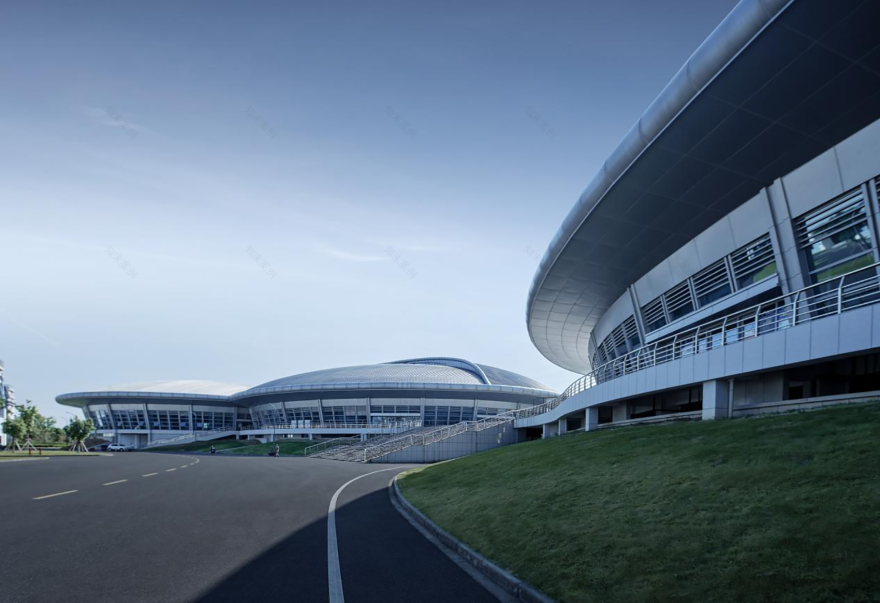
采用”环形分流+双层平台”的动线系统,构建高效互联的校园空间网络。内环设计通过环形路径连接体育馆各功能区,缩短通行距离;双层平台中下层承担交通功能,上层作为观景休憩空间,两者结合形成连贯的步行网络,减少绕行。内环的衔接优化进一步提升校园互联性,使体育馆成为串联教学区、生活区与运动区的关键节点,强化校园空间的整体性与可达性。▼综合体育中心流线模拟分析,
Simulation analysis of streamline in comprehensive sports center
© 中国联合工程有限公司

Adopting a circulation system of “circular diversion+double-layer platform” to construct an efficient and interconnected campus spatial network. The inner ring design connects various functional areas of the sports arena through a circular path, shortening the travel distance; The lower layer of the double-layer platform serves as a transportation function, while the upper layer serves as a viewing and leisure space. The combination of the two forms a coherent pedestrian network, reducing detours. The optimization of the inner loop connection further enhances the interconnectivity of the campus, making the gymnasium a key node connecting the teaching area, living area, and sports area, and strengthening the overall integrity and accessibility of the campus space.
▼综合体育中心实景照片,Photographs of the comprehensive sports center in its actual setting© 奥观摄影
(二)融合市井烟火与赛事功能的弹性空间设计
(2) Elastic Space Design Integrating Municipal Fireworks and Event Functions
基于”弹性生长”理念,采用模块化结构与动态隔断技术实现空间的多功能适配。主体框架采用可扩展式钢构体系,内部增设活动隔断,可快速切换教学(单场地分隔为4个羽毛球训练场)、赛事(3000人观众席模式)及文艺演出(舞台搭建模式)等场景;辅助用房采用可拆卸式轻质隔墙,未来可根据需求调整功能布局。这种设计既满足当前校园使用需求,又为未来发展预留弹性,体现可持续发展的建筑思想。
▼综合体育中心空间模拟分析,Space simulation analysis of comprehensive sports center © 中国联合工程有限公司

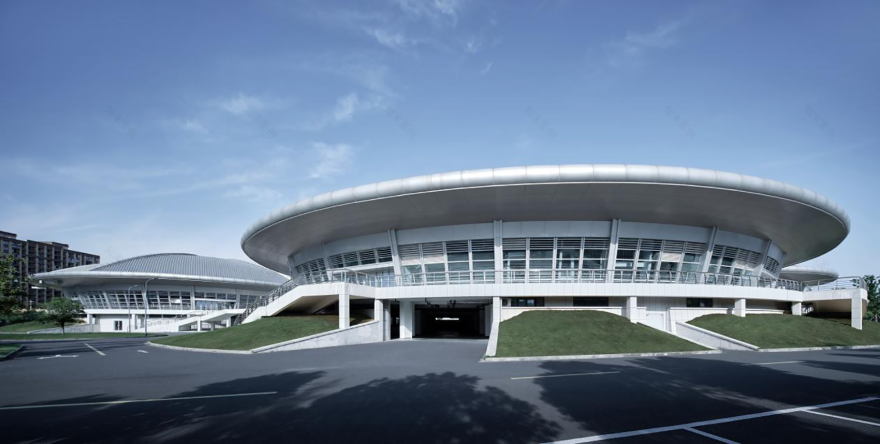
Based on the concept of “elastic growth”, modular structure and dynamic partition technology are adopted to achieve multifunctional adaptation of space. The main framework adopts an expandable steel structure system, with added activity partitions inside, which can quickly switch between teaching (single venue divided into 4 badminton training fields), events (3000 seat mode), and cultural performances (stage construction mode) and other scenes; The auxiliary room adopts detachable lightweight partition walls, and the functional layout can be adjusted according to future needs. This design not only meets the current campus usage needs, but also reserves flexibility for future development, reflecting the architectural concept of sustainable development.
▼综合体育中心实景照片,Realistic photos of the comprehensive sports center © 奥观摄影
三、功能复合:打造集约高效的校园综合体育馆
Ⅲ、 Functional Composite: Creating an Intensive and Efficient Campus Sports Center
(一)高效整合的平面功能布局
(1) Efficient integration of planar functional layout
采用”三区分离+分层利用”的设计策略,实现空间利用效率最大化。主体场馆分为三大板块:居中为运动区(标准篮球场+羽毛球场地),U型环绕的观众区(3000座含无障碍席位),东西两侧为辅助功能区(更衣室、医疗站等),三区流线独立互不干扰;二层设置体育社团活动室及健身房,通过垂直分层拓展使用维度。人车分流设计中,主入口连接校园主干道,后勤通道独立设置,保证大型活动期间交通秩序。
▼综合体育中心形态布局推演分析,
Analysis and deduction of the layout of the comprehensive sports center form
© 中国联合工程有限公司

Adopting the design strategy of “three zone separation+layered utilization” to achieve maximum space utilization efficiency. The main venue is divided into three sections: the sports area (standard basketball court+badminton court) in the center, the audience area surrounded by a U-shape (3000 seats including accessible seats), and the auxiliary functional areas (changing rooms, medical stations, etc.) on the east and west sides. The flow lines of the three areas are independent and do not interfere with each other; On the second floor, sports club activity rooms and fitness centers are set up, expanding the dimensions of use through vertical layering. In the design of pedestrian and vehicle separation, the main entrance is connected to the campus main road, and the logistics channel is independently set up to ensure safety and traffic order during large-scale events.
▼综合体育中心顶视图,Top view of the comprehensive sports center © 奥观摄影

(二)训练馆与游泳馆的空间协同
(2) Space synergy between training center and swimming pool
训练馆与游泳馆采用”水平毗邻+共享大厅”的布局模式,通过公共服务大厅实现功能联动。训练馆配置多功能运动场地(可转换篮球/排球模式),游泳馆设标准泳池及配套更衣区,两者通过共享大厅的垂直交通核连接二层观景平台,并经连廊衔接主体训练教学区,既保证各功能的独立性,又提升空间互联效率。大跨度钢架结构的应用减少柱网干扰,增强空间通透性与使用灵活性。
The training center and swimming pool adopt a layout model of “horizontal adjacency+shared hall”, and achieve functional linkage through a public service hall. The training center is equipped with a multifunctional sports field (convertible basketball/volleyball mode), and the swimming pool has a standard swimming pool and matching changing area. The two are connected to the second floor observation platform through a vertical traffic core in the shared hall, and are linked to the main training and teaching area through a corridor, ensuring the independence of each function and improving spatial connectivity efficiency. The application of large-span steel frame structures reduces column interference, enhances spatial transparency and flexibility in use.
▼综合体育中心实景照片,Realistic photos of the comprehensive sports center ©奥观摄影

(三)剖面与空间设计的技术优化
(3) Technical optimization of profile and spatial design
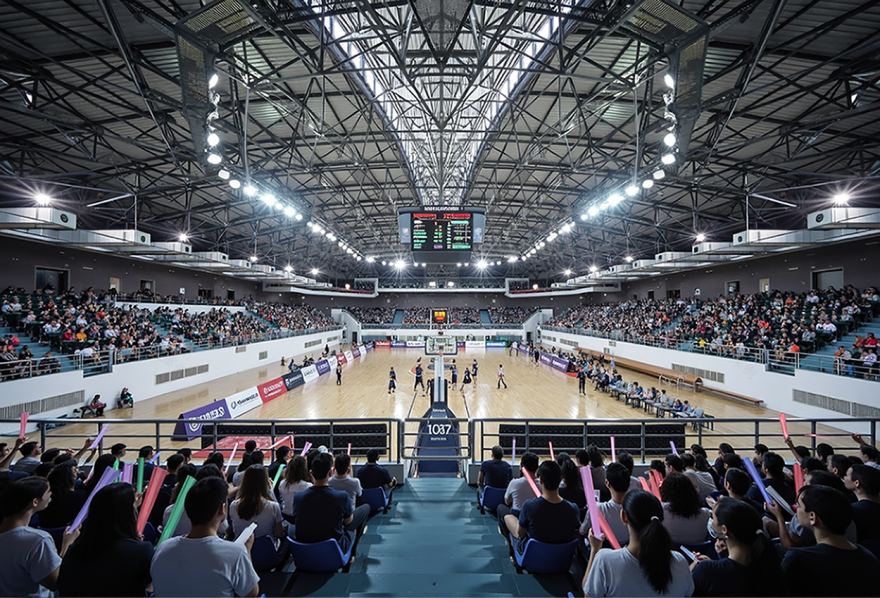
剖面设计以”功能适配+物理环境优化”为核心:主馆比赛大厅采用桁架式钢屋架,形成16米净高的大跨度空间,满足赛事需求;阶梯式观众席通过缓坡形剖面处理,优化视线与声学效果(混响时间控制在1.5秒以内)。采光系统采用”环形天窗+漫反射膜”组合技术,使自然光均匀覆盖场地,降低人工照明能耗;顶部设置智能通风百叶,结合地源热泵系统,实现室内环境的节能调控。空间设计中底层辅助功能区采用可移动隔墙,二层环形走廊串联休息、办公等附属空间,进一步提升空间利用效率。
The cross-sectional design is centered around “functional adaptation+physical environment optimization”: the main competition hall adopts a truss style steel roof truss, forming a large-span space with a net height of 16 meters to meet the needs of the competition; The stepped audience seating is processed with a gentle slope profile to optimize the visual and acoustic effects (with reverberation time controlled within 1.5 seconds). The lighting system adopts the combination technology of “circular skylight+diffuse reflection film” to evenly cover the site with natural light and reduce the energy consumption of artificial lighting; Intelligent ventilation louvers are installed at the top, combined with a ground source heat pump system, to achieve energy-saving regulation of indoor environment. In the spatial design, the bottom auxiliary functional area adopts movable partition walls, and the second floor circular corridor connects auxiliary spaces such as rest and office, further improving the efficiency of space utilization.
▼综合体育中心内景实景照片,Realistic photos of the interior of the comprehensive sports center© 陈峰清
(四)篮球馆的剖面高度与结构特点
(4) Section height and structural characteristics of basketball court
篮球馆剖面高度设计为16米,可充分满足正式比赛与日常训练的空间需求。结构体系采用大跨度钢网架,实现无柱化室内空间,提升使用灵活性;上部屋面采用弧形设计并结合连续采光带,优化自然采光效果。主体结构选用H型钢与混凝土柱组合形式,节点处采用高强度螺栓连接,在保障结构稳定性的同时有效控制自重,适配多功能场景转换需求。
▼综合体育中心空间结构分析,
Analysis of Spatial Structure of Comprehensive Sports Center
© 中国联合工程有限公司
The height of the basketball court section is designed to be 16 meters, which can fully meet the space requirements for formal matches and daily training. The structural system adopts large-span steel truss to achieve column free indoor space and enhance flexibility in use; The upper roof adopts a curved design combined with continuous daylighting strips to optimize the natural lighting effect. The main structure adopts a combination of H-shaped steel and concrete columns, and high-strength bolts are used at the nodes to effectively control the self weight while ensuring structural stability, adapting to the needs of multi-functional scene transformation.
▼综合体育中心实景照片,Realistic photos of the comprehensive sports center © 奥观摄影
(五)训练馆与游泳馆的空间尺度
(5) The spatial scale of training centers and swimming pools
基于高校综合体育馆的复合功能定位,训练馆与游泳馆的空间尺度以”功能性+灵活性”为核心设计原则。其中,训练馆净高不低于12米,可满足篮球、排球等球类运动的标准场地要求;游泳馆按比赛级别设计为50米×25米标准泳池,池边预留≥5米宽通行缓冲区,并通过活动隔断系统实现训练、比赛、教学等场景的快速切换。
▼综合体育中心空间结构分析,
Analysis of Spatial Structure of Comprehensive Sports Center
© 中国联合工程有限公司

Based on the composite functional positioning of university comprehensive sports halls, the spatial scale of training halls and swimming pools is designed with “functionality+flexibility” as the core principle. Among them, the net height of the training hall shall not be less than 12 meters, which can meet the standard venue requirements for basketball, volleyball and other ball sports; The swimming pool is designed as a 50 meter x 25 meter standard swimming pool according to the competition level, with a reserved buffer zone of ≥ 5 meters wide at the edge of the pool, and a movable partition system to quickly switch between training, competition, teaching and other scenes.
▼综合体育中心细部实景照片,Realistic photos of the comprehensive sports center © 奥观摄影

(六)造型与立面设计
(6) Styling and Facade Design
造型设计以体育场馆的功能设置为形态基础,流线型大挑出的钢构曲面重塑屋顶轮廓,椭圆几何元素的重复掩映形成特有的视觉节奏,自然形成悬浮于绿坡之上的未来之碟。材质与细部克制地呼应传统:采用灰色具有竖向肌理的金属板,呼应传统”黛瓦”意象;屋顶处理类似传统“歇山”做法,在屋脊处轻轻拎起构成标志性的屋面形式特征;细部的镂空格栅插入传统符号的转译。整体设计以一种抽象的建筑思维方式强调技术、回应传统,彰显传统与技术、过去与未来间自然的共生共鸣。
▼综合体育中心木质模型,Wooden model © 中国联合工程有限公司
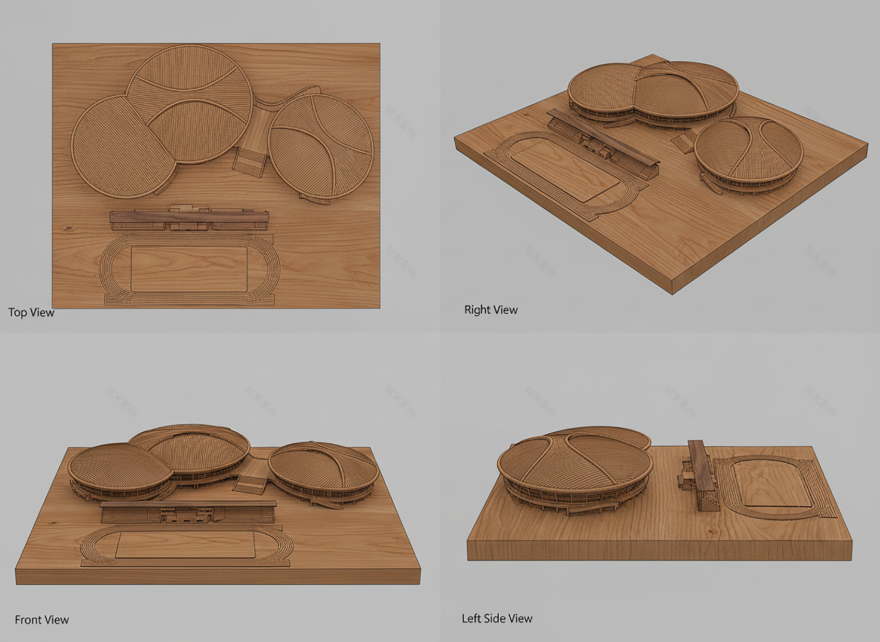

The styling design is based on the functional setting of sports venues, with streamlined steel structure curves reshaping the roof contour, and repeated elliptical geometric elements creating a unique visual rhythm, naturally forming a future disc suspended on the green slope. The material and details are restrained and echo tradition: using gray metal plates with vertical texture, echoing the traditional “Daiwa” image; The roof treatment is similar to the traditional “mountain rest” method, where the iconic roof form features are gently lifted at the ridge; The detailed hollow grille inserts the translation of traditional symbols. The overall design emphasizes technology and responds to tradition in an abstract architectural way, highlighting the natural symbiotic resonance between tradition and technology, past and future.
▼综合体育中心细部实景照片,Realistic photos of the comprehensive sports center © 奥观摄影

(七)色彩与材质的文化表达
(7) Cultural expression of color and material
色彩体系采用冷静的灰白金属感为主调,以现代材质的感觉重新诠释建筑的素雅之气;立面材质选用具有肌理特征的现代金属铝板与格栅,通过钢构玻璃幕墙的通透特性隐喻教育场所的开放包容精神。整体设计以”传统符号+现代材料”的融合,体现学术建筑的文脉传承与时代创新。
The color system adopts a calm gray white metallic feeling as the main tone, reinterpreting the elegant atmosphere of the building with a modern material feel; The facade material is selected from modern metal aluminum panels and grilles with texture characteristics, and the transparent characteristics of the steel structure glass curtain wall symbolize the open and inclusive spirit of educational venues. The overall design combines traditional symbols with modern materials, reflecting the cultural heritage and innovation of academic architecture.
▼综合体育中心屋面鸟瞰实景照片,Realistic photo of the roof of the comprehensive sports center © 奥观摄影

结语
Conclusion
浙江师范大学行知学院综合体育中心的设计突破传统体育建筑的单一功能属性,通过生态融合、网络互联与功能复合三大策略,将其塑造为”体育公园-活力枢纽-文化载体”三位一体的校园公共空间。从抽象的文脉表达,到弹性空间的技术创新,再到生态网络的系统构建,设计始终围绕”以人为本”的核心,既满足体育教学、赛事承办等基本需求,又通过开放的形态、多元的场景与人文的隐喻,成为承载校园生活、激发场所活力的精神地标,为高校体育建筑设计提供了可借鉴的实践经验。
The design of the Comprehensive Sports Center of Xingzhi College, Zhejiang Normal University breaks through the single functional attribute of traditional sports buildings, and shapes it into a three in one campus public space of “sports park vitality hub cultural carrier” through three strategies: ecological integration, network interconnection, and functional composite. From abstract contextual expression, to technological innovation in flexible spaces, and to the systematic construction of ecological networks, the design always revolves around the core of “people-oriented”. It not only meets the basic needs of sports teaching and event hosting, but also becomes a spiritual landmark that carries campus life and inspires vitality through open forms, diverse scenes, and humanistic metaphors, providing practical experience for the design of university sports buildings that can be referenced.
▼综合体育中心首层平面图,Ground Floor Plan © 中国联合工程有限公司

▼综合体育中心二层平面图,Second Floor Plan © 中国联合工程有限公司

▼综合体育中心三层平面图,Third Floor Plan © 中国联合工程有限公司

▼综合体育中心剖面图,Section © 中国联合工程有限公司

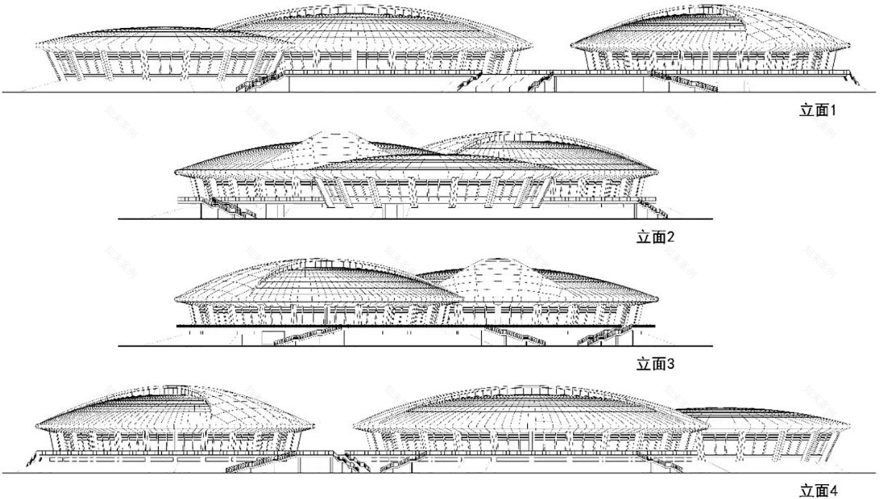
▼综合体育中心立面图,Elevation Drawing © 中国联合工程有限公司
项目地址:浙江/兰溪
项目建筑面积:15006㎡
建成时间:2021年
项目总负责:姜传鉷、郭晔
建筑专业负责:汪 洁 建筑团队:汪 洁、孙玮、张沂乔
结构专业负责:方小军,结构团队:方小军、马腾(网架)、来鹏飞(主体)
机电专业负责及团队:周展浩(给排水专业负责)、林鑫(暖通专业负责)、周涛(电气专业负责)、何君 (暖通)、金持中(电气)
建筑摄影:奥观摄影、陈峰清
编辑:孙玮、许睿
Project Address: Lanxi, Zhejiang
Project building area: 15006 square meters
Construction time: 2021
Project Manager: Jiang Chuanting, Guo Ye
Architectural Professional Manager: Wang Jie Architectural Team: Wang Jie, Sun Wei、Zhang Yiqiao
Responsible for structural engineering: Fang Xiaojun, structural team: Fang Xiaojun, Ma Teng (grid structure), Lai Pengfei (main body)
Mechanical and Electrical Professional Responsibilities and Teams: Zhou Zhanhao (Water Supply and Drainage Professional Responsibilities), Lin Xin (HVAC Professional Responsibilities), Zhou Tao (Electrical Professional Responsibilities), He Jun (HVAC), Jin Chizhong (Electrical)
Architectural Photography: Aoguan Photography, Chen Fengqing
Editors: Sun Wei, Xu Rui
南京喵熊网络科技有限公司 苏ICP备18050492号-4知末 © 2018—2020 . All photos and trademark graphics are copyrighted by their owners.增值电信业务经营许可证(ICP)苏B2-20201444 苏公网安备 32011302321234号
苏公网安备 32011302321234号客服
消息
收藏
下载
最近