

创作上传
VIP
收藏下载
登录 | 注册有礼
查看完整案例

收藏

下载

分享
南通地处长江入海口北岸,长江与黄海在此交汇,形成了“江海相拥”的独特地理格局。这片土地既孕育了包容会通、敢为人先的城市精神,也沉淀了以张謇实业救国思想为核心的企业家文化,以及适应江海气候的传统营造智慧。作为紫琅湖畔的文化地标,紫藤驿站以“百年紫藤”为内核,通过符号转译、技术传承,实现从文化意象到建筑实体的转化,成为平衡文化性、生态性及艺术性的样板。
▼沿湖全景,Panoramic view along the lake © 邱文锏

▼湖景,Lake view © 邱文锏

紫藤
在中国传统文化中,紫藤兼具自然属性与文化象征意义。古人称紫藤为“腾龙”,因其藤蔓盘绕如蛟龙探海,花穗下垂似紫霞垂天,既蕴含“力量与升腾” 的寓意,又承载“繁荣与美好”的愿景。唐代诗人李白在《紫藤树》中写道:“紫藤挂云木,花蔓宜阳春。”勾勒出紫藤攀援高木、花叶繁茂的盎然生机,暗含了“向上而生”的生命哲学。
▼湖景局部,Partial view of the lake © 邱文锏

▼西南俯视,Viewed from the southwest © 邱文锏

中国近代实业家、教育家张謇在其故居濠南别业入口亲手栽种了两株紫藤,历经百年风雨洗礼依旧枝繁叶茂、成为南通企业家精神的具象化象征。驿站将“紫藤”这一文化符号转化为可感知的空间形态,建筑在面向紫琅新天地一侧,以紫藤花架为原型,采用耐候重组竹材以方格模块搭建了一个矩形通高的精神空间,契合紫藤藤蔓攀援的态势,呼应紫藤“向上而生”的姿态。方格模块组合形成精细轻盈的表皮,阳光穿过网格间隙,洒下流动的光影,观者仿佛漫步于百年紫藤花下,实现自然与文化体验的双重共鸣。竹材特有的自然纹理、温润质感与坚韧属性,与紫藤的 “自然之美”、“坚韧之性” 形成呼应,成为南通企业家精神的纪念性空间与传播载体。▼入口,entrance© 邱文锏

▼室内光影,Indoor light and shadow © 邱文锏


“低姿态”布局
南通地处江海交汇地带,属于亚热带季风气候,常年受季风与海陆风双重影响,具有风力大、降雨集中、空气湿度高的气候特征。这种独特的自然环境,孕育了南通传统民居的营造哲学,建筑顺应自然,与环境和谐共生。南通传统民居的生态智慧,集中体现在屋面与屋脊的设计中。为应对强风天气,民居多采用“低姿态”布局,通过降低建筑高度、缩小迎风面,减少风力对建筑的冲击;同时,屋脊采用 “水牛角式” 起翘设计,脊线微微上扬。上扬的脊线能够引导气流沿屋面顺畅过渡,避免气流在屋顶形成涡流,从而降低风压对屋顶的直接冲击,提升建筑的抗风性能。此外,传统民居多采用当地出产的木材、砖瓦等自然材料,实现了材料的循环利用,体现了朴素的生态营造理念。
▼西南局部,Part of Southwest China © 邱文锏

▼西侧局部,Part of the west side© 邱文锏

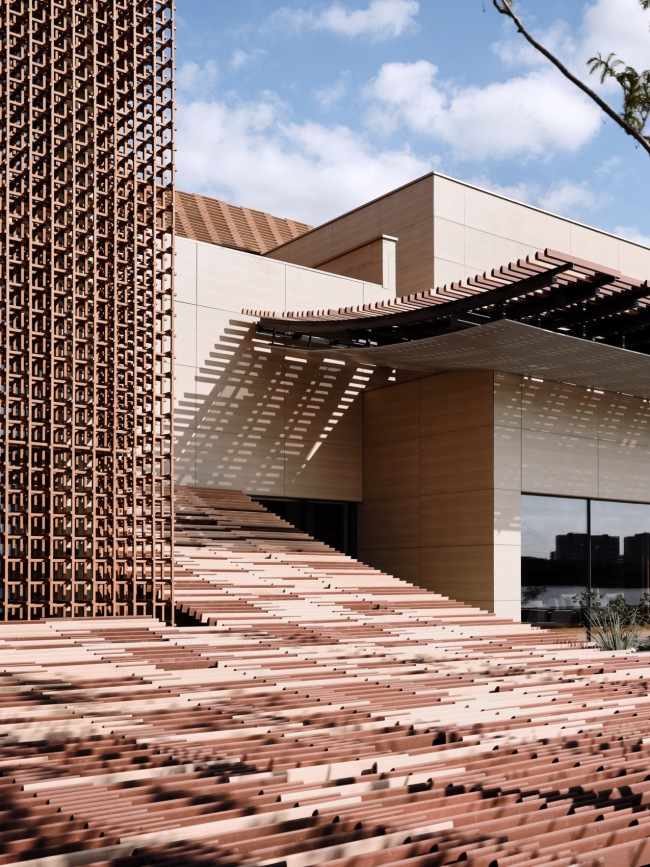
紫藤驿站从在地传统民居的屋面与屋脊形态中提取核心元素,将“低姿态布局”、“曲线脊线”等传统基因转化为适应现代功能需求的建筑形态。建筑临紫琅湖一侧采用曲面屋顶,屋顶向湖面缓缓伸展,形成柔和的水平线条,保持了传统民居“低姿态”生态适应性,诠释了“谦逊的融入环境”的设计理念。曲面屋顶能够引导气流沿屋面平滑流动,减少风荷载对建筑的影响,充分体现江海气候的适应性。屋顶顶部微微上翘,与传统民居“水牛角式”屋脊的曲线形态形成呼应,表现紫藤驿站地域记忆的当代性。
▼建筑与景观,building and landscape© azla


自然材质
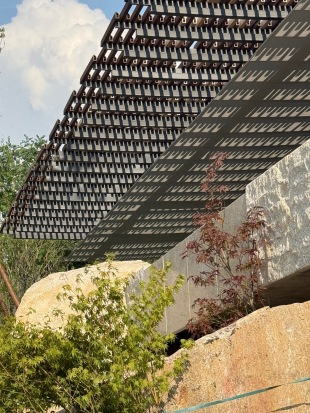
紫藤驿站致力于诠释尊重自然、顺应环境的可持续营造哲学,建筑从材料选择到构造方式,从空间体验到文化表达,无不体现对自然与人文的尊重。艺术中心采用手工质感陶棍、耐候重组竹、木饰面板等自然属性的材料,以积极但谦逊的姿态参与场地的生态循环与文化演进,“消失的屋面”生长临时诗意。紫藤驿站的三处曲面屋顶采用近 8000 根红、褐两色手工质感陶棍,陶棍的色彩与紫琅湖的自然环境形成和谐呼应。二种颜色的陶棍通过参数化计算进行随机排布,巧妙地将紫琅湖波光粼粼的湖面景致,转译成为富有韵律感的立面肌理。此外,陶棍的排布间距与长度经过热工计算,在保证美学效果的同时,有效降低了建筑的太阳辐射,提升了建筑的遮阳性能,实现了美学功能与生态功能的统一。
▼竹钢与陶棍,Bamboo steel and earthenware sticks © 邱文锏


▼陶棍屋面局部,A part of the earthenware stick roof © 邱文锏

在紫藤驿站的材料体系中,耐候重组竹材是工匠精神的集中体现。竹材作为中国传统建筑材料具有生长周期短、可再生性强、强度高的优势,但传统竹制品存在耐候性差、易腐朽、变形大的缺陷,限制了其在户外的应用。耐候性重组竹以4-6年的天然竹材为原料,经过原料预处理、纤维分离、定向重组、高温高压成型的工艺流程制成。这一工艺既保留了竹材的天然纹理与温润质感,又通过纤维定向重组与高温高压固化,提升了材料的强度、耐候性与稳定性,使其在可再生性、低碳环保性、户外耐候性及材料强度四大维度均达到国际领先水平。
▼竹钢立面局部,Partial bamboo and steel facade © azla


紫藤驿站的精神空间采用30mm*30mm截面的重组竹材搭接,形成边长225mm的方格网模块,方格网模块组合成双层竹结构网架。重组竹结构的加工与组装需要较高的精度与技艺,每一处接缝都蕴含了手工的专注与温度,建筑于细微之处表现文化自信,传承传统美学、工匠智慧,彰显工匠传统的传承与创新。
▼模型,model© 杨泽宇

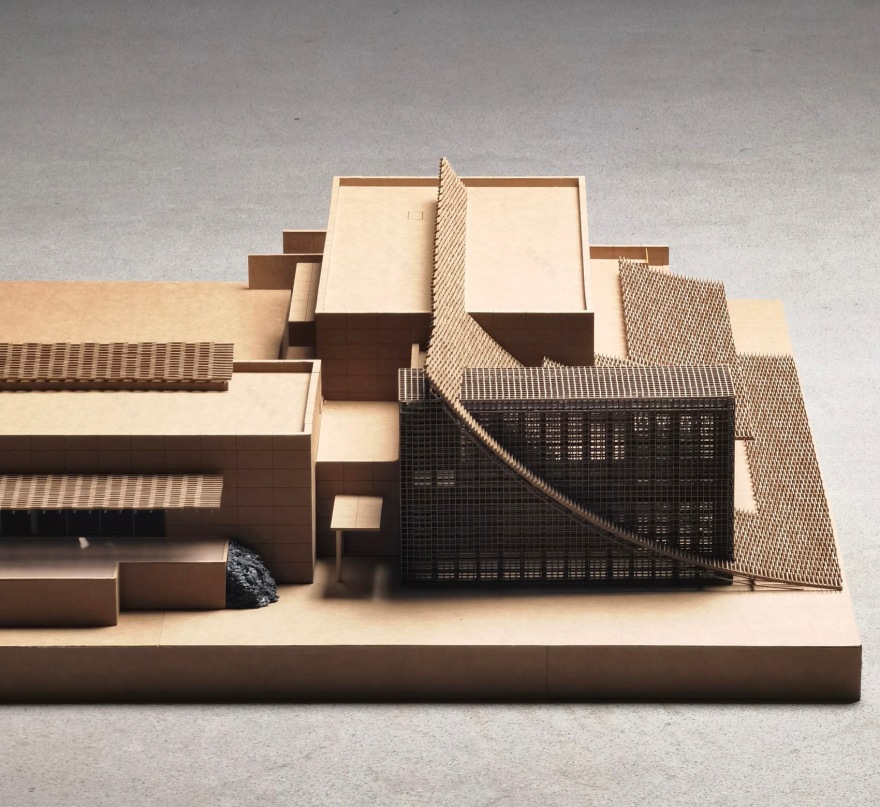

Drawing from the roof and ridge forms of local traditional dwellings, the Wisteria Pavilion extracts core architectural elements and translates traditional genes—such as a low-profile layout and curved ridgelines—into an architectural form that responds to contemporary functional requirements. On the side facing Zilang Lake, the building adopts a curved roof that gently extends toward the water, forming soft horizontal lines. This approach maintains the ecological adaptability inherent in the “low-profile” character of traditional dwellings and articulates a design philosophy of humble integration with the environment. The curved roof guides airflow smoothly along its surface, reducing wind loads on the building and clearly responding to the Jiang–Hai climatic conditions. The subtly upturned roof edge echoes the curved form of the traditional “water-buffalo-horn” ridge, expressing a contemporary interpretation of the pavilion’s regional memory.
The Wisteria Pavilion seeks to articulate a sustainable construction philosophy rooted in respect for nature and responsiveness to the environment. From material selection to construction methods, and from spatial experience to cultural expression, the architecture consistently reflects respect for both natural and human contexts. The art center employs materials with inherent natural qualities—such as handcrafted ceramic rods, weather-resistant reconstituted bamboo, and wood veneer panels—engaging with the site’s ecological cycles and cultural evolution through an active yet humble architectural presence. Here, the “disappearing roof” gives rise to a momentary sense of poetry.
The three curved roofs of the Wisteria Pavilion are composed of nearly 8,000 handcrafted ceramic rods in red and brown tones, whose colors resonate harmoniously with the natural environment of Zilang Lake. The two colors are randomly distributed through parametric calculations, subtly translating the shimmering surface of the lake into a rhythmic façade texture. In addition, the spacing and length of the ceramic rods were determined through thermal performance calculations, ensuring that aesthetic qualities are maintained while effectively reducing solar radiation and improving shading performance. In this way, aesthetic expression and ecological function are brought into alignment.
Within the material system of the Wisteria Pavilion, weather-resistant reconstituted bamboo represents a concentrated expression of craftsmanship. As a traditional Chinese building material, bamboo offers advantages such as a short growth cycle, strong renewability, and high structural strength. However, conventional bamboo products often suffer from poor weather resistance, susceptibility to decay, and significant deformation, which limit their outdoor applications. Weather-resistant reconstituted bamboo is produced from 4–6-year-old natural bamboo through a process that includes raw material pretreatment, fiber separation, directional recomposition, and high-temperature, high-pressure molding. This process preserves the bamboo’s natural grain and warm tactile qualities while enhancing its strength, durability, and stability. As a result, the material achieves internationally leading performance across four dimensions: renewability, low-carbon environmental performance, outdoor weather resistance, and material strength.
The spiritual space of the Wisteria Pavilion is constructed using reconstituted bamboo members with a 30 mm × 30 mm cross-section, interlocked to form square grid modules measuring 225 mm per side. These modules are assembled into a double-layer bamboo structural lattice. The fabrication and assembly of the reconstituted bamboo structure require a high level of precision and craftsmanship. Every joint embodies the focus and warmth of manual work, allowing the architecture to express cultural confidence through meticulous detailing—carrying forward traditional aesthetics and artisanal wisdom while demonstrating both the continuity and innovation of craft traditions.
▼模型细部,model details©杨泽宇


▼1F平面,1F plan© 张·雷

▼2F平面,2F plan©张·雷
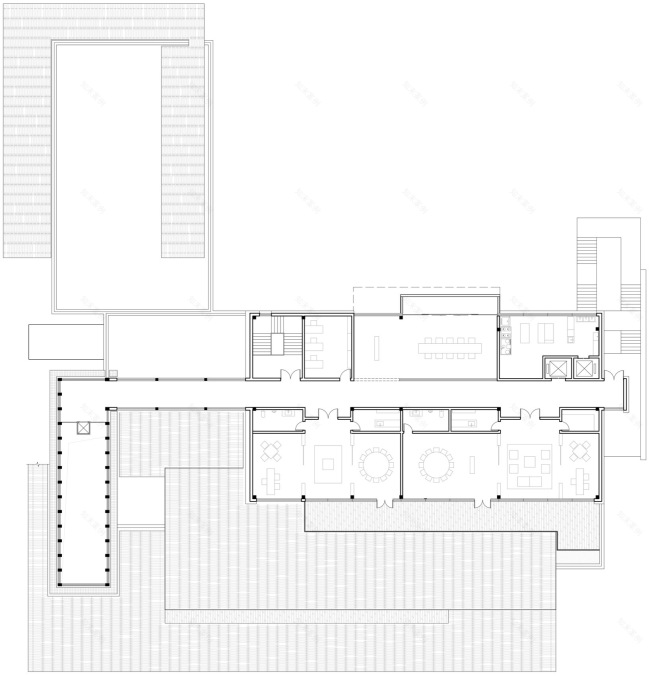
▼屋顶平面,roof plan©张·雷

▼剖面,section©张·雷
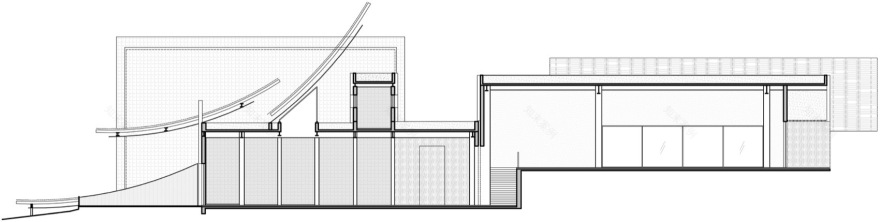
▼立面,elevation©张·雷


完整项目信息
项目名称:紫藤驿站
项目类型:公共建筑
项目地点:江苏南通
建设状态:建成
设计时间:2024年11月
建设时间:2025年9月
用地面积:3993平方米
建筑面积:2210平方米
设计单位:方案设计:张·雷设计研究 azLa
主创建筑师:雷晓华、张雷
设计团队:洪思遥、陈瀚
施工图设计:南京长江都市建筑设计股份有限公司:李欣、张驰、张荣昊、姜磊、黄凯、高跃进、李均、刘强、张工作、刘彩琴、谷加雷
项目业主:招商蛇口苏南公司
业主团队:顾苒、曹潇云、陈文晓、王立强、郎小龙、张翔、司磊、代怡婷、朱晓军、李清雅、恽伟东
摄影:邱文锏
南京喵熊网络科技有限公司 苏ICP备18050492号-4知末 © 2018—2020 . All photos and trademark graphics are copyrighted by their owners.增值电信业务经营许可证(ICP)苏B2-20201444 苏公网安备 32011302321234号
苏公网安备 32011302321234号客服
消息
收藏
下载
最近