

创作上传
VIP
收藏下载
登录 | 注册有礼
查看完整案例

收藏

下载

分享
在粤港澳大湾区与深圳先行示范区“双区驱动”背景下,前海智慧保税仓以“创新型标杆”为定位,突破传统仓储建筑仅是“功能容器”的形象,设计旨在将“文化性、地域性与时代性”与其融合,使其成为承载城市记忆、融入城市环境、引领物流建筑革新的立体地标。本项目以叙事手法和公建化的语言打破传统工业建筑的刻板印象,对承载物流运转的工业载体进行一场美学与功能融合的深度探索与实验。
© 徐勉
Against the backdrop of the dual-drive development of the Guangdong-Hong Kong-Macao Greater Bay Area and Shenzhen Pilot Demonstration Zone, the Qianhai Smart Bonded Warehouse is positioned as an innovative benchmark. It breaks away from the conventional image of storage buildings as mere “functional containers”. The design aims to integrate “cultural attributes, regional characteristics and contemporary relevance” into the structure, enabling it to evolve into a three-dimensional landmark that preserves urban memories, blends into the urban context, and leads the innovation of logistics architecture. Employing a narrative design approach and public building-style language, the project subverts the stereotypical perception of traditional industrial architecture. It represents an in-depth exploration and experiment that seamlessly integrates aesthetic value with functional performance for industrial carriers undertaking logistics operations.
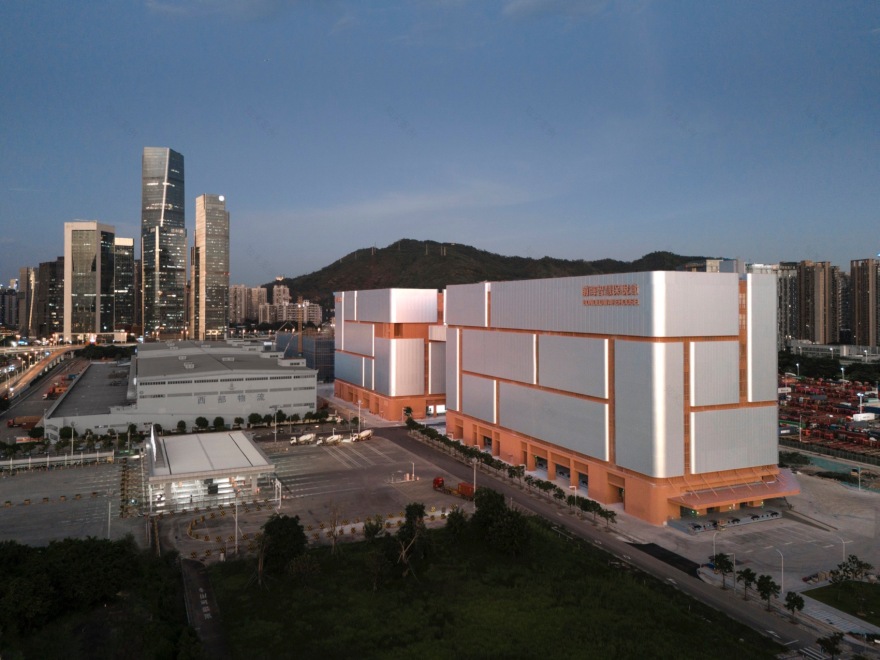
▼区域鸟瞰图,Aerial view of the area © 徐勉


▼鸟瞰图,Aerial view© 徐勉

一,项目区位——城央产业空间的双重诉求
I. Project Location: The Dual Demands of Urban Central Industrial Space
项目坐落于前海妈湾片区地理中心,地处大小南山西侧与珠江入海口东侧的黄金交汇点,海陆空联运网络发达,紧邻蛇口自贸区与前海中心。与传统仓储的边缘区位不同,这座建筑面积11.3万㎡、高60米的高大体量,直接坐落于城市发展核心区,其立面形象不仅关乎于自身功能,更紧密关联前海“国际化城市新中心”的整体风貌,必须从宏观的城市视角出发,回应城市肌理塑造与片区产业发展的双重高阶诉求。
▼区位分析图,site analysis© Architectural Design and Research Institute of SCUT Co., Ltd.

The project is located at the geographic center of the Qianhai Mawan Area, standing at the golden intersection west of the Greater and Lesser Nanshan Mountains and east of the Pearl River Estuary. Boasting a well-developed multi-modal transportation network integrating sea, land and air, it is in close proximity to the Shekou Free Trade Zone and Qianhai Central Business District. Unlike traditional warehouses that are usually situated on the urban fringe, this large-scale building – covering a floor area of 113,000 square meters and standing 60 meters high – is directly located in the core area of urban development. Its façade design is not only tied to its own functional requirements, but also closely linked to the overall urban landscape of Qianhai as a “new international urban center”. Therefore, it is imperative to formulate the design from a macro urban perspective to meet the dual high-end demands of urban texture construction and industrial development in the area.
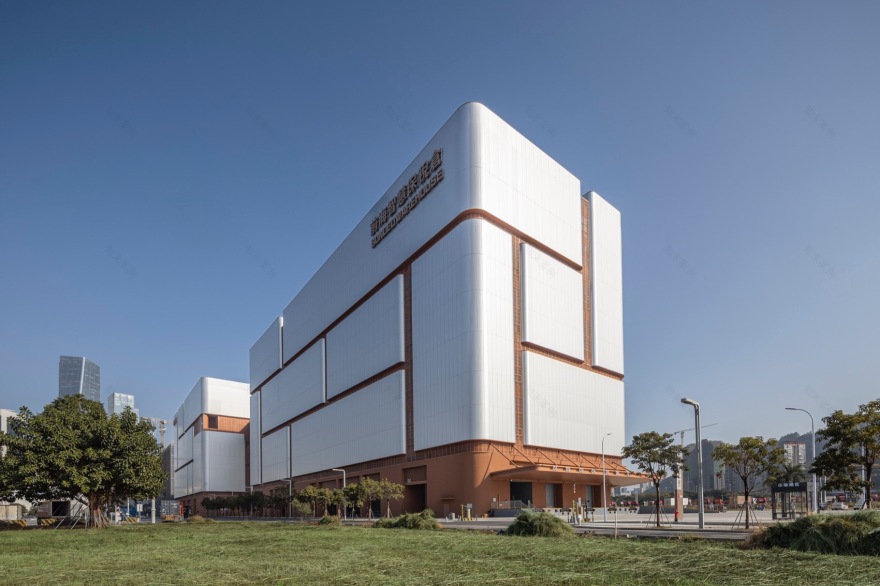
▼主入口方向透视图,Perspective view of the main entrance direction © 徐勉

二,传统仓储建筑困局——工业建筑的形象失语
II. Dilemma of Traditional Warehousing Buildings: The Loss of Identity in Industrial Architecture
前海妈湾片区现存大量仓储建筑,其普遍存在建筑体量庞大、立面单调、与城市环境割裂等问题,在前海核心片区的违和感尤为突出。这些封闭、沉闷、庞大的建筑群体,割裂了山、海、港、城的自然联动和视觉通廊,与前海片区城市风貌形成强烈反差。本设计从宏观城市、中观片区、微观建筑三个维度出发,构建功能、文脉与美学共生的建筑形态,让工业建筑融入城市肌理。
A large number of warehousing buildings are currently situated in the Qianhai Mawan Area, which generally suffer from issues such as unwieldy building volumes, monotonous facades, and disconnection from the urban context. These problems are particularly incongruous in the core area of Qianhai. Such enclosed, dull and bulky building clusters disrupt the natural connection and visual corridors between the mountains, sea, ports and the city, creating a stark contrast with the urban landscape of the Qianhai Area. This design proceeds from three dimensions: the macro urban level, the meso district level and the micro building level, to construct an architectural form where function, cultural context and aesthetics coexist in harmony, thereby integrating the industrial building into the urban texture.
▼立面透视图,Perspective view of the facade© 徐勉

三,项目核心设计策略——功能、形态与文脉的融合共生
III. Core Design Strategies of the Project: Integrated Coexistence of Function, Form and Cultural Context
形体与环境的融合——缝合地块,呼应山海
Integration of Form and Environment: Stitching the Site and Echoing the Mountains and Sea
项目用地被城市道路分割为两块用地,且受地铁道路退让影响,用地显得尤为紧凑且不规整。针对原两块地块割裂问题,设计通过功能性空中连廊实现物理与功能的双重串联,连廊融入深港地标建筑元素,强化门户形象,呼应湾区互联互通的时代理念。建筑整体形态顺应小南山与珠江入海口形成的山海生态通廊,以柔和体量呼应生态肌理,实现产业空间与山海环境的和谐共生与对话。
▼体块生成,Volume generation © Architectural Design and Research Institute of SCUT Co., Ltd.

The project site is divided into two separate parcels by urban roads and, constrained by the setback requirements for metro lines, appears particularly compact and irregular in shape.To address the fragmentation of the original two parcels, the design adopts functional aerial corridors to achieve both physical and functional connection. These corridors incorporate iconic design elements representing Shenzhen and Hong Kong, enhancing the project’s gateway image and echoing the contemporary concept of interconnection across the Greater Bay Area. The overall form of the building aligns with the mountain-sea ecological corridor formed by Lesser Nanshan Mountain and the Pearl River Estuary, with its soft and streamlined volume responding to the ecological texture, thus realizing the harmonious coexistence and dialogue between the industrial space and the mountain-sea environment.
▼低点透视图,Low-point perspective view © 徐勉


公建化转译——肌理重构与尺度消解
Public Building-style Transformation: Texture Reconstruction and Scale Neutralization
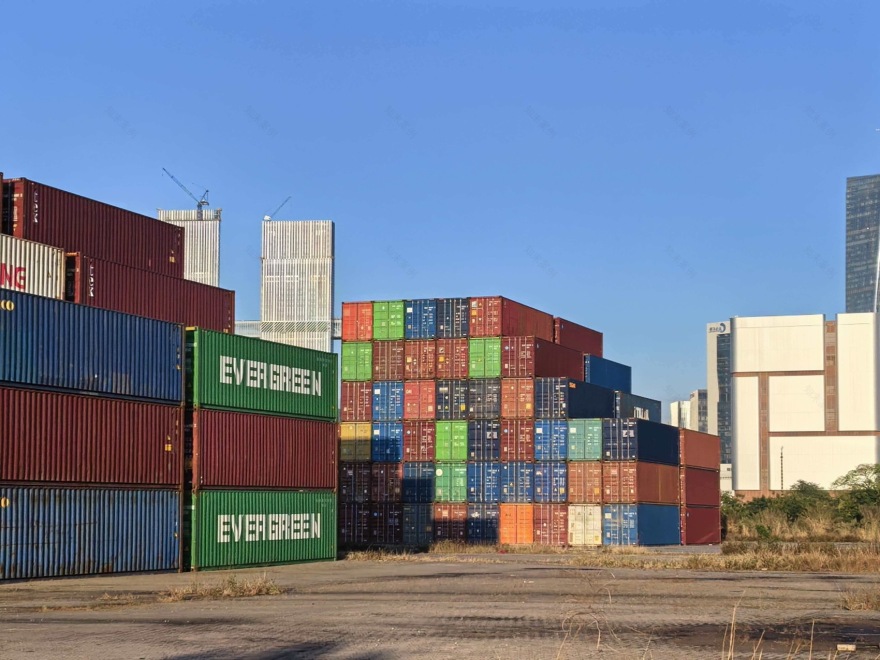
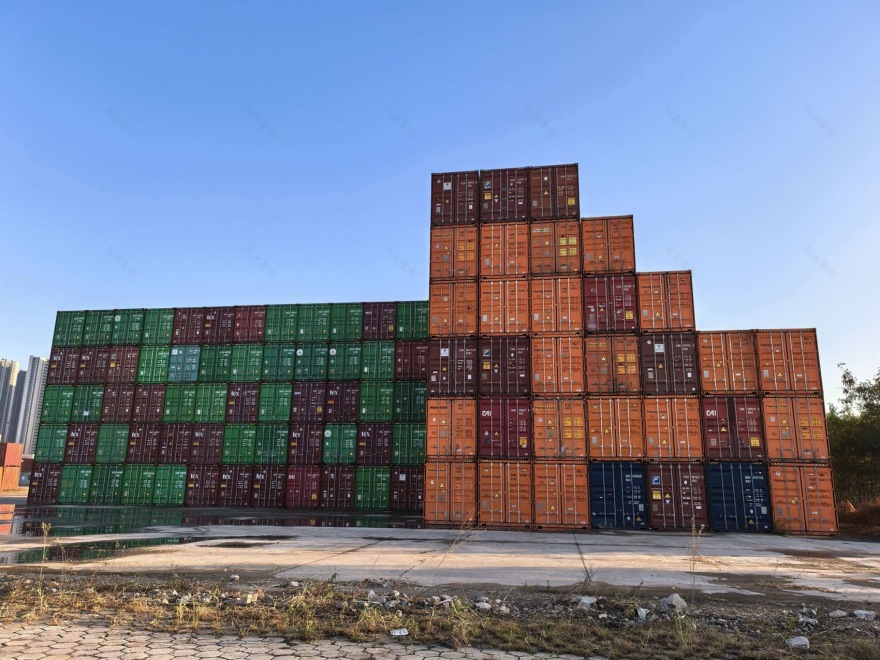
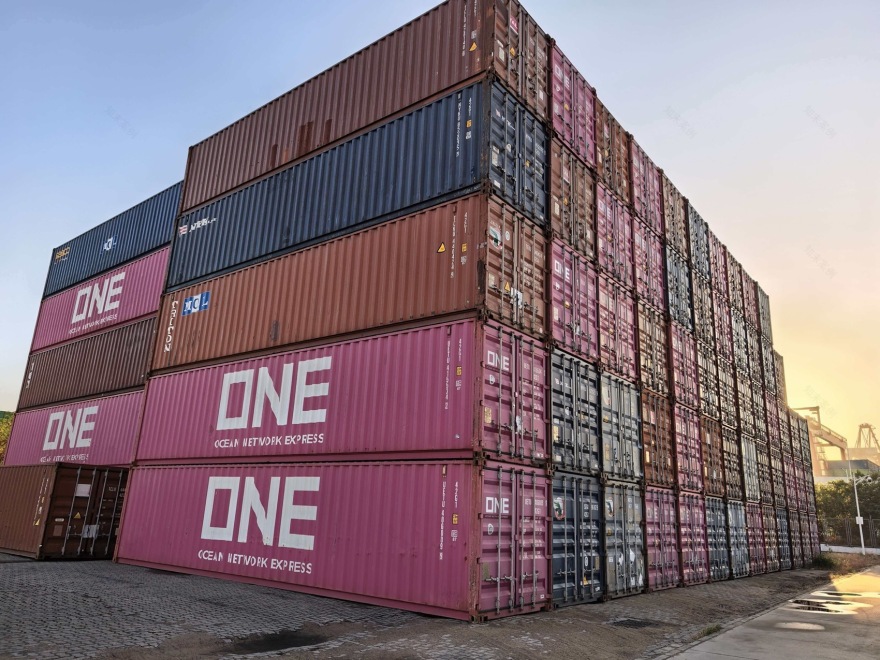
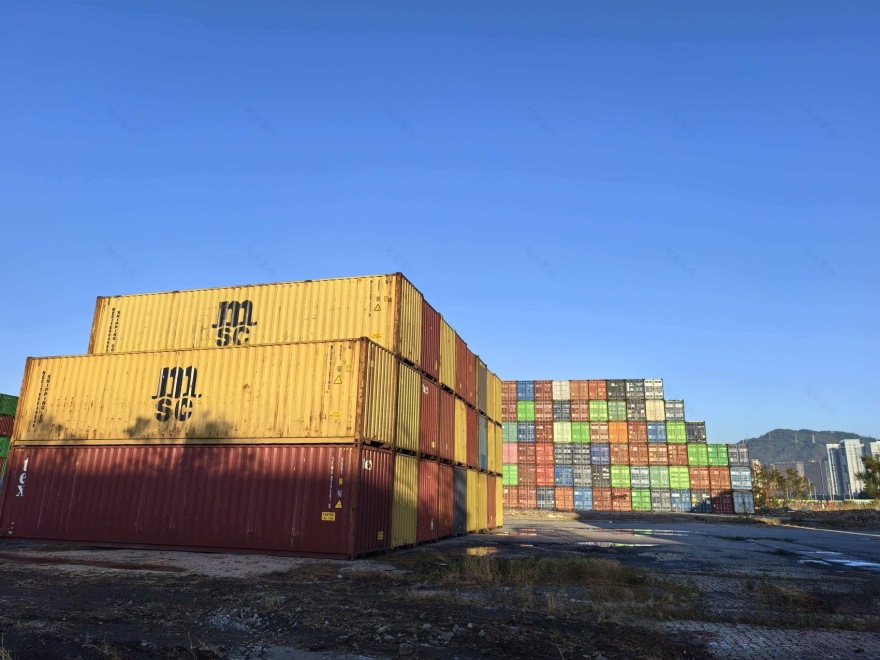
面对270m×72m×60m的庞大体量,如何消解视觉压迫感、避免工业建筑的刻板印象?设计团队从港口核心意象——“集装箱”中提取灵感,将其“堆叠”肌理与“集散”逻辑进行公建化转译。“集”象征前海物流枢纽的资源汇聚能力,“散”隐喻湾区物流的辐射联动,契合深港双城“集约、务实、高效”的城市精神内核。具体操作上,建筑被划分为基座与主体上部体块,上部体块按每两层横向切割为三等份,再进一步竖向切割为错动的形似“集装箱”的小体量立面单元,通过中小尺度的立体层次组合,打破了大尺度立面的沉闷感;立面单元转折处采用倒圆角设计处理,柔化工业建筑的硬朗棱角,减轻了视觉上的体量压迫感。
▼前海深港智慧保税仓项目立面方案概念分析,Conceptual Analysis of the Facade Scheme for theQianhai Smart Bonded Warehouse © Architectural Design and Research Institute of SCUT Co., Ltd.

Faced with the enormous volume of 270m × 72m × 60m, how to alleviate the visual imposingness and avoid the stereotypical impression of industrial architecture? The design team drew inspiration from the core symbol of ports – the container – and carried out a public building-style transformation of its stacking texture and distribution logic. The concept of “gathering” symbolizes the resource-converging capacity of Qianhai’s logistics hub, while “distribution” metaphorically represents the radiation and interconnection of logistics in the Greater Bay Area, which aligns with the core urban spirit of “intensiveness, pragmatism and efficiency” shared by Shenzhen and Hong Kong. In terms of specific implementation, the building is divided into a base and an upper main volume. The upper volume is horizontally split into three equal parts every two floors, and then further vertically segmented into staggered small-scale façade units resembling containers. The combination of three-dimensional layers in medium and small scales breaks the dullness of the large-scale façade. In addition, the turning points of the façade units are treated with rounded corner designs, which soften the rigid edges of the industrial building and reduce the visual sense of bulkiness.
▼集装箱,gathering

材料与工艺——实用与美学的平衡
Material and Craft – Balancing Practicality and Aesthetic
在严格的工期与造价控制下,设计团队经过多种材料对比,最终选用金属面绝热夹芯板为主材,该材料性价比优异、施工快捷、耐候性强,其曲面板块可单独根据设计需求灵活组合,最重要的是可实现建筑转角处的圆滑过渡,强化体量的连续性与韵律感。夹芯板采用凹凸式经典插口,融合岩棉的特点,达到防水、保温隔热性能和吸音降噪效果。板材顶和底用金属型材进行收边,既避免雨渍污染,又为隐藏灯线、勾勒建筑夜间轮廓创造了条件。
Under stringent constraints of construction period and cost, the design team conducted comparisons among various materials and ultimately selected metal-faced insulated sandwich panels as the primary building material. This material offers excellent cost-effectiveness, enables rapid construction, and boasts strong weather resistance. Its curved panels can be flexibly assembled individually according to design requirements; most importantly, it allows for smooth transitions at building corners, enhancing the continuity and rhythm of the overall volume. The sandwich panels adopt a classic concave-convex interlocking design and incorporate the properties of rock wool, achieving waterproofing, thermal insulation, and sound absorption and noise reduction performance. The top and bottom edges of the panels are trimmed with metal profiles, which not only prevent rain stain contamination but also create conditions for concealing light lines and outlining the building’s silhouette at night.
▼外观,appearance© 徐勉

精细化建造——从材料到细节的完成度把控
Meticulous Construction: Quality Control of Execution from Materials to Details
建筑方案落地的核心是细节把控,尤其是外立面的材料选型、工艺落地与系统整合,直接决定 “公建化工业建筑” 理念的呈现效果。本项目以简洁高效的方式构建全流程控制体系:
立面穿孔板既是装饰元素,也是功能载体。设计围绕 “柔化体量、呼应山海” 的核心,测试多种穿孔形态并做光影模拟,最终选定倒圆角形样式 —— 既呼应建筑整体圆角处理,又能在自然光下形成流动光斑,兼顾通风采光、设备隐藏功能与动态美感。为打破工业建筑的冰冷感,立面采用 “全宽缝 + 宽缝窄缝错动拼接” 工艺,通过凹凸对比让肌理更有层次。施工中严格控制曲面板块弧度误差、插口密封防水与收边型材安装精度,既保证实用功能,又确保夜间灯光轮廓的流畅性。
The core of the architectural scheme’s implementation lies in detail control. In particular, the material selection, construction technique implementation, and system integration of the facade directly determine the presentation effect of the “public building-style industrial architecture” concept. This project establishes a full-process control system in a concise and efficient manner: The facade perforated panels serve as both decorative elements and functional carriers. Centering on the core goal of “softening the building volume and echoing the mountains and sea,” the design team tested various perforation patterns and conducted light and shadow simulations, ultimately selecting the rounded corner shape. This not only echoes the overall rounded corner treatment of the building but also forms flowing light spots under natural light, achieving a balance between ventilation, daylighting, equipment concealment functions, and dynamic aesthetic appeal. To break the coldness of industrial architecture, the facade adopts the “full-width joints + staggered splicing of wide and narrow joints” technique, creating a more layered texture through concave-convex contrast. During construction, strict control is exercised over the curvature error of curved panels, the sealing and waterproofing of joints, and the installation accuracy of edge-trim profiles—ensuring both practical functionality and the fluency of the building’s illuminated silhouette at night.
▼立面,facade © 徐勉


▼立面局部,Partial facade© 徐勉


一体化的设计——从功能、设备、形体到标识的系统化设计思维
Integrated Design: A Systematic Design Thinking Covering Function, Equipment, Form and Signage
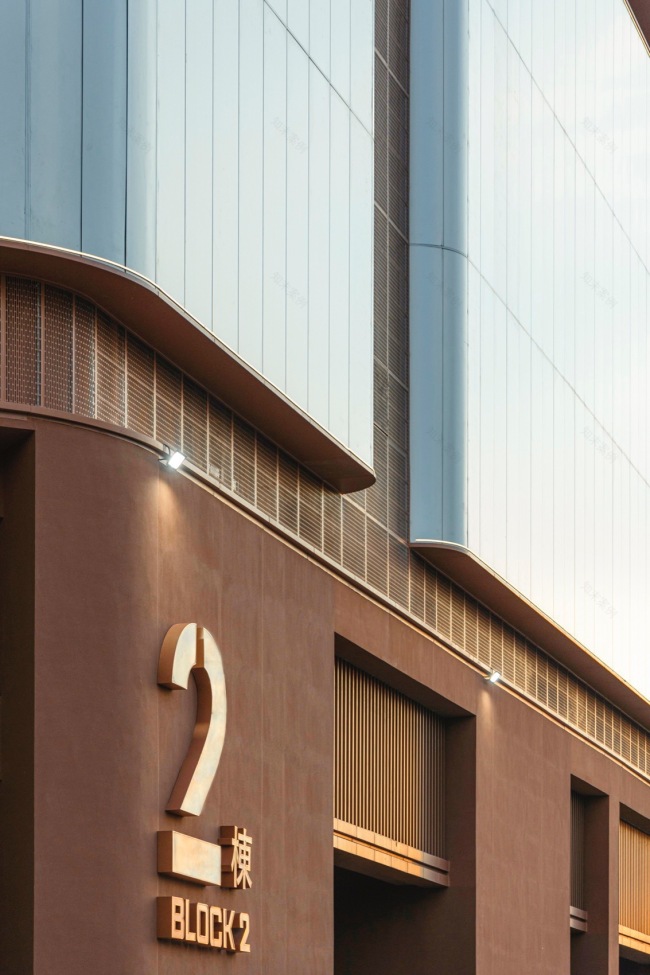
秉持 “建筑即整体” 的设计思维,实现多维度系统整合:摩卡色穿孔板统一覆盖设备功能槽,巧妙隐藏通风口、消防窗等设施;外墙设备按立面网格模数精准定位;标识系统从方案初期便融入设计,字体、尺寸、颜色与立面肌理高度契合,实现了从建筑到细节的一体化集成,避免后置添加的突兀感。
Adhering to the design philosophy of“the building as an integrated whole”, the project achieves multi-dimensional system integration: Mocha-colored perforated panels uniformly cover the equipment functional slots, subtly concealing facilities such as ventilation openings and fire windows; the external wall equipment is precisely positioned according to the modular grid of the facade; the signage system has been integrated into the design from the initial stage of the scheme, with the fonts, sizes and colors highly compatible with the facade texture. This achieves integrated integration from the building’s overall form down to its details, avoiding the abruptness caused by retrofitted additions.
▼材料细部,material details© 徐勉
四,价值延伸——从功能容器到公共窗口
IV. Value Extension: From Functional Container to Public Window
建筑超越了单一的仓储功能,为未来预留了公共性接口。通过规划参观通道、物流科普展区等,建筑可转化为展示现代物流技术与深港合作成果的公共文化窗口。建筑不再只是物流运转的载体,更成为连接产业与城市、技术与人文的桥梁,实现了社会价值、经济价值与文化价值的综合延伸——让工业空间不仅有“效率”,更有“温度”。
▼仓库,Warehouse© Architectural Design and Research Institute of SCUT Co., Ltd.

Transcending its single function as a warehouse, the building reserves public interfaces for future development. By planning visitor routes and logistics science popularization zones, it can be transformed into a public cultural window that showcases modern logistics technologies and the achievements of Shenzhen-Hong Kong cooperation. No longer merely a carrier for logistics operations, the building has evolved into a bridge connecting industry with the city, and technology with humanity. It has thus achieved the comprehensive extension of social, economic and cultural values – endowing industrial spaces with not only“efficiency”but also“warmth”.
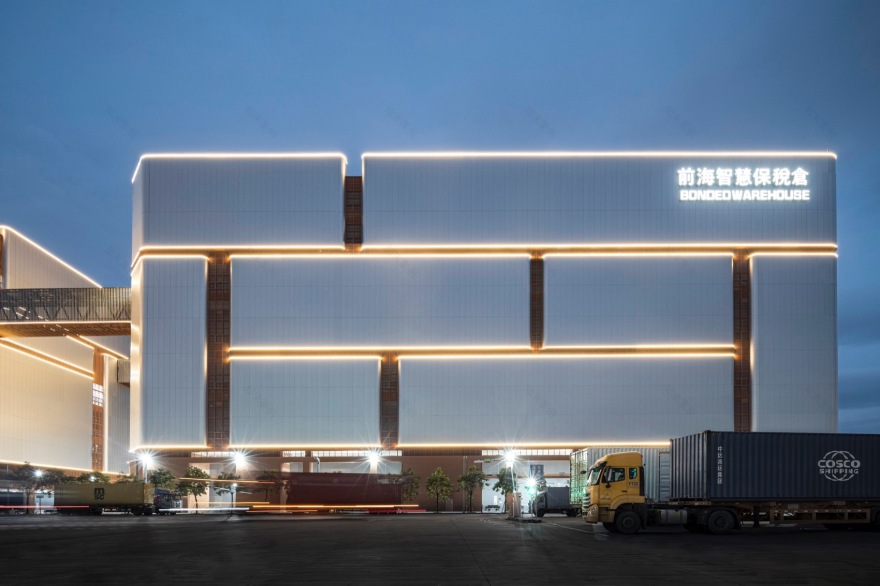
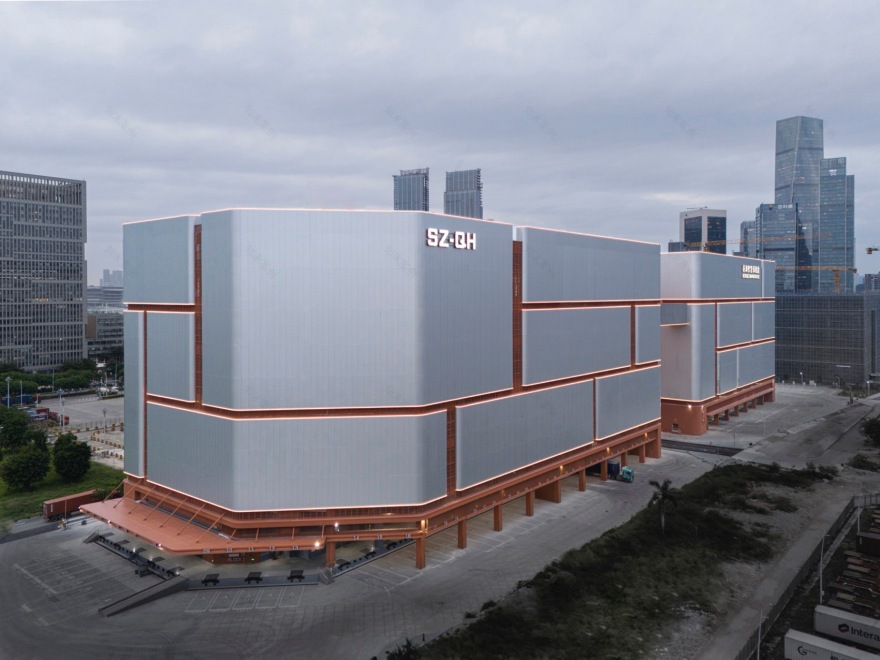
▼夜景鸟瞰图,Aerial viewof the night scene© 徐勉


▼夜景透视图,Night view perspective © 徐勉


结语:
Conclusion:
前海智慧保税仓项目是一场以公建化的语言和设计思维重塑工业建筑美学的实验,以城市共融的策略、立面革新的转译、一体化精细设计,将传统仓储从普通的“功能容器”升级为“承载文脉、彰显活力”的城市地标,打破了传统仓储建筑在城市中的刻板印象,实现了“物流效率、人文温度、城市美学”的三重统一,以积极形象融入了城市核心区,以崭新的姿态迎接城市未来发展。作为特定场域下的创新实践,本项目不仅为深圳前海增添一座有社会担当、有品质、有价值的建筑作品,更为全国仓储类工业建筑的品质提升与风貌转型,提供了具有借鉴价值的一体化设计策略与价值示范。
The Qianhai Smart Bonded Warehouse project is an experiment in reshaping industrial architecture aesthetics through the language and design thinking of civic facilities. Employing strategies of urban integration, innovative facade translation, and integrated, meticulous design, it elevates traditional storage from a commonplace “functional container” to an urban landmark that “carries context and emanates vitality.” It breaks the stereotypical impression of traditional storage buildings in the urban context and achieves a triple unity of “logistical efficiency, humanistic warmth, and urban aesthetics.” Integrating positively into the city core with a renewed form, it embraces future urban development. As an innovative practice within a specific context, this project not only adds a socially responsible, high-quality, and valuable architectural work to Shenzhen’s Qianhai but also provides a referential integrated design strategy and value paradigm for enhancing the quality and transforming the style of storage-type industrial buildings nationwide.
▼过程模型,progress model© Architectural Design and Research Institute of SCUT Co., Ltd.
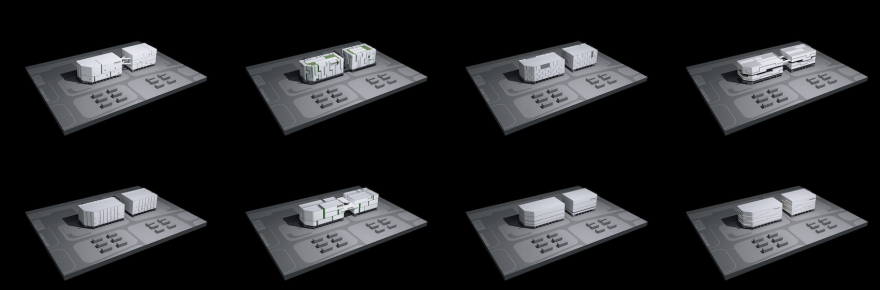
▼模型,model© Architectural Design and Research Institute of SCUT Co., Ltd.


▼总平面图,master plan© Architectural Design and Research Institute of SCUT Co., Ltd.

▼立面图纸,elevation© Architectural Design and Research Institute of SCUT Co., Ltd.

,▼墙身+平面,wall plan© Architectural Design and Research Institute of SCUT Co., Ltd.

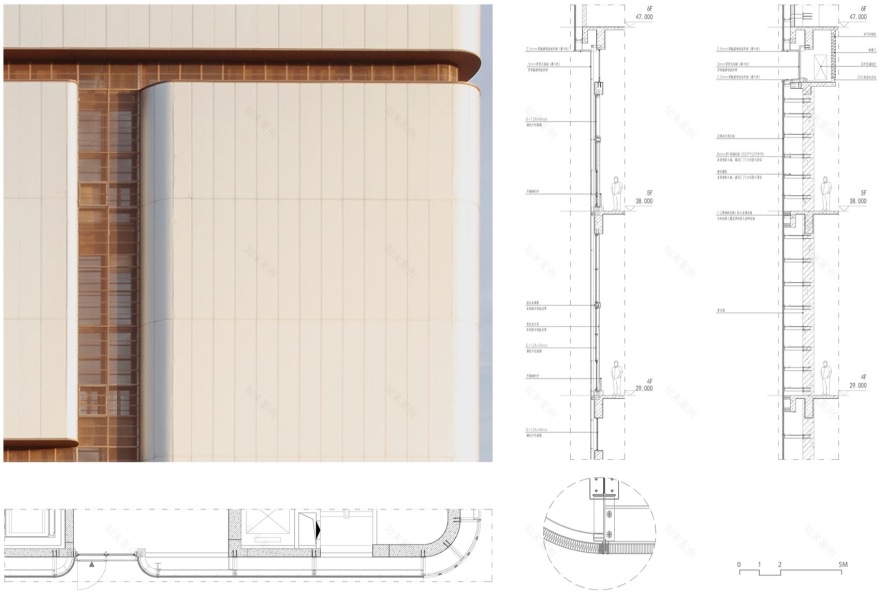
▼盖板节点分析图,Cover plate node analysis diagram © Architectural Design and Research Institute of SCUT Co., Ltd.

▼圆弧段分析图,Analysis diagram of arc segments© Architectural Design and Research Institute of SCUT Co., Ltd.

项目名称:前海智慧保税仓
项目类型:工业建筑
建筑立面方案设计方:华南理工大学建筑设计研究院有限公司
项目设计:2023年11月
完成年份:2025年07月
主持建筑师:盘育丹 王人玉
设计团队:陈桂涛 郭菁儿 钟语 郑常波 曾宪策 张贤杰
项目地址:深圳市前海综合保税区
建筑面积:113000㎡
建设单位:深圳市前海产业发展集团有限公司
业主团队总负责:彭警 孙海萍 张峰玮
工程顾问单位:深圳市中联建工程项目管理有限公司
造价咨询单位:永信和瑞工程咨询有限公司
施工单位:中国建筑第八工程局有限公司
施工图设计单位:中国航空规划设计研究总院有限公司
监理单位:和天(湖南)国际工程管理有限公司
勘察单位:中国建筑西南勘察设计研究院有限公司
材料:金属面绝热夹芯板 穿孔板 铝板
摄影版权:徐勉
Project Name: Qianhai Smart Bonded Warehouse
Project Type: industrial building
Architectural Scheme Design: Architectural Design and Research Institute of SCUT Co., Ltd
Email:
Design Time: November 2023
Completion Time: July 2025
Principal Architects: Pan Yudan, Wang Renyu
Architecture Design: Chen Guitao,Guo Jinger, Zhong Yu, Zeng Xiance, Zheng CHangbo, Zhang Xianjie
Project Address: Qianhai Comprehensive Bonded Zone, Shenzhen
Gross built area:113000㎡
Construction Unit:Shenzhen Qianhai Industrial Development Group Co.,Ltd.
Head of the Owner’s team: Peng Jing, Sun Haiping, Zhang Fengwei
Engineering Consultant Unit: Shenzhen Zhonglianjian Engineering Project Management.,LTD.
Cost Consulting Unit: Yongxinherui Engineering Cosulting Co.,Ltd.
Construction Unit: CHINA Construction Eighth Engineering Division CORP.,LTD
Construction Drawing Design Unit: CHINA Aviation Planning And Design Institute (Group) CO.,LTD
Supervision Unit: Hetian (Hunan) International Engineering Management Co.,LTD
Survey Unit: CHINA Southwest Geotechnical Investigation & Design Institute Co.,LTD
Material: Metal-faced insulated sandwich panel, perforated board, aluminum plate
Photography copyright: Xu Mian






南京喵熊网络科技有限公司 苏ICP备18050492号-4知末 © 2018—2020 . All photos and trademark graphics are copyrighted by their owners.增值电信业务经营许可证(ICP)苏B2-20201444 苏公网安备 32011302321234号
苏公网安备 32011302321234号客服
消息
收藏
下载
最近