

创作上传
VIP
收藏下载
登录 | 注册有礼
查看完整案例

收藏

下载

分享

翻译
Architects:AzulPitanga
Area:146m²
Year:2025
Photographs:Igor Ribeiro
Lead Architects:André Moraes, Carolina Mapurunga
Category:Residential Architecture,Houses
Coordination:André Moraes, Carolina Mapurunga
Project Team:Andressa Gomes, Thomaz Soares, Rute Millene
General Construction:Beca
Engineering & Consulting > Environmental Sustainability:Ciçô
City:Buíque
Country:Brazil
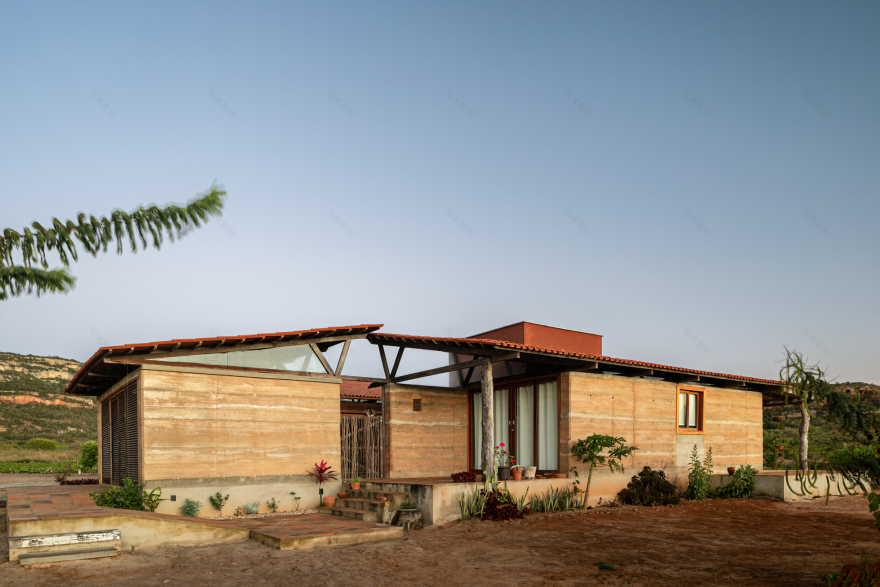
Text description provided by the architects. Located in the municipality of Buíque, in the interior of Pernambuco, Casa Catimbau is situated within the Catimbau National Park, the second largest archaeological conservation unit in Brazil, and one of the most representative areas of the caatinga.


The project proposes an architecture that engages in direct dialogue with the territory: open to natural ventilation, protected from sunlight, built with locally available materials, and oriented by the daily uses of its inhabitants.

Composed of four autonomous blocks organized around a courtyard, the house proposes a decentralized way of living that values being outdoors and the construction of personal time. The rammed earth walls, made with local soil, provide form and mass to the walls. The wood, sourced from the reuse of an old shed in the region, structures light and ventilated roofs.

More than just occupying the space, the house seeks to belong to it—silent, earthy, made from what was available nearby, aligned with the sky and the ground.
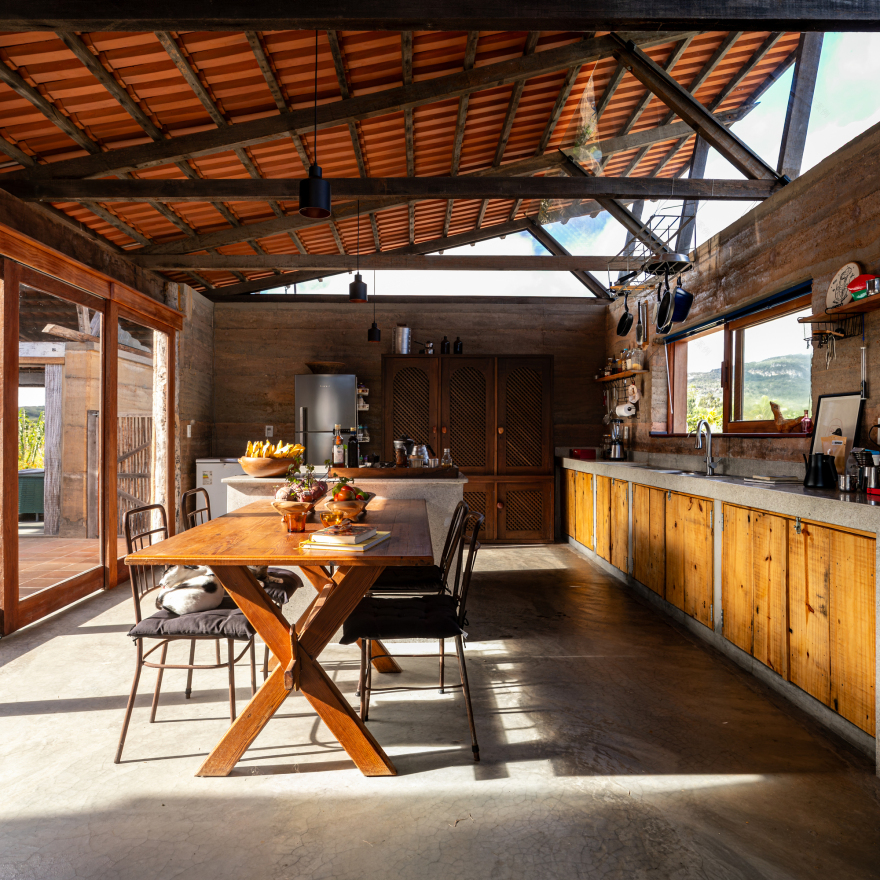
Party. Instead of a single volume, the house is fragmented into four modules: kitchen, bedroom, bathroom, and living room/cinema. Each with its own autonomy of use, each with its own relationship with the landscape. Between them, the courtyard serves as a meeting space.

Implementation and Materiality. Casa Catimbau responds directly to the conditions of a "hot world": intense sun, low humidity, thermal variation, and limited water resources. The implementation considers solar orientation, water capture and management, passive thermal comfort, and the use of low-impact materials.

The main construction system is rammed earth, chosen both for the availability of local soil and for its thermal capacity. The thickness of the walls ensures insulation during the day and gradual heat release at night, stabilizing the internal temperature with minimal artificial resources.

The roofs, supported by structures made of reused wood, are sloped to guarantee cross ventilation and shading of the walls. Continuous gaps under the upper eave allow the escape of accumulated hot air, a simple and efficient strategy for the natural cooling of the house.

In terms of water use, the architecture proposes solutions that are coherent with the semi-arid climate, such as rainwater harvesting for an underground cistern. Furthermore, the house adopts decentralized treatment solutions, with ecological systems:
Without a conventional sewage system, the project understands that water is a resource to be treated locally, not as waste, but as a cycle. This technical choice reduces environmental impact, reverses the logic of treating this water as waste to become a source for gardens without energy expenditure, and strengthens the territory's autonomy in the face of inadequate public infrastructure.

More than just meeting sustainability requirements, the house proposes another logic: an architecture that starts from the climate, the scarcity, and the local abundance, offering integrated solutions, without excess, without waste, and with coherence.

Mais do que atender a exigências de sustentabilidade, a casa propõe outra lógica: uma arquitetura que parte do clima, da escassez e da abundância local, e oferece respostas integradas, sem excessos, sem desperdício, com coerência.

Project gallery


南京喵熊网络科技有限公司 苏ICP备18050492号-4知末 © 2018—2020 . All photos and trademark graphics are copyrighted by their owners.增值电信业务经营许可证(ICP)苏B2-20201444 苏公网安备 32011302321234号
苏公网安备 32011302321234号客服
消息
收藏
下载
最近