

创作上传
VIP
收藏下载
登录 | 注册有礼
查看完整案例

收藏

下载

分享
川菜之味,尽在“麻辣鲜香”四字。而川菜之魂,系于一味传承三百年的酱香:豆瓣。它孕育于成都西北部的郫都区——这里地处都江堰核心灌溉区,是天府农耕文明的沃土、川西林盘场景的典范。在这片土地孕育的农田林木之中,豆瓣博物馆悄然融入,以现代坡顶为形,取意院落空间,诠释着建筑与林盘共生的本质。
The essence of Sichuan cuisine is defined by four sensations: numbing, spicy, umami, and aromatic. Yet, its soul is anchored in a savory legacy passed down for three centuries: Douban (broad bean paste). The museum originates in the Pidu District of northwest Chengdu—the core irrigation zone of the Dujiangyan system. This fertile land, a cradle of agrarian civilization, is a paragon of the Linpan landscape (traditional wooded farmsteads) in Western Sichuan. Nestled amidst cultivated fields and woodlands, the Douban Museum integrates subtly into its context. Adopting a modern pitched roof form inspired by traditional courtyards, the architecture interprets the symbiosis between the built environment and the Linpan.
▼ 博物馆整体鸟瞰,overall aerial view of the museum © 404NFSTUDIO

融入林盘的建筑体量控制
Architectural Massing Integrated with the Linpan
场地所在的安德镇,是都江堰精华灌溉区,传统的农耕文化和现代酱料工厂于此交融,仿佛不经意间呼应着川西林盘间次而生的肌理。木竹环绕,田间农舍是这里的生态本底——保护这份场地的人文与自然生态,是项目贯穿始终的出发点。
The site is located in Ande Town, within the prime irrigation area of Dujiangyan. Here, traditional farming culture intersects with modern sauce production, echoing the organic, interwoven texture of the Western Sichuan Linpan. Surrounded by woodlands and bamboo, with farmhouses dotting the fields, the site possesses a strong ecological foundation. Protecting this cultural and natural ecology became the project’s guiding principle.
▼ 博物馆鸟瞰近景,Aerial close view of the museum© 404NFSTUDIO

保留生态本底:基地中有大量现状树木竹林,设计之初将其中胸径大于20厘米的树木和丛生竹子标识出来,希望结合景观现状融入场地,保留场地的生态本底。建筑体量主动避让、环绕其间,形成“屋在竹中”的共生画面。▼ 现场植被梳理,on-site vegetation survey © CSWADI

Preserving the Ecological Substrate: The site features dense vegetation, including mature trees and bamboo groves. During the initial design phase, trees with a diameter at breast height (DBH) greater than 20cm and clumping bamboo were identified for preservation. The design aims to integrate these elements, allowing the building mass to actively weave around them, creating a symbiotic scene of “a house amidst bamboo.”
▼ 博物馆俯瞰图,overhead view of the museum © 404NFSTUDIO

控制建筑体量:博物馆总建筑面积约7200平方米。为最大限度地弱化地上体量,将主要功能及后勤用房置于地下,地面仅保留约三分之一体量,作为门厅与临时展厅使用,实现“化大为小”的策略。在高度尺度上,建筑严格控制在15米内,恰好能让场地四周的水杉露出冠顶,建筑掩映在林木之间,以一种低伏、平和的姿态融入林盘天际线,避免了对田园视野的突兀切割。借由三片交错的屋顶,依循场地原有的地形起伏和自然脉络蜿蜒展开。▼ 主要功能置于地下,main functions placed underground © CSWADI
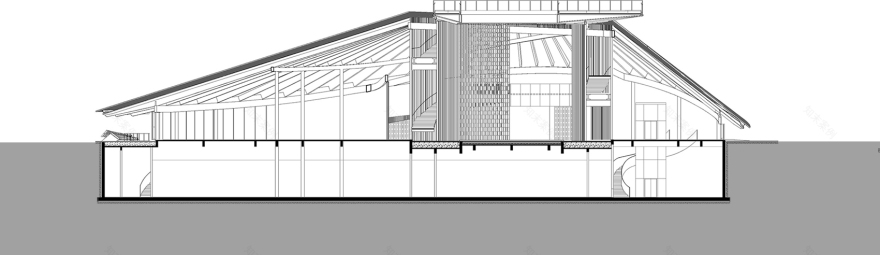
Massing Strategy: The museum has a total floor area of approximately 7,200 square meters. To minimize its visual impact, main functional and service spaces are placed underground. Only about one-third of the volume—housing the lobby and temporary exhibition halls—remains above ground, effectively “breaking down the large into small.” The building height is strictly controlled within 15 meters, allowing the surrounding metasequoia trees to crown the roof. Nestled among the trees, the building merges into the Linpan skyline with a low-profile, humble posture, avoiding any abrupt disruption of the pastoral vista. Three interlocking roof forms unfold along the site’s natural topography and undulations.
▼ 林盘田野中的博物馆,the museum in the Linpan landscape © 404NFSTUDIO

坡屋顶的当代化表达
Contemporary Expression of the Pitched Roof
成都平原传统民居的坡屋顶,有着“深出挑,薄封檐”的轻盈而自由的造型。博物馆的设计从形体、色彩与建构三个层面展开细腻的推敲,融入川西林盘自然生态的空间肌理。▼ 博物馆实体模型细部,details of the physical model © CSWADI


The pitched roofs of traditional dwellings on the Chengdu Plain are known for their lightweight, free-form elegance, characterized by “deep cantilevers and slender eaves.” The museum’s design meticulously reinterprets this vernacular through form, color, and tectonics, weaving it into the spatial fabric of the Linpan’s natural ecology.
▼ 交叠的坡屋顶,interlocking pitched roofs © 404NFSTUDIO

坡屋顶:这里林盘上民居的坡屋顶,多为适应常年湿热多雨的特点。针对这一传统基因的当代化转译,将传统民居的坡屋顶的经典形态当代化、艺术化。项目从自北向南逐渐抬升的田地为出发点,以一个豆瓣般的椭圆曲面作为屋面主体,北侧一片小屋面从场地上升至展厅屋顶,南侧的小屋面嵌入下沉庭院。三片屋面与地形的变化相呼应,相互交叠,尽显川西屋顶的轻盈自由。
▼ 不同角度的坡顶分析,pitched roof analysis from different angles © CSWADI

Pitched Roof Morphology: The local pitched roofs are an adaptation to the region’s hot, humid, and rainy climate. Translating this traditional DNA into a contemporary context, the design modernizes and artisticizes the classic form. Responding to the terrain that rises from north to south, the main roof takes the shape of an elliptical, bean-like curved surface. A smaller roof on the north rises from the ground to the exhibition hall, while a southern roof embeds itself into the sunken courtyard. These three planes respond to topographical changes, overlapping to express the lightness and freedom typical of Western Sichuan architecture.
▼ 坡屋顶的现代转译,modern translation of the pitched roof © 404NFSTUDIO

彩椒:传统屋面的小青瓦被创新性的“彩椒”元素替代。屋面装饰的“彩椒”灵感来源于辣椒从成熟到风干过程中自然呈现的色彩演变——由绿转红,再由红渐黑。历经半年的反复打样与调试,我们最终提取出四种关键色,并确定其在屋面上的构成比例:红色(30%)、深红(36%)、墨绿(14%)与深灰(20),以随机方式分布于屋面。在形态上,设计抽象自“二荆条辣椒”的截面轮廓,以直径80毫米的铝合金圆管为基础单元,其间随机穿插直径140毫米的放大圆管,以增强屋顶的视觉层次与动态变化。整个屋顶共由一万八千余根长短不一、色韵交织的“彩椒”圆管构建而成,犹如将无数辣椒轻洒于建筑之上。这一设计既延续了传统建筑的神韵,又赋予了屋顶鲜明的当代质感与审美意趣。
▼ 辣椒色谱分析图,chili pepper color spectrum analysis diagram © CSWADI

▼彩椒洒落屋顶意向,concept of colorful peppers scattered on the roof© CSWADI

Chromatic Pepper Elements: Traditional grey tiles are replaced by innovative “colorful pepper” elements. The inspiration comes from the natural color transformation of chili peppers during ripening and air-drying—shifting from green to red, and gradually to black. After six months of prototyping, four key colors were selected and distributed randomly across the roof: red (30%), deep red (36%), dark green (14%), and dark gray (20%). In form, the design abstracts the cross-section of the local “Erjingtiao” chili. Using 80mm diameter aluminum alloy tubes as the basic unit, larger 140mm tubes are interspersed to enhance visual hierarchy and dynamism. The entire roof is composed of over 18,000 “pepper” tubes of varying lengths and interwoven hues, appearing as if countless chilies were lightly scattered atop the building. This design retains the charm of traditional architecture while imbuing the roof with a distinct contemporary texture and aesthetic.
▼ 彩椒细节,details of colorful pepper elements © CSWADI

建构:传统川西建筑以穿斗式木结构屋架为主,项目胶合木梁为骨,望板和封檐板采用竹木装饰条,还原传统材料又满足当代的建构需求。结构在钢柱顶端以双曲钢环梁支撑木结构,既满足博物馆大空间的需求,又最大化利用了木梁的力学特性。钢环梁的布置不仅与建筑平面布局形成统一,以环形框架与屋面每一圈的金属彩椒划分形成深度关联:金属彩椒的划分线条沿钢环梁的曲线轨迹自然延伸,精准适配,使结构框架不再是隐藏于表皮之下的 “骨架”,而是与造型表皮相互诠释、彼此强化的整体。
▼ 屋顶结构分析图,roof structure analysis diagram © CSWADI

Tectonics: While traditional Western Sichuan architecture relies on the “Chuandou” (column-and-tie) timber frame, this project utilizes Glulam (glued laminated timber) beams as the primary structure. Bamboo-wood decorative strips are used for the roof sheathing and fascia, recalling traditional materials while meeting modern construction standards. Structurally, double-curved steel ring beams atop steel columns support the timber roof. This hybrid system accommodates the museum’s large-span requirements while maximizing the mechanical properties of the wood. The arrangement of the steel ring beams aligns with the floor plan and forms a deep connection with the roof’s cladding: the division lines of the metal “peppers” naturally extend along the curvature of the ring beams. This ensures the structural framework is not merely a skeleton hidden beneath the skin, but an integral part of the whole, mutually reinforcing the form.
▼ 彩椒及屋顶细节,details of colorful pepper elements and roof © 404NFSTUDIO

川味院落的空间再现
Spatial Reinterpretation of Sichuan-Style Courtyards
川西林盘中民居的院落和天井,不仅仅是“四水归堂”的礼仪延伸,围绕其生活的檐廊、堂屋也是市民生活的重要场所。
The courtyards and skywells of Western Sichuan Linpan dwellings are more than just the ritualistic “Si Shui Gui Tang” (Four Waters Returning to the Hall); the eaves, corridors, and main halls surrounding them are vital spaces for daily life.
▼ 主入口连接中心院落,main entrance connecting to the central courtyard © 404NFSTUDIO

中心院落:博物馆的正中的空间延续“院落”的意境,四壁围合而顶部开敞的空间形态,打破水平向的空间局限,创造出强烈的向上延伸感。中心院落也是博物馆空间流线组织的核心,人流由城市里到达从这里进入序厅参观,观展结束后又回到这里走向田野,围绕中心院落的水景大家相聚于此,交流洽谈,再现院落内“摆龙门阵”的生活场景。
▼ 中心院落概念,central courtyard concept © CSWADI
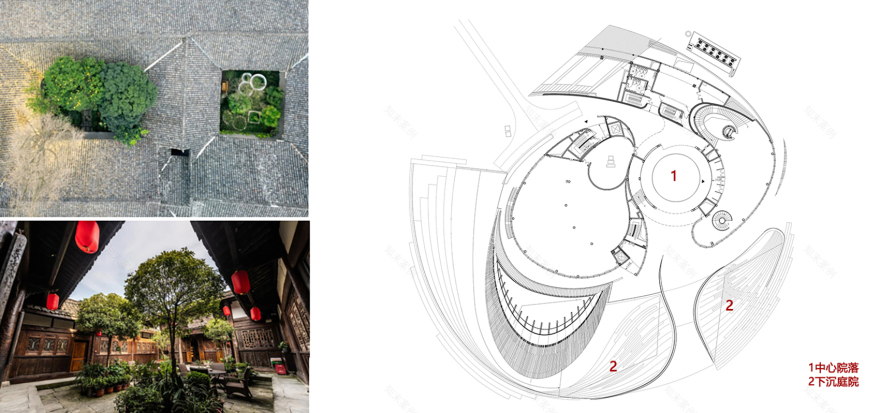
Central Courtyard: The museum’s central space continues the “courtyard” typology. Enclosed by four walls yet open to the sky, it breaks horizontal spatial limitations, creating a strong sense of verticality. This central courtyard serves as the core of the museum’s circulation. Visitors arrive from the city, enter the lobby, and after viewing the exhibitions, return here before walking out towards the fields. Gathering around the central water feature for conversation recreates the lively “Bai Longmenzhen” (social chatting) scene typical of Sichuan courtyards.
▼ 中心院落及木质格栅,central courtyard and wooden grille © 404NFSTUDIO
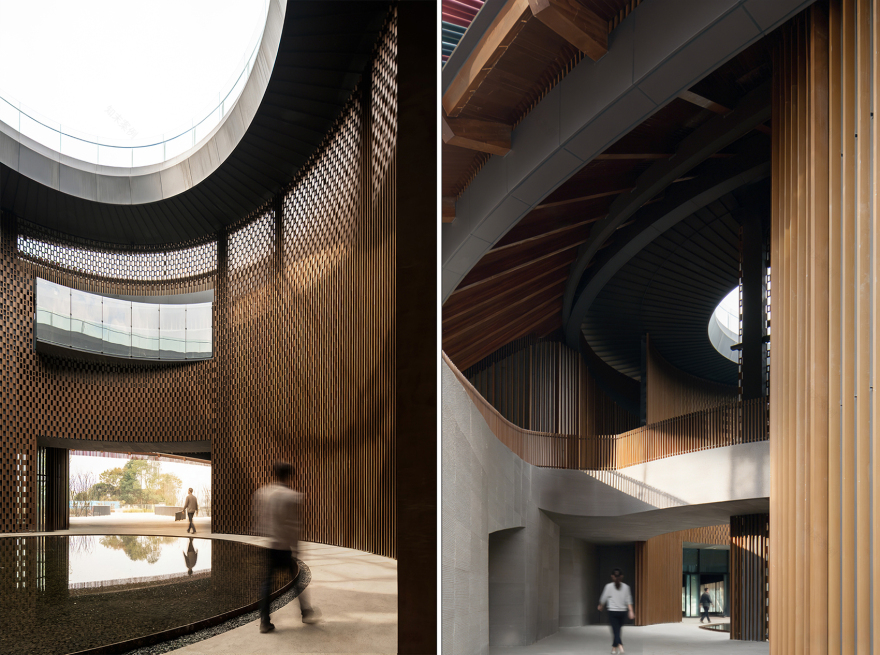
围绕中庭的弧形楼梯,让自然光线透过格栅洒落踏步,形成斑驳流动的光影效果,引导人拾级而上,可抵达屋顶平台俯瞰这片田野。既延续了传统建筑 “借景自然、虚实相生” 的意境,又为当代展示空间注入了温润的生命力。
A curved staircase surrounding the atrium allows natural light to filter through the grille, casting dappled, flowing shadows on the steps. It guides visitors upward to the roof platform for a panoramic view of the fields. This design continues the traditional concept of “borrowing scenery” and the interplay of void and solid, infusing the contemporary exhibition space with a warm, human-scale vitality.
▼ 下沉庭院俯瞰,view into the sunken courtyard © 404NFSTUDIO

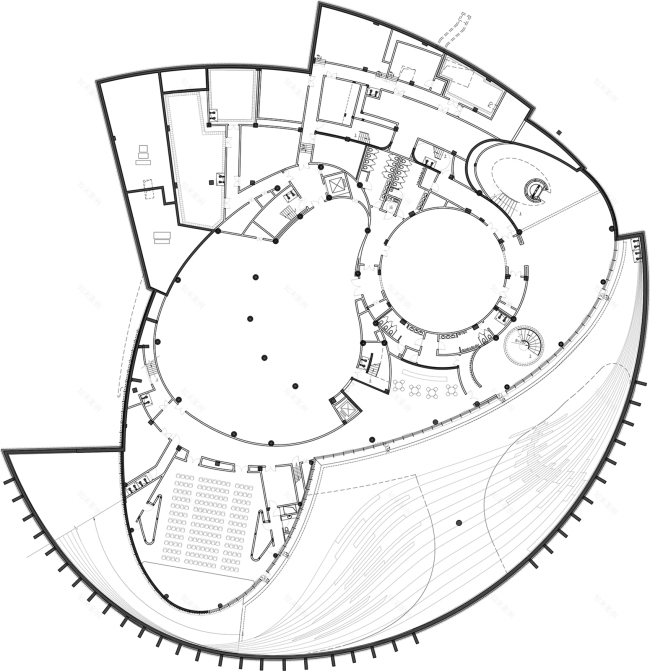
下沉庭院:朝南的场地下挖形成一处月牙状的庭院,为负一层的多功能厅和公共空间引入自然采光。逐级跌落的绿阶让人参观结束后便可一览绿意,采用水洗石一体成型的踏步与砾石场地,不经意融入大田景观,诠释自然朴素的川味美学。
Sunken Courtyard: A crescent-shaped courtyard is excavated on the south side, introducing natural light to the multi-functional hall and public spaces on the basement level. Terraced green steps allow visitors to immerse themselves in greenery immediately after their tour. The monolithic washed-stone steps and gravel paving blend effortlessly with the vast field landscape, interpreting the natural and rustic aesthetic of Sichuan.
▼ 下沉庭院空间,sunken courtyard space © 404NFSTUDIO

结语
Conclusion
如豆瓣粒洒落田间的博物馆,宛若天成般嵌入川西林盘“农田为底、宅院为图”的自然环境。彩椒的屋面构成独具辨识度的“椒顶”,延续林盘舒缓坡屋顶特征,适配盆地气候,以现代手法演绎屋面层级关系,再现错落生动的形态特质。从胶合木的榫卯意趣到竹格栅的光影叙事,本土材质与现代技艺在碰撞中共生,让林盘基因与豆瓣文化深度交融。为川西建筑的在地创新写下生动注脚。
Like Douban grains scattered in the fields, the museum is naturally embedded in the Western Sichuan Linpan environment, where “fields form the background and dwellings act as the figure.” The chromatic roof creates a distinctive “Pepper-Top,” extending the gentle pitched roof typology of the Linpan and adapting to the basin climate. Using modern techniques to interpret roof hierarchies, the design recreates a staggered, lively form. From the structural logic of Glulam joinery to the light-and-shadow narrative of bamboo grilles, local materials and modern craftsmanship coexist. The project allows Linpan genes and Douban culture to deeply integrate, writing a vivid footnote for the vernacular innovation of Western Sichuan architecture.
▼ 总平面图,site plan © CSWADI

▼ 首层平面图,first floor plan © CSWADI

▼ 地下一层平面图,basement floor plan © CSWADI
▼ 南立面图,south elevation © CSWADI

▼ 西立面图,west elevation © CSWADI

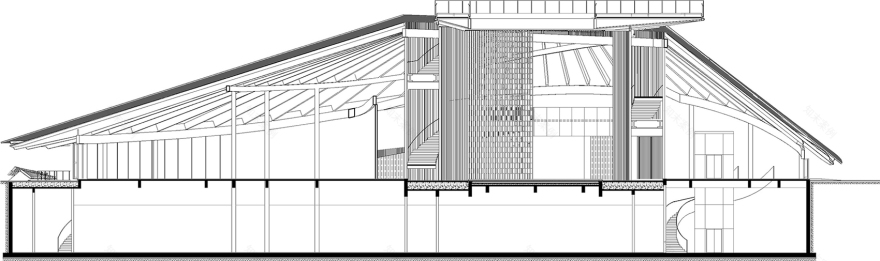
▼ 剖面图,section © CSWADI
项目地点| 成都市郫都区安德街道棋田村
项目业主| 成都蜀都文化旅游投资发展有限公司
设计时间| 2022年12月
建成时间| 2025年12月
用地面积| 7021.60平方米
建筑面积| 6765.10平方米
设计单位| 中国建筑西南设计研究院有限公司 郑勇工作室+建筑工业化设计研究中心
设计总负责人| 郑勇、陈嘉乐
建筑专业| 续文琪、张入介、王依璇
结构专业| 龙卫国,雷雨,陈迪,李波,欧加加,陈远意
给排水专业| 马腾飞、樊旭、韩勇、范曰飞、郭礼宝、安婓
暖通专业| 李权、任星晔、钟磊、聂贤、方宇
电气专业| 李慧、王星楠、李倩、敖发兴、徐建兵、王少伟、吴寰
幕墙专业| 殷兵利、张国庆、魏海龙
建筑技术| 陈俊、罗晶、窦枚
景观设计| Yudao studio昱道景观
摄影|404NFSTUDIO
Project Location: Qitian Village, Ande Subdistrict, Pidu District, Chengdu
Client: Chengdu Shudu Cultural Tourism Investment Development Co., Ltd.
Design Period: December 2022
Completion Time: December 2025
Site Area: 7,021.60 sqm
Floor Area: 6,765.10 sqm
Design Unit: China Southwest Architectural Design and Research Institute Corp. Ltd. – Zheng Yong Studio + Building Industrialization Design and Research Center
Design Principals: Zheng Yong, Chen Jiale
Architectural Design: Xu Wenqi, Zhang Rujie, Wang Yixuan
Structural Design: Long Weiguo, Lei Yu, Chen Di, Li Bo, Ou Jiajia, Chen Yuanyi
Plumbing & Drainage Design: Ma Tengfei, Fan Xu, Han Yong, Fan Yuefei, Guo Libao, An Fei
HVAC Design: Li Quan, Ren Xingye, Zhong Lei, Nie Xian, Fang Yu
Electrical Design: Li Hui, Wang Xingnan, Li Qian, Ao Faxing, Xu Jianbing, Wang Shaowei, Wu Huan
Curtain Wall Design: Yin Bingli, Zhang Guoqing, Wei Hailong
Building Technology: Chen Jun, Luo Jing, Dou Mei
Landscape Design: Yudao Landscape Design
Photography: 404NFSTUDIO
南京喵熊网络科技有限公司 苏ICP备18050492号-4知末 © 2018—2020 . All photos and trademark graphics are copyrighted by their owners.增值电信业务经营许可证(ICP)苏B2-20201444 苏公网安备 32011302321234号
苏公网安备 32011302321234号客服
消息
收藏
下载
最近