

创作上传
VIP
收藏下载
登录 | 注册有礼
查看完整案例

收藏

下载

分享

翻译
WEIQUE TAVERN | 65㎡ Bar Interior, Shanghai
Project Information
Location: Shanghai, China
Project Type: Bar Interior Renovation
Scope: Interior Design, Spatial Strategy, Construction Coordination
Area: 65㎡
Seating Capacity: 24 seats (standard), expandable to 38-40 seats (peak)
Timeline: Design started Sept 2024, Construction Oct 2024, Phased delivery before opening
Design & Site Coordination: ArchIntera Lab / INF Studio
Photography: ALTNVISION
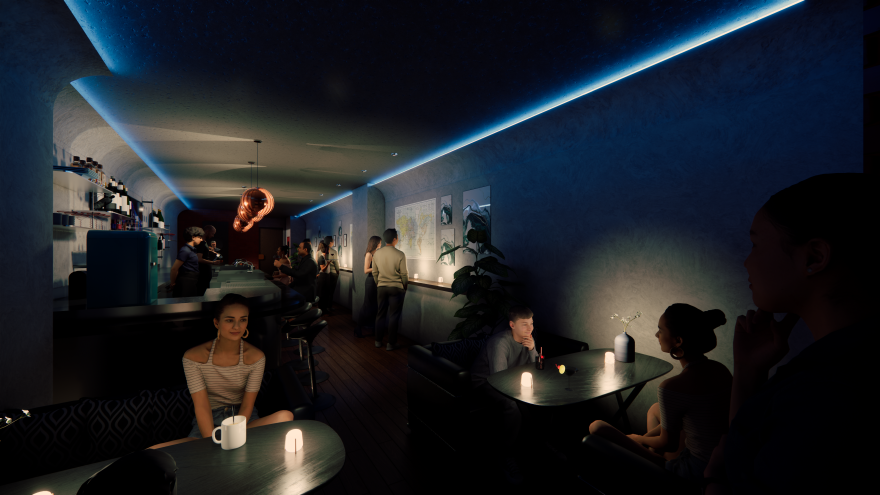
Using the bar counter as a spatial spine, transforming a narrow space into a continuous journey, establishing clear service logic and recognizable nighttime atmosphere.


Street Facade & Recognition
Street presence requires clear identification. Entrance information concentrates on signage and opening interface. Facade combines brick and wood, emphasizing continuity with interior. Windows reveal partial back-of-house operations, enhancing authenticity and nighttime appeal.


Design Challenge
Under an approximately 65 sqm footprint and a long, narrow plan, the project had to address three issues at the same time. First, the depth from the entrance to the back could easily split the experience into disconnected front and rear zones. Second, within a limited frontage, guest circulation and staff service paths tend to cross and create bottlenecks. Third, in a small tavern, operational efficiency for prep, making, serving, and clearing is critical. Any redundant movement is amplified at the level of daily operation.
The design responded with two strategies. First, the bar counter was used to build the spatial spine, forming a readable route and a stable social interface. Second, a tight material palette was used to carry the light environment. A serialized lighting layout established a depth rhythm and a recognizable night atmosphere.

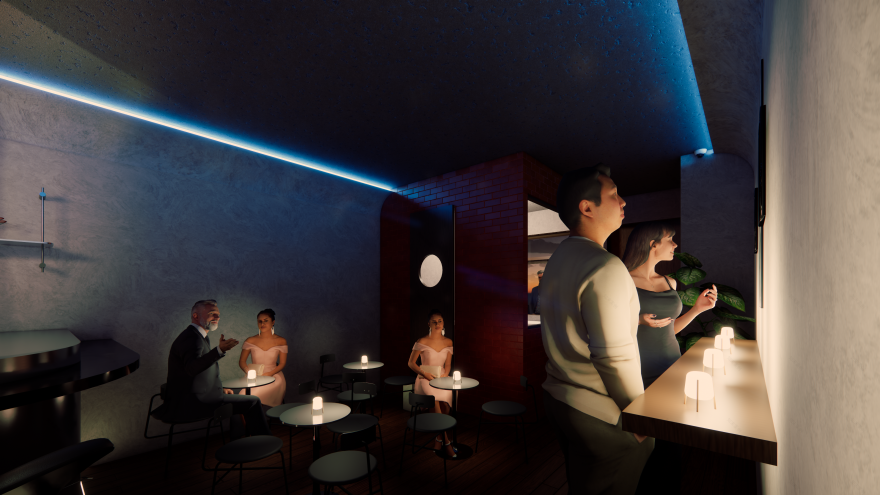
Concept
In many contemporary food and hospitality interiors, space is often asked to prove its value: better service, higher quality, stronger atmosphere, higher price. WeiQue chooses the opposite direction. This project questions the meaning of “good reviews” itself. Many positive reviews today are formulaic and emotionally neutral. What WeiQue values is not how high the score is, but whether the experience is real, diverse, and honestly expressed. This stance fundamentally shaped the spatial concept. The space does not try to leave a “strong impression.” It does not actively guide emotion, nor does it predefine a perception route. It functions more as a container, allowing use, interruption, misunderstanding, and judgment to happen.
Design Philosophy
This project did not begin with the pursuit of a specific style. At the brand level, WeiQue Tavern deliberately adopts a stance that does not seek easy approval. Low ratings and negative reviews are kept, and openly discussed as part of the brand narrative. Rather than pursuing a single, uniformly positive image, the brand allows contradiction and emotional complexity to coexist. The spatial design does not attempt to correct this strategy. It aligns with it. Located in a high-traffic area of Shanghai, INS New World Club near Fuxing Park, the project was initiated in late September under an extremely compressed schedule, with design and construction proceeding in parallel. On-site conditions were complex. Dense and intersecting ceiling services significantly reduced clear height. Under the pressure to open before Halloween, the design focus shifted from expression to preservation. The brand’s principles, “embracing imperfection, acknowledging vulnerability, seeking truth,” were translated into a set of practical decisions in space. “Embracing imperfection” meant giving up the pursuit of a clearly defined refinement. The space avoids excessive decoration, while retaining traces of manual work and conditions that remain partly unresolved. White and warm grey form the primary palette, not as a “safe neutral,” but to allow light, movement, and behavior to define the space. “Acknowledging vulnerability” meant accepting constraints as real. The ceiling avoids formal gestures and instead organizes all systems within a unified logic. Air conditioning, fire protection, and lighting no longer compete for visual dominance. Restraint replaces emphasis. “Seeking truth” is expressed through use. The bar counter is not shaped as a stage, but as a fully exposed workbench, or a competitive table. Two bartenders operate with different menus that rotate in phases and by season. The space deliberately avoids distance and refuses emotional scripting.
Design here does not explain. It provides a container for a position.


On-Site Realization:
Construction and operation in an unfinished state
Construction was a continuous process of adjustment. Ceiling services were extremely dense, and site conditions changed frequently. Design decisions were refined through constant coordination with the construction team. On Halloween night, the bar opened while still under construction. Some details remained unresolved. This was not an ideal scenario, but it aligned closely with the brand’s character. At that moment, the space revealed its most honest state: it was being used, not presented. The bar operated as a workplace, with guests, bartenders, equipment, and sound collectively forming the spatial content. The unfinished state brought a kind of honesty. Limitations were not concealed, and there was no claim of "final statement." This project is not a demonstration of completion. It is a response to reality. Here, design is not an endpoint, but a form of participation
Materials & Surfaces
Material selection follows "minimal and stable" principle:• White walls: carry light and shadow, maintain clean feel• Wood flooring: directional to reinforce depth perception• Brick volume: structural memory point, spatial divider• Metal-wood combination: durable bar interface


Spatial Organization & Circulation
Space unfolds in three stages: entrance, middle, depth.
The entrance segment provides the first decision point upon arrival, reducing hesitation.
The middle section organizes primary seating and ordering behaviors around the bar counter. Guest circulation wraps around the outside of the bar.
Service circulation closes inside the bar, forming a continuous workflow: prep, make, serve, collect.
This organization aims to minimize intersection points. When foot traffic increases, guests still complete ordering and seating in a single direction, while staff complete closed-loop operations inside the bar, reducing congestion and wait times.


Lighting & Atmosphere
Spatial recognition comes from two light sources: • Bar work surface lighting: emphasizes precision and detail • Pendant light sequence: emphasizes rhythm and depth
Continuous pendant lights transform 18m depth into "followable rhythm." Colored lamp shades create memorable light layers on white walls.


Bar Counter System
The bar is not just a surface, but a working system divided into four zones: • Prep zone: frequently-used materials within reach • Production zone: water, power, equipment concentrated • Service zone: clean customer-facing interface • Collection zone: maintains surface order and hygiene
Rounded corners at bar ends: • Smoother traffic flow in narrow space • Natural pause points for standing socializing

Seating Strategy & Flexible Capacity
Daily seating is organized around the bar counter, supported by a limited number of small tables and a more private sofa zone toward the back. This arrangement enables quick seating for solo guests, pairs, and small groups.
Peak-time capacity relies on two flexible seating points. Along the wall, a continuous counter ledge supports both standing and the temporary addition of bar stools, allowing seat count to increase quickly. Small tables can also be freely rearranged into denser groupings when needed.
Under this expansion mode, circulation remains continuous and comfortable. The primary passage is kept along the outer side of the bar to reduce cross-traffic and head-on conflicts, so service efficiency and basic safety margins remain relatively stable during peak hours.
Drawing Phase
During the drawing phase, priority was given to order rather than form.
The floor plan emphasizes operational efficiency and communication flow. The bar occupies a central position without forming a visual hierarchy. Seating dimensions and circulation are based on actual use rather than visual density.
A unified flat ceiling strategy was adopted to preserve perceived height. Unified horizontal control and linear air outlets reduce visual compression. Mechanical, fire protection, lighting, and maintenance systems are all coordinated within a single logic.
Lighting balances function and atmosphere. Base illumination meets safety and work requirements, while focused lighting defines the bar workspace. Warm color temperatures support presence rather than performance.
These drawings were made for execution, not for complexity.
Lessons Learned & Designer’s Reflection
This project reaffirmed that design does not always emerge from complete conditions. Within a highly constrained timeline, the designer’s role shifts toward prioritization over resolution. Not every limitation requires resolution—some constraints are intrinsic to spatial reality and should remain visible.
The ceiling complexity highlighted that spatial quality does not rely solely on formal expression. Order, proportion, and continuity often prove more effective than decorative interventions. Through system coordination rather than additive form-making, spatial clarity can be established even with limited clear height.
The relationship between brand narrative and spatial expression is not a simple translation. Space does not need to explain brand concepts—it needs to support behavior. When operational logic is clear, brand character becomes perceptible through use.
An "unfinished" state does not indicate design failure. Allowing real operation to expose issues creates a clearer foundation for future refinement. Design does not need to present a final answer at opening.
This project reinforces that interior design is about outcomes and decision-making itself. Making restrained and precise choices under real conditions is a central part of professional practice. Here, the space leaves room for judgment—approval, disappointment, or critique all valid.
南京喵熊网络科技有限公司 苏ICP备18050492号-4知末 © 2018—2020 . All photos and trademark graphics are copyrighted by their owners.增值电信业务经营许可证(ICP)苏B2-20201444 苏公网安备 32011302321234号
苏公网安备 32011302321234号客服
消息
收藏
下载
最近