

创作上传
VIP
收藏下载
登录 | 注册有礼
查看完整案例

收藏

下载

分享
Transformative Densification
Arteconomy

If there would be a place where opposites -old/new, in/out, owner/guest, definite/indefinite- cease to be such, what would it look like? A place of productive doubt, of vital ambiguity?
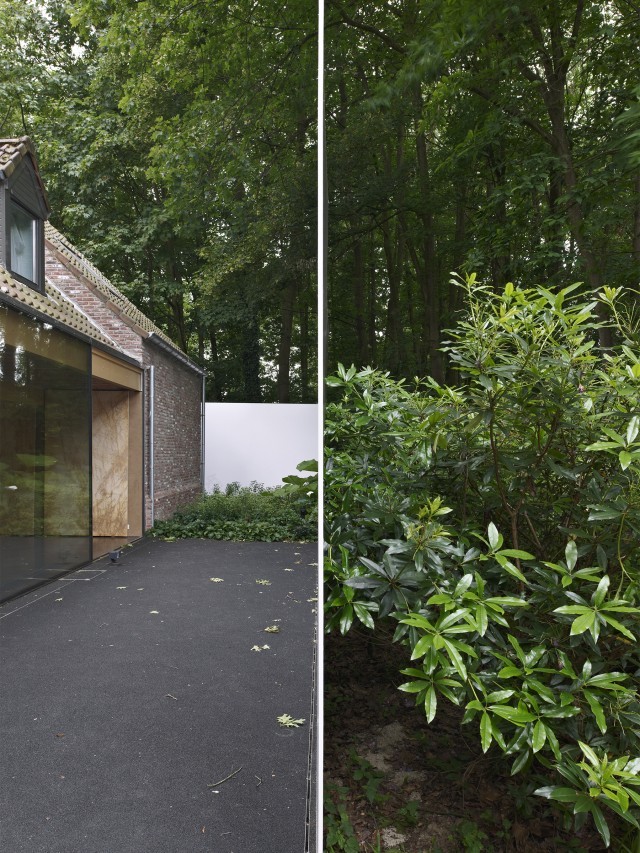
The idyllic forest location is marked by an existing house, which badly mimics the typical 19th century Belgian farmhouse. The sole quality of this construct, built some twenty years ago, is its containment of the client’s history, both their family life and artistic life. After two decades of homeliness they had, however, outgrown their habitat, mentally and physically. There were but two restrictions to the assignment: the house couldn’t be torn down and the client wished to continue to live in it during its (re)construction. In turn, two radical interventions were proposed both aiming at opening up the house: gutting the interior and walling the exterior. As a result a new set of spatial and social relationships - still to be deciphered - could arise.
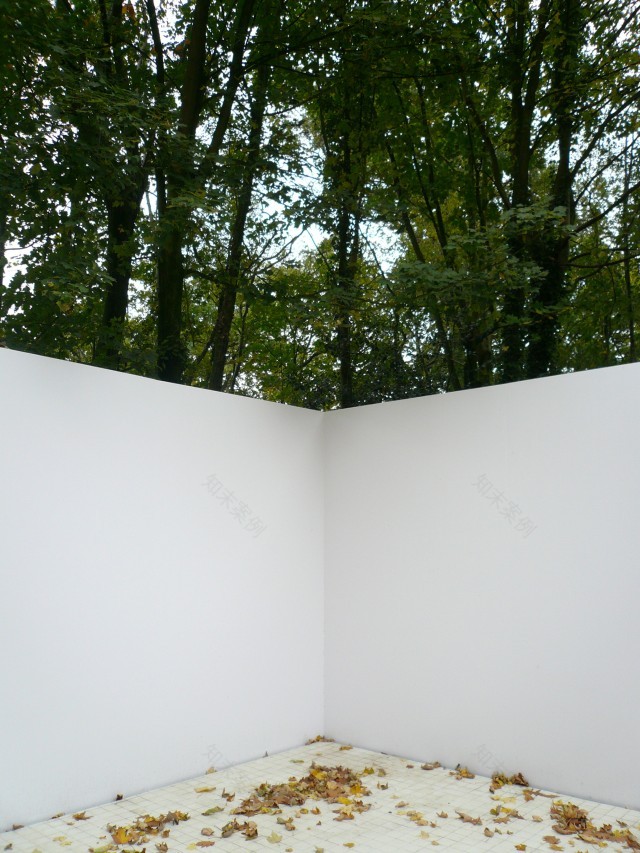
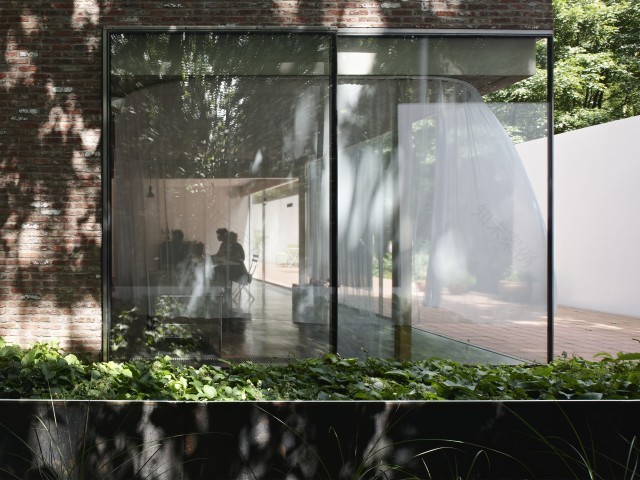
The steel wall (12 millimeters thick, 3 meters high, 70 meters long) recollects an up-scaled sheet of paper: a wall too thin to protect, too unstable to divide, though capturing views and patterns of light that were always there but never framed. The gutting of the interior has literally cleansed the house, opening up a serpentine space that is foreign to both domestic dimensions and expectations. By the same logic the front door was abolished and replaced by a fifty-centimeters slit to lure people in. The steel wall acts as an interchange between the house and its context, blurring limits in all directions. Once “inside”, stepping through the steel wall’s opening, a protected space partially covered by tree crowns unfolds itself. Painted off-white on the interior, the steel catches the filtered daylight and projects it deep into the serpentine space. The forest, garden, interior and exterior become part of the same spatial sequence: one open, continuous and tactile atmosphere where - day and night - the light feels endless and almost ritual.
The open-ended character of the house is reinforced by the finishing and the detailing of the new “walls”. Seen from the inside the white steel delineation represents an eye-challenging series of abstract planes intercut by faraway and close by landscape fragments. Due to the fact that the new glass surfaces are conceived as frameless panes, the eye’s focus is challenged moreover, abolishing the immutability and enclosure of the single-family house for good. On the outside the steel wall has kept its original patina, a dark-blue grey nearing to black, abstracting the existing house’s remnants when seen from the “outside”. Back “inside”, the new serpentine space is dominated by a monumental and uncanny daybed, where visitors and inhabitants can install themselves at their own convenience.
Location
St-Elois Winkel, Belgium
Client
Private
Invited competition
2004
Completion
2009
51N4E project team
Johan Anrys, Freek Persyn, Peter Swinnen, Sotiria Kornaropoulou, Joost Körver, Bob De Wispelaere, Philippe Nathan, Kelly Hendriks, Emmanuel Debroise
51N4E involvement
Lead Architect
Structural engineer
BAS/ Dirk Jaspaert
Façade
Van Santen & associates
Interior
Daybed: Julie Vandenbroucke / 51N4E / Chevalier-Masson
Landscape
Denis Dujardin
Construction management
Krist Denorme
Construction cost (excl. VAT)
undisclosed
Programme
Single family house, exhibition private art collection
Site surface
3.100 m²
Built surface
350 m²
Image credits
51N4E




南京喵熊网络科技有限公司 苏ICP备18050492号-4知末 © 2018—2020 . All photos and trademark graphics are copyrighted by their owners.增值电信业务经营许可证(ICP)苏B2-20201444 苏公网安备 32011302321234号
苏公网安备 32011302321234号客服
消息
收藏
下载
最近