

创作上传
VIP
收藏下载
登录 | 注册有礼
查看完整案例

收藏

下载

分享
Shaping Space and Light: Roberto di Donato on Dome House
“There’s something deeply satisfying about connecting contemporary projects to these ancient material traditions.”
Dome House by Roberto Di Donato is a bold transformation of a Victorian home in London, blending historical charm with modern minimalism. The design centres on creating a calm, meditative space filled with light, openness, and a strong connection to nature, while preserving the home’s original character.
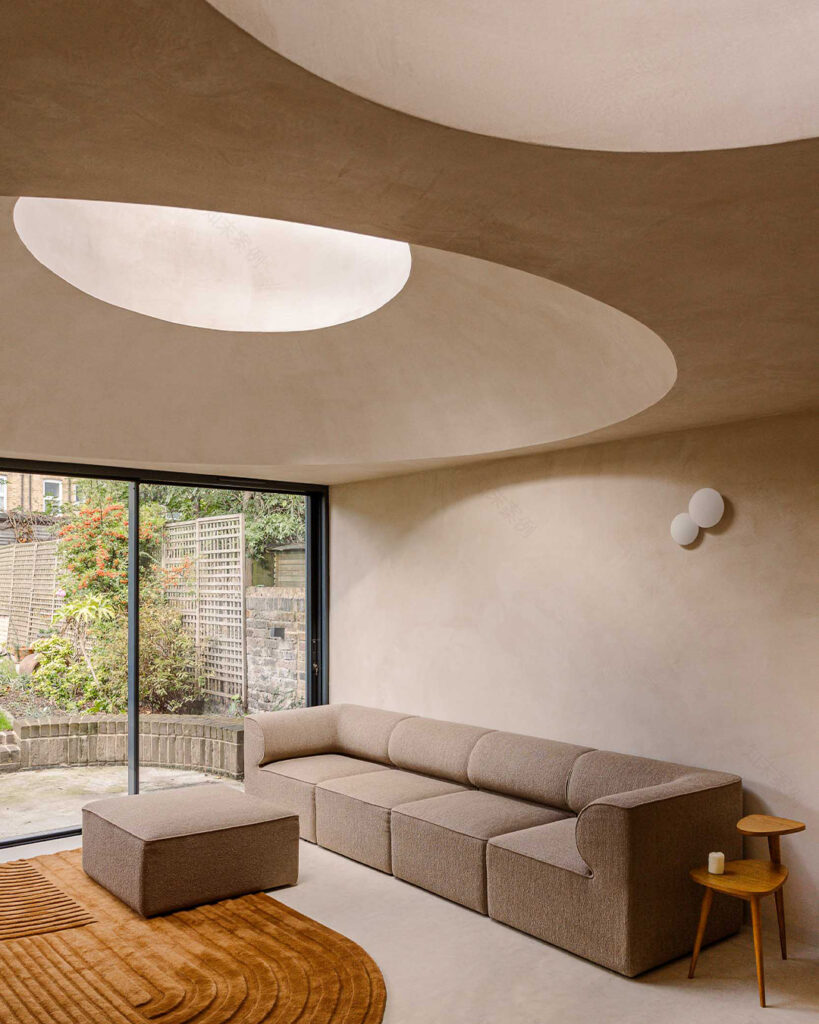
Curved forms, finished with our smooth clay plaster, define the new extension, linking the kitchen to a new living space, crowned by a central dome.
Here at Clayworks, Dome House exemplifies a thoughtful, sensorial approach to modern city living.
We spoke with architect Roberto about the clients’ brief, the studio’s approach to the project and his design inspirations.
What can you tell us about the clients’ brief?
Roberto Di Donato: “The clients were a young, professional couple with a modest, unpretentious lifestyle. Like many others, the experience of lockdown had rapidly exposed the limitations of their existing living conditions – a cluttered and compartmentalised home that no longer supported their needs. This house, however, offered the ideal canvas for a thoughtful transformation.
They never provided a detailed brief filled with specific functional requirements or stylistic references; the clients approached the project with an open and exploratory mindset. In our early conversations, they only expressed a desire to follow a few simple principles:
Maximise natural light throughout the house, despite the challenges of a north-facing terrace.
Establish an organic and intuitive spatial flow, connecting the kitchen and shared living spaces with the garden beyond.
Create distinct and uplifting workspaces, far removed from the typical dark and forgotten box room.
And finally, “whatever the outcome, make it exciting an architectural escape to break the monotony of the everyday”.”
We’d love to know about your inspirations for the project, and more broadly. Which architects, designers, movements inspire you?
Roberto: “Our studio’s approach to architecture is rooted in the idea that design does not emerge from sudden bursts of inspiration, but from a thoughtful process that weaves together the existing context with the aspirations of the client. We tend to be cautious in bringing direct references to the table, as we believe each project should find its own voice. That said, this particular project felt like a natural alignment between the clients’ desires and our own architectural language.
Our work is deeply rooted in minimalism, yet always softened by the use of warm, natural materials. A true master of this balance is Claudio Silvestrin, from whom I had the fortune to learn a great deal while working with him in the early years of my career.
Another important pillar of our practice is the lesson drawn from Luis Barragán. His architecture – through its mastery of geometry, light, colour, and tactility – has a unique ability to move people in the most elemental way. Visiting several of his projects in person was a profoundly moving experience and continues to resonate in my own design sensibility.
Beyond architecture, we also find inspiration in the work of artists who transcend disciplines. James Turrell, particularly through his Skyspaces, has been a direct reference in refining the shape and scale of our skylights.”

‘Claymoon’ artworks by Adam Weismann, illuminated by the vast skylight at James Turrell’s Skyspace in the Tremenheere Sculpture Gardens in Cornwall.
Roberto: “I cannot speak about architectural inspiration without mentioning the work of César Manrique on the island of Lanzarote. I have a very personal, almost visceral connection to that island, and each visit reveals new lessons, not only from Manrique’s work but also from the island’s vernacular traditions.”
Dome House feels calm and contemporary while still holding onto its Victorian character. How did you strike the balance between old and new when reimagining the space?
Roberto: “I believe the balance was achieved by not giving too much weight to either the old or the new. We didn’t try to impose modern elements across the entire house. Instead, we preserved the existing features that felt naturally connected to the proposed scheme and negotiated their integration through contemporary forms and natural materials. For example, the fireplace was reimagined with an unconventional concave shape, but we retained the original insert and complemented it with a simple mantle of raw bricks. The staircase kept its original form, now carpeted, but gained a modern touch through the addition of a wooden handrail with an integrated light along the wall side. In the garden, we kept the design as natural and simple as possible, introducing curved elements built with bricks in a tone similar to the existing party fence.
A clearer separation emerges between the existing house and the new extension. This threshold is marked by three wooden steps and a change in flooring. The extension was conceived as a more minimalist environment, with a seamless microcement floor that visually continues onto the walls and ceiling. By contrast, the original part of the house retains a warmer atmosphere with an oak floor in a natural tone.”

The ceiling and skylight are such striking features. Can you tell us how this idea came about, and what kind of atmosphere you wanted people to experience when standing in that space?
Roberto: “The skylights and the shape of the roof didn’t emerge immediately, they evolved through our design process.
We began the project focusing on layout. A key decision was placing the living area at the rear, opening onto the garden. This maximised the house’s full width between party walls, breaking free from the spatial limitations of the narrow Victorian footprint. In contrast, we positioned the kitchen at the front, where it could connect with the vibrancy of street life while remaining close to the central staircase for easy access to the upper floors.
The extension’s roof and skylights then emerged organically as solutions to practical needs: maximising ceiling height at the room’s centre to enhance spaciousness while keeping lower heights along the party walls to meet planning regulations and respect neighbouring properties. At this stage, we were working with straight lines – the same spatial concept but expressed through angular geometry.
As our dialogue with the clients deepened, the design began gravitating toward a calmer, more contemplative atmosphere with understated elegance. This is when curved surfaces naturally appeared in our sketches, giving birth to the distinctive dome.”

Materials play a big role in the look and feel of the house. What drew you to using natural finishes like Clayworks clay plaster?
Roberto: “At our practice, we consistently advocate for pure, natural, and tactile materials, believing this translates into clean, timeless architecture.
From our earliest conversations, the clients expressed a desire to create a meditative and calming environment.
When the project’s shell evolved into curved forms, we immediately knew that Clayworks was going to be perfect to be used across all walls and ceilings. This continuous, earthy finish brings extraordinary softness to the interiors and generates a cocoon-like atmosphere, visually and materially unifying the spaces while amplifying how natural light plays across the textured surfaces.
My fascination with lime and clay plasters stems from my student days, when I participated in a workshop in my native region of Abruzzo in central Italy. In a specific area of the region the landscape is predominantly clay-based. For this reason, the area has a rich heritage of vernacular constructions built using the “Cob technique,” which we call “Massone” locally.
During that workshop, I learned about raw earth construction, including clay and lime finishes. Years later, when we discovered Clayworks products for our London practice, we immediately incorporated them into our material palette. There’s something deeply satisfying about connecting contemporary projects to these ancient material traditions. Clayworks allows us to bring that same earthy authenticity and tactile quality to modern spaces.”

The furnishings sit perfectly with the rounded forms of the scheme. Did you collaborate with an interior designer on the project?
Roberto: “We didn’t collaborate with external interior designers on this project. We knew the space needed to be completed with carefully chosen pieces, and more importantly, we understood there was no need to clutter it with excessive furniture. The architecture itself demanded restraint. We integrated furniture into our drawings from the early stages, defining exactly the perfect location, type, and dimensions needed for each piece. We then provided the clients with a curated list of options that would complement the space’s soft - minimal aesthetic. At this stage, the clients played a crucial role and demonstrated exceptional sensitivity to the design. They took the time to research and experience each piece in person, ensuring every selection was perfect for the space. This collaborative approach resulted in furnishings that feel like natural extensions of the architecture rather than additions to it.”
Image Credits: All photographs of Dome House by Nacho Rivera. Photograph of James Turrell Skyspace by Cat Vinton, with artworks by Adam Weismann, Claymoon.


南京喵熊网络科技有限公司 苏ICP备18050492号-4知末 © 2018—2020 . All photos and trademark graphics are copyrighted by their owners.增值电信业务经营许可证(ICP)苏B2-20201444 苏公网安备 32011302321234号
苏公网安备 32011302321234号客服
消息
收藏
下载
最近