

创作上传
VIP
收藏下载
登录 | 注册有礼
查看完整案例

收藏

下载

分享

翻译
Architects:Atelier Tom Vanhee
Area:347m²
Year:2024
Photographs:Filip Dujardin
Manufacturers:Sto,Schluter,AGC,Derbigum,Gyproc,Resitrix,Sapa Building System International NV,Skylux,URSA,Umicore,Victorian Emporium
Category:Residential Architecture,Houses,Refurbishment
Design Team:Tom Vanhee
Engineering & Consulting > Structural:Lime Engineers
City:Bruxelles
Country:Belgium

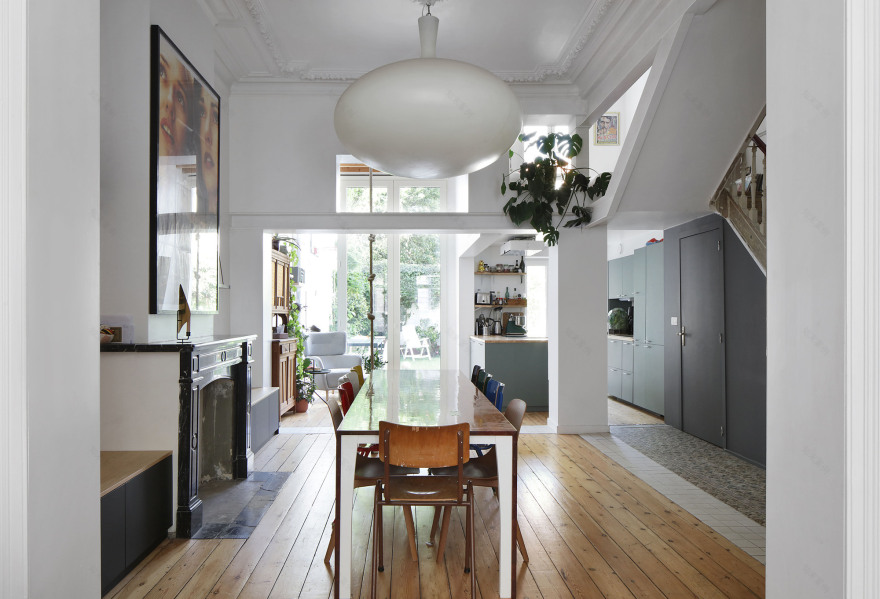
Text description provided by the architects. The Brussels townhouse consists of three stories with an attic, a basement level, and a rear extension with an intermediate level. The ground floor connects directly to a walled garden. Characteristic elements such as interior joinery, ceiling mouldings, and original wooden plank floors are preserved as much as possible and remain defining features of the building.


The house is subdivided into two separate units: a dwelling and a studio. The studio is located on the first floor, while the dwelling occupies the ground floor and the second and third floors. Both units are accessed via a shared entrance hall. The studio is given a separate access via a new staircase in the entrance hall, allowing for a more efficient use of the existing circulation space. By relocating the original access door in the corridor, the dwelling can also be reached via the same entrance. Space for bicycle storage is provided next to the staircase. These interventions allow the dwelling and the studio to function independently, while respecting the privacy of both.

The existing staircase remains the central circulation axis of the house and provides access to all levels, including the basement and the intermediate level. The flat roofs of the extensions are renewed and insulated, as is the rear façade, which is finished with plaster. On the garden side, a highly insulated glazed façade with large opening doors is installed. The window opening at the kitchen level is extended down to ground level to strengthen the relationship with the garden. All other exterior joinery, with the exception of the front door, is replaced with higher-performance insulating joinery, while maintaining the existing window openings. Solar panels are installed on the pitched roof.

Within the dwelling, the sense of spatial openness on the ground floor is enhanced by demolishing a wall between the central room and the stair hall, and by creating new openings towards the garden side and the TV room on the intermediate level. This results in a visually continuous living space with different atmospheres and increased daylight penetration into the heart of the house. The structural changes create a three-dimensional painting. The upper floors accommodate the bedrooms. The pitched roof is insulated, and the existing ceiling mouldings and wooden plank floors are preserved.

The studio on the first floor benefits from high ceilings, abundant natural light, and a balcony at the front. It is accessed via the new staircase, while the existing connections to the main stair hall are closed off. A new bathroom is installed at the front, and a kitchen is located on the garden side. The studio is flexible in layout and retains its character thanks to the existing ceiling mouldings and wooden plank floor.

The decorative plaster of the rear extension of the dwelling is finished in white, with grey window frames. The upper rear façade of the main house is finished in grey decorative plaster with white window frames. Removed wall sections are left visible and finished with white tiles. The terrace and the new sanitary spaces are also executed in the same tile format.

Project gallery


南京喵熊网络科技有限公司 苏ICP备18050492号-4知末 © 2018—2020 . All photos and trademark graphics are copyrighted by their owners.增值电信业务经营许可证(ICP)苏B2-20201444 苏公网安备 32011302321234号
苏公网安备 32011302321234号客服
消息
收藏
下载
最近