

创作上传
VIP
收藏下载
登录 | 注册有礼
查看完整案例

收藏

下载

分享
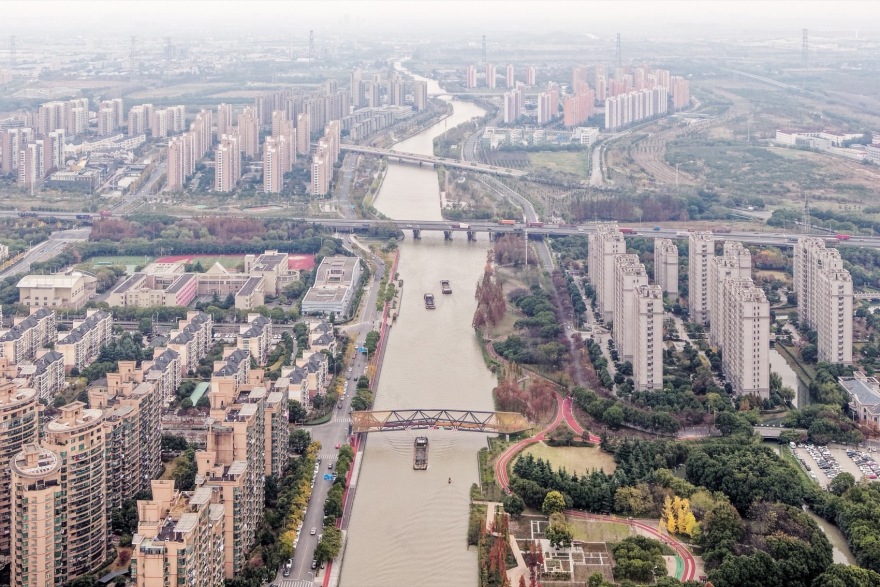
上海市青浦区位于太湖流域下游,具有典型的江南平原河网城市的特征。自西向东的航道淀浦河对于区域城市格局发展产生了重要的影响。每一座跨河桥梁都因通航要求被架高,引桥长度往往超过百米。为控制引桥这对沿岸城市地块的沿河交通产生显著阻隔,跨河桥梁的平均间距超过1km——这使得在规划上被定义为“蓝轴–滨水游憩轴”的淀浦河,实际上成为了一道“蓝墙”。因此,在机动车桥之间适当增设步行桥,建立相对合理的跨河慢行系统的需求十分迫切。这也是在居住区旁建设大跨度的纯步行桥的城市地理与规划背景。
©肖潇
Qingpu District of Shanghai is located in the lower reaches of the Taihu Lake Basin, featuring the typical characteristics of a river network city in the Jiangnan Plain. The Dianpu River, a waterway running from west to east, has exerted a significant impact on the development of the regional urban pattern. Every bridge spanning the river is elevated to meet navigation requirements, with approach bridges often exceeding 100 meters in length. To mitigate the significant barrier effect of these approach bridges on the riverside traffic of adjacent urban plots, the average distance between cross-river bridges is set at over 1 kilometer. This situation has turned the Dianpu River, which is designated as a “blue axis—waterfront recreational axis” in urban planning, into an actual “blue wall”. Therefore, there is an urgent need to appropriately add footbridges between motor vehicle bridges and establish a relatively reasonable cross-river non-motorized traffic system. This is the urban geographical and planning background for constructing a long-span pedestrian-only bridge adjacent to residential areas.
▼远景,viewing the project at distance©肖潇

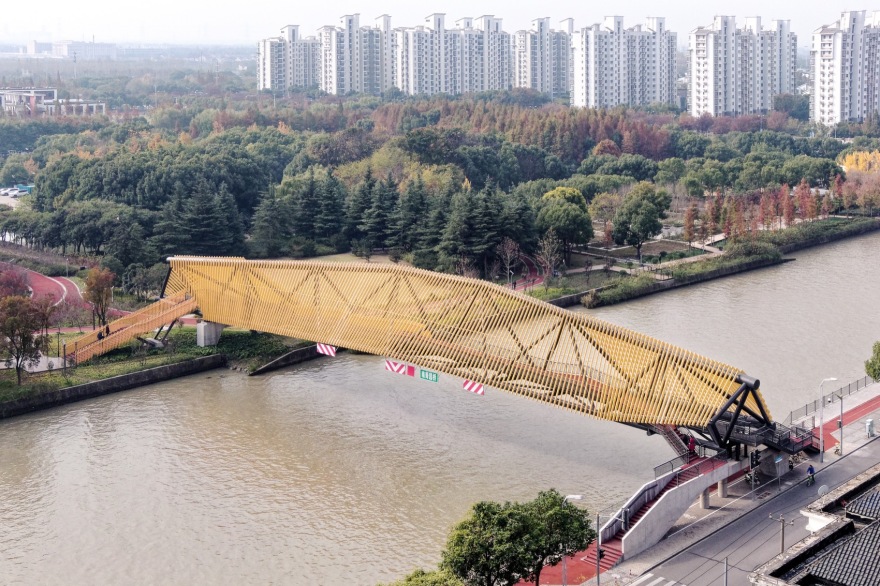
百穗桥的选址为设计带来了结构与场地的双重制约:一方面,水务上一跨过河的要求让桥梁的净跨超过75米,但与此同时北岸的岸线进深仅6.3米,需在这样局促的空间中完成大跨桥梁支撑结构以及架高4m的桥梁阶梯的路径组织设计。此外,施工期间仍需保证淀浦河正常通航。
▼区位,location©谷徳地图

The site selection of the Tassel Bridge has imposed dual constraints of structure and site conditions on the design. On one hand, the water conservancy requirement of spanning the river in a single span necessitates a clear span of over 75 meters for the bridge. On the other hand, the shoreline depth on the north bank is merely 6.3 meters, requiring the design to organize the path of the bridge staircase, which is elevated by 4 meters, along with the supporting structure of the long-span bridge within such a limited space. In addition, the normal navigation of the Dianpu River must be ensured during the construction period.
▼街景,street view©肖潇

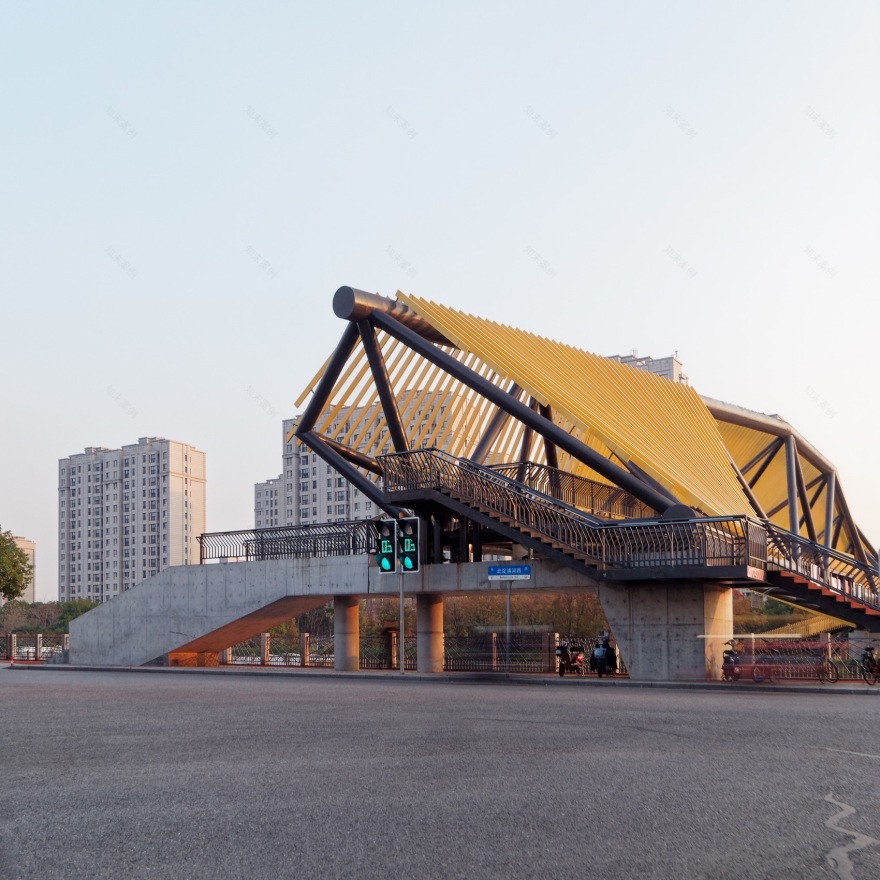
▼由周边环境看项目,viewing the bridge from the river bank©肖潇


▼楼梯,staircase©肖潇 /吕恒中&车凯


为此,便于整体吊装的三角锥桁架体系是较为合理的技术选项。尽管通过结构师的精心优化,桥梁结构杆件仍因其跨度原因不可避免地较为粗壮。穿越此单元重复的大跨结构的空间体验,是设计展开的主要线索。
▼结构及感知概念,structural & perceptual concepts©致正建筑工作室+博风建筑

For this reason, the triangular pyramid truss system, which facilitates integral hoisting, is a relatively reasonable technical option. Despite the meticulous optimization by structural engineers, the structural members of the bridge are inevitably bulky due to the span requirement. The spatial experience of traversing this long-span structure with repeated unit modules serves as the main thread guiding the design.
▼远景,distant views©吕恒中&车凯

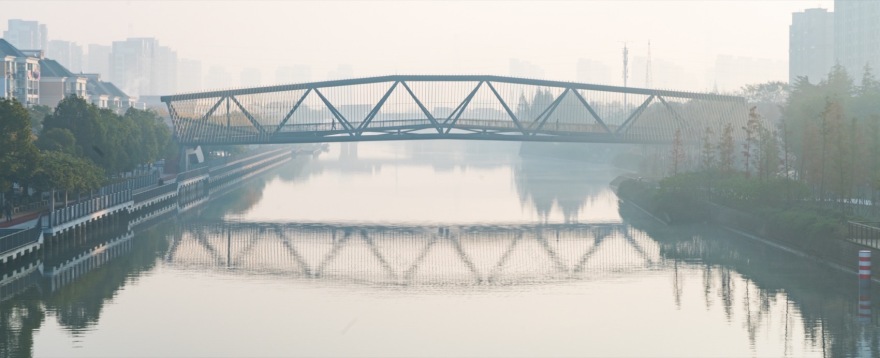
▼桥身,bridge©肖潇


▼桥体与水面,the bridge and the river©肖潇


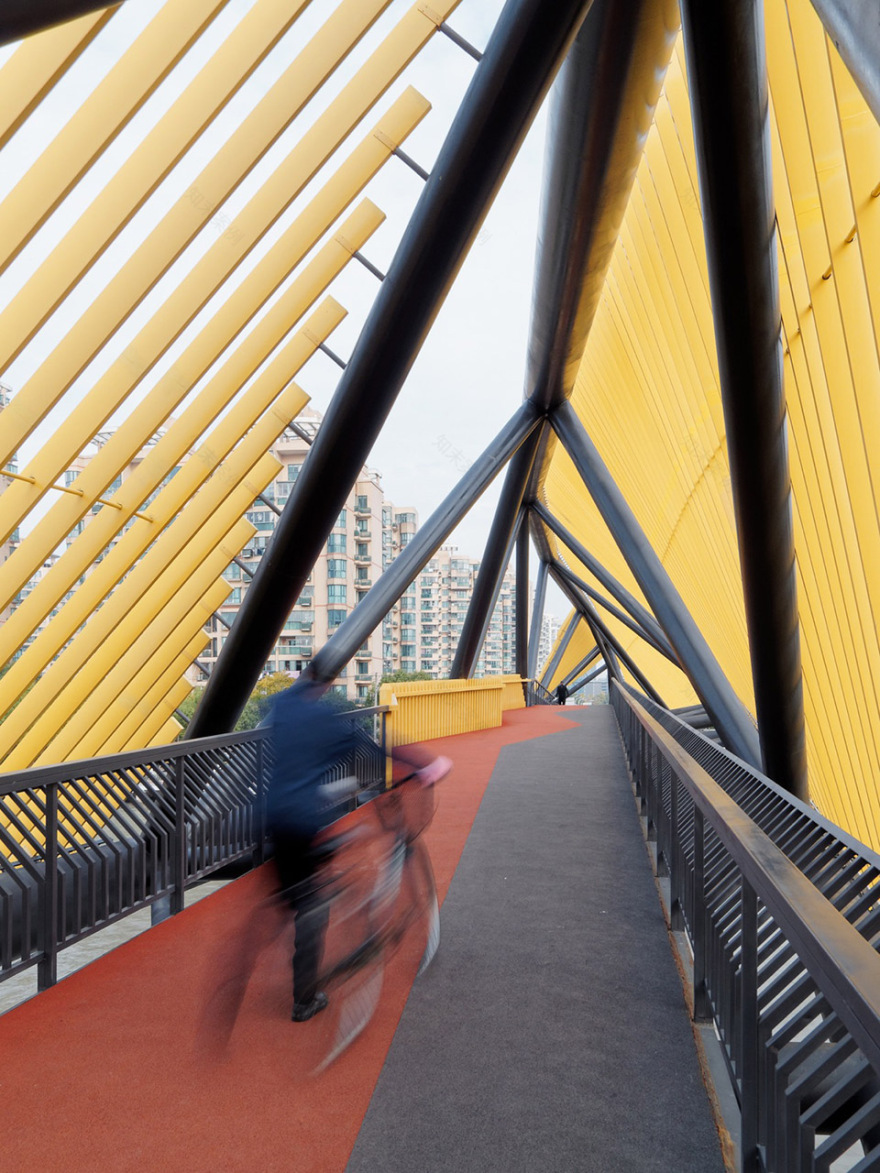
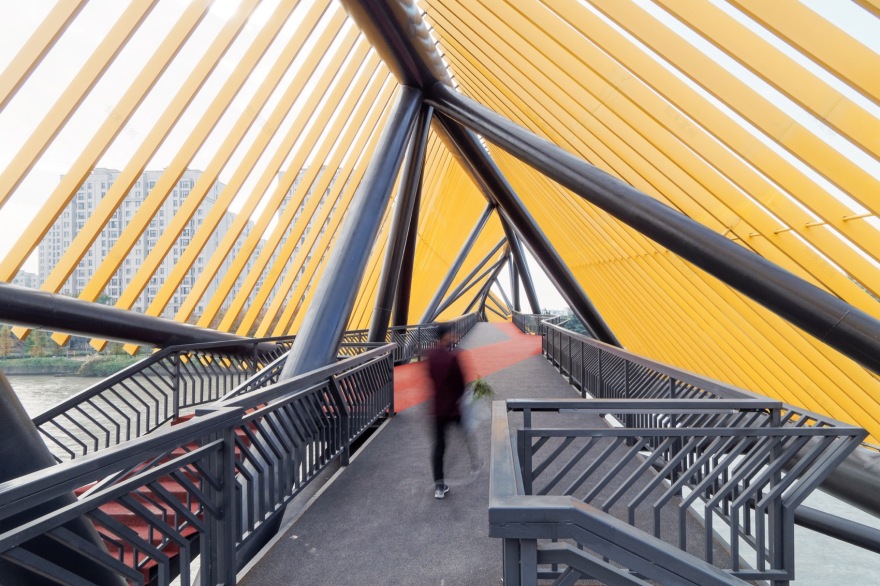
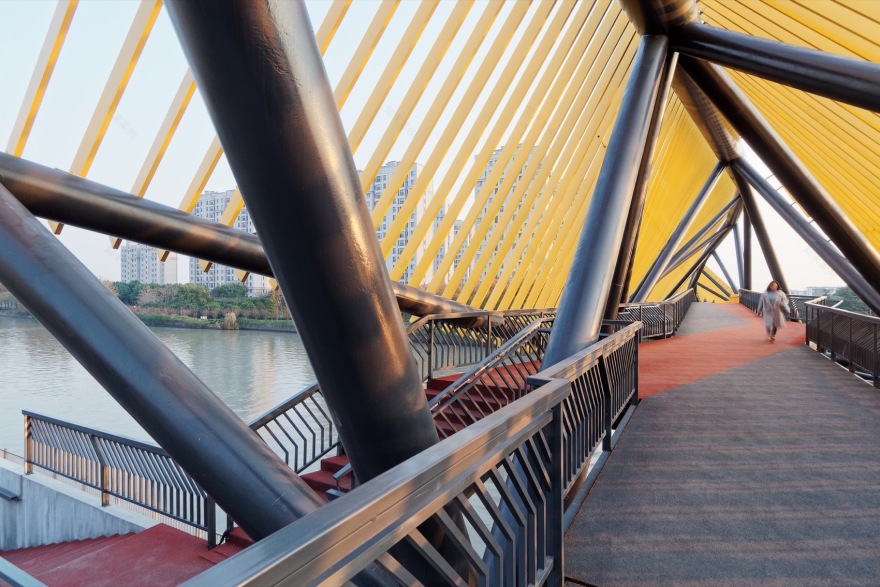
总体上主要采用三个综合的策略:一、平面上笔直的栈道从中央穿过扭转摇摆的结构体形成穿越桥梁的空间体验基调;二、局部设置的阳光色的格栅在桥梁上形成了上游下游的感知区分;三、通过几何的经营,以不同的权宜方式在桁架杆件之间寻找机会穿越的楼梯踏步空间。通过这样的从系统组织到局部迂回的设计方式,形成与航拍图像所显示的截然不同的丰富的现场穿越空间体验感。
▼剖透视图,perspective section©致正建筑工作室+博风建筑

Overall, three integrated strategies are adopted. First, a straight plank road runs through the twisting and swaying structure in the plane, setting the tone for the spatial experience of crossing the bridge. Second, locally installed sun-colored grilles create a perceptual distinction between the upstream and downstream sides of the bridge. Third, through geometric arrangement, stair step spaces are opportunistically inserted between truss members using various adaptive approaches. Through this design method ranging from systematic organization to local circuitous layout, a rich on-site spatial experience of crossing the bridge is achieved, which is completely different from the visual perception presented in aerial images.
▼桥面,the bridge©肖潇


▼过桥的行人,people on the bridge©肖潇


▼细部,details©肖潇

桥梁的建造位于江西九江的造船厂,在通过工厂内的制作、预拼装、拆解后,所有杆件由淀浦河航道运送至场地南侧的南箐园公园草坪上,经过十天的安装,在约一小时内完成了主体结构的整体吊装,整个过程将对航道的交通影响降到了最低的限度。
▼体系拆分,elements analysis ©致正建筑工作室+博风建筑

The construction of the bridge was carried out at a shipyard in Jiujiang, Jiangxi Province. After fabrication, pre-assembly and disassembly in the factory, all structural members were transported via the Dianpu River waterway to the lawn of Nanqing Garden Park on the south side of the construction site. Following a ten-day on-site installation process, the integral hoisting of the main structure was completed in approximately one hour. The entire construction process minimized the impact on waterway traffic.
▼细部,details©肖潇
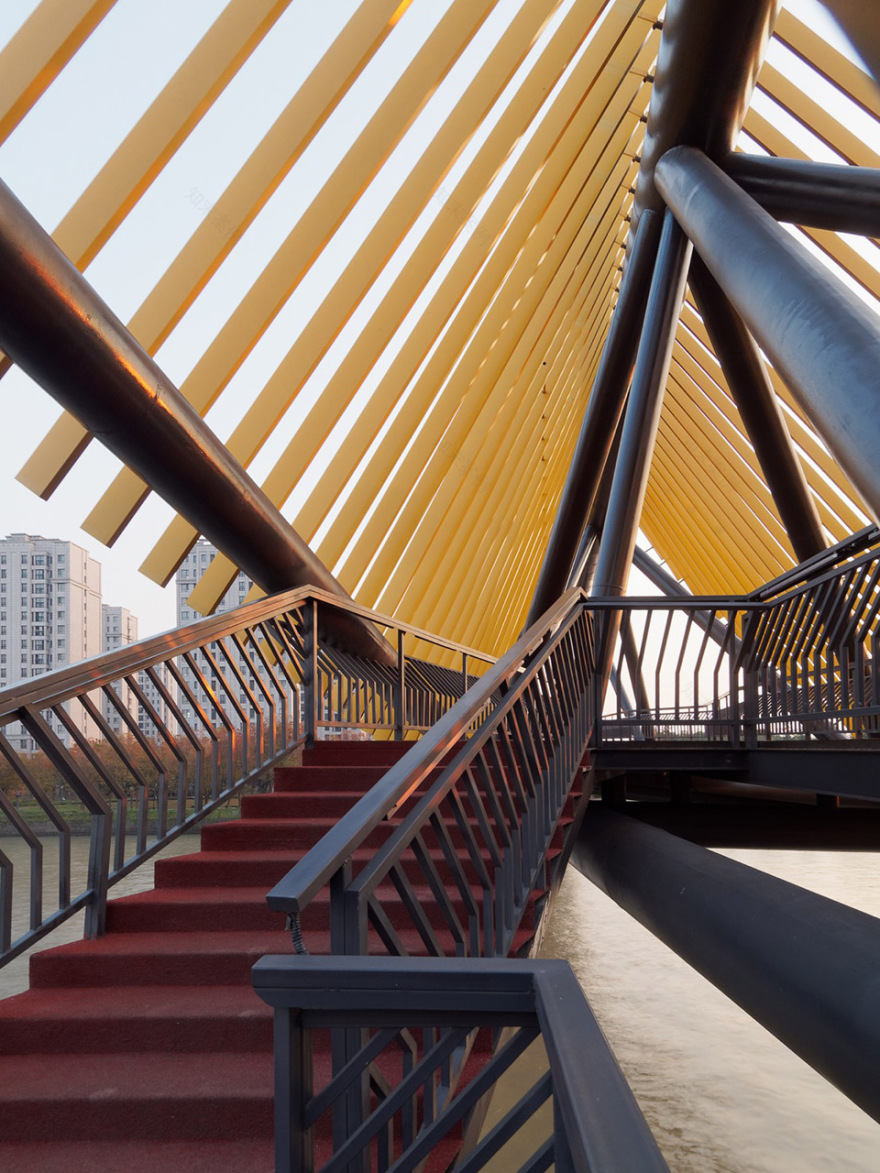


▼细部,details©肖潇


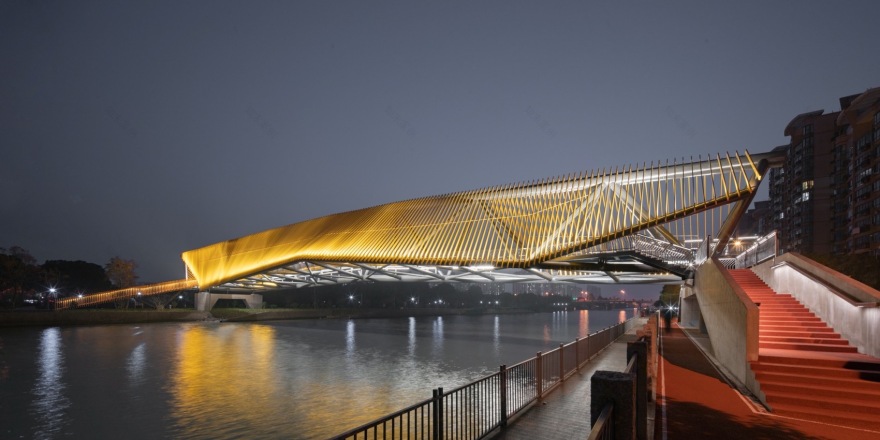
建成后的百穗桥,扮演了三重的城市角色:对于青浦城区内的大部分居民而言,百穗桥成为他们跨河进入南箐园公园空间的主要通道,它成为了跨在河上的公园大门;对于淀浦河上每日往来的大量船只,百穗桥金色的百叶已经成为了由航道进入青浦区域的重要的门户标志;更为生动和有意义的是,因为桥梁两侧有两座区域性的小学和初中,大量原本需驾车绕路上学的学生,如今都选择在清晨和傍晚穿过铺满金色阳光的百穗桥通行,在这些时刻,这里也成为了最有活力的校园通廊。
After its completion, the Tassel Bridge plays three important urban roles. For most residents in Qingpu urban area, it serves as the primary passage to cross the river and enter Nanqing Garden Park, functioning as a “park gate” spanning the river. For the large number of vessels navigating the Dianpu River daily, the golden louvers of the Tassel Bridge have become an important gateway landmark indicating the entry into the Qingpu section of the waterway. More vividly and significantly, as there are two regional primary and secondary schools on both sides of the bridge, a large number of students who originally needed to drive a detour to school now choose to walk through the Tassel Bridge covered in golden sunlight in the early morning and evening. During these times, the bridge also transforms into the most vibrant campus corridor.
▼夜景,night views©肖潇 /吕恒中&车凯

▼钢构厂整体拼装(江西九江) ,Steel structure factory assembly ©杨剑飞

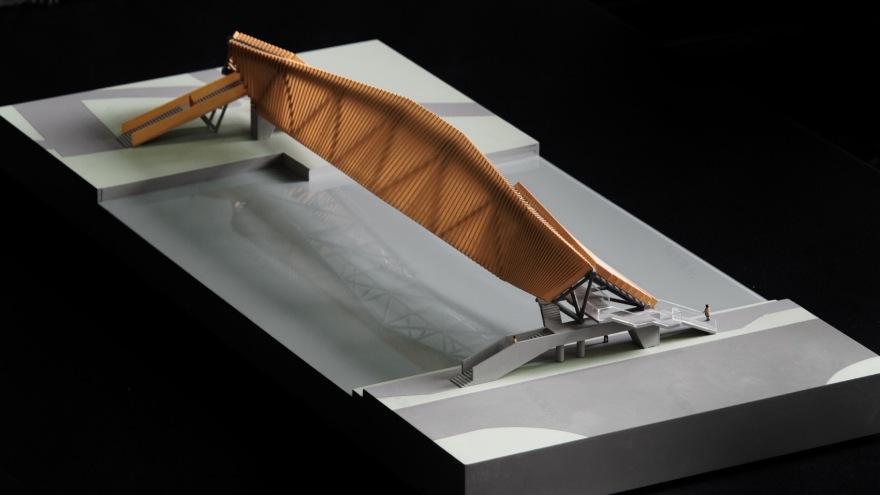
▼模型,models©致正建筑工作室+博风建筑


▼总平面图,master plan©致正建筑工作室+博风建筑

▼平面图,plan©致正建筑工作室+博风建筑
▼剖面图,section©致正建筑工作室+博风建筑

项目名称:百穗桥——青浦南箐园北侧人行桥
项目类型:景观建筑
设计方:致正建筑工作室+博风建筑
项目设计:2017 - 2019年
完成年份:2019年
主持建筑师:张斌、王方戟
项目建筑师:肖潇、董晓
设计团队:杨剑飞、游航、陈又新、赵鹏宇、焦威、林婧
建设地点:上海青浦南箐园
基地面积:约1600㎡
占地面积:约350㎡
结构形式:钢结构
结构跨度:75.6M
摄影版权:吕恒中,车凯,杨剑飞,肖潇
结构顾问:上海源规建筑结构设计事务所/张业巍
合作设计:华建市政工程设计院
施工总包:上海水务建设工程有限公司、上海园林绿化建设有限公司
客户:上海淀山湖新城发展有限公司
材料:钢、铝合金格栅
Project name: Tassel Bridge, Pedestrian Bridge on the North Side of Nanqing Garden, Qingpu
Project type: Landscape architecture
Design: Atelier Z+ & temp architects
Design year:2017 - 2019
Completion Year:2019
Leader designer & Team: Partner in Charge: ZHANG Bin , Wang Fangji
Project Architect: XIAO Xiao, Dong Xiao
Project Team: Yang Jianfei, You Hang, Chen Youxin, Zhao Pengyu, Jiao Wei, Lin Jin
Project location:Nanqingyuan Park, Qingpu, Shanghai
Site Area: About 1600 ㎡
Building Area: About 350 ㎡
Structure: Steel
Structural span:75.6m
Photo credit: LV Hengzhong, CHE Kai,YANG Jianfei, XIAO Xiao
Structural Consultant: Board Design/ZHANG Yewei
Design Cooperation: ECADI Municipal Engineering Design Institute
General Contractor: Shanghai Water Construction and Engineering Co.,Ltd, Shanghai Gardening - Landscaping Construction Co.,Ltd
Clients: Shanghai Qingpu Newcity Development (Group) Co.,Ltd.
Materials:Steel, Aluminum louver





南京喵熊网络科技有限公司 苏ICP备18050492号-4知末 © 2018—2020 . All photos and trademark graphics are copyrighted by their owners.增值电信业务经营许可证(ICP)苏B2-20201444 苏公网安备 32011302321234号
苏公网安备 32011302321234号客服
消息
收藏
下载
最近