

创作上传
VIP
收藏下载
登录 | 注册有礼
查看完整案例

收藏

下载

分享

翻译
Architects:Atelier cnS
Area:45435m²
Year:2025
Photographs:Siming Wu
Category:Park,Community,Renovation
Design Director:Song Gang, Zhong Guanqiu, Zhu Zhiyuan
Design Team:Atelier cnS-Group C: Rongjuan Wu, Huayong Liang, Xinru Duan, Jun Peng, Liting Qian, Boting Wang, Mingtian Zhang, Yifan Chen; Atelier cnS-Group B: Hairui Lin, Yaqian Cai, Dongyan Lin, Hang Zhao, Ziqi Zhang, Wenlang Liang, Tiankai Feng, Shanshan Xie; Atelier cnS-TECON: Hui Wang, Junhui Li; Atelier cnS-CICADA ART: Zi'an Luo, Shengxiang Jin, Ganrong Deng, Shifeng Mo, Jingyi Zeng, Qiuyi Jian; Atelier cnS-S&C Design: Zimao Zheng, Xiaomin Sun, Guangming Li, Xingsong Chen, Hongqin Lin, Yinglun Yao, Zhonghai Chen, Huang Cai, Ziming Yu, Jianjun Lin, Zhongjun Li
Lighting Art Directors:Hong Lin, Yiding Yang
Joint Design Units:Guangzhou Urban Planning & Design Survey Research Institute Co., Ltd.; Guangzhou Municipal Engineering Design & Research Institute Co., Ltd.; Guangdong Huafang Engineering Design Co., Ltd.
Construction Parties:Guangzhou Building Decoration Group Co., Ltd.; Guangzhou Municipal Engineering Machinery Construction Co., Ltd.; Guangzhou Construction Group Co., Ltd.
Interior Design:Yishanshe Space Design Team
Lighting Design:Seraphina Lighting Design Team
City:Guangzhou
Country:China

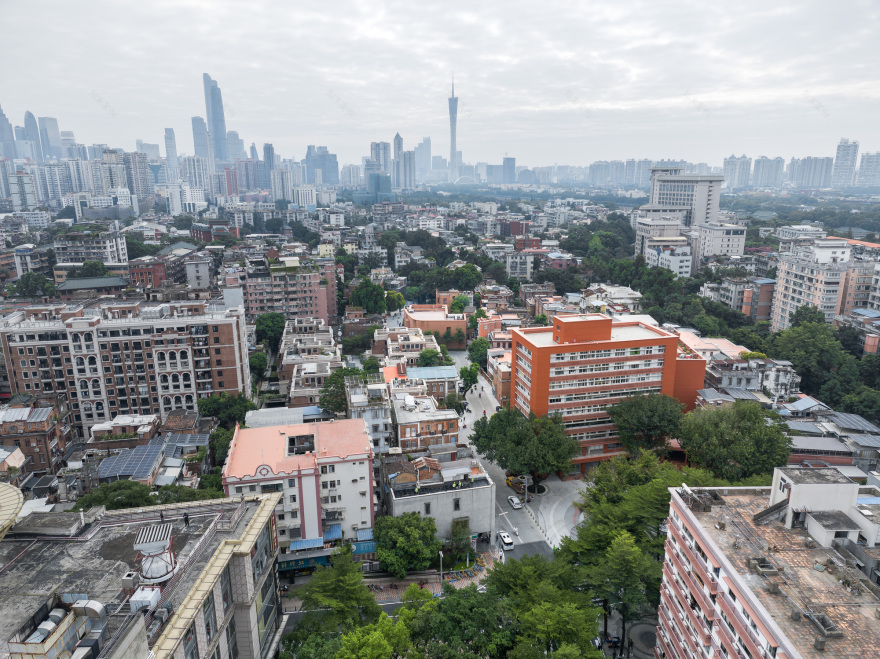
Text description provided by the architects. The Xinhepu Historical and Cultural Precinct is imbued with rich historical layers and urban memories. This enhancement initiative deliberately avoids large-scale demolition and reconstruction. Instead, it follows a strategy of "micro-regeneration and refined enhancement," focusing on reconnecting the precinct's spatial network. Guided by the "one building, one tailored solution" to architectural restoration and driven by the goal of improving everyday livability, the project employs meticulous craftsmanship and techniques. The ultimate aim is to foster a vibrant precinct where historical character and contemporary life exist in symbiosis.
I.Overall Spatial Optimization: Establishing a Cohesive and Accessible Block Spatial System - Starting from the macro spatial structure, the project systematically organizes pedestrian flows along Dongshan Street, Xinhepu Road, and Xuguyuan Road to create a cohesive cultural route. Key nodes such as the Memorial Hall of the Third National Congress of the CPC, the Jiandong Cluster, and the Xinhepu Northwest Corner Square are integrated organically with historical buildings like Xinyuan and No. 4 Guangdongqian Street, collectively crafting an immersive walking experience. Centered on "functional integration and spatial openness," the project links three major public squares to create a spindle-shaped public space framework. This connects historical and contemporary functions, transforming the precinct from a series of scattered spaces into an interconnected whole.


Guangdongqian Street is designed as the ceremonial axis of the precinct. Through enhanced spatial sequencing and wayfinding, it integrates the spatial relationships among Xinyuan, No. 4 Guangdongqian Street, and the entrance plaza of the Jiandong Building, forming a cohesive and highly recognizable gateway interface. A comprehensive pedestrian network is established throughout the project. By adding lighting, seating, and fitness facilities, and by improving parking lot interfaces, the quality of the walking environment is elevated. Terrain adjustments follow a lightweight strategy, incorporating micro-topography, uniform pavement materials, and integrated step-ramp designs to ensure a smooth and pleasant walking experience.


II. Architectural Restoration in the Historical and Cultural Precinct: "One Building, One Tailored Solution" Based on Classification and Coordination - Confronted with diverse building types, the project establishes a renovation system guided by "classified coordination and needs-based repair."
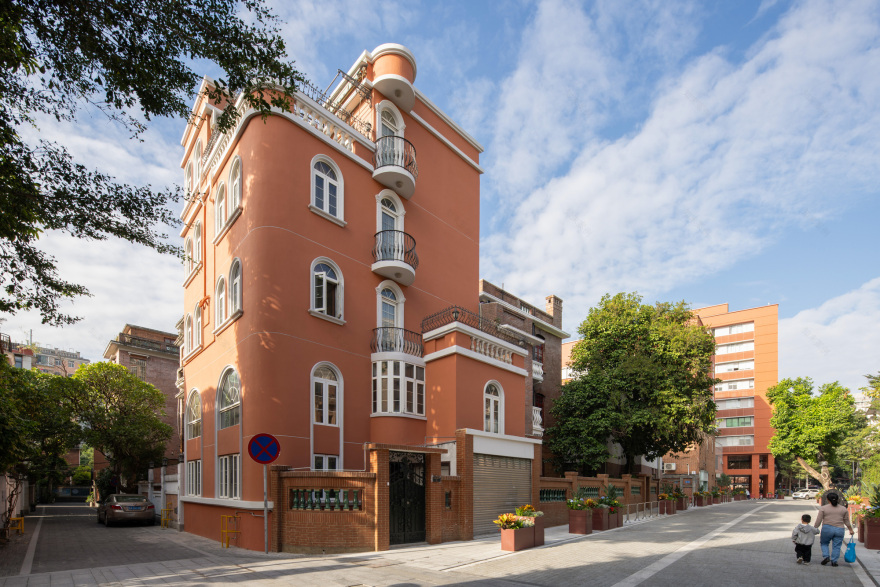
1. Heritage-Status Buildings: Precise Restoration to Preserve AuthenticityFor buildings of historical value, the principle "repair the old as old" is followed. Through structural reinforcement, façade restoration, revival of traditional craftsmanship, and repair of detailed components, the original fabric and traces of time are preserved to the greatest extent possible.


2. General Buildings: Harmonizing Visual LanguageFor ordinary buildings, the original volume and proportions are maintained. By unifying colors, moldings, materials, and window-opening ratios, they are integrated into the precinct's overall character, avoiding abrupt visual intrusion. The "one building, one tailored solution" is applied throughout, with each building independently assessed and given a specific plan to ensure that restoration balances safety and livability while respecting original appearance and material texture. Issues commonly found in older residential areas—such as roof leaks, peeling exterior walls, poor drainage, and inadequate drying space—are addressed through economical and low-intervention methods, effectively improving residents' quality of life. The "fifth façade" roof system is designed to integrate drying, rain shelter, and greenery functions, enhancing both visual coherence and daily convenience. All designs are based on "one building, one tailored solution," balancing practical needs with visual management.


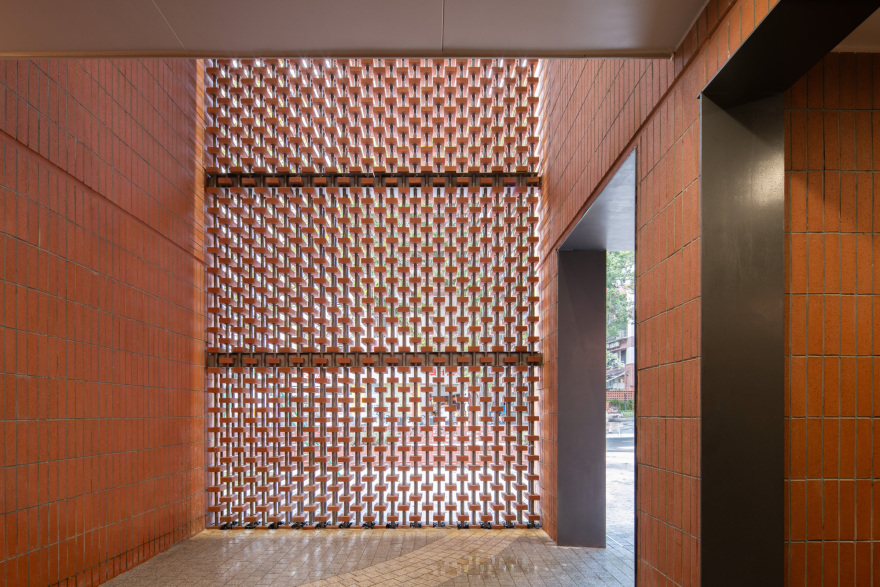
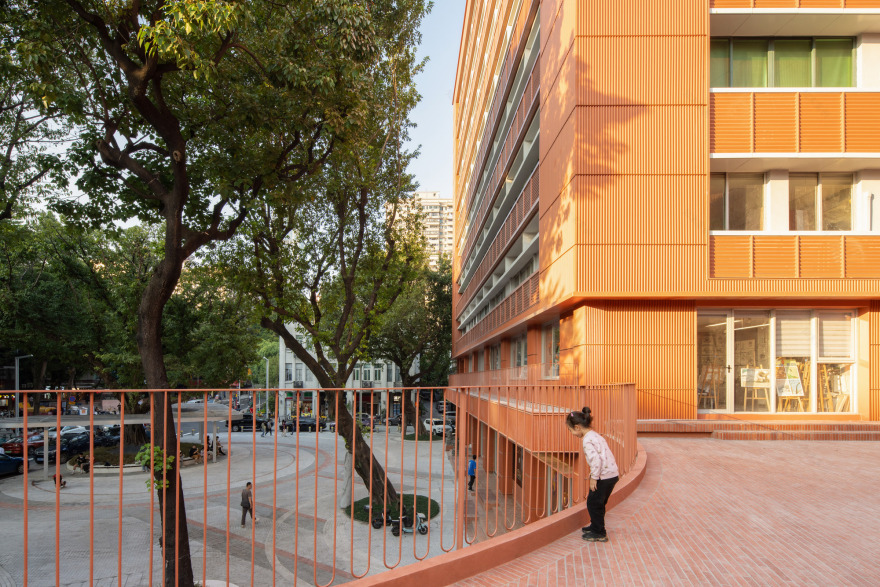
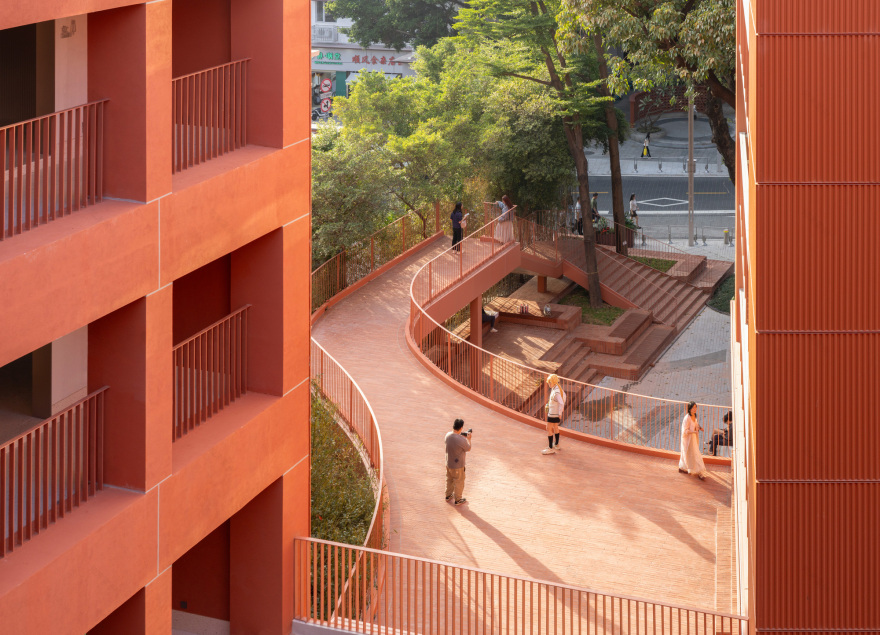
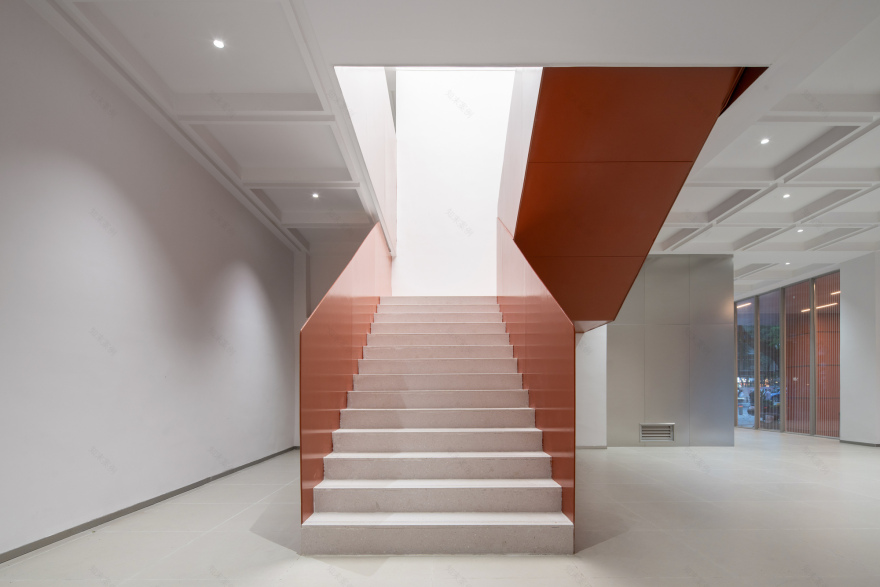
3.Jiandong Cluster: An Interface Between Old and NewThe Jiandong Cluster exemplifies the symbiosis of old and new in this project. The Jiandong Building's façade renovation employs a composite terracotta-aluminum panel curtain wall system and red interior wall paint, adding contemporary material layers to the precinct. A shaded corridor extends from the building's southwest corner, linking the first and second floors with a bus stop and public activity area. This provides shelter, seating, and pedestrian connectivity, naturally bridging the building and the square to form a continuous urban interface. On the first floor, the "Remembering the Source" Atrium is paved with red terracotta brick and features water elements, creating a central scene that visually dialogues with the preserved ruins of the original Guangdong Hall. Natural light from above, the sound of water, and the historic remnants together produce a tranquil atmosphere, giving the space an immersive and sensory depth. The second-floor exhibition hall wraps around the atrium in a U-shaped circulation path, guiding visitors' sightlines and movement naturally toward the balcony. The balcony serves as an outdoor rest area, accentuating the façade's play of solids and voids while complementing the exterior functions. Supporting facilities such as public restrooms are also considered within the overall visual harmony, using brickwork techniques to blend with the traditional precinct setting.


4. Interior Transformation: Xinhepu Neighborhood HubNo. 7 Xuguyuan Road has been converted into a multifunctional community center that combines reading, activities, services, and public information. The triple-height atrium creates an open and flowing neighborhood circulation, revitalizing the old structure with contemporary design language.

III. Public Space Design and Development: Building a Cohesive System from Spatial Integration to Quality Enhancement - This project integrates the Xinhepu Northwest Corner Square, the Xinhepu Southwest Corner Square, and the entrance plaza of the Jiandong Building into a unified landscape system, creating an interconnected and complementary network of public spaces. The Xinhepu Northwest Corner Square functions as an open urban lounge. While preserving the existing sculpture, its spatial structure is redefined through subtle landform adjustments and consistent paving. Steps, ramps, seating, and landscaping are combined to gracefully resolve level changes, improving pedestrian flow continuity and visual coherence. The design also incorporates sponge city features such as rain gardens and permeable paving to enhance the site's ecological resilience. The Xinhepu Southwest Corner Square employs refined elements like curved tree planters, built-in seating, and permeable paving to foster a more inviting and interactive environment. By opening up its edges toward the residential area, the design improves visual and physical access, making the space more permeable and welcoming.

The entrance plaza of the Jiandong Building focuses on harmonizing the bus stop with a preserved ancient tree. The tree planter is integrated with seating to create a comfortable and sheltered waiting area. A canopy of transparent polycarbonate panels allows light to filter through, casting dynamic shadows with the ancient banyan tree and reinforcing its role as a symbolic landmark and repository of collective memory. Building upon this framework, the project further develops a coordinated urban furniture system. This includes strategically adding seating, wayfinding signage, and lighting to improve functionality and identity. Elements such as guardrails, partitions, corridors, and bollards are designed to serve multiple purposes—providing rest points, guiding circulation, and softly defining spaces. The outcome is a flexible, adaptable, and high-quality public space system.


IV. Systematic Technical Framework: Reinterpreting and Integrating Traditional Materials with Contemporary Techniques - During the construction phase, the project prioritized a harmonious balance between traditional craftsmanship and modern materials and methods.
1. Meticulous Craftsmanship and Technical InnovationFor the restoration of heritage buildings, veteran artisans were engaged to apply traditional techniques—such as repairing fair-faced red brick walls, wooden doors and windows, decorative moldings, and exposed aggregate (water-washed) stone finishes. These methods are complemented by modern and eco-friendly reinforcement materials like carbon fiber fabric to strengthen the timber and brick structures. Building upon these traditional skills, the project also innovates through contemporary applications. Techniques like perforated brickwork and terracotta cladding are employed, with an innovative dry-hung perforated terracotta system developed specifically for this project. Combined with terrazzo finishes, this represents a modern reinterpretation of traditional materials, offering a replicable technical and theoretical model for the renewal of historic districts.

2. Integrated Infrastructure EnhancementUtility Wiring Underground Relocation: The previously exposed overhead wiring on the Jiandong Building facade have been systematically rerouted and integrated into a newly constructed underground utility corridor at the building's side. This project successfully achieves the objectives of visual concealment and enhanced urban regularization. Relocation of Wall-Mounted Frame to Ground Level: The wall-mounted frame on the north facade of Nos. 702-680 Donghua East Road has been dismantled and relocated. It is now installed at ground level behind the landscape wall in the eastern plaza. This intervention has completely eliminated visual clutter on the building facade, significantly enhanced its visual neatness, and removed all associated overhead safety hazards at their source.


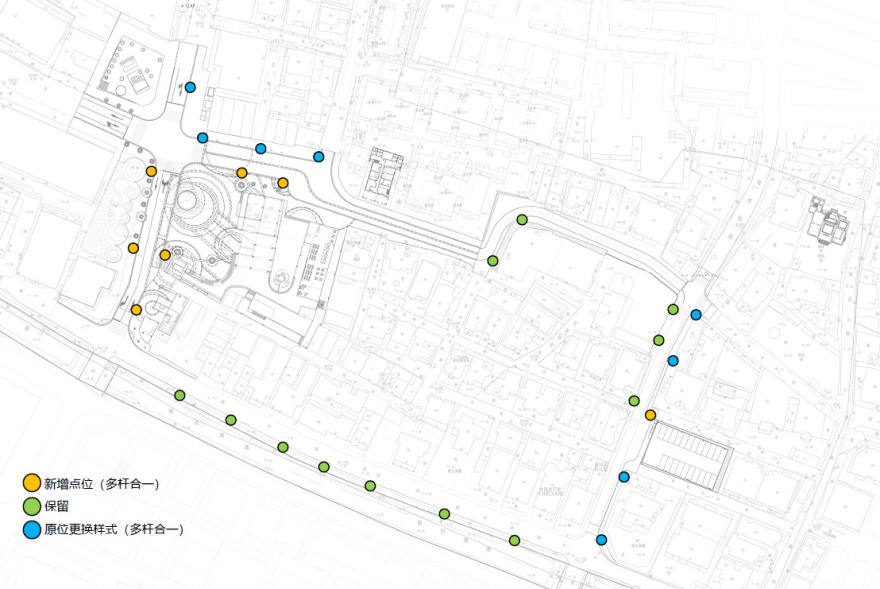
Consolidation and Concealment of Services: To address the cluttered appearance of the building exteriors, a systematic consolidation of exterior wiring and equipment has been carried out. This involves the integration and orderly repositioning of air-conditioning outdoor units on the first and second floors, the removal of originally protruding aluminum panels, and the concealment of all exposed pipes, conduits, and stairway undersides within unified enclosures. Multi-Functional Smart Pole Integration: Various street furniture elements—including streetlights, surveillance cameras, signage, and intelligent traffic displays—which were previously mounted on separate poles, have been consolidated. They are now integrated into unified and streamlined smart poles. This achieves a simplified streetscape with a cohesive visual identity.

Project gallery





南京喵熊网络科技有限公司 苏ICP备18050492号-4知末 © 2018—2020 . All photos and trademark graphics are copyrighted by their owners.增值电信业务经营许可证(ICP)苏B2-20201444 苏公网安备 32011302321234号
苏公网安备 32011302321234号客服
消息
收藏
下载
最近