

创作上传
VIP
收藏下载
登录 | 注册有礼
查看完整案例

收藏

下载

分享

翻译
Architects:co.arch studio
Area:120m²
Year:2025
Photographs:Francesca Iovene
Manufacturers:Artemide,Astro Lighting,Besana Moquette,Cristina Rubinetterie,Davide Groppi,Falegnameria Tarantola,Flaminia,La Calce del Brenta,RABATTO,Unknown (Removed)
Category:Interior Design,Residential Interiors
Project Architects:Andrea Pezzoli, Giulia Urciuoli
Project Team Collaborators:Federica Leonardi, Alice Ricci, Tosca Lagona, Natália Zaťková
General Contractor:CF Ediliza
City:Breuil-Cervinia
Country:Italy

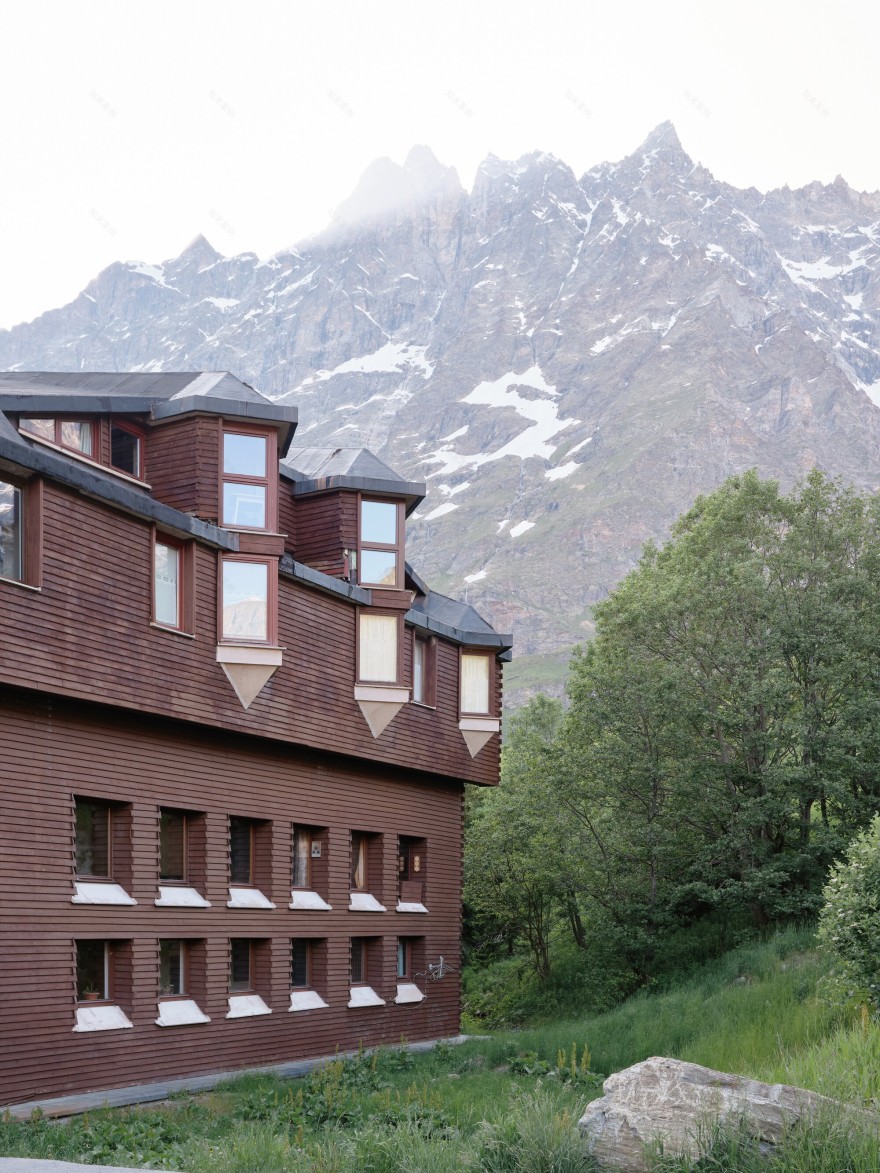
Text description provided by the architects. co.arch's project (Andrea Pezzoli and Giulia Urciuoli) in Cervinia is set within the Giomein complex, designed by Mario Galvagni and completed in 1972 on the homonymous promontory, overlooking the Breuil basin and the profile of the Cervino. Conceived during the peak expansion of Alpine tourism—new ski runs, cableways, infrastructure, and holiday residences—Giomein interprets the mountain not as scenery but as a morphological and perceptual system against which architecture chooses to measure itself.

The intervention concerns a domestic interior on the fourth and fifth floors, commissioned by a couple of art collectors. The apartment preserved a strongly defined decorative universe: jacquard fabrics applied to the walls and fixed with passementerie, carpeting extending even into the bathrooms, timber boiserie, continuous mirror surfaces, and gridded ceilings. It was a coherent, highly personal whole, complete in itself—making clear how any further stylistic layering could have strained the original condition. The survey addressed the space's complexity across two complementary dimensions: geometry and materiality. Broken roof planes with ever-shifting pitches, varied floor levels, curved walls, triangular windows, and bow windows shaped an interior already architecturally "in tension".

Subsequent investigations with the contractors and stratigraphic probes clarified the impossibility of preserving wall coverings and carpeting, both of which were compromised over time. Removing the fabrics enabled remediation of the masonry and a new calibration of interior heights, revealing the most essential spatial structure of Galvagni's work. In this "return to the bare bones", the interior's expressive elements emerged more sharply: the roof clad externally in copper and internally in larch boards, echoing the logic of mountain ridgelines through variable heights and acute volumes; and the projecting bow windows, understood as optical devices that regulate the relationship between inhabitant and landscape. The building appears here as a visual filter that directs the gaze toward the mountain and translates its harshness into a domestic grammar of lines and cuts of light—an "analogon", in Galvagni's terms, a device that amplifies the perception of the mountain.

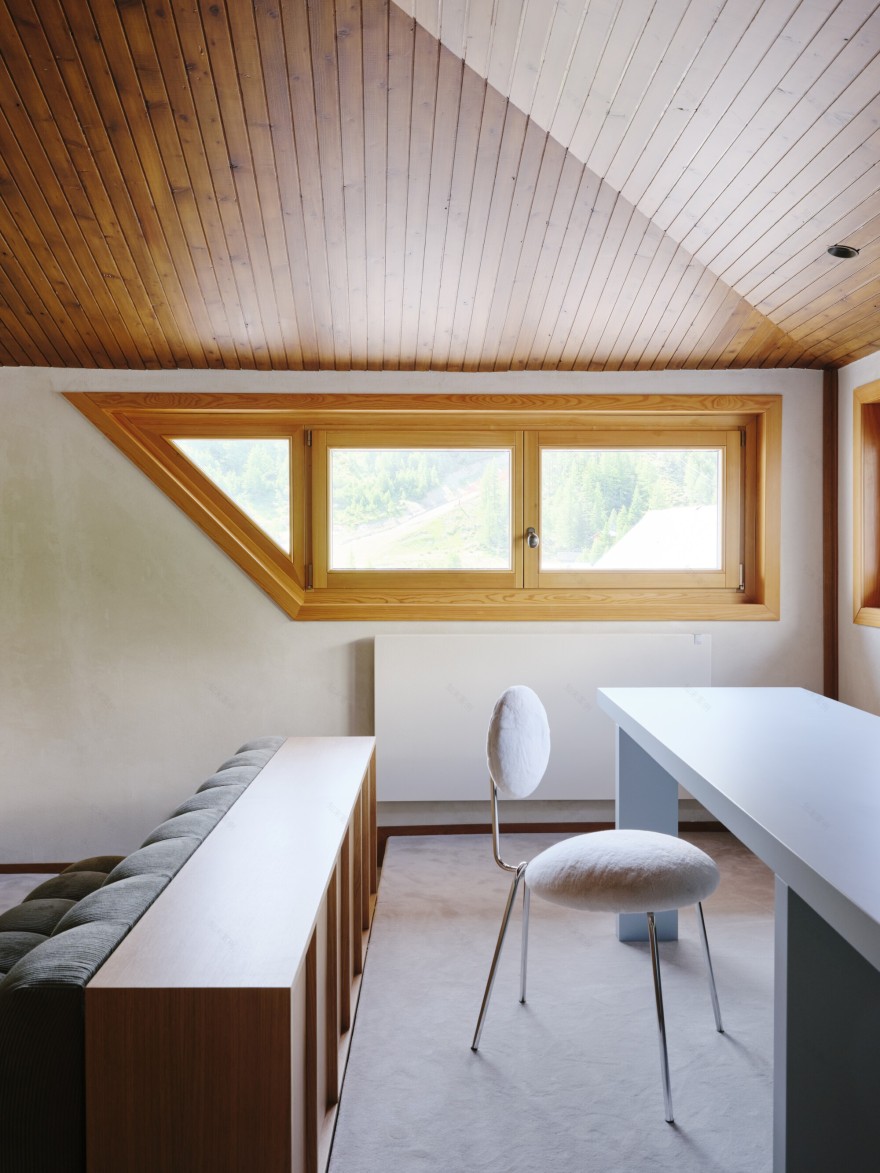
The interior design, therefore, moves within a precise balance: preserving the spatial memory of the 1970s without literally replicating its decorative codes. A soft, lived-in character is maintained through Besana carpeting across the home, with chromatic shifts between the living area, circulation spaces, and bedrooms. In more functional rooms—bathrooms and kitchen—floors and wall surfaces are finished in beige-toned limestone, cooling the palette without interrupting material continuity. A declared reference is Carlo Scarpa's Casa Tabarelli, particularly in the use of contrangoli as tools for spatial definition and in the search for wall surfaces that are both alive and controlled. Calce del Brenta was used to unify the walls and introduce a measured texture, compatible with the tactile nature of the original envelope.

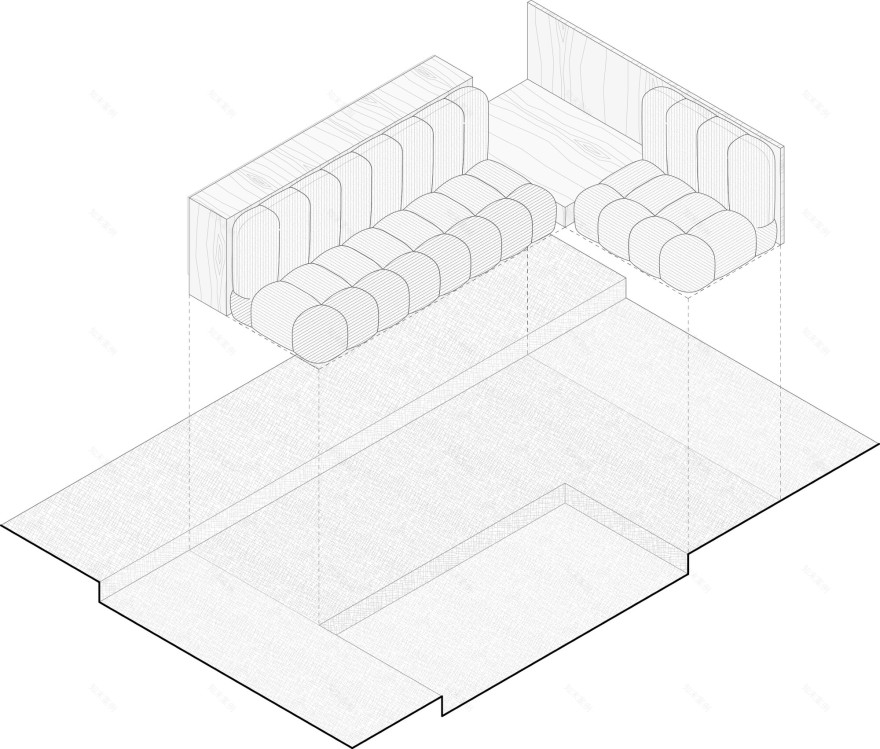
The living room is the heart of the intervention, conceived as the home's relational nucleus. Here, the "conversation pit"—an emblematic 1970s interior archetype—is reread as a room within the room. Floor levels were redesigned to articulate a lowered area for bespoke sofas: a soft built-in element that discreetly references the modular logic of Mario Bellini's Camaleonda. An oak structure defines the perimeter and creates a more intimate field, oriented toward a monolithic fireplace set within a volume clad in Verde Alpi marble. The upper level hosts the dining area, with a custom-designed refectory-style table in a pale light-blue tone, paired with a fixed bench along the wall to intensify the relationship with the windows and high-altitude light. The kitchen is glimpsed through a new rotated-square opening—a controlled homage to the luminous geometries of Galvagni's common areas. A Verde Alpi marble step introduces a lower level where pale limestone meets earth-green lacquered cabinetry and a stainless-steel worktop.

A corridor finally distributes the sleeping quarters, developed through bespoke elements and carefully targeted interventions. The children's room features a custom bunk bed that suggests a small internal architecture, somewhere between Nordic cabin and Alpine bivouac. In the main bedroom, a 1970s Le Mura bed by Cassina, designed by Mario Bellini in brown corduroy velvet, has been recovered. In the attic, the master room becomes an almost autonomous episode: a timber platform evoking a ship's cabin and orienting rest toward the corner window that frames the Cervino as a constant presence. Here too, internal wooden shutters complete the control of light and the relationship with the exterior.

The Giomein apartment works through subtraction and precision: it clears away what time has made fragile, recomposes spatial coherence, and restores a contemporary domesticity to Galvagni's architecture. The result is an interior in which the landscape is not only a view but a structural condition—entering the slopes of the ceiling, the direction of light cuts, and the posture of the furnishings, becoming part of the everyday life of its inhabitants and their collection.

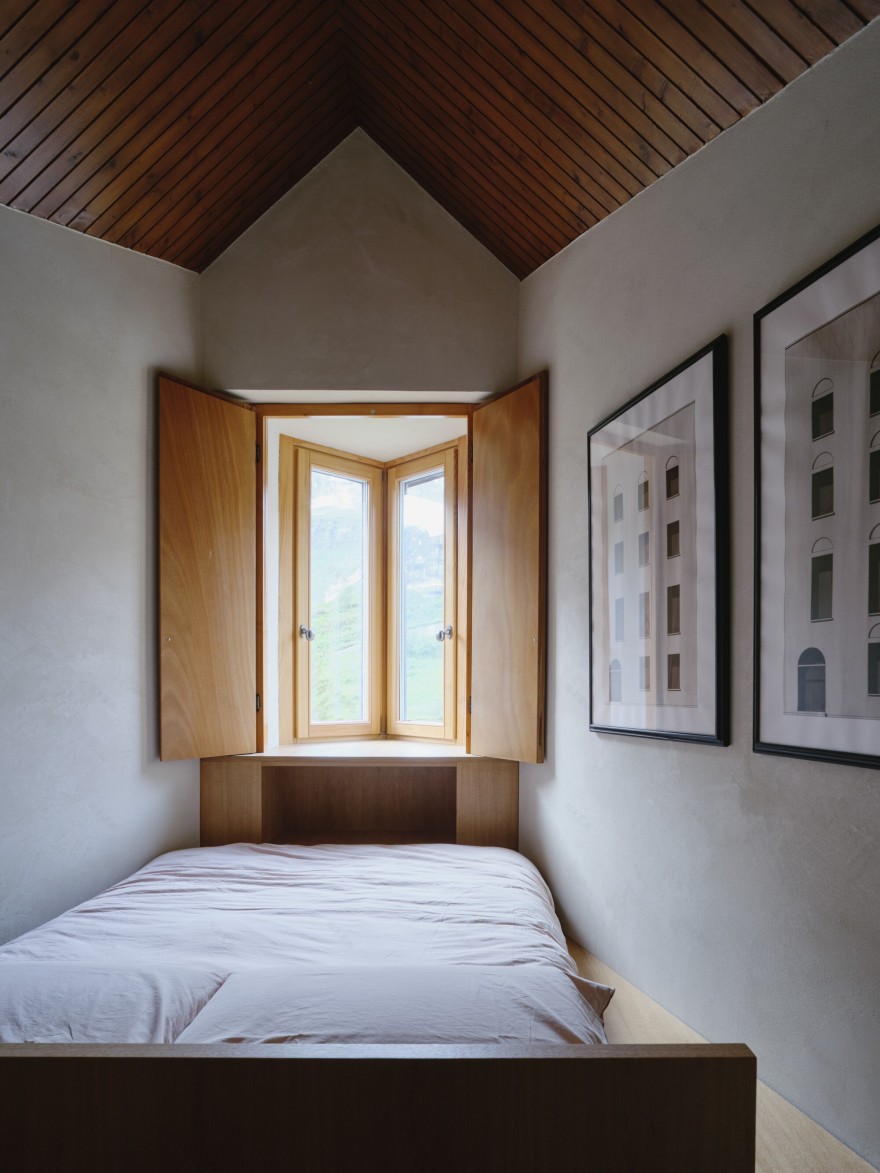
Another quiet yet decisive axis of the project is the presence of contemporary artworks, selected by the owners — a Milanese collector couple — as an integral part of the spatial composition. In the corridor, the rhythm of the oak corner profiles frames and marks out two recent photographs by Joanna Piotrowska, 70×90 hand-printed silver gelatin prints, alongside Cathartic Illustration by Jeremy Shaw. In the living area, Amari Rossori by Iva Lulashi — presented at the 2024 Biennale — introduces a chromatic tension that dialogues with the material softness of the space. The green bedroom houses a wooden altarpiece by Nerone and Patuzzi NP2, a group of artists and architects that has explored the union between art and architecture. The master bedroom finally hosts a diptych by Pablo Bronstein, an Argentinian artist tied to an Italian imaginary, as an erudite, measured counterpoint to the more intimate dimension of the attic.

Project gallery


南京喵熊网络科技有限公司 苏ICP备18050492号-4知末 © 2018—2020 . All photos and trademark graphics are copyrighted by their owners.增值电信业务经营许可证(ICP)苏B2-20201444 苏公网安备 32011302321234号
苏公网安备 32011302321234号客服
消息
收藏
下载
最近