

创作上传
VIP
收藏下载
登录 | 注册有礼
查看完整案例

收藏

下载

分享
华沙大学心理学院的新院楼重新定义了学术空间的概念。这不仅是一栋服务于教学的建筑,更是一处支持人与人之间关系、促进大学与城市对话的场所。它将教学功能与开放精神和可持续设计理念融为一体。
The new home of the Faculty of Psychology at the University of Warsaw redefines the concept of academic space. It is a building that not only serves education but also supports relationships among its users and fosters a dialogue between the university and the city. It combines teaching functions with an ethos of openness and sustainable design.
▼项目鸟瞰,Aerial-view of the project © Nate Cook

▼屋顶鸟瞰,Aerial-view of the roof © Nate Cook

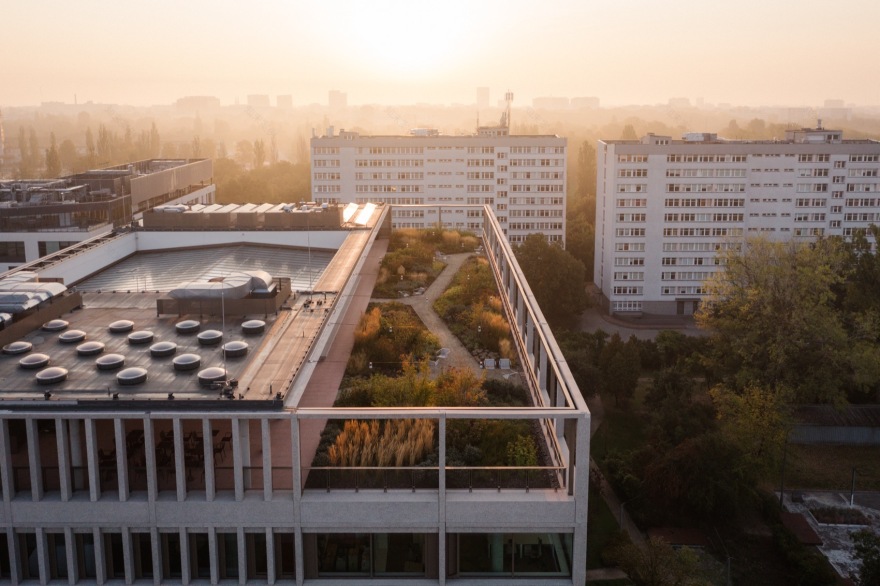
在位于斯塔夫基街(Stawki Street)的旧址使用半个多世纪后,心理学院迁入了华沙大学位于奥霍塔校区的新址。该项目由建筑事务所 Projekt Praga 设计,在2017年的建筑竞赛中脱颖而出。从一开始,设计就被构想为一个同时向校园与社区开放的空间。Projekt Praga 全程负责了项目的整体概念、深化设计以及施工阶段的作者监理,工作范围涵盖城市规划、景观绿化、定制家具乃至视觉识别系统。
After more than half a century in its former building on Stawki Street, the Faculty has moved to a new location on the Ochota campus. The project, designed by the architecture studio Projekt Praga and selected in a 2017 architectural competition, was conceived from the outset as a place open to both the campus and the district. Projekt Praga was comprehensively responsible for the concept, detailed design, and authors’ supervision of the construction — from urban planning and greenery to custom furniture and visual identity.
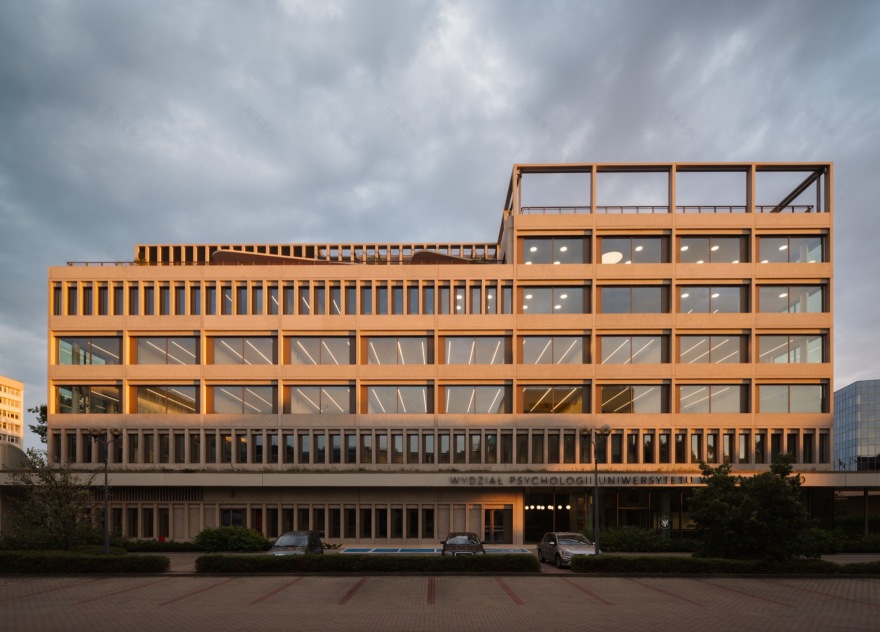
▼远眺立面,Overview of the exterior © Nate Cook

▼外观概览,Overview of the exterior © Nate Cook


▼立面局部,Partial-view of exterior © Nate Cook


开放的建筑
Architecture of Openness
“大学不仅是学习的场所,它同样是校园与街区生活的一部分,是日常活动发生的空间。在为心理学院设计这座建筑时,我们希望它能够积极参与这种生活。因此,我们将大量精力投入到建筑内外的公共空间设计之中。”Projekt Praga 的建筑师 Karolina Tunajek 与 Marcin Garbacki 如是说。
“A university is not just a place for learning — it is also part of the campus and the neighborhood, where everyday life unfolds. When designing the building for the Faculty of Psychology, we wanted it to actively participate in this life. That’s why we devoted so much attention to public spaces both around and inside the building,” explain Karolina Tunajek and Marcin Garbacki from Projekt Praga.
▼户外连廊,Outdoor corridor © Nate Cook
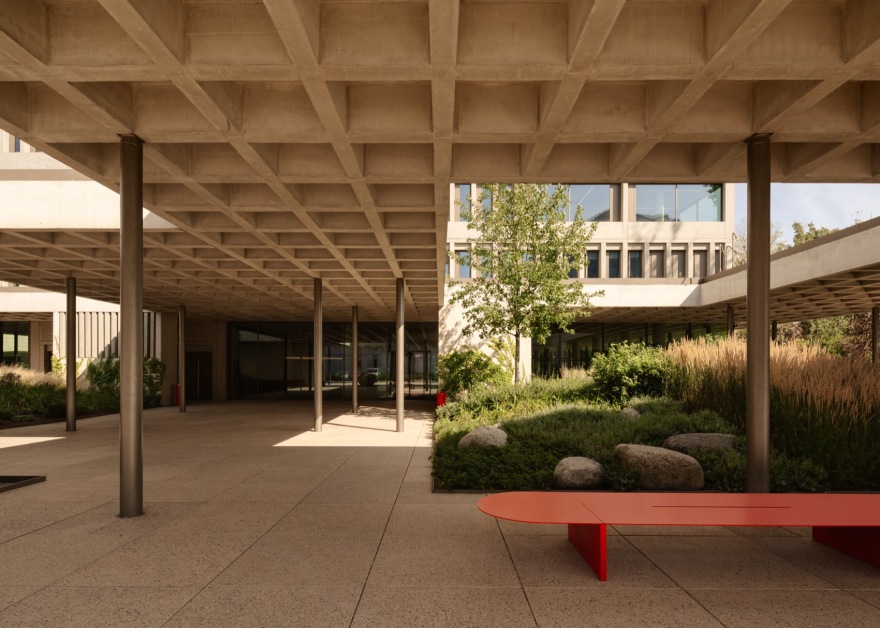

▼室外景观,Outdoor landscap © Nate Cook

新建筑最具辨识度的特征之一,是贯穿整个首层的混凝土格构顶棚。它在室内与室外同时可见,形成统一而强烈的建筑母题,将建筑牢牢锚定于周边环境之中。顶棚之下,是一处向公众开放的灰空间:绿植、座椅、交流场所与自行车停放设施交织其间,构成一个全天候可使用、遮阳避雨的友好环境。这一空间不仅向师生开放,也向奥霍塔社区居民与校园使用者敞开,自然地促成日常层面的互动。
One of the most distinctive features of the new building is the concrete coffered canopy extending over the entire ground floor. Visible both inside and outside, it creates a unifying architectural motif that anchors the building within its context. Beneath it lies a public space filled with greenery, seating, meeting areas, and bike racks — a friendly, sheltered environment usable at any time of day, protected from sun and rain. This open zone is available not only to students and staff but also to Ochota residents and campus users, naturally inviting everyday interaction with the faculty’s surroundings.
▼停车场入口,The parking entrance © Nate Cook

▼混凝土格构顶棚,The concrete coffered canopy © Nate Cook


在室内,最具突破性的空间策略是“两个首层”的设置。第一个首层构成对公众开放的区域,包含宽敞的大厅、食堂、咖啡馆以及一座通透的玻璃礼堂——它被视为心理学院的“开放客厅”。这些空间可在教学活动之外独立运作,使建筑在课程结束后依然保持活力。▼轴测剖视图,Sectional axonometric diagram © Projekt Praga

Inside, the key spatial innovation is the creation of “two ground floors.” The first forms a public zone with spacious halls, a canteen, a café, and a glazed auditorium — the faculty’s “open living room.” These spaces can function independently of the faculty’s operations, ensuring that the building remains active long after classes end.
▼大厅,Lobby © ONI Studio


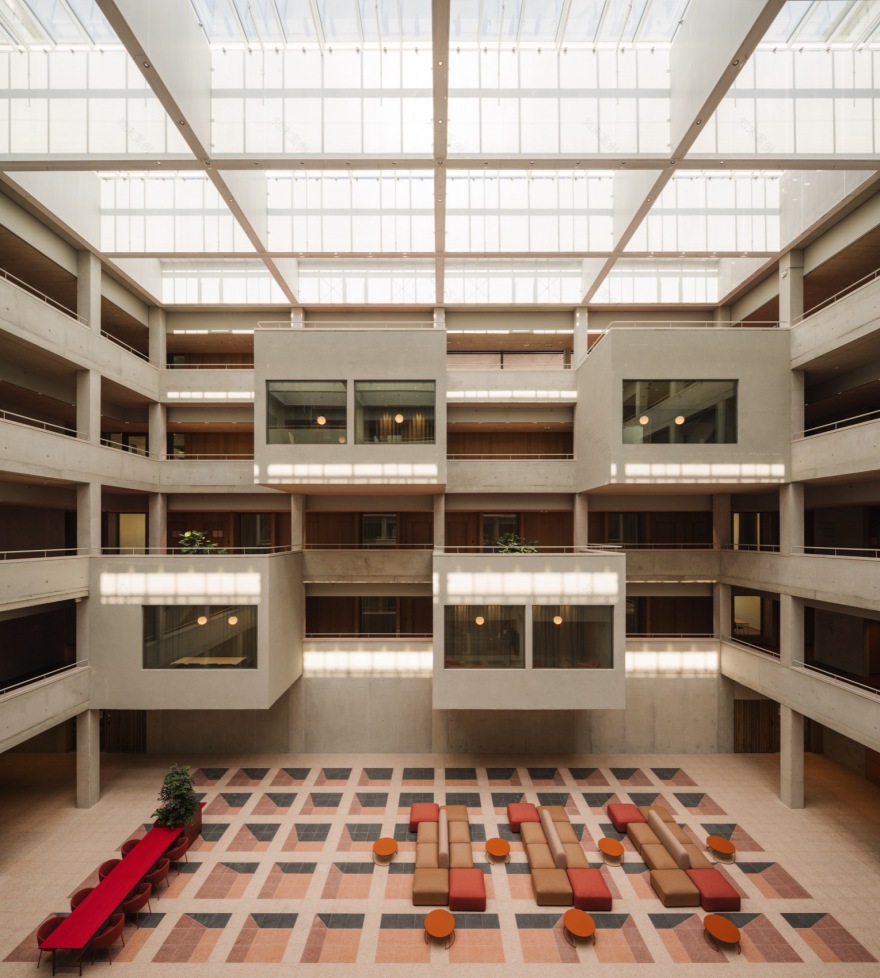
向上一个层级,第二个“首层”围绕一个大型中庭展开,主要服务于学院内部使用。玻璃屋顶将自然光引入建筑深处。传统的封闭走廊被开放式的环形廊道取代,通向教室、实验室、工作与学习空间,以及一座可通往露台的双层图书馆。其间散布着大量用于独立学习与休憩的凹龛空间,鼓励偶发性的交流与相遇。
One level above, a second ground floor opens into a large atrium designed for the faculty community. A glazed roof fills the interior with natural light. Traditional corridors were replaced by open galleries leading to classrooms, laboratories, work and study spaces, and a two-level library with access to a terrace. Between them, numerous alcoves for individual work and rest encourage spontaneous encounters.
▼大型中庭,Large atrium © Nate Cook
“我们希望这栋建筑不仅仅是上课的地方,而是一个让人愿意反复回到其中的空间,”建筑师表示,“我们的目标是打造一个能够吸引人的场所——面向学生、教职员工,也面向邻里。这里的建筑并非用来分隔或制造等级,而是用来连接。”
“We wanted this building to be more than a place for classes — a space people want to return to,” say the architects. “Our aim was to create a place that attracts people: students, staff, and neighbors. Architecture here is meant to connect, not divide or create hierarchies.”
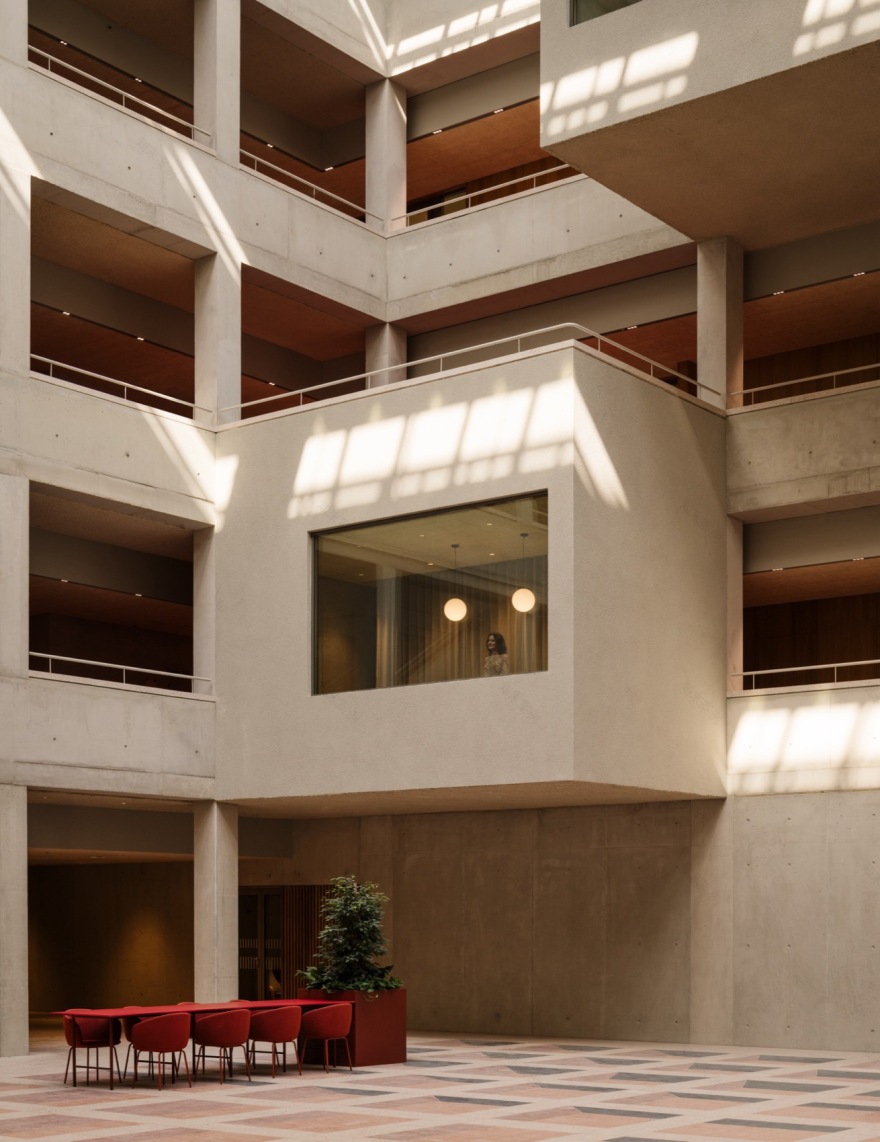
▼突出的体量,Protruding volume © Nate Cook

公共区域与学院内部区域通过两座雕塑感十足的螺旋楼梯相互连接,形成富有张力的空间对位关系:一座向城市敞开,另一座则转向内部,营造专注与协作的氛围。
The two main zones — public and faculty-specific — are linked by sculptural spiral staircases, forming a spatial counterpoint. One opens to the city; the other turns inward, fostering focus and collaboration.
▼雕塑感的螺旋楼梯,Sculptural spiral staircases © Nate Cook
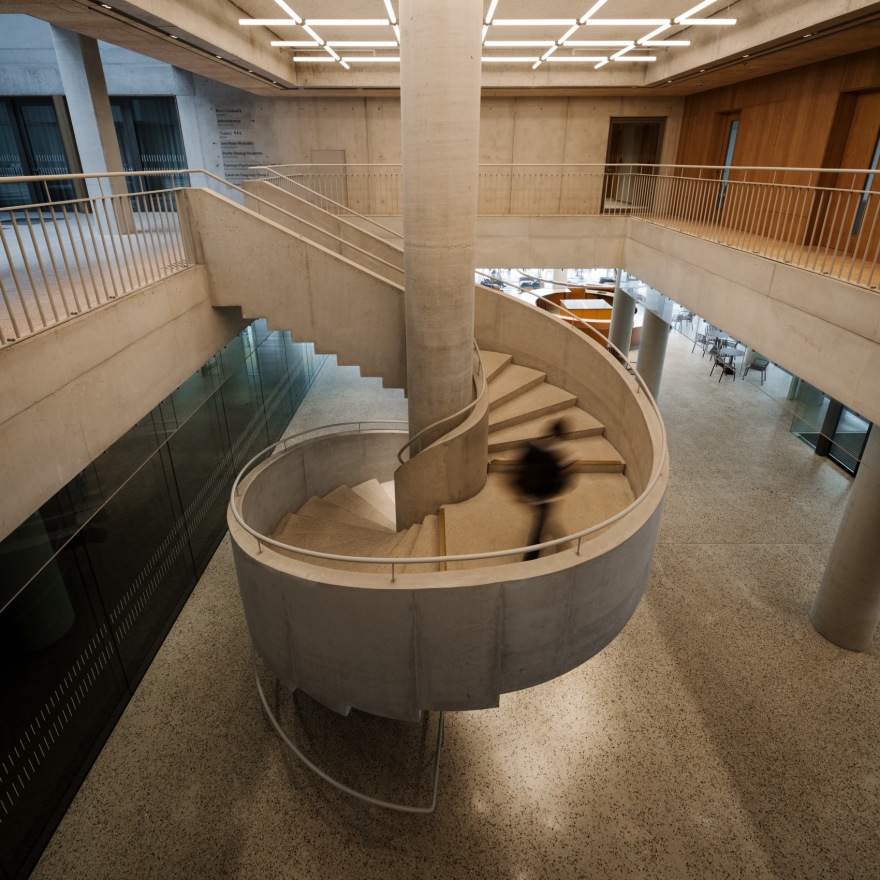
▼交通楼梯,Transportation stairs © ONI Studio

“开放”是该项目的核心理念,既是字面意义上的,也是象征层面的。大量的玻璃界面、被精心框取的视线、取代走廊的公共廊道、屋顶花园以及丰富的共享空间,共同构成了一种邀请光线与人进入建筑的空间姿态。
The idea of the project is openness — both literal and symbolic. The architecture invites light and people inside through extensive glazing, framed views, galleries instead of corridors, rooftop gardens, and numerous shared spaces.
▼玻璃界面,Extensive glazing © ONI Studio

▼公共走廊,Galleries © ONI Studio


▼座位区,Seating area © ONI Studio

建筑师将该项目形容为“生态粗野主义”——一种将混凝土的真实、质朴表达与环境友好策略及大量绿植相结合的设计路径。混凝土因其塑造大尺度空间的能力及长期耐久性,被广泛应用于结构、立面与室内空间之中,并以未经修饰的原始状态呈现。这种材料的一致性营造出克制而统一的整体气质,而混凝土的粗粝感则通过木材、自然光、植物与柔和的色彩点缀得以平衡。
The architects describe the building as eco-brutalist — a combination of raw concrete honesty with pro-environmental solutions and abundant greenery integrated into the architecture. Concrete, chosen for its capacity to shape large-scale spaces and its long-term durability, was used in structural elements, façades, and interiors. It appears in its raw, expressive form — without unnecessary finishing layers. This material consistency allowed the creation of a calm and cohesive composition, in which the roughness of concrete is complemented by the warmth of wood, natural light, greenery, and subtle color accents.
▼丰富的室内色彩,Rich interior color palette © Nate Cook


▼天窗,Sky window © Nate Cook

建筑外观简洁而克制,但内部却呈现出丰富而多样的空间体验。规律而理性的立面背后,是一系列尺度各异、氛围不同的空间:从开敞的中庭,到不同规模的阶梯教室,再到适合专注与休憩的私密角落。设计的目标,是回应当代教育对多样化空间的需求,在舒适性与协作性之间取得平衡,并培育社区感。
Although the exterior is simple and restrained, the interior reveals surprising spatial richness. Behind the rhythmic, disciplined façade lies a diverse program of rooms and a series of shared spaces offering varied scales and atmospheres: from the open atrium to lecture halls of different sizes and intimate niches for work and rest. The aim was to create a friendly and diverse environment that meets the needs of contemporary education — supporting both individual comfort and collaboration, and fostering a sense of community.
▼顶层露台,Roof terrace © Nate Cook
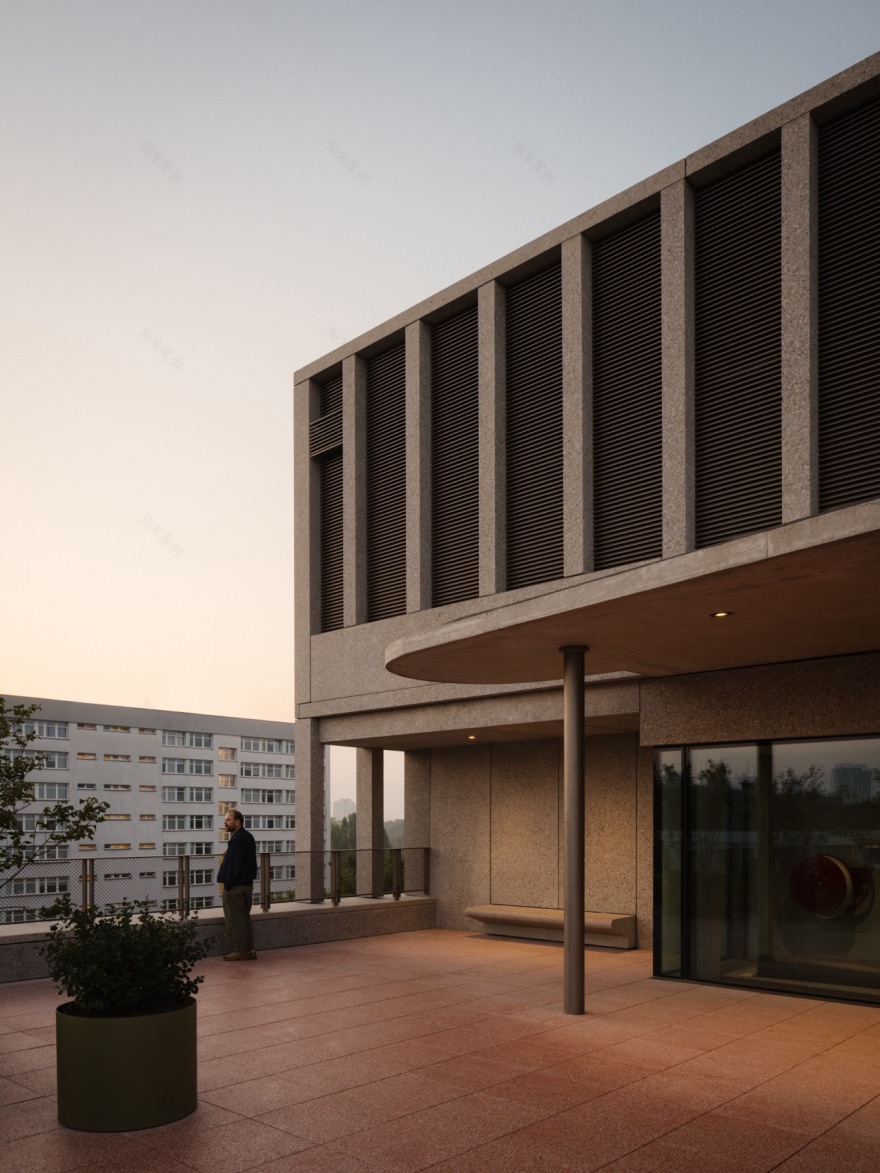
▼露台休息区,Terrace seating area © Nate Cook

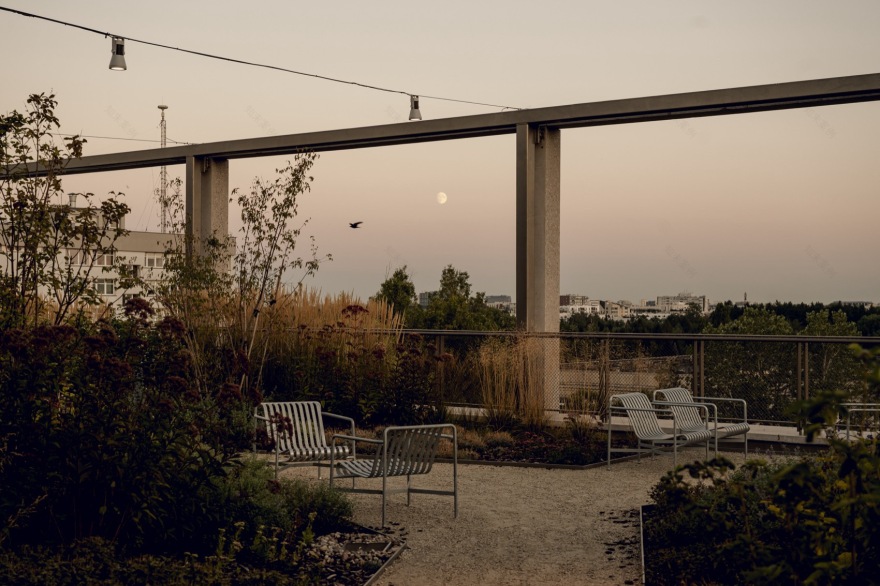
绿化并非附加元素,而是贯穿建筑与场地的整体性组成部分。从建筑周边的树木,到室内植物,再到屋顶花园,自然以不同层次渗透其中,为空间赋予柔和而生动的气质。首层顶棚上的野花草甸不仅能够滞留雨水,还在立面周围形成微气候;屋顶花园则设有步行路径、向阳座椅以及一处被覆盖的户外空间。植物同样出现在图书馆露台及专门的微型种植区中。绿化在这里并非装饰,而是一种塑造空间氛围与建筑身份的核心要素。
Greenery is an integral part of the building — permeating its structure and surroundings to form a unified whole. From the trees around the building to indoor plants and the rooftop garden, nature is omnipresent, giving the space a gentle, natural character. A wildflower meadow on the ground-floor canopy retains rainwater and creates a microclimate along the façades, while the rooftop garden features a walking path, sunlit seating areas, and a covered outdoor room. Plants also appear on the library terrace and in a dedicated micro-cultivation zone. This is not decoration but a full-fledged component of the architecture that shapes the atmosphere and identity of the new Faculty of Psychology.
▼屋顶花园绿化,Roof garden landscape © ONI Studio

可持续与无障碍
Sustainable and Accessible
在建筑粗犷而克制的外表之下,隐藏着一套高度整合的可持续系统。建筑采用地源热泵进行供暖与制冷,屋顶铺设光伏板,雨水被收集并循环利用;外遮阳系统有效防止过热,而绿色屋顶则增强了整体保温性能。
Behind the building’s raw architectural expression lies an advanced system of sustainable solutions. Heating and cooling are provided by heat pumps with geothermal wells, photovoltaic panels cover the roof, and rainwater is collected and reused. External blinds protect against overheating, while green roofs enhance natural insulation.
▼公共区域,Public spacee © ONI Studio

室内空间在声学与照明舒适性方面均经过精细设计,同时建筑全面实现无障碍使用:无台阶入口、电梯、报告厅内的感应助听系统、各层无障碍卫生间、清晰的流线组织以及直观的图形导视系统,共同构成真正意义上的“可达性”。
The interiors were designed with acoustic and lighting comfort in mind, and the building is fully accessible for people with disabilities. Step-free entrances, elevators, induction loops in the auditorium, appropriately designed restrooms on each floor, a clear circulation layout, and intuitive graphic signage ensure accessibility in the most literal sense of the word.
▼讲堂,Lecture © ONI Studio

▼教室排布,Furniture layering © ONI Studio


▼细部,Details © ONI Studio


新的心理学院不仅是一栋教学建筑,更是一处积极支持科研发展、协作交流与日常学术生活的场所。在超过21,000平方米的空间中,它为近2,000名使用者提供了兼顾功能性、舒适度与开放性的工作与研究环境。该项目证明,公共学术建筑同样可以兼具实用性、耐久性与亲和力——在城市之中,成为连接人与思想的媒介。
The new Faculty of Psychology is more than an educational building — it is a space that actively supports the development of science, collaboration, and everyday academic life. Across more than 21,000 m², it provides an environment for work and research for nearly 2,000 users, designed with functionality, comfort, and openness in mind. It demonstrates that academic public buildings can be practical, durable, and welcoming — supporting relationships, exchange of ideas, and connection with the city.
▼夜览,Nightview © Nate Cook


▼夜景照明,Night illumination © Nate Cook

▼首层平面图,First floor plan © PROJEKT PRAGA

▼平面图,Floor plan © PROJEKT PRAGA

▼剖视图,Sectional perspective© PROJEKT PRAGA




南京喵熊网络科技有限公司 苏ICP备18050492号-4知末 © 2018—2020 . All photos and trademark graphics are copyrighted by their owners.增值电信业务经营许可证(ICP)苏B2-20201444 苏公网安备 32011302321234号
苏公网安备 32011302321234号客服
消息
收藏
下载
最近