

创作上传
VIP
收藏下载
登录 | 注册有礼
查看完整案例

收藏

下载

分享
稻田与水塘之间,一段不规则的用地被田埂与农路切割,一侧探入水面。项目同时承担稻作文化展示、农产品展销与游客停留的公共功能,并需要一处能够抬升视线的观景点。紧凑的尺度促成“塔与体的共生”:体验馆沿水岸展开,塔楼嵌入其端部,形成一组可被行走与观看的乡野装置。
Between rice paddies and a pond, an irregular plot is sliced by field ridges and farm roads, with one edge extending into the water. The project accommodates multiple public programs—exhibiting rice-farming culture, showcasing and selling local produce, and providing space for visitors to pause and stay—while also requiring an elevated viewpoint. The compact site condition leads to a “symbiosis of tower and hall”: the pavilion unfolds along the shoreline, and a tower is embedded at its end, forming a rural device that can be walked through and looked from.
▼周边环境,Site Surrounding © 赵奕龙

▼项目概览,Project Overview © 赵奕龙
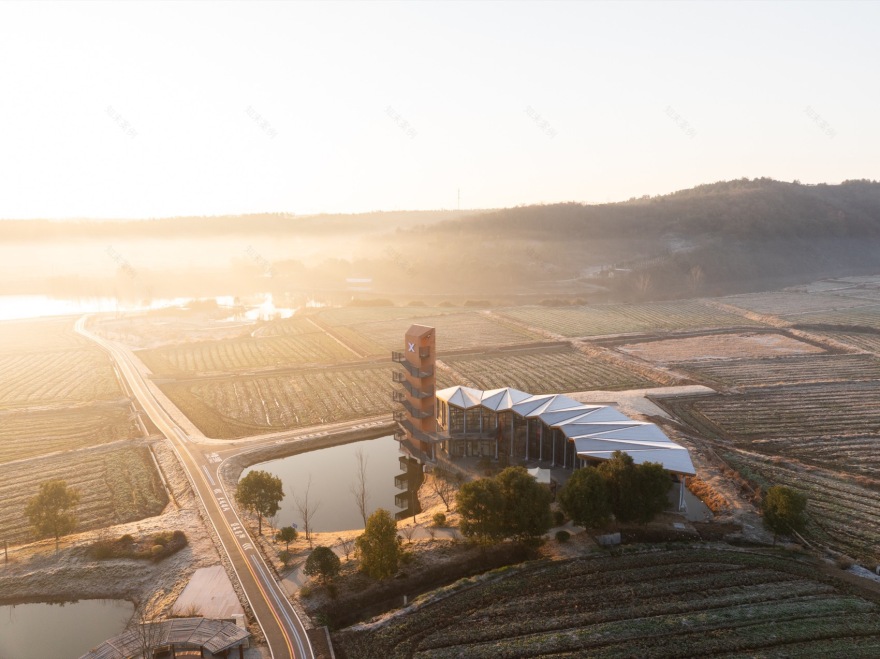
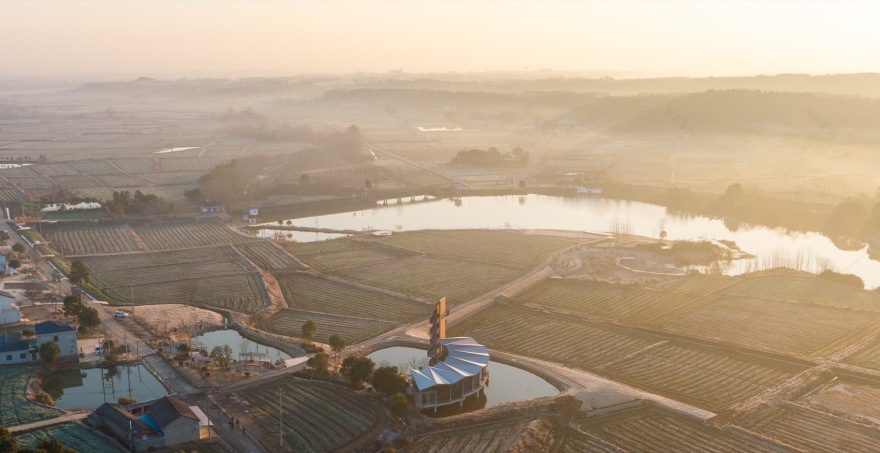
▼场地俯拍,Aerial View of the Site © 赵奕龙

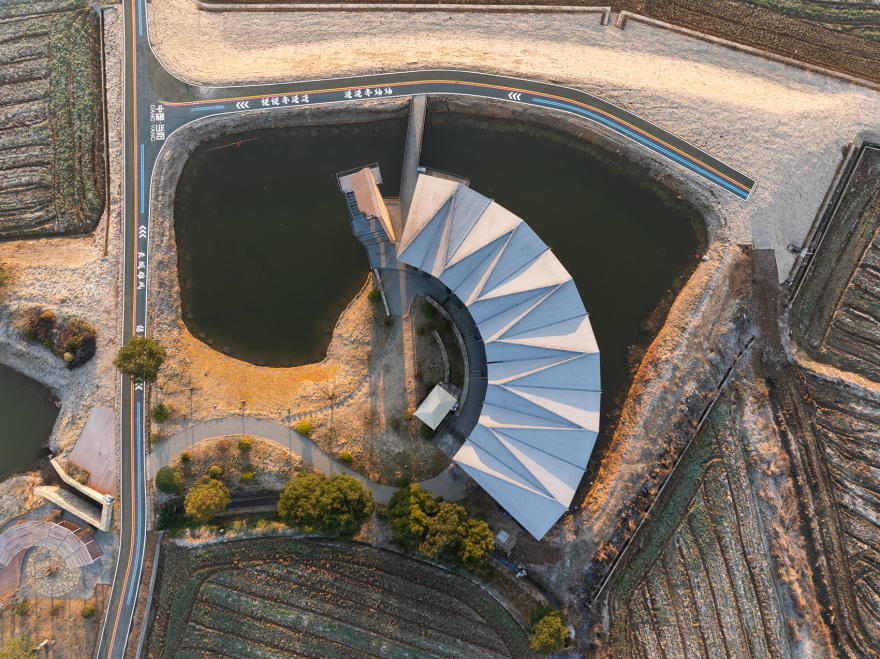
平面以向心式弧形布局组织:建筑沿水面展开成一段收拢的弧线,形成面向水塘的内向界面。连续的展陈与展销界面串联动线,将“稻作文化”与“农产品展销/体验”嵌入同一条可漫游的空间带。不同房间在弧线牵引下依次展开,视线在临水界面与内向开敞空间之间切换,并在行走尽端自然导向竖向的观景塔。
The plan is organized through a centripetal, curved layout. Stretching along the water, the building gathers into a tightened arc to form an inward-facing edge toward the pond. A continuous exhibition-and-retail frontage stitches the circulation together, embedding “rice-farming culture” and “produce display/experience” into a single, meandering spatial band. Under the pull of the arc, rooms unfold in sequence; views shift between the waterside interface and the inner open space, and the route naturally leads to the vertical viewing tower at the end.
▼项目鸟瞰,Aerial View © 赵奕龙

屋顶以参数化折线生成起伏节奏,像被抬起的稻浪等高线。折线按单元化节奏逐段展开并连续拼接,将展厅、服务与停留空间统一在同一片“覆盖”之下;高低变化在体量上削弱乡村公共建筑常见的厚重感,使建筑更像一片轻覆在田水之间的构架。从结构轴测与细部可见,木屋面与钢柱体系共同形成清晰而轻盈的构造边界。
▼屋顶结构轴测,Axonometric Diagram of Structure © 辑禾设计工作室

The roof generates an undulating rhythm through a parametrically derived folded line, resembling lifted contour waves across the fields. Developed in modular segments and continuously spliced, the folded roof unifies the exhibition hall, service areas, and rest spaces under one continuous “cover.” Variations in height reduce the heaviness typical of rural public buildings, making the architecture read as a lightweight frame hovering between farmland and water. As seen in the axonometric and details, the timber roof and the steel column system together establish a clear yet light construction boundary.
▼屋顶细部,Roof Details © 赵奕龙
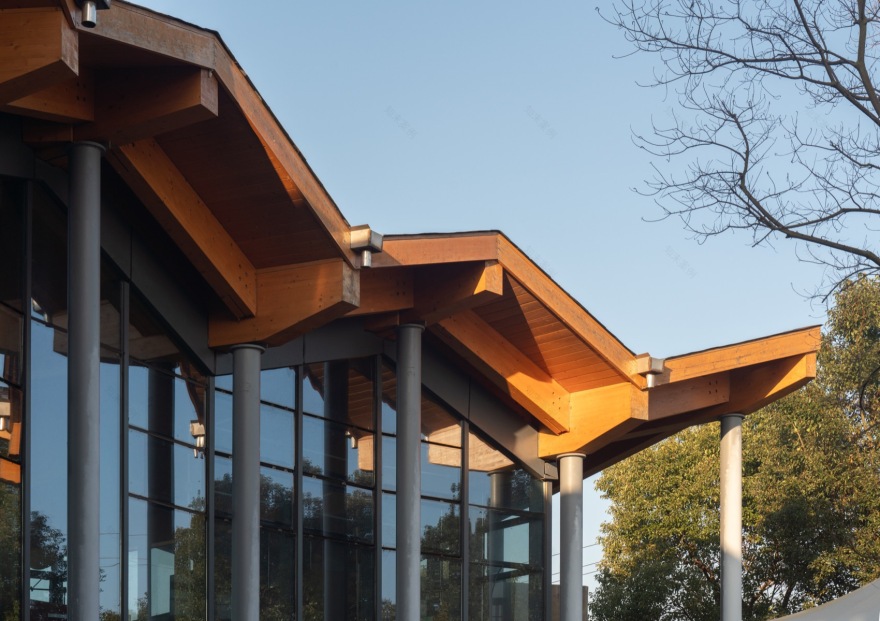
从屋面内侧可见,木梁与木檩条构成均匀的结构逻辑,木质板面作为顶棚连续展开。深檐口将屋面厚度与结构层次直接暴露出来。由于弧形向心的平面控制,屋架在不同位置的尺寸与角度产生细微变化,檐口线因此呈现出更为丰富的起伏与转向。
From the underside, timber beams and purlins reveal a consistent structural logic, while timber boards extend continuously as a ceiling plane. Deep eaves directly expose the thickness and layering of the roof. Controlled by the centripetal curved plan, roof members vary subtly in size and angle across different positions, producing a richer eave line with shifts, rises, and turns.
▼屋顶细部(檐口与结构),Roof Detail © 竺辉奇

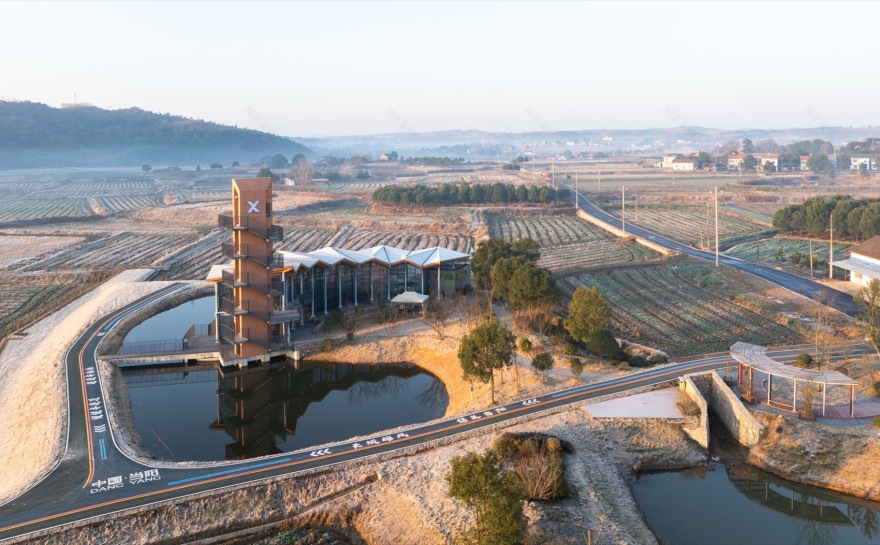
塔楼作为场地的识别点,与横向展开的体验馆形成“塔与体的共生”。竖向瞭望台与折线屋面相互映衬,外部楼梯将登高过程外显为一段可被观看的路径;人在拾级而上时,视线从近处水面与稻田逐步抬升,最终获得对村庄与田野的远眺。
The tower serves as a site marker and forms a “tower–hall symbiosis” with the horizontally extended pavilion. Set against the folded roof, the vertical lookout is paired with an external stair that makes the ascent a visible route. As visitors climb, the view gradually lifts from the nearby water and fields, eventually opening toward a distant panorama of the village and farmland.
▼项目鸟瞰(塔楼与水面),Aerial View (Tower & Pond) © 赵奕龙


▼周边道路视角,View from the Road © 赵奕龙
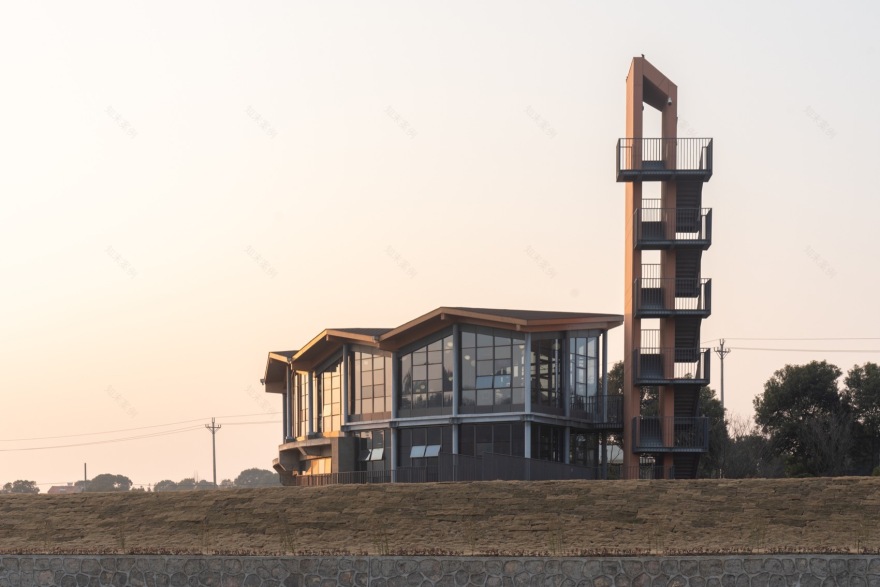

材料与构造进一步强化这种“轻与重”的对比:建筑以混凝土框架作为稳定的基底,上部以钢结构与大面积落地玻璃幕墙组织公共界面,使展陈、咖啡与休憩空间与田水景观保持最大程度的渗透;局部插入实体片墙,提供展陈背景与必要遮蔽。塔楼的外置梯段以扁铁栏杆与平台串联,穿插包绕在外挂水泥装饰板的实墙之间,虚实结合使“地标”不以压迫的体量出现,而以可触摸的细部与光影建立亲近。
Materials and construction further reinforce the contrast between “light and heavy.” A concrete frame establishes a stable base, while the upper structure—steel framing with large floor-to-ceiling glazing—organizes the public frontage, maximizing visual permeability between exhibition, café, and resting areas and the surrounding farmland-and-water landscape. Solid wall panels are inserted locally to provide exhibition backdrops and necessary screening. The tower’s external stair is connected by flat-steel railings and platforms, interweaving around solid walls clad with mounted cement decorative panels. This interplay of solid and void allows the “landmark” to appear not as a dominant mass, but as an approachable assemblage of details and light-and-shadow.
▼项目鸟瞰(屋顶与田野),Aerial View (Roof & Fields) © 赵奕龙

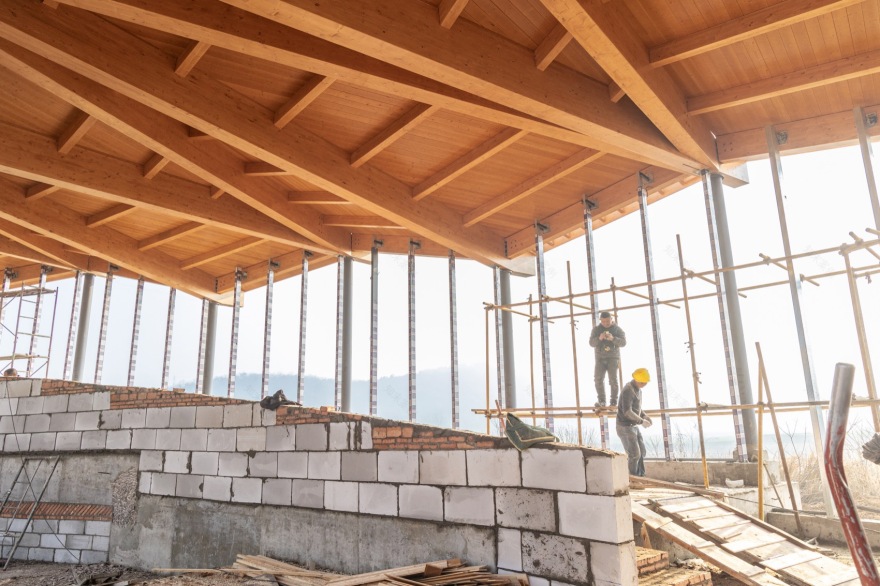
在施工阶段,建筑的结构逻辑被最大程度地“裸露”出来:钢柱与钢梁先建立起清晰的受力网格,场地上出现一个通透的架空框架。随后,装配式木屋架逐榀吊装、定位,木梁与木板面向外延。钢结构楼梯作为垂直路径同步成形,使建筑在尚未完成围合时就已经呈现出清晰的空间骨架。
During construction, the structural logic is exposed to its fullest. Steel columns and beams first establish a clear load-bearing grid, forming an elevated, transparent frame on site. Prefabricated timber roof frames are then lifted and positioned piece by piece, extending the timber beams and roof boards outward. The steel stair—built in parallel as a vertical route—allows the project’s spatial skeleton to become legible even before the enclosure is completed.
▼施工过程,Construction Process © 竺辉奇


室内以木梁与木质顶面形成连续、温暖的顶棚基调,折线屋面的节奏转译为起伏的梁架序列;弧形实体墙一侧承载展陈与信息界面,另一侧由大面积玻璃打开视线,田野与水面被引入日常的停坐与漫游。水平分格的窗带过滤光线,光影在混凝土地面与木构上移动,使空间在不同时间呈现出层次与方向感。
Inside, timber beams and a timber ceiling form a continuous, warm overhead field, translating the folded roof into a sequence of undulating beam frames. On one side, a curved solid wall carries exhibition and information surfaces; on the other, large glazing opens the view, bringing fields and water into everyday sitting and wandering. Horizontal window bands filter the light, while shifting shadows move across the concrete floor and timber structure, giving the interior changing depth and directional cues over time.
▼室内空间,Interior Space © 赵奕龙


▼室内空间,Interior Space © 赵奕龙

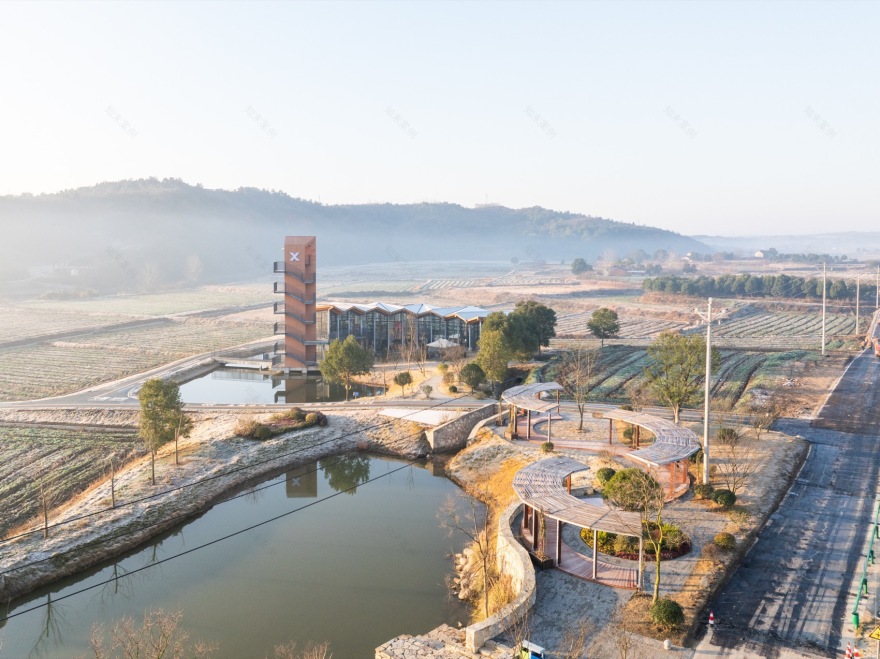
建筑局部跨入水面,水塘的倒影把折线屋面再次“延长”为另一道波纹;塔的竖向线条与田埂、岸线的水平肌理形成对照,成为乡野尺度中的一个轻盈坐标。沿水塘的步道与停留平台把人流引向体验馆与塔楼,再从建筑延续到水岸与田野之中,让稻作景观从远处的背景被转译为可抵达、可停留、可被观看的公共日常。
Part of the building extends over the water, and the pond’s reflection “extends” the folded roof into a second ripple. The tower’s vertical lines contrast with the horizontal textures of ridges and shoreline, becoming a light coordinate within the rural scale. Paths and small stopping platforms along the pond guide visitors toward the pavilion and tower, then continue from the architecture back to the water’s edge and into the fields—transforming the rice-farming landscape from a distant backdrop into an everyday public scene that can be reached, paused within, and viewed.
▼场地周边,Site Surroundings © 赵奕龙


▼屋顶平面,Roof Plan © 辑禾设计工作室

▼一层平面,Floor Plan © 辑禾设计工作室

▼立面图 ,Elevation © 辑禾设计工作室

▼剖面图,Section © 辑禾设计工作室

项目名称:当阳·稻义 MAN 村体验馆
项目类型:建筑
设计方:辑禾设计工作室
完成年份:2024
方案主创:成忠溯
设计团队: 郑辑宏、彭蓉、王梅、郑昕晨、余妏劼、赵青、张莉 、王磊、李建平、殷涛
项目地址:湖北省宜昌市当阳市
建筑面积:550.23㎡
摄影版权:赵奕龙、竺辉奇
施工方:湖北华欣城建工程有限公司
木结构施工:武汉林榔木建筑工程科技有限公司
业主方:当阳市玉阳街道办事处
材料:混凝土、木构、玻璃
Project name: Dangyang · Daoyi Man Village Experience Pavillion
Project type: Architecture
Design: Jihe Design Studio
Completion Year: 2024
Leader designer & Team: Cheng Zhongsu, Zheng Jihong, Peng Rong, Wang Mei, Zheng Xinchen, Yu Wenjie, Zhao Qing, Zhang Li, Wang Lei, Li Jianping, Yin Tao
Project location: Dangyang, Yichang, Hubei
Gross built area: 550.23㎡
Photo credit: Zhao Yilong, Zhu Huiqi
Contractor: Hubei Huaxin Urban Construction Engineering Co., Ltd.
Timber Structure Contractor: Wuhan Linlang Timber Architecture Engineering Technology Co., Ltd.
Clients: Yuyang Subdistrict Office, Dangyang
Materials: Concrete, Timber, Glass
南京喵熊网络科技有限公司 苏ICP备18050492号-4知末 © 2018—2020 . All photos and trademark graphics are copyrighted by their owners.增值电信业务经营许可证(ICP)苏B2-20201444 苏公网安备 32011302321234号
苏公网安备 32011302321234号客服
消息
收藏
下载
最近